

Home Blog Page 336

My five cents…

0

As Texas recovers from the destructive storms last week, the legislature is back at work and focused on finding answers to what happened last week. This week we also resumed work on the budget in the Senate Finance Committee. We heard from Article III agencies, including TEA and all of our institutes of higher education. To finish the week, we will hear from Article II agencies, including Health and Human Services Commission and the Department of State Health Services.

Here are five things happening around your state:

1. Six ERCOT board members resign

As of Thursday, six members of ERCOT’s 16-member board announced they would resign Tuesday after massive blackouts affecting millions of Texans during disastrous winter weather left many without power in subfreezing temperatures for days. Five of the six board members that are resigning, including the chairwoman and the vice-chairman, live out-of-state, a fact that many Texans and legislators take issue with. Several legislators have filed bills to ensure that all ERCOT board members are Texas residents. ERCOT manages the flow of electric power through the state’s power grid. Weeks before the storm, ERCOT assured stakeholders that power plants were prepared for winter storms. It’s obvious that was not the case, and as the vice-chair of the Senate Business and Commerce Committee, I look forward to getting answers from ERCOT, the PUC, power generators, and other industry professionals about what went wrong and how to prevent such a catastrophic failure in the future.

2. Governor calls meeting of legislators about electric billing

Over the weekend, Governor Abbott convened an emergency meeting of a group of legislators to discuss the spike in Texans energy bills following the power outages across the state. As a member of that work group, I think it’s important for Texans to know that this issue is a priority for all of us. We are working quickly and collaboratively in both chambers to address this issue. The system is complicated and assessing the total cost of these energy bills is ongoing. I look forward to finding a solution to these issues and find ways the state can help mollify this extreme financial burden.

3. Vaccinations get back on track after winter storms

Distribution for the COVID-19 vaccine was disrupted last week due to the intense winter weather Texas faced. Six million doses nationwide, including 450,000 doses bound for Texas, were delayed due to deferred shipments, impassable road conditions, and power outages. However, vaccine providers are confident that Texas can rebound. This week 1.5 million doses are set to arrive in the state, including last week’s undelivered doses. This comes as vaccine makers told Congress that a big jump in delivery of doses is coming in the near future. By the end of March, Pfizer and Moderna expect to have provided the government with 220 million vaccines. Moreover, both companies expect to deliver 300 million doses each by the end of the summer and Johnson and Johnson assured they would provide 100 million of their vaccines.

4. PUC issues moratorium on utility disconnection for non-payment

In an emergency meeting, the Public Utility Commission issued an order halting utility disconnections for non-payment. These orders are directed at investor owned utilities that fall under the PUC’s jurisdiction, including Oncor, AEP, CenterPoint, and TNMP. Importantly, they do not apply to municipally owned utilities or electric cooperatives. This is welcome news as many Texas received high electric bills following the widespread power outages during the winter storms. Though many Texans are on fixed rate electricity contracts with their providers, those that are not are facing sky-rocketing bills. The PUC strongly urged retail electric providers to delay sending invoices out, especially to residential customers.

5. Students learning virtually will not have to take the STAAR test

Texas Education Commissioner Mike Morath announced that Texas students who are learning remotely this semester will not be required to take the annual STAAR test. The state logistically can’t administer the test remotely, so those students can opt-out. However, students who are learning in-person will be taking the STAAR test, but without any of the stakes attached. This year, the test is being used to gauge where students are at after a year of disrupted learning caused by the pandemic. There will be no accountability for school districts or campuses attached to the STAAR this year and it will not be used to evaluate whether or not students can or should progress to the next grade level.


CORRIGAN RAILROAD CROSSING SCHEDULED FOR CLOSURE

0

 A railroad crossing closure is planned for Monday on US 287 near the US 59 intersection in Corrigan.

Union Pacific Railroad will be closing the crossing on Monday, March 1 from 7 pm until 5 am, March 2. Portable message boards announcing the closure will be in place on US 59 and US 287. Detour signs will also be set notifying motorists of the closure and detour.

Railroad crews will be working to replace the crossing at this location. RoadSafe Traffic Systems, Pflugerville, TX, will be providing traffic control and TxDOT crews will be on site to repair approaches to the crossing as the work is completed.

Motorists should stay alert for traffic congestion as they enter Corrigan in southbound lanes. Reduce speed and prepare for slight delays as vehicles slow down to access detours that will be set north of the intersection.

For more information, contact Rhonda.Oaks@txdot.gov or call (936) 633-4395.

4 Easy Tips to Help Older Adults Stay Active at Home

0

As the COVID-19 pandemic continues, many older adults are following the advice of public health experts and remaining at home to limit risk of exposure. Bad weather conditions can also keep people inside for days at a time. But a strong body and mind are as important as ever, and the good news is being indoors doesn’t mean having to give up on exercising.

There are many great health benefits to staying active, such as improving mobility and balance, developing muscle and bone strength, increasing energy and managing weight. Exercise can also reduce blood pressure and lower the risk of heart disease, stroke and diabetes.

According to Dr. Gina Conflitti, chief medical officer for Medicare at Cigna, the advantages aren’t just physical: “Keeping active has a positive impact on mental health, too,” she said. “With regular exercise, many older adults enjoy better sleep, clearer thinking, lower stress and improved mood.”

According to Cigna, which serves many older adults through its Medicare Advantage plans, here are four simple tips for exercising in the comfort of home:

  1. Make a plan. What is your long-term goal? Having something to work toward is great motivation to keep up daily activity and set yourself up for success. Before you begin any physical activity, talk to your doctor about your health goals. Your doctor can provide guidance on exercises that are safe and attainable as you begin a new chapter of your wellness journey.
  2. Take it slow. You don’t have to run a marathon or even lift weights to keep fit – the most important thing is to just move. Start by walking around your house a few times a day or doing some gentle stretching. Just adding five minutes of activity to your day can make a difference in your overall health and mood. As your body gets used to daily movement, you can enhance your physical activities as recommended by your health care provider.
  3. Use what you have. You don’t need a gym to get a healthy workout. In fact, there are plenty of exercises you can do using items found around the house. For example, “chair dips” are an effective arm and shoulder workout – just place both feet on the ground, face away from a chair and support your body by putting your hands on the seat behind you with straight arms. Next, raise and lower yourself by bending and unbending your arms.

You can even exercise while seated. Hold your leg out in front of you and trace each letter of the alphabet. Work your feet and leg muscles by laying a kitchen towel on the floor, then use your toes to grab, release and push the fabric.

  1. Check your health care plan benefits. If you have a Medicare Advantage plan, you might be eligible for extra benefits such as at-home fitness programs, including free on-demand workouts accessible from your computer, smart device or phone, as well as gear, such as resistance bands.

Find more healthy aging and exercise tips at cigna.com/medicare/healthy-aging/physical-activity.

“As you start, remember to be flexible and stay positive,” Dr. Conflitti suggests. “Changing habits can take time, but every step is progress. If you haven’t reached a goal, don’t be hard on yourself – it’s most important to continue at your own pace.”

Help Is Available For Small Businesses Through The Angelina College Small Business Development Center

0

Unfortunately, many small business owners are struggling to keep the doors open these days. They could really use some help from experienced business and banking professionals.

What many of them don’t know is that help is available, at no charge, from the Small Business Development Center at Angelina College. They can help develop business plans for starting new businesses, as well as do financial analysis, give help filling out government forms, assist with loan applications, as well as provide other services that can help existing businesses get firmer footing. Their advisors can even help with research of local industries and markets, helping businesses strive for success even in difficult times.

The Angelina College SBDC can aid in finding information that would allow small business owners to make critical decisions that are in their company’s best interest.

For more information, you can look up the Angelina College Small Business Development Center online at: https://www.sbdc.uh.edu/sbdc/Angelina_College_SBDC.asp or call them today at (936) 633-5400.

Governor Abbott, TDLR Issue Temporary Waiver To Increase Fuel Supply In Texas

0

Governor Greg Abbott and the Texas Department of Licensing and Regulation (TDLR) have issued a temporary waiver to increase the fuel supply in Texas. This waiver  permits regulated refineries to make fuel in compliance with any seasonal specifications and authorizes parties downstream of the refinery, such as terminals and retail fuel stations, to distribute fuel of any seasonal specification until stocks are depleted.

This allowance will expand gasoline production and distribution while ensuring that refiners, distributors, and retailers do not face administrative penalties for having fuel that does not meet set seasonal requirements. 

“The severe winter storm has created challenges related to our fuel supply, but we are working tirelessly to restore access to fuel in our communities,” said Governor Abbott. “This temporary waivers helps increase the supply of fuel in Texas and expands access to fuel in our communities.”

Drug-Free All Stars to Kick Off Project Sticker Shock

0

The Angelina County Drug-Free All Stars, alongside The Coalition’s Board of Directors and staff, will kick off Project Sticker Shock on Monday, March 1 with a press conference at Brookshire Brothers Gaslight, 1807 W. Frank St., in Lufkin beginning at 10:00am. The guest speakers will be Judge Clyde Herrington, County Court at Law No. 2; Madilyn Simmons, Drug-Free All Star and Pineywoods Community Academy student; and Melissa Crager, Public Relations Coordinator for Brookshire Brothers.

Project Sticker Shock is a Drug-Free All Star community awareness campaign that aims to make adults aware of the dangers of underage drinking and the consequences of providing alcohol to minors. The participating stores are Brookshire Brothers, Tobacco Barn, La Michocana Meat Market, Big’s convenience stores, Hernandez Grocery, and Coleman’s convenience store in Zavalla. The Drug-Free All Stars hold this event annually before the Spring Break holiday. Spring Break is one of the deadliest times for alcohol-related accidents involving minors.

Since 1988, The Coalition has focused on eliminating the use of harmful substances by affecting public policy, laws, attitudes and behaviors, all in an effort to foster healthy life-long choices for the local community. For more information about the Drug-Free All Stars, contact Abby Baker at The Coalition at 936-634-9308.

Governor Abbott, HHSC Announce Federal Approval For Automatic SNAP Benefit Replacements For 66 Disaster Counties

0

Governor Greg Abbott today announced that the Texas Health and Human Services Commission (HHSC) has received federal approval to automatically provide replacement benefits for Supplemental Nutrition Assistance Program (SNAP) recipients in 66 impacted counties for food lost or destroyed due to winter storm Uri, which began on Feb. 11. Those 66 counties met federal criteria for mass replacements of benefits based on the severity of storm impacts in their area.

“Thank you to our federal partners for approving these replacement benefits for Texans in need,” said Governor Abbott. “As we recover from the severe winter storm, we are ensuring that Texans affected by this storm can continue to put food on the table.”

“Many Texans continue to face serious challenges resulting from last week’s storm,” said Wayne Salter, Texas HHS Access and Eligibility Services deputy executive commissioner. “Being able to replace benefits for families across the state will help them resume their normal lives.”

Current SNAP recipients in the 66 counties receiving approval for automatic replacement benefits do not need to take any action and do not need to call 2-1-1 to receive their replacement benefits. Recipients in the affected counties will automatically receive a percentage of their February benefit allotment on their Lone Star cards by March 4.

Counties eligible to receive automatic partial replacement include: Angelina, Aransas, Bastrop, Blanco, Borden, Brazoria, Brewster, Burnet, Calhoun, Chambers, Coke, Colorado, Comanche, Cooke, Delta, Duval, Eastland, Edwards, Falls, Frio, Galveston, Garza, Gillespie, Glasscock, Goliad, Haskell, Irion, Jim Wells, Kenedy, Kerr, Kinney, Knox, La Salle, Leon, Liberty, Live Oak, Llano, Loving, Lynn, Martin, Matagorda, McCulloch, Medina, Menard, Mitchell, Montgomery, Oldham, Parker, Reagan, Refugio, San Patricio, San Saba, Stephens, Sterling, Sutton, Terrell, Throckmorton, Trinity, Upton, Uvalde, Val Verde, Waller, Williamson, Young, Zapata, and Zavala.

Texans who do not live in one of the 66 eligible counties have until March 31 to report SNAP food loss and request replacement benefits. SNAP recipients in these counties must apply for replacement benefits. SNAP recipients in the 66 counties can also report other food loss and request additional benefits until March 31.

To allow people to continue social distancing and stay at home, HHSC is encouraging SNAP clients to request their replacement food benefits by calling 2-1-1 and pressing option 2. Alternately, recipients can download Form H1855 (Affidavit for Nonreceipt or Destroyed Food Stamp Benefits) on the HHSC website. To limit exposure to COVID-19, recipients are encouraged to mail or fax the completed form to HHSC instead of visiting their local offices. Completed forms should be mailed to Texas Health and Human Services Commission, PO Box 149027, Austin, TX, 78714-9027, or faxed to 1-877-447-2839. For more information, please visit hhs.texas.gov.

To check benefit amounts deposited on a card, SNAP recipients with an online account can visit YourTexasBenefits.com, or they can call the Lone Star Help Desk at 800-777-7328.

Administered by HHSC, SNAP is a federal program that provides food assistance to approximately 1.6 million eligible, low-income families and individuals in Texas. Texans in need can apply for benefits, including SNAP and Medicaid, at YourTexasBenefits.com or use the Your Texas Benefits mobile app to manage their benefits.

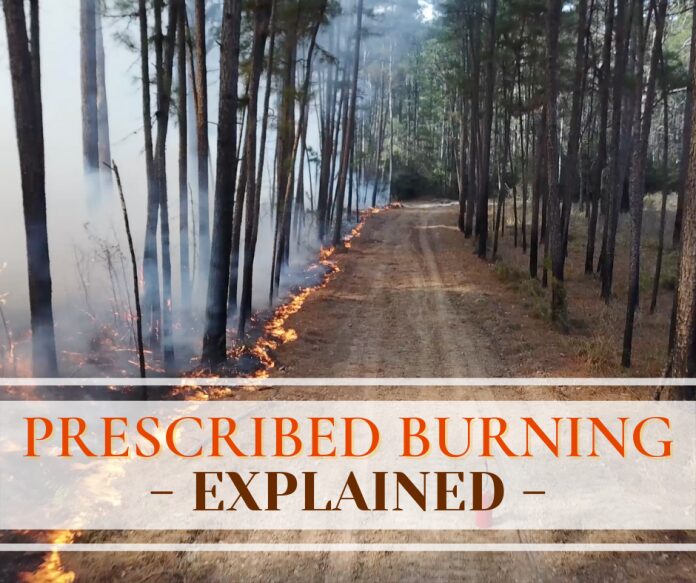
Prescribed Burning – Explained

0

When Texans see a pillar of smoke rising out of a forest or state park, our gut instinct is always the same: wildfire. However, that isn’t always the case.

Prescribed burning has become one of the most efficient and effective tools for land management in the state of Texas, and some of the state’s leading experts in wildland fire management—from Texas A&M Forest Service to the Texas Parks and Wildlife Department—can’t emphasize its merits enough.

“Prescribed burning helps reduce fuel loading,” explained Connor Murnane, a district forester with the Texas A&M Forest Service. “We see fuel as a woody, shrubby or herbaceous species that can easily burn.”

Eliminating some of this excess “fuel” reduces the risk and severity of potential wildfires. If there’s not enough brush or grass on the ground for a fire to feed on, it won’t get as hot or as big, and it’s less likely for the flames to reach the canopy of more established trees. It can also help slow down a raging wildfire, giving Texas A&M Forest Service and local firefighters a better shot at containment.

It feels counter-intuitive to light a fire in dry, burnable conditions, and many Texans believe that humans should simply “get out of the way” and let nature run its course, but the result would mean disbanding fire suppression all together. Since fire suppression has been integral to the establishment and upkeep of communities across Texas, one of the main issues facing wildland fire management is the build-up of fuels from about a hundred years of unnatural fire suppression.

“For a long time, we excluded fire,” said Chris Schenck, the State Fire Program Leader for the wildlife division of Texas Parks and Wildlife. “At the turn of the 20th century, we looked at fighting fires as almost the moral equivalent of war.”

In fact, one of the earliest laws in Texas prohibited the burning of grass. People didn’t realize that fire is a natural part of the Texas landscape. Before Texas was fully settled, lightning would strike in the heart of an eastern pine forest—or on the grassy plains of the Panhandle—and spark a fire to sweep across the land, purging it of invasive species, diseases and unwanted undergrowth.It was an essential element that helped uphold the natural balance.

“Native Americans recognized the importance of fire in their environment,” said Murnane. “They would often intentionally light fires to create a better habitat for hunting or browsing of wildlife species.”

East Texas is what Murnane calls a “fire-dependent ecosystem,” and the wall of understory brush – namely yaupon, sweetgum, Chinese tallow and other invasive species – is unnatural. Because of the lack of fire suppression by humans, east Texas used to look more like a pine meadow or savannah, with beautiful open spaces filled with green grasses and wildflowers between the trees. And while that kind of environment is visually pleasing and aesthetic to us, it’s also attractive to wildlife.

“One of the immediate positive results of any prescribed fire is forage production and habitat improvement,” said Schenck. “Better feed means better care and capacity for the land, and therefore greater diversity of species, both wild and domestic.”

Wildlife depends on open space and healthy plant life for foraging – including grasses, fruits, seeds and other vegetation – and out of the ashes of a prescribed fire rises healthy new plants. The trick, it seems, is to avoid fully incinerating the brush.

“Depending on the fire’s intensity, the ash produced following a burn can be full of valuable nutrients,” said Mike Lloyd, a Wildland Fire Manager with Texas State Parks.

Prescribed burning breaks down the chemical composition of organic matter, recycling nutrients back into the soil. According to THIS STUDY by Leonard F. DeBano, some of those nutrients are “volatilized” or lost, but most are made more readily available to plants and native organisms. The fire acts as a mineralizing agent, making nutrients immediately accessible, instead of being gradually recycled over the span of years, or even decades, via decomposition.

Even for us, fire (heat) can make an otherwise inedible substance not only palatable, but more nutritious. Cooking anything too long, however, can leave it charred, vaporizing its nutrients. In the case of forest management, the most endangered element is nitrogen. If a wildfire burns off too much nitrogen, it can adversely affect a wildland ecosystem for decades.

This is one of the many reasons that prescribed burning is so crucial—to prevent wildfires from burning forests past the point of rehabilitation—but it is also a key reason why prescribed burning is so highly regulated, and so carefully conducted. For Texas A&M Forest Service, very specific conditions are required to conduct a prescribed burn.

“It’s extremely weather dependent,” said Murnane. “The winds, the direction of your winds, your mixing heights, what your fuel moisture is at, all sorts of different things, and all of this comes back to the prescribed burn plans that we’re required to write.”

Once a burn plan is in place – which can be written and approved by Texas A&M Forest Service up to six months in advance – foresters look for an ideal weather window to conduct their burn. These usually occur between November and March, during the dormant season. Then it has to be a clear-skies day to help with smoke dispersal, and the winds have to be no less than 5 mph, but no greater than 15 mph. If the winds are too strong it could blow the fire out of control and start an uncontained wildfire, but if the winds are too weak, the fire won’t disperse well and parts of the forest could overheat, burning the roots of trees.

That’s why at the W.G. Jones State Forest prescribed burning requires a lot of preparation, and a lot of boots on the ground.

“We get several firefighters dragging drip torches, and several more on type-6 engines that are ‘holding’ so we don’t have a spread or a spot fire,” said Murnane. “Then we’ve got several bulldozers on standby, just in case.”

While Texas A&M Forest Service has the resources and capacity to take all of these precautions, not many landowners do. That’s why Murnane recommends any landowner interested in conducting a prescribed burn reach out to their local TFS forester or Parks and Wildlife Biologist. According to Murnane, they would be happy to visit the property and give their recommendations. They also have local connections with certified burn vendors that can provide prescribed burning services.

Schenck of Texas Parks and Wildlife even encourages landowners interested in learning how to conduct their own prescribed burns to reach out to their local forester or TPWD Regional Fire Coordinator.

“Because Texas is 95% privately owned, one of our roles is to provide landowners with technical guidance, and the development of a burn plan,” said Schenck. “Then we help them implement it. We teach them how to use their prescribed fire tools, how to prepare their land and how to implement that fire.”

Schenck was a federal wildland firefighter for years, but he still sees a need for prescribed burns across the state. This is, in part, because he’s witnessed the benefits of prescribed burning firsthand: from the clearing and rejuvenation of Wildlife Management Areas, to the survival of forests and structures during the catastrophic wildfires of 2011. In Bastrop, Schenck and Lloyd recall how areas that had received a prescribed burn the year before survived virtually unscathed.

“Believe it or not, prescribed burning saved a lot of the structures in those parks because we had burned the year prior,” said Lloyd. “At the Bastrop state park, I wonder if those cabins would’ve made it if we hadn’t implemented a prescribed burn around them the year before.”

A survey conducted by the Coalition of Prescribed Fire Councils (CPFC) and Texas A&M Forest Service found that over 325,000 acres of land in Texas were successfully treated with prescribed burns in 2019. That number is down from the year prior, but even 2018’s record amount is shy of where Texas A&M Forest Service and Texas Parks and Wildlife would like it to be.

“For Texas to get enough prescribed fires safely on the landscape, it’s going to take a lot of people,” said Schenck. “But if you’re going to light ‘em, you’ve got to know how to fight ‘em.”

Fortunately, Texas A&M Forest Service does both. They also provide ample resources to help landowners conduct their own prescribed burns – from grants and cost-shares to help subsidize the price of a prescribed burn vendor, to courses and trainings on how to become qualified to conduct prescribed burns yourself. But the most important element, for both Texas A&M Forest Service and Texas Parks and Wildlife, is educating the public.

If you’re a home or landowner interested in conducting a prescribed burn on your property, visit the PRESCRIBED BURNS page of the Texas A&M Forest Service website or the WILDLAND FIRE MANAGEMENT page by Texas Parks and Wildlife. There’s also this INTERACTIVE MAP to help you determine your eligibility for a Prescribed Fire Grant, with additional information on how to apply HERE.

DETCOG Accepting Pre-Applications for Rental Assistance Waiting List Lottery

0

The Deep East Texas Regional Housing Authority (DETCOG) will open its waiting list lottery for the Section 8 Housing Choice Voucher Program and begin accepting pre-applications on Monday, March 1, 2021 at 8:00 a.m. CT through Wednesday, March 31, 2021 at 11:59 p.m. CT. Pre-applications will be accepted online at https://www.waitlistcheck.com/TX2875 and will NOT be accepted at the Housing Authority’s office, nor by fax or mail.

The date and time the pre-application is submitted during the waiting list lottery opening period does not determine whether a pre-application will be selected for the waiting list. Pre-applications will be selected using a random lottery system. DETCOG will accept 1,000 applications during the waiting list lottery opening period. Applicants will be placed on the waiting list by random lottery and according to DETCOG preference(s). Applicants – will be notified of waiting list status by May 15, 2021 through their waitlistcheck.com login.

Preferences include: 1) Families who live or work in the DETCOG Regional Housing Authority service area, including: Angelina, Hardin, Houston, Jasper, Newton, Polk, Sabine, San Augustine, San Jacinto, Shelby, Trinity and Tyler .~ Counties (Houston County does not include Houston, Texas nor any part of Harris County, Texas; Tyler County does not include Tyler, Texas nor any part of Smith County, Texas); 2) Veterans and veterans’ families; 3) Victims of domestic violence, dating violence, sexual assault, or stalking referred by a partnering service agency or consortia, or a religious organization; and 4) Families whose head, co-head or spouse is disabled.

Pre-applications will be accepted on-line at https://www.waitlistcheck.com/TX2875  and may be submitted anytime day or night during the waiting list lottery opening from any computer or mobile device with internet access. Any computer or mobile device with internet access can be used to complete the pre- application. Request for a reasonable accommodation can be made by calling our office at (936) 634-2247, Ext 5262. There is no cost to apply for housing and a credit report is not needed to apply.

No applicant has the right nor is entitled to be listed on the waiting list, or to any particular position on the waiting list. Placement on the waiting list does not indicate that the family is, in fact, eligible for assistance. Receiving assistance is subject to eligibility requirements.

White Earns Conservation Award

0

Craig White of Huntington, Texas, has received national recognition from the National Wild Turkey Federation as the recipient of the Roger M. Latham Sportsman Wild Turkey Service Award for his leadership in in the Lone Star State.

“It is truly an honor to be nominated and to receive this prestigious award,” White said. “As I look at the list of past recipients, I’m humbled to be in the mix with some of the greatest volunteers to ever contribute to the NWTF. I was asked to join my local chapter several years ago by a good friend, but soon thereafter, I developed a love for the mission of NWTF, and I was ready to do everything I could to make it better and help enable our younger generation to carry on our legacy. I look forward to continuing our efforts and working to reach new milestones as the years pass.”

White received one of five Roger M. Latham Sportsman Wild Turkey Service awards presented at the 45th annual NWTF Convention and Sport Show, held virtually in 2021.
 
White is a dedicated steward of the wild turkey and proponent of the NWTF’s mission in Texas, which was evident in his four-year service as NWTF state chapter president. In that role, White brought exemplary leadership skills, fresh ideas, a businesslike approach and encouragement to NWTF volunteers.

White’s leadership skills and dedicative spirit also helped his local NWTF chapter reach new heights. The April AWOL Chapter has become a highly productive chapter and routinely places in the top three Texas chapters for net dollars, as well as winning national awards for its fundraising efforts.

“Craig’s commitment to the NWTF’s charge is tireless,” NWTF CEO Becky Humphries said. “He is an exemplary NWTF volunteer and leader, and we are honored to present him with a Roger Latham Award.”  
 
The NWTF presents Roger M. Latham Sportsman Wild Turkey Service awards to members who are not employed as professional wildlife managers but have made significant contributions to wild turkey conservation.

About the National Wild Turkey Federation
When the National Wild Turkey Federation was founded in 1973, there were about 1.3 million wild turkeys in North America. After decades of work, that number hit a historic high of almost 7 million turkeys. To succeed, the NWTF stood behind science-based conservation and hunters’ rights. Today, the NWTF is focused on the future of hunting and conservation through its Save the Habitat. Save the Hunt. initiative – a charge that mobilizes science, fundraising and devoted volunteers to conserve or enhance more than 4 million acres of essential wildlife habitat, recruit at least 1.5 million hunters and open access to 500,000 acres for hunting. For more information, visit NWTF.org.