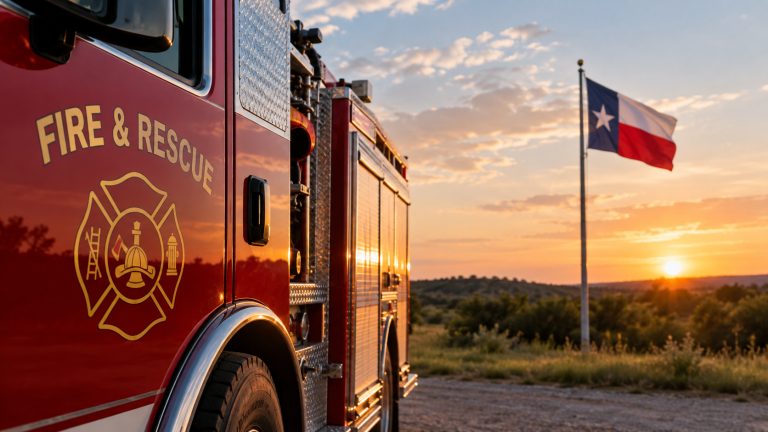
COLLEGE STATION, Texas — Texas A&M Forest Service awarded nearly $5 million to 118 rural volunteer fire departments across the state to support firefighting equipment and emergency response needs.
The $4.99 million awarded Aug. 26 will help departments purchase firefighting apparatus, fire and rescue equipment, protective clothing and other resources needed to safely and effectively respond to emergencies in their communities.
Rural volunteer fire departments provide essential emergency response services across Texas and often serve as the first line of response to wildfires and other emergencies. Funding through the Rural Volunteer Fire Department Assistance Program helps departments maintain response capabilities while providing firefighters with the resources needed to safely serve their communities.
“We work diligently to utilize all available program funds to assist fire departments in acquiring the necessary equipment and training to allow them to better protect life and property across the state of Texas,” said Jason Keiningham, Texas A&M Forest Service Capacity Building Department Head. “We’re proud to do everything in our power to help our partners in the fire service.”
The assistance was awarded during the fifth and final round of fiscal year 2026. Demand for assistance through the program routinely exceeds available funding as volunteer fire departments work to maintain and replace vehicles, protective gear and other essential resources. In response to the continued need, the 89th Texas Legislature allocated an unprecedented $192 million in one-time additional funding to address outstanding funding requests.
In fiscal year 2026, Texas A&M Forest Service awarded over $227 million through the program to support 1,229 volunteer fire departments across the state.
In addition to providing grants for firefighting apparatus and equipment, the program provides funding for training tuition, volunteer recruitment resources and the repair or replacement of equipment damaged or lost following catastrophic events or declared states of disaster.
Applications not approved during the Aug. 26 funding round will automatically move forward for consideration during future funding rounds. The next funding round is scheduled for October 2026.
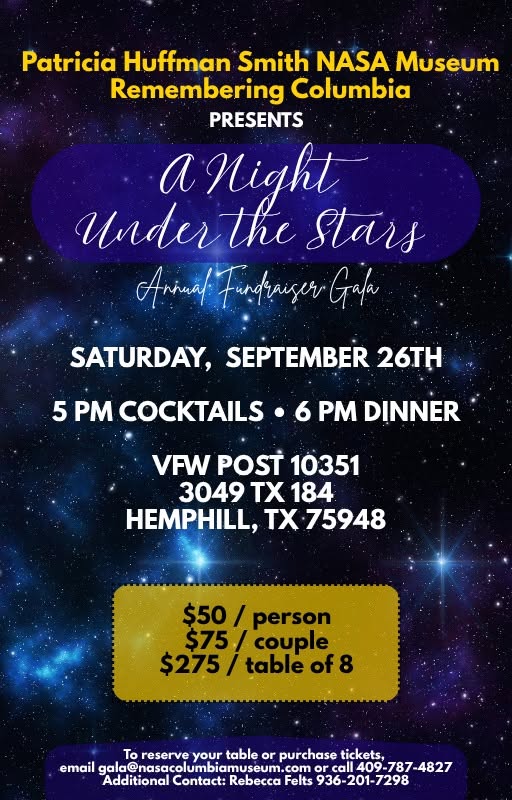
HEMPHILL, TX – The 7th annual Galactic Gala will return to the Hemphill VFW on Saturday, September 26, 2026. Organized by Friends of the PHS NASA Museum, the black-tie social event will celebrate the museum’s impact in the community and efforts to inspire young people to pursue careers in STEAM (Science, Technology, Engineering, the Arts and Math) fields.
This year’s gala will again feature an evening of cocktails, a catered meal, and an exciting program. Live entertainment, a silent auction, and a special guest will highlight the space-themed formal event, which serves as the museum’s largest annual fundraiser. An after-party featuring live music and dancing will follow.
The Hemphill VFW, located at 3049 State Highway 184, will host the gala.
Doors will open at 5 p.m. for a cocktail hour, followed by the meal at 6 p.m.
The highlight of each year’s gala is a keynote. This year’s guest of honor is retired 41-year NASA employee and author Dr. Estella Hernández Gillette.
Estella Hernández Gillette, Ed.D., has had a continuous relationship with NASA with her 40-year career at NASA, then post-retirement, because of her involvement in the NASA Alumni League-Johnson Space Center (NAL-JSC). Pre-retirement, for 10 years, she was adjunct faculty at Embry Riddle Aeronautical University, Houston Branch. Post-retirement, for 6 years, she was adjunct faculty in the University of Houston (main campus), Human Resource Development degree program, and a Consultant in Human Resources, including with Logical Innovations, Inc.
Gillette began her work at NASA in 1964 as a clerk-stenographer, no degree, and retired in 2006 as a member of the JSC senior staff and as a 10-year member of the Astronaut Selection Board, and completed coursework for a Doctorate in Education. She navigated her way through NASA JSC by learning the organization well, including opportunities for development that resulted in a career that would allow her to participate and witness the evolving workforce at JSC. She believes everyone has potential, given the opportunity to learn and to practice new experiences that contribute to individual development for greater contributions to the organization’s mission.
Gillette has received several NASA and JSC awards that reflect the different phases of her career, including: renaming of the JSC STAR Secretarial Excellence Award to the Estella Hernández Gillette STAR Award; Silver Snoopy Award; NASA Exceptional Service Medal; the NASA Exceptional Achievement Medal; the JSC Federal Women’s Program Award. Non-NASA awards include 100 Most Important Hispanics in Technology and Business Award; United Cerebral Palsy of Texas 1997 Tribute Award—Innovative Trend Setter; the Federal Business Administration Supervisor of the Year Award; and, the National Secretaries Association Secretary of the Year, NASA-Clear Lake Chapter. Post-NASA, for her contributions to professional activities, she has received awards, including: the NASA Exceptional Public Service Medal (2025); Great Minds in STEM (Hispanic Engineering National Achievement Award Conference), Luminary Award; Distinguished Alumni Award, Northside High School (formerly Jefferson Davis High School); and Distinguished Alumni Award, UHCL.
She is one of several women featured in the book Mexicanas En El Espacio, by Javier Montiel, et.al., about Latina women who have made contributions to the U.S. space program. She is also one of several NASA women “pioneers” featured in the book Making Space for Women, by Dr. Jennifer Ross-Nazzal. Dr. Gillette’s dissertation (A Case Study of Socialization Experiences in an Organization Characterized as a High Reliability Organization: NASA’s Extravehicular Activity (EVA) Team, the Spacewalkers in the Astronaut Corps) was an outcome of the experiences she had at NASA when she joined in 1964, when she figured out how to navigate her way in an environment that appeared very different to her upbringing.
Gillette has been married to Peter Gillette, a retired NASA rocket scientist, for 59 years. They met at NASA. The Gillettes have two sons, one in private industry in civil engineering, the other at NASA as a civil servant. Having no grandchildren around, they focus on their 6 cats–3 inside males and 2 feral females.
Seating for the popular event is limited, so table reservations are encouraged by Sep. 1. Tickets, which are $50 per person, $75 per couple, or $275 for a table of 8, may be purchased by contacting the museum at (409) 787-4827 or Rebecca Felts at (936) 201-7298. Tables are available for $275 and include 8 guests.
Sponsorships and donations of silent auction items are available to businesses and organizations wishing to support this cause. Please contact the museum by emailing gala@nasacolumbiamuseum.com .
All proceeds from the event will directly support the educational facility’s efforts to create science and technology-inspiring learning opportunities for children and adults in East Texas and western Louisiana.
Don’t forget to join us this Saturday (Sept. 19) at 10:30am for Marian LaSalle’s class on “Building Your Online Community.” Marian is a local business owner who wants to share useful knowledge and tips for promoting your business, hobby and other interests.
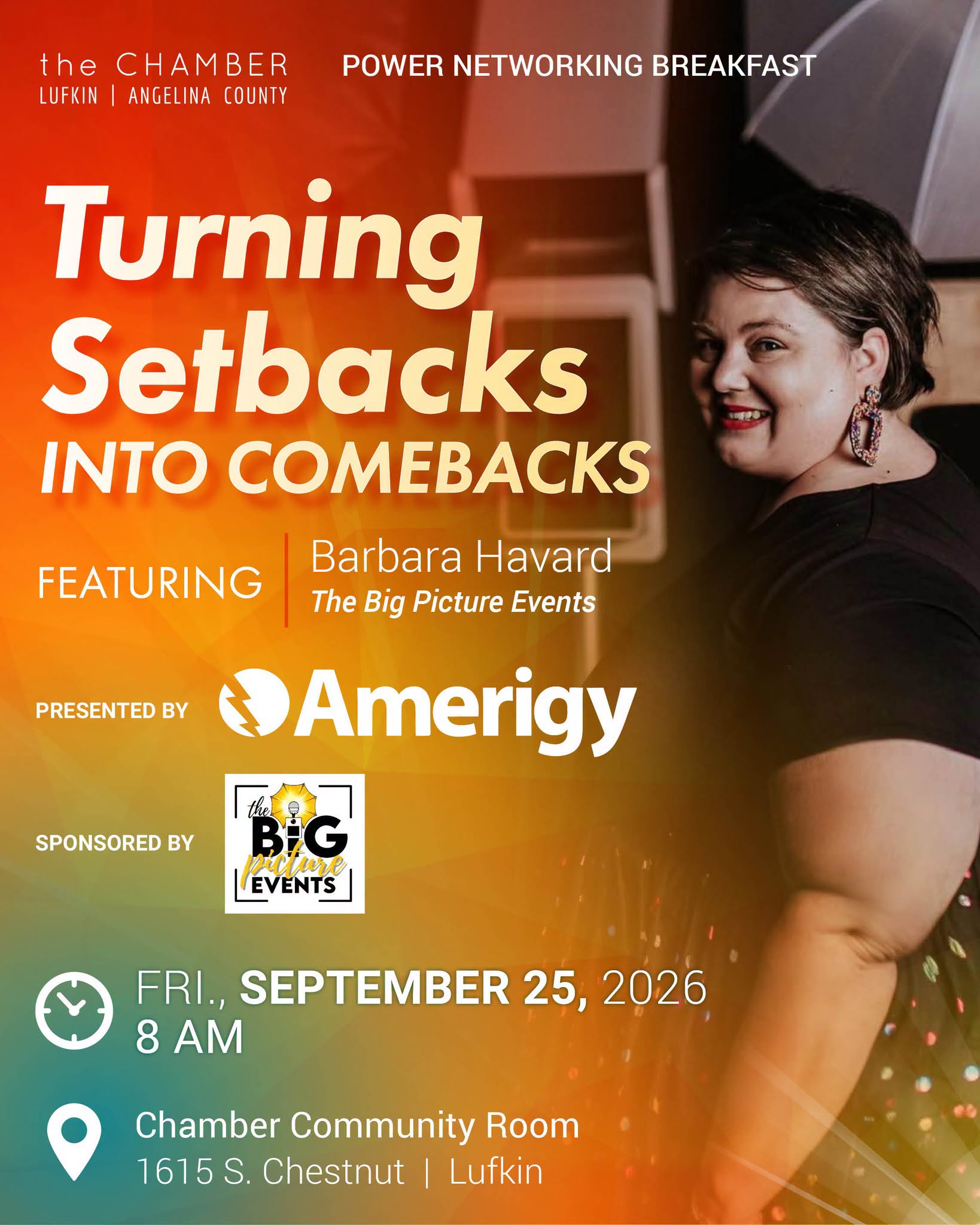
Join us on Friday, October, for our next First Friday Luncheon featuring a legislative update from State Representative Trent Ashby, along with the presentation of the Jack O. (Butch) McMullen Silver Spike Award, presented by Southside Bank.
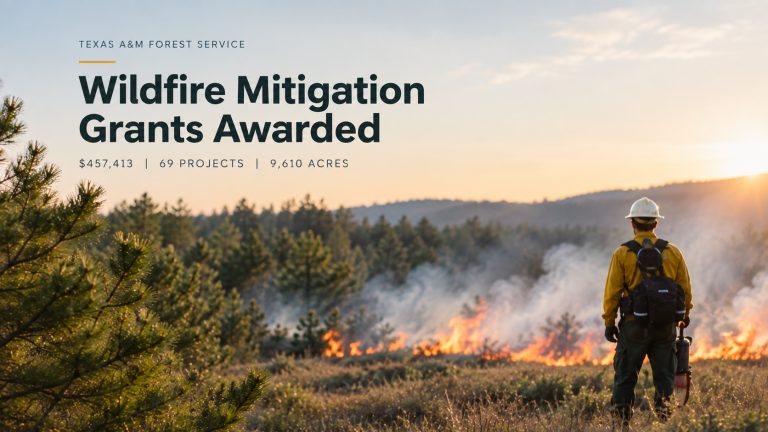
COLLEGE STATION, Texas – Texas communities will be more resilient against wildfire following the award of $457,413 through the Texas A&M Forest Service Community Wildfire Risk Reduction Grant Program.
The funding, provided to landowners, will support 69 wildfire mitigation projects that will treat 9,610 acres, helping protect homes, infrastructure, natural resources and the people who live in at-risk areas.
As wildfire risk continues to affect many areas of Texas, mitigation projects like mechanical fuel reduction and prescribed fire fill a vital role in protecting lives and property while supporting long-term community safety. By reducing hazardous fuels, communities can lower the intensity and spread of future wildfires and improve overall preparedness.
“These grants help landowners take proactive steps to lessen wildfire risk while supporting healthy, resilient landscapes across Texas,” said Karen Stafford, Texas A&M Forest Service community resilience program coordinator. “By investing in mitigation today, we can better safeguard communities and improve their ability to withstand future wildfire events.”
The projects will strengthen community resilience by reducing the buildup of vegetation that can contribute to dangerous wildfires and creating safer conditions around homes and other assets. Through mechanical fuel reduction and prescribed fire activities, landowners and local partners will take proactive steps to reduce wildfire risk before fires occur.
“Reducing hazardous fuels before a wildfire occurs is one of the most effective ways to protect people, homes and natural resources,” said Stafford.
The Community Wildfire Risk Reduction Grant Program is part of Texas A&M Forest Service’s ongoing commitment to helping Texans prepare for and reduce wildfire risk through education, planning and implementation of proven mitigation practices.
Funding for the program is provided by the USDA Forest Service and U.S. Fish and Wildlife Service and administered by Texas A&M Forest Service.
Applications are accepted annually from June 1 through July 14. Landowners, communities and partners interested in future funding opportunities can learn more through Texas A&M Forest Service and explore additional grant programs through the Funding Connector.
We finally received approval from TEA for granting CEU’s to our educators who would like to attend our first prevention workshop!
Get signed up now and join us for a day filled with out-of-the box collaborators who will share with you some great tools that will help while serving youth and families.
The Angelina College Foundation will host Dinner at the Diamond on Saturday, September 26, from 7:00–10:00 PM at Poland Field at Angelina College. Guests can enjoy a live performance by Donice Morace, along with food and drinks, live and silent auctions, games, and more.
Tickets are $100 for individuals or $800 for a reserved table of eight. Proceeds from the evening will support the Angelina College Foundation and its work to create opportunities for students.
A great night of music, fun, and giving back is waiting at the Diamond!
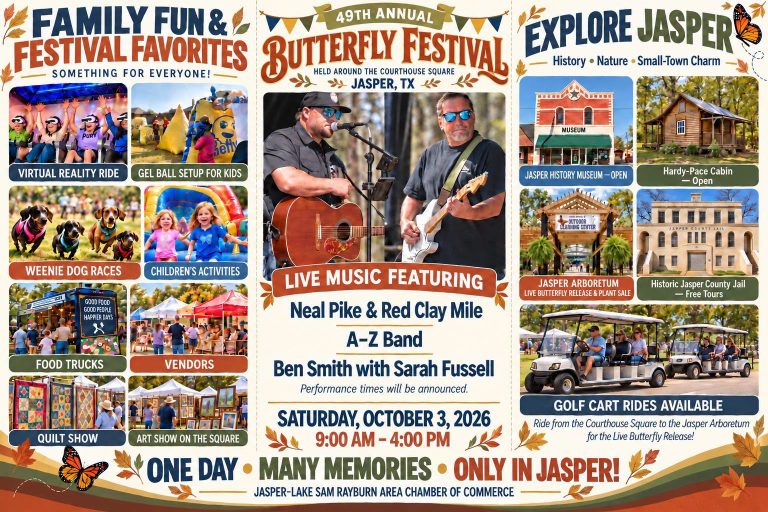
Join us for the 49th Annual Butterfly Festival on Saturday, October 3, from 9:00 AM–4:00 PM, held around the Courthouse Square in Jasper!
It’s going to be a full day of family fun featuring:
Live music Local vendors Food trucks Weenie dog races Art and quilt shows Virtual reality rides Gel ball fun for kids Live butterfly release and plant sale Local museums, historic attractions and free jail tours
Golf cart rides to the Jasper Arboretum …and so much more!
Vendor spaces are still available! If you would like to showcase your products, crafts, food or business at one of Jasper’s favorite community traditions, contact the Jasper–Lake Sam Rayburn Area Chamber of Commerce today.
Make plans to spend the day with us and experience the history, nature and small-town charm of Jasper, Texas!