Home Blog Page 367

Nacogdoches officials emphasize preparedness in wake of Hurricane Laura.

0

As Hurricane Laura, presently a category 3 hurricane, makes its approach to the Nacogdoches area, city and county officials urge citizens to remain diligent in monitoring and preparing for the potentially life-threatening weather conditions. Damaging wind gusts, flooding, and isolated tornadoes are expected across the area as the storm quickly moves inland.

“While hurricane paths can be unpredictable, we need to continue our readiness activities under the assumption Hurricane Laura will hit us as a major hurricane. Now is the time to urgently wrap up preparations to protect yourself and your property,” stated County Judge Greg Sowell.

Pre-Storm Activities for Residents
● Review your emergency kit– include enough food, water, and supplies for at least 3
days. Don’t forget medication, cloth face coverings, pet supplies, etc.
● Secure outdoor furniture and decorations– these could become flying projectiles.
● Prepare for life-threatening wind and rainfall flooding– if in a place vulnerable to high
wind, such as near large trees or a mobile home or in low-lying or poor drainage areas,
plan to move to safe shelter.
● Prepare for power outages– review generator best practices, check flashlight batteries,
have a backup means to charge your phone and other electronics.
● Remember flood water is dangerous– do not attempt to walk, swim or drive through
standing water. Turn around, don’t drown.
● Stay informed!– Weather conditions are ever-changing. Use reliable sources such as
weather.gov/shv and nhc.noaa.gov as well as local news channels, the City website and
Facebook page, and the County Emergency Management Facebook page.

“I strongly encourage everyone to find a safe place to ride out the storm and stay off the roads if at all possible until the dangerous weather has passed. Check on your neighbors, look out for pets, and be safe.” stated Mayor Shelley Brophy.

The Emergency Operation Center (EOC) is operating at Level II (High Readiness) at the
Courthouse Annex and Nacogdoches Police Department. “With public safety as the utmost
priority, Emergency Management staff and our city and county departments are working
diligently to provide support during this emergency,” said City Manager Mario Canizares.

Mayor Shelley Brophy and County Judge Sowell declared local disasters Tuesday afternoon to allow for access to state and federal resources and seek possible reimbursement for related expenses.

Governor Abbott Provides Update On Texas’ Response To Hurricane Laura, Adds 36 Counties To State Disaster Declaration

0

Governor Greg Abbott today held a press conference at the Alternate State Operations Center in Austin where he provided an update on the state’s response to Hurricane Laura. This hurricane is expected to impact the Texas coast and Southeast Texas as early as Wednesday and bring heavy rainfall, flooding, high winds, and storm surge. The Governor also received a briefing from the Texas Division of Emergency Management (TDEM), which included an update on response and preparedness efforts from state agency directors and the Federal Emergency Management Agency (FEMA). Additionally, the Governor announced that he has added 36 counties to his State Disaster Declaration due to the threat of severe rain, wind, and flooding.

During the press conference, Governor Abbott discussed the threat of high winds as well as life-threatening storm surge where Hurricane Laura makes landfall. The Governor also discussed evacuation efforts throughout the state, and announced that reception centers in San Antonio, Dallas-Fort Worth, and Austin will open later today. The state is providing buses to transport Texans that are evacuating. There are also over 225,000 hotel rooms available across the state to provide shelter to evacuees. A full list of mandatory and voluntary evacuations can be found on the Texas Hurricane Center web page. Governor Abbott urged Texans to take action now to protect themselves and their property.

“Hurricane Laura is rapidly intensifying and poses a major threat to communities in Southeast Texas and along the coast,” said Governor Abbott. “Texans in the path of this storm should waste no time preparing for the impact of Hurricane Laura and take immediate action to keep themselves and their loved ones safe. I urge our Southeast and coastal communities to heed the guidance of local officials, follow evacuation orders, and remain vigilant as we brace for the impact of Hurricane Laura. The State of Texas will continue to monitor this storm and provide the resources needed to keep Texans safe.”

Hurricane Laura was upgraded from a Tropical Storm earlier today. It is currently a Category 1 hurricane but is expected to gain strength to a Category 3 or 4 hurricane as it makes landfall over Southeast Texas and Southwest Louisiana late Wednesday or early Thursday. Beginning Wednesday, these areas will experience tropical storm force winds, heavy rain, significant storm surge, possible flash flooding, and rising water levels. The chances of hurricane force winds will increase Wednesday evening. Heavy rainfall that begins over Southeast Texas on Wednesday will shift into Northeast Texas on Thursday. The primary water threat will be from storm surge. Texans are urged to remain vigilant and aware as Hurricane Laura continues to head towards Texas.

Additional state resources have been rostered to help respond to Hurricane Laura. TDEM has activated the following resources and personnel:

  • Texas A&M Forest Service: Incident management teams, chain saw crews, firefighting strike teams, and water evacuation and rescue teams
  • Texas A&M Engineering Extension Service: Urban search and rescue teams and swift water rescue teams, including Texas A&M Task Force 1 and 2
  • Texas A&M Agrilife: Agents positioned to support emergency operations centers and disaster finance teams
  • Texas Military Department: High profile water rescue vehicles, airplanes and helicopters for evacuation and rescue, shelter management teams, evacuee tracking network teams, 6th Civilian Response Team available for Hazmat response
  • Texas Department of Public Safety: Rescue helicopters, command and control airplanes, swift water rescue boat teams, flood response boat teams, dive boat teams, as well as Troopers, agents, and Rangers to assist local Law Enforcement with evacuation and securing evacuated areas
  • Texas Parks and Wildlife: Game Wardens, State Park Police, swift water rescue boats, Shallow water evacuation boats, air boats, incident management teams, and a helicopter rescue team
  • Texas Department of State Health Services: Emergency Medical Task Force (EMTF) Ambuses, EMTF ambulances, EMTF Medical incident management and support teams
  • Texas Department of Transportation: High profile water rescue vehicles, traffic control devices, and flood protection barriers
  • Texas Commission on Environmental Quality: Water and waste water monitoring teams and hazmat response teams

The Texas Health and Human Services Commission and the Public Utility Commission are also assisting in response efforts. For more information on the state’s response to Hurricane Laura, as well as resources for those impacted by the storm, visit the Texas Hurricane Center.

Reception centers for evacuees:

San Antonio (Opening at 3:00 PM CT  today)

254 Gembler Road

San Antonio, TX 78219

Austin (Opening at 4:00 PM today)

Circuit of the Americas

9201 Circuit of the Americas Boulevard

Austin, TX 78617

Dallas Fort-Worth (Opening at 7:00 PM today)

Mesquite Reception Center

15515 E. IH-20

Mesquite, TX 75181

Ellis County (Opening at 7:00 PM today)

Knights of Columbus Hall

850 S IH-45

Ennis, TX 75119

View the Governor’s proclamation adding more counties to his State Disaster Declaration.

Texas Salvation Army Preparing Response to Storms Threatening the Gulf Coast

0

The Salvation Army is closely monitoring not one, but two storms, that could potentially seriously impact communities in South East Texas and along the Gulf Coast. Tropical Storm Laura and Hurricane Marco are both anticipated to make landfall on Tuesday or Wednesday this week. 20 Salvation Army disaster units in Texas and neighboring states are fully stocked and on standby for deployment. Heavy rain and potential flash flooding are a possibility in greater Houston and throughout the Golden Triangle area.

The Salvation Army Emergency Disaster Services (EDS) staff has been in communication with all affected field units, staff, and volunteers, placing 10 mobile feeding units in Texas on standby for pre-positioning closer to the affected area. Each mobile feeding unit has the capacity to deliver up to 1,500 meals per day. Response teams and supplies will be staged north of the potential landfall for rapid deployment into affected communities.

“It is very unusual to have two storms threatening the Gulf Coast at the same time and our EDS teams in Texas are paying special attention to Hurricane Marco,” said Alvin Migues, Texas Emergency Services Director for The Salvation Army. “Many communities in Houston, Beaumont and Orange are still recovering from Hurricane Harvey in 2017 and extensive flooding caused by Tropical Storm Imelda in 2019. The Salvation Army was there to provide help and practical assistance after those storms, and we will be ready and prepared to deliver services again to those affected in the coming days.”

The ongoing COVID-19 pandemic has presented additional challenges for the emergency response teams. “Mobile kitchens, cooking and serving areas, and utensils, are all being deep-cleaned multiple times a day which takes time and increased supplies. Our teams are paying special attention to safety protocols put into place due to COVID-19, wearing PPE and social distancing. Many of our committed volunteers are older in age and so we are doing everything possible to keep everyone safe while ensuring we are in a position to effectively meet the needs of the community.”

Local preparations are underway in Houston where four mobile kitchens are stocked and ready for deployment. “At the height of service during Hurricane Harvey The Salvation Army had 103 mobile kitchens, from all over the country, serving food, snacks and drinks in Houston and South Texas,” said Major Zach Bell, Area Commander for The Salvation Army in Houston. “Our year-round commitment to serve those in crisis is only heightened during disaster response. Trained Salvation Army staff and volunteers not only provide for the immediate physical needs of those affected, but also for their emotional and spiritual needs through listening and sharing words of encouragement and prayer. The Salvation Army has been serving the residents of Houston since 1897, providing shelter, food, rehabilitation and much more, and we will continue to serve throughout this storm and beyond.” For the latest information please go to www.disaster.salvationarmy.org and watch for regular updates on our social media pages at www.facebook.com/salvationarmytexas/ and www.twitter.com/salarmytx. To make a donation go www.helpsalvationarmy.org.

Governor Abbott Holds Briefing, Press Conference On Hurricane Marco And Tropical Storm Laura, Requests Federal Emergency Declaration

0

Governor Greg Abbott today held a press conference at the Alternate State Operations Center in Austin where he provided an update on the state’s response to Hurricane Marco and Tropical Storm Laura, both of which are forecast to impact parts of the Texas Coast and East Texas in the coming days. Prior to the press conference, the Governor received a briefing from the Texas Division of Emergency Management (TDEM), as well as an update on response and preparedness efforts from state agency directors and the Federal Emergency Management Agency (FEMA).

The Governor also announced that he has issued a state disaster declaration and has requested an Emergency Declaration from President Trump and FEMA for Public Assistance Category B (Emergency Protective Measures), Direct Federal Assistance, and Hazard Mitigation statewide. Counties included in the state disaster declaration are Aransas, Bexar, Brazoria, Calhoun, Cameron, Chambers, Galveston, Hardin, Harris, Jackson, Jasper, Jefferson, Kenedy, Kleberg, Liberty, Matagorda, Newton, Nueces, Orange, Refugio, San Patricio, Victoria, and Willacy.

“As Hurricane Marco and Tropical Storm Laura approach Texas, the state is taking necessary precautions to protect our communities and keep Texans safe,” said Governor Abbott. “I urge Texans in the path of these storms to plan ahead and heed the guidance of their local officials. The State of Texas is working with local and federal partners to monitor these storms and provide the resources our communities need to respond.”

Hurricane Marco is expected to make landfall in Louisiana on Monday before moving towards Texas on Tuesday evening as a depression. This hurricane is expected to bring heavy rain and tropical storm force winds to the Texas Coast and Southeast Texas as it approaches the state. Tropical Storm Laura is forecast to become a Hurricane on Tuesday, and this storm is expected to make landfall anywhere over Southeast Texas or Louisiana early Thursday. Wind, heavy rain, and storm surges are expected on Wednesday as Tropical Storm Laura enters the Gulf.

TDEM has rostered the following resources in preparation to support request from local officials:

  • Texas A&M Forest Service: Saw Crews and Incident Management Teams
  • Texas A&M Engineering and Extension Service: Texas A&M Task Force One and Two Search and Rescue Teams
  • Texas Parks and Wildlife Department: Boat Teams to support Water Rescue Operations
  • Texas Military Department: Helicopters, sheltering teams, disinfecting teams, mobile testing teams, and High Profile Vehicle packages
  • Texas Department of State Health Services: Emergency Medical Task Force severe weather packages and Ambulance Strike Teams
  • Texas Department of Transportation: High Profile Vehicles
  • Texas Department of Public Safety – Texas Highway Patrol: Search and Rescue Aircraft with hoist capability and the Tactical Marine Unit

The Texas Health and Human Services Commission and the Texas Commission on Environmental Quality are also assisting in response efforts. The Alamo Regional Command Center has been activated in San Antonio to support staging of resources that have been rostered by the State of Texas. TDEM has secured fuel, hygiene, and shelter resources and more.

Texans are urged to follow these flood preparedness and safety tips during severe weather events:

  • Know types of flood risk in your area. Visit FEMA’s Flood Map Service Center for information here: https://msc.fema.gov/portal/home
  • Sign up for your community’s warning system. The Emergency Alert System (EAS) and National Oceanic and Atmospheric Administration (NOAA) Weather Radio also provide emergency alerts.
  • Build an emergency supply kit. For more information on how to build a kit, visit: https://www.ready.gov/kit
  • Keep important documents in a waterproof container. Create password-protected digital copies.
  • Protect your property. Move valuables to higher levels. Declutter drains and gutters. Install check valves. Consider a sump pump with a battery.
  • Be extremely cautious of any water on roads or in creeks, streams, storm drains, or other areas – never attempt to cross flowing streams or drive across flooded roadways and always observe road barricades placed for your protection. Remember, Turn Around Don’t Drown.

Be extremely cautious of any water on roads or in creeks, streams, storm drains, or other areas – never attempt to cross flowing streams or drive across flooded roadways and always observe road barricades placed for your protection. Remember, Turn Around Don’t Drown.

For more flood safety tips, visit gov.texas.gov/hurricane.

View the Governor’s Disaster Declaration.

Area of extremely dry vegetation expanding, increasing potential for wildfire activity near populated areas

0

Dry air will persist over the state through the weekend, contributing to increased rates of drying in vegetation. Wildfire activity and fuel dryness is continuing to expand north and east into higher population centers.

Fire environment—weather, fuels and current conditions

Critically dry wildland vegetation currently observed across the landscape is very receptive to any source of ignition, which causes wildfires to burn more intensely, making them much more resistant to control. With activity and critically dry fuels expanding closer to highly populated areas, there is an elevated risk of human-caused wildfires.

There is also a risk of dry lightning over areas of the Hill Country on Friday night into Saturday. With critically dry vegetation, the potential for wildfire ignitions will increase.

“The potential for increased wildfire activity through the weekend is very high in the Hill Country and along the Interstate 35 corridor from Waco to New Braunfels,” said Brad Smith, Texas A&M Forest Service Predictive Services Department Head.

For current conditions and wildfire outlook, check out the Texas Fire Potential Outlook: https://bit.ly/3kemhbG.

Fire activity

Due to significant fire activity occurring in multiple geographical areas across the country and heavy commitment of shared resources to large fires nationally, the National Multi Agency Coordinating Group has raised the National Preparedness Level to Level 5.

Preparedness Levels are dictated by fuel and weather conditions, fire activity and fire suppression resource availability throughout the country. Level 5 is the highest level of wildland fire activity and indicates heavy resource commitment to fires nationally. The state of Texas is currently at a Level 3 with increased resource commitment and wildfire activity statewide.

According to Les Rogers, Texas A&M Forest Service Chief of Fire Operations, state wildland firefighters have been extremely busy responding to the increase in wildfire activity across the state. Numerous out-of-state resources are currently in Texas working together with state personnel to contain wildfires that are burning statewide.

“Texas A&M Forest Service remains dedicated to protecting Texas’ citizens and natural resources from wildfire, even as national activity increases,” said Rogers. “It is crucial that all residents take care to prevent wildfires and to take measures around their home to reduce wildfire risk.”

Over the past seven days, state and local resources have responded to 150 fires that have burned 69,897 acres. This includes many large, multi-day fires including the still-burning McMean Fire in Sutton County at 3,921 acres and 60% contained, the Lockhart Mountain Fire in Llano County at 422 acres and 90% contained and the Poverty Canyon Fire in Coke County at 300 acres and 80% contained. Activity increased across the state with multiple fires in the west, northwest, north, and central portions of the state.

Many of the recent wildfire starts have been attributed to human activities—such as equipment use and debris burning—and are preventable. So far in 2020, at least 1,850 wildfires that have burned 69,897 acres were human-caused. This includes at least 80 fires that have burned 2,395 acres over the past week.

Aviation resources continue to assist ground crews with water and retardant drops to slow forward progression of fires and douse hotspots across fire areas. Fire suppression aircraft have logged approximately 290 hours of flight time over the past week.

Efforts involved dropping 191,580 gallons of water and 107,228 gallons of retardant on multiple fires including the McMean Fire in Sutton County, the Lockhart Mountain Fire in Llano County, the Poverty Canyon Fire in Coke County, the Turkey Creek Fire in Palo Pinto (247 acres, 100% contained), the Glover 2 Fire in Archer County (300 acres, 100% contained) and the 8 Mile Fire in Terrell County (625 acres, 100% contained).

Aviation resources staged in state include two Type 1 helicopters, two Type 3 helicopters, 13 single engine air tankers and two air attack platforms.

Since January 1, 2020, state and local resources have responded to 3,692 fires that have burned a total of 184,774 acres. Aviation resources have flown 1,800 hours, dropping 1,816,409 gallons of water and retardant on Texas wildfires so far this year.

If a wildfire is spotted, immediately contact local authorities. A quick response can help save lives and property.

For frequent wildfire and incident updates, follow the Texas A&M Forest Service incident information Twitter account, https://twitter.com/AllHazardsTFS.

Prevention and Mitigation

Many areas of the state are experiencing triple-digit temperatures and critically dry vegetation, increasing wildfire potential. These critically dry fuels are highly susceptible to ignition from any spark. Texans should be mindful of any outdoor activity that may cause a spark.

  • Always check with local officials for outdoor burning restrictions in your area. Obey local burn bans or other restrictions. Do not conduct any outdoor burning in hot, dry or windy conditions.
  • Vehicles may cause wildfires. Secure trailer safety chains to ensure they do not cause a spark and ignite a roadside fire.
  • Avoid parking or idling in tall, dry grass. Catalytic converters underneath the vehicle can become hot enough to ignite grass under the vehicle.
  • Many outdoor activities may produce sparks and ignite nearby vegetation including welding, grinding, mowing or shredding. If possible, postpone these activities until fuel dryness conditions improve. If not possible, take extra precautions by having a water source or fire extinguisher nearby.

Successfully preparing for a wildfire requires everyone to take personal responsibility for protecting themselves, their families and their properties.

“It is the responsibility of each individual resident to prepare their home for wildfires,” stated Kari Hines, Texas A&M Forest Service Firewise Coordinator. “Just this week, there were dozens of examples of homes that survived wildfires unaided or allowed firefighters to operate safely to protect them. And this was due to the landscaping and building choices made long before the fire ever started.”

Texas A&M Forest Service encourages Texans to take the following steps around their homes today to reduce the risk of wildfire:

  • Creating defensible space around your home allows for low intensity, slow-burning conditions in the event of a wildfire.
  • Within the first 30 feet of your home, use non-flammable landscaping materials. Within the first five feet, water plants, trees and mulch regularly, and consider xeriscaping if you are affected by water restrictions.
  • A healthy, well-maintained landscape is important to the survival of homes during a wildfire. Make sure your plants are carefully spaced, low growing and free of resins, oils and waxes that burn easily.
  • Remove dead vegetation from under the deck of your home and within 10 feet of the house.
  • Prune your trees six to 10 feet up from the ground.

“Even simple things such as moving flammable material away from wooden structures such as decks and steps, pruning shrubs in front of windows and under mature trees and cleaning out gutters can be done with a limited amount of time if a fire is in the area,” said Hines.

Taking simple steps to help maintain your property could save it during a wildfire. For more information on how to create defensible space around your home, visit https://tfsweb.tamu.edu/ProtectYourHome/.

Residents should pay attention to county burn bans and avoid all outdoor burning until conditions improve. Burn ban information can be found by contacting local fire departments or by visiting https://tfsweb.tamu.edu/TexasBurnBans/.

For media resources, including public service announcements, posters and audio and video files, visit https://tfsweb.tamu.edu/mediaresources/.

Pond Slimes, Foams, and “Sheens”

0

Ponds can be a complex ecosystem. Certainly its an system that we can’t figure out (many times) by simply looking at the surface of water.

One of the questions I’ll get occasionally is about the “oily” look or perhaps foam that is on top of the farm pond water. “Doesn’t that mean we have an oil/gasoline/petroleum spill from somewhere?” Though it could be, there are some very organic, natural processes that cause slimes, foams, and “sheens” on ponds.

A surface film results anytime when insoluble substances enter the water. These substances come from a variety of physical, chemical, or biological sources.

Pollen and atmospheric dust are common causes of surface films. Pine, oak, and other pollen in the spring can accumulate. Its common that spring showers wash pollen into ponds where it floats and forms a yellow-green surface film that will dissipate within a few weeks.

Films also are formed by the growth of certain kinds of blue-green algae. This can be quite toxic to livestock and is a particularly bad form of algae to have in a pond. Films formed by blue-green algae are usually bright green and form swirls and bands as they move over the pond with the wind. On rare occasion the pond may develop a bright red or blood red film which is the result of the growth of “red algae.”

The third source of a “film” is from hydrocarbons and oils. Oils are produced naturally by the decay of leaves, algae and organic matter, but these oils behave differently from cooking oil or motor oil. To determine if the oil sheen you see on your pond is from a natural organic source, poke it with a stick. If it is from the decay of leaves and other organics, it will most likely crack and shatter like a thin layer of glass and will not reform as the stick is removed. If it reforms or does not shatter, it is likely from automotive or cooking oils that have washed into the pond.

Lastly, surface films may be the result of insoluble compounds in the soil. Soil-based films usually accompany muddy water, are similar in color and will dissipate as the muddy water clears. Eliminating the cause of the muddy water will usually eliminate this type of surface film.

Very little can be done to remove a surface film. If it is biological in origin (pollen or algae), it usually will dissipate or biodegrade on its own within a couple of weeks. If the film is the result of soils and muddy water, the problem may persist until erosion can be stopped or the source of the muddy water is eliminated.

If you have an off-site, non-natural contamination, the source of the oil must be eliminated. This means that you need to be inspect for evidence of oil dumping into storm drains, or the streets and driveways need to be inspected for evidence of an oil spill.

Foams that form on the surface of stormwater ponds may be the result of illicit discharges of soap or they can be formed naturally, usually in association with algae blooms.

All plant cells contain natural surfactants that change water surface tension. After an algae bloom occurs and the algae begin to die, their cells rupture and release these natural surfactants into the water. Add some current or wave action to this mixture and this water can begin to form a froth or foam.

If you’ve noticed this on lakes and the ocean, this is the most common reason. Natural foams also form in water with a lot of organic matter such as in black water rivers and swamps. All of the leaves and woody debris that fall in swamps decay and release their natural surfactants into the water.

Ever notice the foam on freshly brewed coffee? Yep, it’s the same kind of natural oils!

To tell natural foam from soaps and detergents, foam formed by man-made soaps and detergents will retain its bright white color for many days regardless of the color or clarity of the water. Natural foams, on the other hand, are formed by organics that rapidly biodegrade. For this reason, natural foams usually begin to turn brown within hours of being formed.

Another way to tell them apart is to look at the individual bubbles in the foam. Soaps are more efficient surfactants so they can create larger bubbles, so bubbles in soapy foams often are large and of variable size. Natural foams cannot create large bubbles easily, so they tend to have small bubbles that are more uniform in size. Last, soapy foams are able to disperse easily, so they often spread out from their source. Natural foams do not disperse as well, so they tend to stay close to the source.

Slimes are usually the result of biological activity in the pond. They often are formed by the growth of algae or microbes at the water’s edge or on the bottom in the shallow areas of the pond. These types of slimes are most often green or black, and are familiar to most pond owners.

So, be it a slime, foam, or sheen on top of your water, all of these conditions are certainly organic and can be a natural part of the cycle of your pond’s ecosystem.

Still in the Swing of Things Thirteenth Annual Guy Davis Golf Tournament Provides Boost to AC Athletics

0
Team Fun Group (Fun Group (Ben Honeywell, Dylan Peterson, Ben Augustine, Payton Bass) was the overall winner of Saturday’s 13th Annual Guy Davis Golf Tournament held at Crown Colony Country Club. (Molli Morgan/AC Press photo)

While each of the previous 12 versions of the Guy Davis Golf Tournament has been important for Angelina College athletics programs, the 2020 version may have been the most important of all those events.

Hosted annually by the Roadrunner Foundation and the Crown Colony Country Club in Lufkin, the tournament has always provided Roadrunner athletics with much-needed community and financial support.

Featuring a total of 240 players spread across 48 teams, this year’s event showed the entire community that AC Athletics programs are revving up – and feeling support – for the Fall 2021 and Spring 2022 seasons – an important message following this year’s news that all Angelina College sports programs would sit out the year because of the ongoing worldwide pandemic.

“It was important to show that the community still backs Angelina College and its athletics programs during these tough times with the ongoing pandemic, and to show support for AC’s programs getting ready to come back strong in 2021,” Foundation president Wes Welch said. “This tournament has become one of the larger ones held in Angelina County, and it’s a testament not only to Angelina College itself, but also to Coach Guy Davis and his legacy.”

Former Roadrunners and other participants traveled from as far away as Arkansas, Florida and Tennessee to play in a tournament that has grown tremendously since the first version.

The Friday before the tournament has always featured a kickoff dinner and an auction held inside Crown Colony’s dining area. This year, the same events took place outside in an attempt to follow social distancing protocols.

Funds raised from the weekend’s events go toward supporting Angelina College’s soccer, basketball, baseball and softball programs.

“Even with everything shut down the way it has been, the amount of money we were able to raise with this year’s events surpassed my expectations,” Welch said. “This will go toward the Roadrunner programs as they hit the fields and courts in 2021. A big thanks to all members of the Roadrunner Foundation, who make this event possible, and to our creative auctioneer Gary Ivins for all his excellent work.”

In the tournament, Second Flight winner Fun Group (Ben Honeywell, Dylan Peterson, Ben Augustine, Payton Bass) edged out First Flight winner Couldn’t Find a Sponsor (Monte Bostwick, Ian Bostwick, Trevor Rasmussen, Michael Rasmussen, AJ Goff) for the overall lowest score (gross) of the tournament with a 53.

Flight winners (gross per flight) and their respective players were as follows:

1st Flight – Couldn’t Find a Sponsor (Monte Bostwick, Ian Bostwick, Trevor Rasmussen, Michael Rasmussen, AJ Goff); 2nd Flight – Fun Group (Ben Honeywell, Dylan Peterson, Ben Augustine, Payton Bass); 3rd Flight –Acme Brick (Lee Wallace, Eric Tarrant, Brad Hall, David Bowen, Will Langston); 4th Flight – William George (Randy George, Cole Alderman, Will Alvis, Josh McMahon, Shawn Woods); 5th Flight – Loving Auto Group (Marcus Eubanks, Chris

Watson, Nick Massey, Cory Denman, Matt Wier); 6th Flight – Hinkelman (Scott Hinkelman, Micah Montes, Steve King, Justin Parks, Randy Lindley).

The e-mail address for Angelina College’s Sports Information Director is gstallard@angelina.edu.

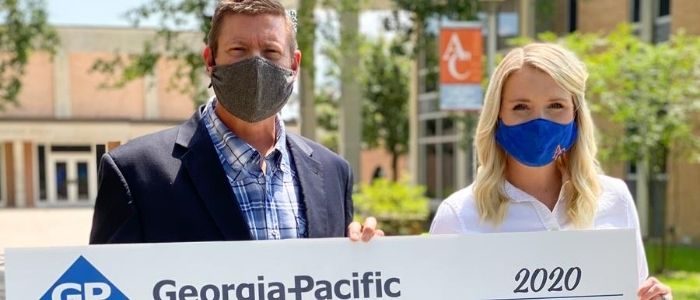
Georgia-Pacific Contributes $10,000 to Angelina College Technology and Workforce Development Programs

0

Georgia-Pacific’s partnership with Angelina College continues to assist AC in developing both talent and opportunities for future and current employees through the East Texas area.

Last week, GP’s Charitable Foundation continued its generosity by donating another $10,000 to AC’s Technology and Workforce Development Center. Those funds will provide equipment and training for maintenance technicians in AC’s Technology and Workforce Development Center.

The training and education received through AC’s programs have helped trainees advance in their current employment situations and in future career choices. Georgia Pacific officials have explained that AC has helped prepare “ready-made employees” who are fully prepared to begin working in various manufacturing positions.

The partnership also helps cultivate home-grown talent, which aids the entire community in what GP officials have called a “highly competitive work environment.”

In 2019, GP’s donation led to the purchase of such key items as electrical cabinets for motor control projects, but the pandemic and subsequent campus shutdowns delayed implementation, according to AC Technology instructor David Turbeville. This year, Turbeville said, the funds provided will allow the purchase of material handling equipment “to provide a realistic learning environment which will be tied in with the motor control and programmable logic controller systems.”

“Our students are benefiting from the use of standard industrial equipment and from having a system which can be modified and rewired as needed,” Turbeville said.

AC president Dr. Michael Simon lauded the continued support from area industries.

“I’m thankful for the ongoing support from Georgia Pacific,” Simon said. “The AC team works diligently to meet the workforce development needs of regional employees such as GP. We’re happy to be on a ‘winning team’ with GP.”

Georgia-Pacific Partners with Habitat to Build New Homes in Huntington

0
The Georgia-Pacific Foundation is donating funds that will help local families build homes through Habitat for Humanity of Angelina County. The Powell family is currently helping to construct their home in Diboll while the Anderson and Ryan families anticipate the upcoming start dates on their new homes in Huntington. Pictured (from l to r) are Jason Anderson, Jaida Anderson, Flora Powell, Francesca Anderson, Urica Powell, Kyra Anderson, Fannecia Jackson, Chloe Napier, and Charity Ryan.

Georgia-Pacific is partnering with Habitat for Humanity of Angelina County (HFHAC) to help build new homes in the City of Huntington for two local families in need. This is the first time the non-profit organization has selected new home sites in the south end of the county. “We have built many homes in Lufkin and Diboll since the organization was founded in 1995,” said Susan Robertson, Habitat Executive Director. “However, it is only fitting that we expand our operations to other areas within the county as we celebrate 25 years of service.”

Georgia-Pacific has donated funds that will help Habitat build the new home sites in Huntington. As an ongoing supporter of Habitat, Georgia-Pacific is proud to continue to play a part in securing decent, affordable home ownership for area families. “For almost 90 years, Georgia-Pacific has been an integral part of the communities we call home,” said Yana Ogletree, Georgia-Pacific Public Affairs Manager. “We realize the importance of creating value for our community and supporting organizations like Habitat that make us stronger together.”

The two families purchasing the homes have already been selected. They will contribute 300 hours of sweat equity, and will work alongside volunteers to build their homes. The new homeowners will also receive financial literacy training.

Since its inception, Habitat for Humanity of Angelina County has built homes for over 20 low income families. The organization constructs new homes for families in need and provides mortgage servicing where Habitat finances and manages each partner family’s mortgage, taxes, and home insurance. “Through the Habitat program, families receive a home that is safe and affordable, with no closing costs or down payment, low or no interest, and pay off the loan over a 20-year period through affordable monthly payments,” said Robertson.

Governor Abbott Statement On Industrial Fire In Grand Prairie

0

Governor Greg Abbott today issued a statement on the industrial fire in Grand Prairie:

“The State of Texas is monitoring the industrial fire in Grand Prairie and working closely with local officials and first responders to address safety concerns in the community,” said Governor Abbott. “The Texas Commission on Environmental Quality and Grand Prairie officials are continually checking air quality conditions and the State will provide any necessary resources to the area. I ask Texans in the Grand Prairie community to heed the guidance of local officials and pray for the safety of the first responders combating the fire.”