Home Blog Page 538

Cinema en Español

0

NACOGDOCHES, TX –

Nacogdoches Public Library will add a special movie to its Movie Night repertoire, the first in a soon-to-be Spanish-language movie series. The event will feature free popcorn, light snacks and a Selena-Look-a-Like and Dance Contest. Selena was the talented, young Tejano singer whose life was cut short. While it has been over 20 years since her death, she remains hugely popular, even among fans who had not been born when she died. The movie event will be held Saturday, June 17th at 6:30 pm. The event is open to all ages, but attendance is limited. Tickets to this free event may be obtained at the check-out desk of the public library. For more information about library programs, please call 936-559-2970.

Rep. James White Legislative Update

0

Austin, TX – The 85th Legislative Session has adjourned sine die, a Latin phrase, that means “without a day.” Myself along with my other 149 colleagues spent 140 days under the State Capitol discussing legislation that will go into effect in the coming months. I was proud to pass many pieces of conservative commonsense legislation, which will help our youth in the foster and juvenile justice systems and improve public safety and rehabilitation in our adult criminal justice system. I was also proud to co-author, joint author, and vote for bills that will boost our local prosperity, secure our Texas border, provide testing relief for our public education students, protect our 2nd Amendment
rights, uplift religious freedom and the sanctity of life, and preserve our states’ rights. Lastly, I was honored to chair the House Corrections Committee. I am proud of the work that the committee achieved in promoting public safety and look forward to our interim work over the next few months.

The House passed our most important and only bill, the State Budget (Senate Bill (SB) 1), required by the Texas Constitution. SB 1 appropriates about $107 billion in General Revenue and almost $1 billion from the state’s Economic Stabilization Fund (also known as the Rainy Day Fund). Including federal funds and other dollars, the budget totals $217 billion. This is $1 billion dollars less than the previous biennial budget.

The Legislature and Governor Greg Abbott have made it a priority during this year’s legislative session to improve Child Protective Services (CPS) and the state’s foster care system. The budget provides an additional $508 million for child protection, including $88 million in new funding for almost 600 CPS caseworkers and $85.4 million to enhance foster care provider rates. The budget also has $32.5 million in additional support for kinship care or for family members who take in abused children.

The additional CPS caseworkers are in addition to the 829 new caseworkers that state leaders authorized in late December and that legislators formally approved with the passage of House Bill (HB) 2, which is the supplemental budget for the rest of the current fiscal year ending on August 31.

I was proud to be an author, joint-author, and co-author of legislation that will make our foster care system more efficient. This session, I authored HB 928, which will assist foster care youth through the college admissions process. I also authored and passed HB 3338, that will mandate that the Department of Family and Protective Services coordinate getting foster children a proper form of identification when they age out of the system.

I joined as a co-author of HB 1549 and HB 3859 and I co-sponsored SB 11. HB 1549 proposes to improve CPS workforce development through retention and staffing strategies, increase foster care parent recruitment and placements, and better evaluate of Prevention and Early Intervention services and outcomes. HB 3859, seeks to protect the rights of conscience for child welfare service providers. SB 11 creates a community-based foster care system. With the aim of improving the lives
of our foster youth, all of these pieces of legislation have passed both chambers of the Texas Legislature. Governor Abbott has either signed them into law or they are pending his review and signature.

Another top priority for the Texas House has been mental health care. The budget provides $300 million for new construction, significant repairs and increased capacity at state mental health hospitals. It also appropriates $62.7 million to eliminate projected waiting lists for community mental health services for adults and children and $37.5 million for a new mental health jail diversion program.

The budget also appropriates $350 million to increase the contribution rate and address a projected shortfall in TRS-Care, which is the health care program for retired teachers. Without that funding, retired educators would have faced significant increases in their health care premiums and deductibles or the TRS-Care would have just cratered. In addition, the budget forces public community colleges and universities to seek savings and provide more affordable higher education
opportunities.

I am thankful for the work of Appropriations Chairman Zerwas and my colleagues on the House budget writing committee. There were many moving parts shaping the budget and I acknowledge the negotiations involved in crafting a budget. I voted for SB 1 conditionally, because House and Senate public education leaders were still discussing public school finance and funding. After finding out that they failed to reach a compromise, I submitted a House Journal statement in opposition
to SB 1. I believe this budget does not satisfy the constitutional provisions set out in Article 7, Section 1 of the Texas Constitution which states that “it shall be the duty of the Legislature of the State to establish and make suitable provision for the support and maintenance of an efficient system of public free schools.” This budget has millions of dollars for subsidies to pick winners and losers in the marketplace, but fails to provide the minimal funding commitment for our students in Southeast Texas.

Additionally, HB 2, the supplemental budget provided $15 million to the Department of State Health Services for a shortfall with State Hospitals and appropriated $4.5 million to Health and Human Services Commission to provide for Early Childhood Intervention. I appreciate the work that was put into this bill, but ultimately, I was unable to cast my vote in support of it. Throughout the past year, I have heard from parents and had constituents come to Austin to testify against the severe therapy cuts that the Legislature imposed in 2015. These cuts continue to hurt two- and three-year old children. Although child therapy involves medical procedures, the Legislature based these cuts on a highly controversial and questionable study that was not conducted by a medical institution or even medical practitioners. This supplemental failed to restore those cuts that some of the most vulnerable children in my district need desperately. In the future, these cuts will cost the state and local school district taxpayers billions of more in health care and special education costs, respectively.

Aside from the budgetary appropriations, I voted for SB 5 that strengthens our existing photo Voter ID law and attempts to protect it from a federal court challenge. The bill outlines the proper forms of ID that voters may use and requires the Secretary of State to establish a program using mobile units to provide election identification certificates to voters in order to satisfy the requirements of the voter ID law. SB 5 prohibits the Secretary of State from charging a fee for these mobile units. The voting process in Texas demands the highest level of integrity. Voter ID requirements are in place to uphold and protect the most fundamental right of Americans: to protect ballot box integrity. Texans and all Americans are accustomed to presenting valid photo identification in many places to gain access or privilege – in airports, hotels, offices, government buildings, and even courtrooms. The voting process is no less important than any of these and should have the same safeguards to
insure the fairest outcome in every election.

Additionally, I joined my House and Senate colleagues in voting for SB 12, which creates a grant program to assist law enforcement agencies with the purchase of bulletproof vests and body armor.

During the last remaining days of the session, a few great Southeast Texans visited their State Capitol. Silsbee native, Kimberly Roach, is a recent graduate of Sam Houston State University, and future graduate student at the Texas A&M Bush School of Government and Public Service. Throughout the session, she interned with the Texas Association of Counties. I thanked her for fighting for county government and wished her the best as she continues her studies in College Station.

May usually brings many UIL students to their State Capitol. We visited with band and choir students from Livingston, Silsbee, and Kountze High Schools. The Silsbee choir group sang during their visit in the House Chamber. Later, the Kountze band had the opportunity to perform their ensembles in the Capitol rotunda. It was truly a fitting end to a long session.

During the legislative interim, both my Capitol and Woodville offices are open to those who need assistance. If there is anything I can ever do for you do not hesitate to contact us at 512- 463-0490 or 409-283-3700.


FRIDAY NIGHT BLUEGRASS CONCERT KICKS OFF BLUEBERRY FESTIVAL

0

NACOGDOCHES, Texas — The Texas Blueberry Festival kicks off with the Blueberry Bluegrass Concert in the Park, from 6 to 10 p.m. June 9 at Festival Plaza in downtown Nacogdoches. Rex Perry Autoplex is sponsoring the family-friendly event that will feature four musical acts: The Purple Hulls, The Baker Family, The Blake Brothers and The Sabine River Bend Band.

The concert starts at 6 p.m. and features The Purple Hulls, identical twin sisters from Kilgore;The Baker Family, an award-winning band from Birch Tree, Missouri; The Blake Brothers, a high-energy bluegrass group from Shreveport; and The Sabine River Bend Band, a group of long-time Southeast Texas musicians who have been playing together since 2008.

THE ACTS

The Purple Hulls are identical twins Katy Lou and Penny Lea Clark. The Clark sisters were raised on a working family farm in Kilgore and they paid for college with money from the family’s purple hull harvest. After graduation, they moved to Nashville, where they began touring with various country artists and writing songs for Nashville’s largest publishing company, Sony Tree. The sisters returned home in 2012 to care for their terminally ill father and they stayed in East Texas after he passed away, helping their mother with the farm while continuing their music career. The Purple Hulls are spending the first few months of 2017 touring Europe, and will return to the United States just in time for the Blueberry Bluegrass Concert.

From south central Missouri, The Baker Family performs Bluegrass, Gospel and Classic Country at events and competitions throughout the country. They were named the 2016 Bluegrass Artist of the Year by the International Country Gospel Music Association. They won the 2015 and 2014 Oklahoma State Band championships and in 2013 placed first in the Pickin’ in the Pines Bluegrass contest in Flagstaff, Ariz. The acclaimed family band includes 17-year-old Trustin on fiddle, banjo, and vocals. He has earned several accolades, including the 2016 Arkansas State Champion title, the 2015 Tennessee State Grand Champion Fiddler, the 2015 Grand Lakes Grand Champion, the 2014 Oklahoma Junior State Fiddle Champion, the 2013 Junior National Grand Master Fiddler, the 2013 Texas Freshman State Champion, the 2011-14 Missouri Junior Champion and the 2011-12 Arkansas Junior State Fiddle Champion. Carina, 15, who plays mandolin, sings and jig dances, was a 2014 nominee for the Society for the Preservation of Bluegrass Music for America’s female vocalist of the year. Elijah, 13, plays upright bass and sings, and their mother, Carrie, plays guitar and sings.

The Blake Brothers, formed in 2000 by Tim and Bruce Blake, feature Britt Green on mandolin and Nancy Blake on bass. The North Louisiana band performed at the inaugural BlueberryBluegrass Concert and has performed extensively across East Texas over the years.

The Sabine River Bend Band was formed by in 2008 by Earl Cochran Jr., who plays guitar and sings lead and harmony vocals. Reuben Maddox plays the mandolin, Trey Cochran plays the banjo and Brad Hight plays the upright and electric bass.

FOOD, PARKING AND MORE

The concert will also feature food vendors, including Red Tulip Rolling Bistro, Old Souls and Eat A Bite Food Trucks, B’s Family BBQ, Merci’s World Cuisine, Texas Custom Catering, The Fresh Lemonade Store and Snowball Express! Organizers encourage attendees to bring blankets and lawn chairs. The event is family-friendly, so no coolers or alcohol will be allowed.

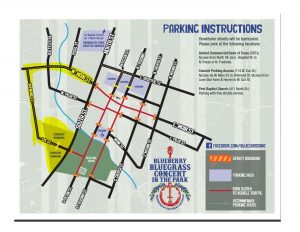
Parking will be available downtown.  However, some downtown streets will be closed due to the Blueberry Festival, so concert-goers are urged to visit www.Facebook.com/bluegrassnacorwww.tbf.nacogdoches.org/page.php?id=60 for parking instructions.  Parking with free shuttle service to the concert venue will be available at First Baptist Church, 411 North St.
Parking closest to Festival Park will be at the Nacogdoches City Garage location at 114 W. Cox St.  From West Main Street (Douglass Highway), turn south on Bremond Street across from Lone Star Farm & Home.  Then turn left on W. Cox Street, and look for volunteers to assist with parking.

Organizers are grateful for the enthusiastic partners that make the concert possible, especially Rex Perry Autoplex and the City of Nacogdoches, First Baptist Church, Nacogdoches Main Street and the Nacogdoches County Chamber of Commerce.

The Texas Blueberry Festival presented by Tipton Ford continues Saturday with a full day of activities in downtown Nacogdoches, including a Blueberry pancake breakfast, competitions, shopping and more live entertainment. For more information, visit tbf.nacogdoches.org/ or call936-560-5533.

Butt pick-up at Kit McConnico

0
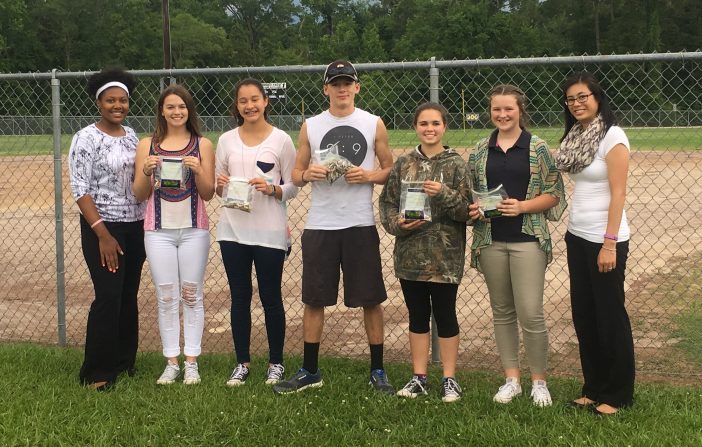
Around 500 cigarette butts were picked up in an hour at Lufkin’s Kit McConnico Park as students participated in the observance of World No Tobacco Day recently.
The Coalition, Inc., partnering with Angelina Beautiful/Clean sponsored the event to inform the public about the dangers of using tobacco and to encourage people to reduce or completely stop the use of tobacco products.
“Even with city ordinances geared toward preventing littering and smoking, the harsh reality is that smokers do not see tossing a cigarette butt to the ground as littering,” said Angelina Beautiful/Clean Executive Director, Jennifer La Corte. “As members of the community, each of us has the power to help keep our public spaces litter-free and tobacco-free. Together, we can make Angelina County a cleaner place to live, work and play.”
The students who participated in the cleanup are members of SAY WHAT! (Students, Adults, and Youth Working Hard Against Tobacco) sponsored by Tobacco Prevention and Control Coalition whose mission is preventing tobacco use among young people. Statistics show that each day in the U.S., more than 3,200 kids under the age of 18 smoke their first cigarette.
Students showing off the bags of cigarette butts they collected in an hour at Kit McConnico Park are, from left, Maci Hopkins, Kayla Warner, Jazmine Jamison, Garrett Greene, Madalyn Howard, Faith Thompson, and Jennifer La Corte.
For more information, contact Kayla Garris at 936-634-9308 or kgarris@angelinacoalition.org

Becoming a U.S. Citizen Class at the Public Library

0

(Nacogdoches, TX) –

The Nacogdoches Public Library is hosting a program called “Become a U.S. Citizen.” Rosa Ramirez from U.S. Immigration & Customs Enforcement will provide information about becoming a U.S. citizen. Ramirez will explain the forms, fees, the citizenship exam and interview process. Information and handouts will be provided to participants in English and Spanish. The event is scheduled for June 13th at 6:00 pm. The program is free and no registration is required. For more information about this or other library programs, please call 559-2970.

Texas A&M research suggests strokes may cause increased preference for alcohol

0
(BRYAN, Texas) —
Brain changes after stroke may lead to increase in alcohol-seeking behavior, at least in animal models, according to research published Wednesday in the journal Scientific Reports. Although it is known that excessive alcohol intake (more than two drinks per day) is a risk factor for stroke, there hasn’t been much scientific study about how alcohol-related behavior might change after a stroke has occurred. When researchers at the Texas A&M College of Medicine looked into the issue, they found that strokes in a certain part of the brain increase alcohol-seeking behavior and preference for alcohol.
“It’s important because although stroke is a severe disease, more and more people are surviving and recovering after their first stroke,” said Jun Wang, MD, PhD, assistant professor in the Department of Neuroscience and Experimental Therapeutics at the College of Medicine and co-principal investigator of this project. “Therefore, it is important to study behavior change after stroke, and how that behavior can affect the chances of having another one, which is often fatal.” People who have had one stroke are often advised to limit their consumption of alcohol to help prevent a recurrence, but that may be difficult if damage caused by the stroke itself is encouraging them to actually drink more. That might help explain anecdotal reports that compliance with the instruction not to drink after a stroke is low.
“In an ischemic stroke, a blood vessel to the brain is blocked, which deprives the neurons in the brain of glucose and oxygen,” said Farida Sohrabji, PhD, presidential impact fellow and professor in the Department of Neuroscience and Experimental Therapeutics at the College of Medicine and co-principal investigator of this project, who studies acute and long-term consequences of strokes, as well as novel stroke therapies. “Neurons are very dependent on these two nutrients, and without them, neurons very rapidly begin to die.”
After an ischemic stroke in the middle cerebral artery—one of the most common types of stroke in humans—the animal models showed much lower overall fluid intake but increased preference for alcohol over water when they did drink. These effects were significant even though the stroke only affected one side of the brain, leaving the other half of the brain without damage. “Their preference for alcohol can be seen five days after stroke and through at least the first month after the stroke,” Wang said. “Specifically, when given a choice between water and alcohol, they chose alcohol a higher percentage of the time than they did before the stroke.”
What the researchers think is happening is that the stroke kills neurons in a part of the brain called the dorsal lateral striatum, and they stop inhibiting certain neurons in the midbrain. These midbrain neurons, which are now far more excitable, send a signal to a particular type of dopamine receptor, called D1. These D1 receptor-containing cells, located in the dorsomedial striatum, were shown in Wang’s previous work to compel the individual to perform an action—like having an alcoholic beverage. “This circuit is interesting because it means that when the dorsal lateral striatum neurons die, the result is increased excitement of the D1 neurons in the dorsomedial striatum,” Wang said. “It is this increased excitement that we think is causing alcohol-seeking behavior.”
However, when the D1 receptor was inhibited, alcohol-seeking behavior in individuals with stroke damage decreased significantly while the control group didn’t exhibit much of a change. “This is a hint at how the brain works,” Wang said, “and although we’re a long way off, something to inhibit this D1 receptor might be a possible therapeutic target for a drug to help people resist the urge to drink after a stroke.”
“As much as possible, we tried to use a model that would replicate the experience of a human patient,” Sohrabji said. “Therefore, we think that these findings, although preliminary, might eventually help people who have experienced any type of brain injury, whether a stroke or an accident that causes traumatic brain injury.”
This study was a collaboration between the laboratories of Wang, who studies alcohol use disorders, and Sohrabji, who studies ischemic stroke, and funded by a seed grant from the Texas A&M University Health Science Center Division of Research. Other funding for the research was provided by grants from the National Institute on Alcohol Abuse and Alcoholism (NIAAA) and the National Institute of Neurological Disorders and Stroke (NINDS).

Sen. Nichols ‘My 5 Cents’

0
This weekend, our country will observe Memorial Day and remember the sacrifices of the military men and women who gave their lives serving our nation. I hope we all take time to give thanks for those who sacrificed everything for our nation so we might live free.
Here are five things happening at your Capitol this week:
1. Session almost over
Wednesday of this week marked the last day the Senate was able to vote on House bills, and the last day the House was able to vote on Senate bills. Both chambers worked late into the night, attempting to get through as many as possible. Thursday began the few day period at the very end of session in which 10-person conference committees are formed between members of the House and Senate and they attempt to work out slight differences between bills which have passed both sides of the legislature. The next time you hear from me the 85th Legislative Session will have adjourned for Sine Die, meaning we have adjourned without setting a date for the next time we will meet, on May 29th.
2. Payments for Relative Caregivers
The Texas Senate has approved House Bill 4 which would increase the payments for relatives who are caregivers to abused children. This is being done in recognition that children often thrive more in the care of family members than in foster care. However, many times these relatives may not be able to afford to take the children in, such as grandparents who are on a fixed income. To qualify they would have to make less than three times the federal poverty level. For a family of four this is no more than $73,800. Currently kinship foster parents only receive a one-time $1,000 and $500 per year. Under House Bill 4, they could receive up to $4,200 a year. I believe this is a great step toward ensuring these children have a home.
3. Hogs, Coyotes and Hot Air Balloons
In recent years, Texas has been plagued with an increase of feral hogs and coyotes in the state. There have been many proposals as to how to deal with this problem as they cause millions of dollars of damages every year. One of these proposed solutions would take hunters into the air. House Bill 3535 has been passed by the Senate and House chambers and would allow qualified
landowners to hunt feral hogs and coyotes from a hot air balloon with a permit. If signed into law, Texans could start hunting from hot air balloons as soon as September 1, 2017.
4. Protecting Pastors
Governor Abbott has signed Senate Bill 24, of which I am a co-author, into law. This bill makes it impossible for a government entity to force religious leaders to hand over their sermons. A governmental entity includes the state and any of its agencies, as well as any political subdivision of the state such as a city, county or school district. A religious leader will be protected in that they will not be able to be compelled to disclose a written, audio or video version of a sermon delivered during religious worship of a religious organization, and they may also not be compelled to testify regarding the sermon.
My grandfather was Methodist minister who traveled and visited different communities in East Texas for fifty years. I learned from him the important role ministers play in our lives and because of this I believe it is important to ensure we are protecting the religious freedoms of the citizens of Texas.
5. Texting and Driving
A bill to ban texting and driving statewide has finally passed the Legislature. House Bill 62 would create a ban on reading, writing or sending electronic messages from a phone in a moving vehicle. Texting would still be allowed in an emergency, and drivers can use their phone to access their GPS and music apps.
This bill does not supersede stricter local ordinances. Practices that are against both local and state law, such as typing a text, would be subject to only a state citation. A police officer would have to witness a violation or other evidence, such as the person admitting to texting or weaving in traffic, for a citation to be issued. For a first offense it would carry a fine of up to $99, and $100 to $200 for a second offense. If texting leads to an accident causing death or serious injury, it would be a Class A misdemeanor.

Angelina College Launches Virtual Advising

0
LUFKIN, TEXAS, June 1, 2017 – Angelina College will offer virtual advising during June and July. This new tool lets students meet with their advisors using Collaborate software on their smart phone, tablet or desktop computer.
“We realize that many of our students live in areas outside of Angelina County. We want to provide an easy way for them to have access to their advisors without having to travel long distances. This new tool makes meeting with an advisor much more convenient,” said Sellestine Hunt, associate dean of Student Services.
Virtual advising makes schedule planning fast and easy. The process is simple. Students make an advising appointment with Student Services and an email will be sent to them, providing an access link to a virtual room where they meet with their advisor.
To set an appointment, call 936-633-5212 or email cva@angelina.edu.

Nichols named President Pro Tempore, after a successful 85th Legislative Session

0

AUSTIN, TX – On Monday, the 85th Legislative Session came to a close, marking another successful session for the people of Texas. Senator Robert Nichols (R-Jacksonville), was also elected President Pro Tempore, by a unanimous vote from the members of the Texas Senate.

“Working together, I believe this Legislature has passed integral legislation to benefit the entire State of Texas,” said Senator Robert Nichols. “Serving the people of Senate District 3 has been one of the greatest honors of my life, and I look forward to continuing to work for them.”

As a member of the Senate Finance Committee, Nichols played an important role in determining the state’s $217 billion budget for the next biennium. This includes $300 million from the Economic Stabilization Fund to begin much needed repairs of our state hospital system and $63 million in additional funding for the states mental health services. The budget also includes $800 million to secure the border and hire new troopers, and an additional $2.65 billion to cover enrollment growth in the state’s education system.

Nichols served for the third session as Chairman for the Senate Transportation Committee. “I want to thank Lt. Gov. Dan Patrick for his leadership and for entrusting me with this Chairmanship,” said Nichols. “We passed important legislation to allow Texas to maintain its competitive edge when it comes to exporting products and directed $5 billion in sales tax revenue to address transportation issues across the state.”

On Sine Die, Senator Nichols was named President Pro Tempore. If the Governor and Lt. Governor are out of the State at the same time, Nichols will be the acting Governor in their absence. This is based on seniority and made by a vote of the Senate members.

“I am honored to be named President Pro Tempore. I look forward to serving in this position throughout the interim, and am grateful for the trust of my colleagues in the Senate,” said Nichols.

Other legislative highlights include:

· Senate Bill 16 which lowered the License to Carry Fee application and renewal fees in Texas. Making it one of the lowest fees in the Nation.

· Senate Bill 24 which provider protections for Pastors by prohibiting the subpoena of their sermons by state officials

· Senate Bill 12 to allocate $25 million for protective vests for law enforcement

· HB 62 – bans texting while driving across the state

· Senate Bill 7 which creates a criminal offense and cracks down on improper teacher-student relationships

· Senate Bill 4 which bans ‘Sanctuary Cities’ in the State

· Increased the funding for Child Protective Services by over $500 million

CHI St. Luke’s Health-Memorial Lufkin Delivers Nationally Recognized Stroke Care

0
LUFKIN, TEXAS –
A Groveton man is walking and talking again after a stroke left him temporarily paralyzed and speechless. Kenneth Pangburn was admitted to CHI St. Luke’s Health-Memorial over the Easter weekend, suffering from atrial fibrillation. That Monday, during a scheduled heart catheterization procedure, Pangburn suffered a stroke.
“We were told by the cardiologist that a stroke could be an unfortunate risk during a heart cath,” his wife, Brenda Pangburn said. “We never thought it would happen to us, but we were very pleased with the way the nurses and doctors took quick action to reverse the stroke.”
The designated stroke team at CHI St. Luke’s Health worked collaboratively with the cardiac team to identify the issue and administer tissue plasminogen activator (tPA), the only FDA-approved acute treatment for ischemic strokes. When given promptly, this medication can save lives and reduce the long-term effects of stroke.
Which is exactly what happened for Pangburn.
“If you saw him that first day and then see him now, you would not believe it’s the same person,” Brenda said. “It’s amazing the change we see in him every day. We have friends that say, ‘It’s unbelievable the difference.’ He’s really come a long way.”
Pangburn spent a week in the hospital’s inpatient rehabilitation program receiving Speech, Occupational and Physical Therapy. He now receives Speech and Occupational Therapy at the Memorial Outpatient Therapy Center two times a week as he works on his vocabulary and “finding his words,” his wife said.
Stroke is the fifth leading cause of death in the United States after heart disease and cancer and is the leading cause of disability in the U.S. Each May, the nation recognizes Stroke Awareness Month. However, the physicians and staff at CHI St. Luke’s Health-Memorial recognize the need for quality stroke care all year long. In East Texas, the prevalence, incidence, and mortality rates from stroke are up to four times higher than the national average. CHI St. Luke’s Health-Memorial’s highly trained and experienced stroke-care team, which includes on-staff neurologists and neurosurgeons, offers excellence in stroke care and hope to the people of our community.
CHI St. Luke’s Health-Memorial Lufkin delivers nationally recognized stroke and neurological care. Pictured from left to right: Stig Peitersen, M.D., Neurosurgeon; Dr. Cherry Mathew, Neurology; Sunil Cherry, M.D., Neurology; and Dr. Munawwer Khurshid, Neurology. Not pictured: Marco Benitez, Neurology.
CHI St. Luke’s Health-Memorial is home to the first and only Joint Commission Certified Stroke Care Center in East Texas and a Primary Level II Stroke Facility in trauma service. Undergoing a rigorous onsite review, the healthcare facility’s compliance with stroke-related standards and requirements was evaluated by Joint Commission experts who determined the hospital’s achievement of the strict criteria maintained by national organizations.
“We pride ourselves on delivering quality care specific to patients with cerebrovascular events,” said Sunil Cherry, M.D., Medical Director for the CHI Stroke Program. “Our dedicated stroke-care team takes this disease seriously and works diligently to provide the services our community deserves. We are committed to attaining high standards of care, and independent quality evaluations demonstrate how we are achieving that goal.”
Since the inception of the stroke program in 2010, CHI-Memorial has earned nearly every honor and award possible at the state and national level.
Along with the stroke certification, Memorial earned the Joint Commission’s Gold Seal of Approval and the American Heart Association/American Stroke Association’s Heart-Check Mark for Advanced Certification for Primary Stroke Centers. This year, Memorial was named among the top 10 percent of hospitals in the nation for medical excellence in neurological care and stroke care by CareChex, an information service of Quantros, Inc. CareChex provides clinical, financial, and patient satisfaction findings to consumers, providers, and purchasers of U.S. medical care. Unlike other publicly available quality ratings, CareChex provides a composite evaluation of all components of medical quality including process of care, outcomes of care, and patient experiences. For access
to provider quality ratings, visit www.CareChex.com
CHI St. Luke’s Health also received the 2017 Women’s Choice Award as one of America’s Best Stroke Centers. Because women account for 90% of all family healthcare decisions, there is no stronger consumer segment than women. The Women’s Choice Award names the best healthcare providers that women can trust based on what matters most to them.
To earn the prestigious title as one of America’s Best Stroke Centers, Memorial had to meet strict disease-specific requirements, clinically specific requirements, and high expectations, such as a standardized method of delivering care, tailored treatment and intervention to individual needs, patient recommendation scores above the national average, and rank in the top 80 percent of hospitals across the nation on time from the emergency department arrival to head CT scan results and the time from first symptoms
to receiving thrombolytic therapy.
In order to provide the best care, CHI St. Luke’s Health has CT technology designated specifically for stroke patients, 24-hour Radiologist service, a dedicated Stroke unit on campus, full rehabilitation services, including physical, speech and occupational therapy, and neurosurgical physicians and neurologists on staff.
“Providing excellent care is only possible with our outstanding physicians and staff. We are extremely grateful for their ability to care for patients in such an exceptional manner,” Dr. Cherry said.