Just before Thanksgiving, most gardeners I’ve visited with had their first frost. Historically, our first frost in Angelina County is the middle of November. And we seemed to be right on target with that date.
The first frost brings about an end to the growing season of warm season vegetables and many areas of your landscape. My Bermuda grass, in the pasture and the lawn, is now brown and is done with growing until the late spring when nighttime low temperatures stay in mid-60’s.
Don’t even think of adding a “winter-izer fertilizer” now. Giving nutrients to a warm season lawn in December is akin to serving supper to someone in bed, asleep, at 1 am. It’s not gonna be appreciated!
My cannas are done for the year. Break out the loppers and cut them back and add them to the compost pile. If you had any warm season vegetables still out and bit back, remove them and add to the compost pile.
Yes, some garden plants (think kale, greens and cabbage) are still doing well and can continue to produce without a hard freeze. What can you do to protect your cool season plants that are still thriving?
Irrigate before a freeze. A moist soil can hold four times more heat than a dry soil. It will also conduct heat to the soil surface faster than a dry soil, aiding in frost prevention. In a study performed years ago, the air temperature above a wet soil was 5 degrees F higher than that above a dry soil and the difference was maintained until 6 a.m. the next morning.
Covering plants can with a sheet can give you 2 to 5 degrees F protection. The covers can be laid right over the crop or can be supported on stakes. The difference lies with whether the cover touches the plant. Any material can be used to cover plants; however, woven fabrics are better insulation than plastics or paper.
Finally, if you have a hankering to plant something now, plant onions! Truly a cool season crop that may need to be protected from hard freezes, onions are a cold season crop that do better in cool weather than our late spring when we get too warm.
Editor’s Note: Marijuana has become a hot topic among East Texans as multiple states across the nation voted on legalizing the drug for recreational and medical purposes on election day, which was just weeks ago. The issue soon become a topic of discussion in the newsroom as we each gave our two cents on the matter. So, we decided to take the debate to the streets of East Texas. Over the next few weeks we will be talking with those who are in support of legalizing marijuana and those who want to keep it illegal. As Texans, it is not something that was on our ballot this year, but without a doubt it will be in the future. It is now the time to become educated on the issues and decide what your stance will be. Please email us to voice your opinion on the matter at info@texasforestcountryliving.com.
For almost 20 years, Author Kevin Sabet has studied, researched, written, and implemented drug policy. He has served on three presidential administrations, including Clinton, Bush, and most recently Obama, serving more than two years as the senior advisor to President Obama’s drug control director.
In 2013, he launched Smart Approaches to Marijuana, an “an alliance of organizations and individuals dedicated to a health-first approach to marijuana policy.”
We chatted with Kevin to learn more about his opinion on legalizing marijuana and to learn more about SAM.
Keep reading for the experiences Kevin had to come to his conclusions on the debate of marijuana and how you can get involved.
TFCL: What is your opinion on legalizing marijuana? Kevin: The existing dialogue surrounding marijuana legalization centers on an impossible choice: commercialization or criminalization. That’s just not good enough. Data from states like Colorado, which already legalized recreational marijuana, points to numerous public health damages that can be directly attributed to the drug. And criminalization puts nonviolent, often young people in prison. Even when they get out, they have a criminal record, making it difficult for them to get legitimate jobs and forcing them deeper into illegal activities. Instead, I advocate for a third way. I believe that all marijuana policy should start and end with scientific data about the drug’s impact on the human body and mind. I’m a strong supporter of the continued, responsible research surrounding marijuana, and so far, that research has not proven that marijuana’s widespread, total legalization will not have serious, long term negative repercussions, especially when regulations on the commercial marijuana industry, which is undeniably driven by profit instead of health, is given so much leeway regarding retail store location and advertising.
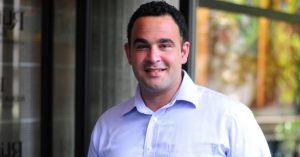
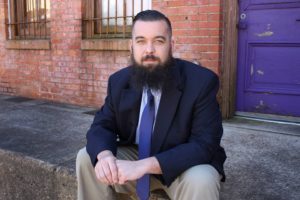
A photo of Kevin Sabet.
TFCL: Tell me about Smart Approaches to Marijuana (SAM). Kevin: Smart Approaches to Marijuana was created to advocate for and facilitate that third way. We want to educate people on all of the data surrounding marijuana, not just what corporate interests want people to hear. In our current social and political landscape, it’s more important than ever for the American public to make educated decisions about marijuana policy, so that we do not set ourselves on a destructive path that could have been avoided if we had thought more carefully and knowledgeably about marijuana regulation.
TFCL: How did you get involved? Kevin: I got involved as a young junior high school student. I was appalled at how my community was in denial about drug abuse, and I latched onto a local community group that was pushing back against that norm. My experience then took me to the White House as a senior drug policy advisor. During my tenure, marijuana stood out because, although many are quick to advocate for total legalization, very little is actually known about its effects. More specifically, many people still treat marijuana like it’s the same all-natural, Woodstock weed of the baby boomer generation. In reality, it’s become entirely manufactured, and significantly more harmful. Whereas the weed of the past had less than 3 percent THC, today it’s available with up to 30 percent. At that level of potency, it can actually become very addictive, and that’s the type of product that these profit-driven industries would be allowed to market in the form of kid-friendly edibles like candies and sodas. While I’ll never demonize marijuana or its users, I also feel an enormous responsibility to take action when I see a situation, like this, that could quickly turn very, very bad.
TFCL: In your opinion why do people want to legalize marijuana? Kevin: It comes back to that misconception about what is actually being legalized, and the answer isn’t just the stereotypical, all natural, smokeable weed of the past. In my experience, people just don’t realize that they’re also legalizing edibles and high potency THC extract in the form of hash oil, all of which could be widely advertised across all media, including television, and sold in their neighborhoods, where their families and children would have easy access. But this is not the public’s fault; this is a direct result of an incredibly well-funded industry that seeks to profit off drug use. They’ve intentionally perpetuated the misconceptions surrounding the harms of today’s marijuana, despite all the evidence to the contrary.
Author Kevin Sabet is against legalizing recreational marijuana use.
TFCL: What is the reality of legalizing the drug? Kevin: Legalizing recreational marijuana has unintended consequences in both the long and short term. In Colorado, the rate of marijuana-related traffic fatalities has skyrocketed, as have marijuana-related emergency department visits. The most recent data shows that out of all traffic fatalities, one in five drivers are now testing positive for marijuana. Furthermore, current scientific studies have proven that today’s marijuana is directly linked to an increased likelihood of developing mental health conditions like anxiety, depression and even schizophrenia. But most concerning of all, marijuana specifically targets adolescent brains. After legalization, Colorado jumped to number one in the nation for underage use, and its college-age marijuana use also increased, while decreasing on a national level at the same time. A lack of regulation in areas where recreational marijuana is legal makes it just as easy, if not easier, for underage kids to get marijuana as it would be for them to get a six pack of beer, and now we know that that specific demographic is the one most vulnerable to negative health effects as a result of using the drug.
TFCL: How do you think it will affect children and teenagers? Kevin: As mentioned above, marijuana has the most significant negative effects on developing brains, according to scientific and medical research. But more specifically, numerous studies have shown that regular marijuana use can continue to negatively impact people even after they quit, especially if used regularly during adolescence. Much like a cigarette smoker will always have a higher likelihood of developing lung disease, past marijuana users have a higher risk of developing mental health conditions later on in life.
TFCL: What is your opinion on legalizing medical marijuana? Kevin: So far, there isn’t enough scientific data to justify support of medical marijuana, but I’m a strong advocate for medical marijuana research. There are currently medical drugs that have been derived from marijuana, and while they’re not a perfect solution, they’re a step in the right direction for the responsible use of marijuana for the benefit of the public health. Just like we do for all of our medicine, we need to put marijuana and its derivatives through FDA testing before we distribute them. If marijuana or any marijuana derivative clears those tests, thereby proving that it truly does help people, then I’m all for it. But recreational marijuana is an entirely different thing from medical marijuana. All of the ballot initiatives I’ve seen have been handcrafted for the commercial marijuana industry, not the public health.
TFCL: What do readers need to know? Kevin: The marijuana industry is not on your side. They have proven, at every opportunity, that they are willing to trade public health for personal profit. Voters need to educate themselves on the ballot initiatives in their state, and not take for granted that the industry will forego profit by self-regulating where they are not forced to do so.
TFCL: How can people get involved in advocacy against legalizing marijuana? Kevin: This is a game of awareness and advocacy. First, educate yourself on the reality of recreational marijuana legalization: What it would look like in your state, and what regulations, if any, are included in the initiatives. Educate your families and your communities, so that people understand what is at stake. And then, work with policymakers to ensure that the people’s voice is heard. Protect your children by rejecting unsatisfactory initiatives, and by demanding adequate regulations where necessary.
To learn more about Kevin, visit his website at kevinsabet.com. To learn more about SAM, visit learnaboutsam.org.
“And if you give yourself to the hungry; and satisfy the desire of the afflicted, then your light will rise in darkness and your gloom will become like midday.” Isaiah 57:10
Imagine leaving everything behind, moving to a new country, and learning a foreign language.
That is exactly what married duo Miranda and Chris Rudd are doing.
Originally from Lufkin, the couple is currently preparing to move to Bolivia to work with the international organization Word Made Flesh Bolivia, a program “which seeks to find abundant life for those affected by prostitution,” Miranda said.
The first mission trip
Chris Rudd, left, and his wife Miranda stand in from of the capitol building in La Paz, Bolivia.
It all started in the summer of 2014 when speakers came to the Rudd’s church at Harmony Hill Baptist Church and spoke about their newest commitment to La Paz, Bolivia. That day, church administrators signed a covenant with the speakers that they would send teams at least once a year for missionary work in Bolivia.
It was during that service that Chris said “I’ve never heard God more clearly” to serve a mission in the South America country.
“After the service I told her (Miranda), I think we’re moving to Bolivia,” he said. “We laughed it off and just thought we were excited about this first mission trip.”
It wasn’t until a year later in the fall of 2015 the duo was able to finally serve a week long mission trip in La Paz with others from their church. The group joined other missionaries and assisted in putting together a “Spiritual Emphasis Week,” an annual event at Highlands International School, much like Vacation Bible School, Miranda said.
During the week, Chris assisted in leading praise every morning for the older children and led a group of teenage boys in discussions, while Miranda helped lead the younger children during various activities.
“The whole week we were there, it felt so comfortable to be there. Obviously, you could see the differences between Bolivia and America, but it was really comfortable,” Miranda said. “At the end of the night…you would literally walk through a flat city, you’re in poverty in a way we don’t really experience here in America, but at the same time you’re looking out at the city that is home to three plus million people and beyond that you’re looking at mountains. There is something that is so beautiful and comforting about it. …I just feel that it resonated with the both of us; it just feels like home now.”
Working with Word Made Flesh Bolivia
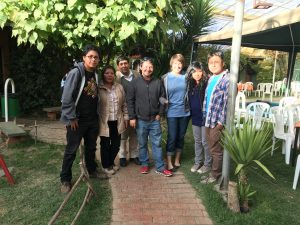
A photo of Chris Rudd, center, and his wife Miranda, right of him, and their host family in Bolivia.
During that first mission trip, near the end of the week, the church group visited the office of Word Made Flesh Bolivia, and they also participated in a walk through the Red Light District. They walked through brothels and saw areas where underage girls were taken. Businesses advertised with signs that said “free Wi-Fi, cable, or clean bathrooms,” but in reality they were selling sex,” Miranda said.
The couple realized more than ever the work that needed to happen in Bolivia and they wanted to be a part of it.
“The majority of the women have seen and lived through stuff most of us thankfully never will have to, and I think to truly recover from the trauma they have all experienced and to accept and love their selves, they need the healing and restoration only Christ can bring to you,” Miranda said. “I feel only Christ can restore them to the beautiful women he created them to be and restore that sense of hope in them and to help them love their selves more.”
The married couple stayed in separate living quarters during their first trip. Miranda stayed in the home of the director of Word Made Flesh, who later invited Miranda and Chris to “come work with us.”
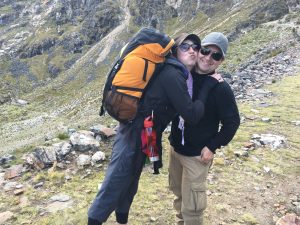
Miranda, Rudd, left, and her husband Chris take a photo before they begin a three day hike of the Takesi Trail and Inca Trail.
So, the couple applied for internships with the international organization and returned to Bolivia in February 2016. For 109 days, until June, the couple worked and lived there.
During that time, Chris said it only confirmed “more that Bolivia is the place for us.”
“Our first two weeks of our internship were our last two weeks of a course online – the perspective missionary course. During that time we had to write our final project, which was like a 10-page essay, and in doing that I looked up the statistics, and the tragedies these women are going through,” Chris said. “Nine out of 10 of these women have been abused physically, emotionally, or sexually at some point in their lives. Rape and abuse are common in the field. I think the statistic is, a man is more likely to slip, fall, and die in the shower than he is to be convicted and punished for committing a crime against these women. There is no system in place to protect them.
“And it hit me, when I was talking to our director and getting these specifics – it’s not about statistics, it’s about faces. These are their friends who are coming into the ministry; they’re seeing them almost on a daily basis, they know these women,” he continued. ”And I had to stop, close my computer, and just step away from it. I think I wrote a journal entry to process through it. That’s really when it clicked that I needed to be here and do something to help, to try at least.”
The couple then knew they needed to make a commitment to serve in Bolivia, and not only serve but live there.
Letting go
A photo of La Paz, Bolivia from a terrace.
“It’s weird to say home now, does that mean Texas or does that mean Bolivia,” Miranda said. “It’s an odd feeling.”
Leaving jobs and families behind in Texas, the couple has decided to make a three-year commitment with Word Made Flesh as missionaries. They will not get paid for their service, so they are currently working on earning enough money to fund their mission trip. Once they have enough saved for one year, they will be able to schedule their departure date for their move.
“It’s been a huge exercise in patience; it’s been a really good teaching time that it’s not in our timing. It’s in God’s timing,” Chris said. “It’s not easy to let go of control of that; no matter how much I know that this is what I’m supposed to do. It doesn’t make it any easier. We’re learning to let go.”
Even though it will be difficult to leave family and friends, including not being there for birthdays and graduations, the duo knows Bolivia is where they need to be.
“God has done everything for me. Why would I not want to want to do the littlest things for him?” Miranda said. “He could send us to some crazy place where we wouldn’t be happy, even with that, he is sending us to Bolivia where we have gone and experienced the community there and how beautiful it is there and how wonderful the country is. Even in his calling for us to walk with him and to work with him, he is still fulfilling our desires. He’s still giving us this beautiful place we love and people we love. That kind of faithfulness he displays in us and his desires to just love us, it’s hard to not be obedient to that and honor that.”
To learn more about the Rudds or to partner with them as they serve in Bolivia, visit discoveringpurpose.net.
My family loves to put our own twist on our annual Christmas cards and have it reflect our family and how our year has been.
For our family photo this year, we dressed as different things and characters that represent Christmas, such as: a snowman, Rudolf, an elf, and Mr. and Mrs. Clause.
Last year, we based our card off of one of our favorite Christmas movies. This year, we dressed as different things and characters that represent Christmas, such as: a snowman, Rudolf, an elf, and Mr. and Mrs. Clause.
An original idea to represent our town would be to do a picture in front of Rudolf the Red Nose Pumping Unit. You could include a quote from a family favorite Christmas movie.
A different pose we tried during our family Christmas photoshoot.
If you prefer a simple and more classic Christmas card that represents your year, you could do a collage of pictures from your most memorable moments of the year.
Christmas cards should be festive and joyful, so have fun with them. Check back next Friday for more tips for this Christmas season!
Thanksgiving is over and the holiday shopping season is in full swing.
Buying all those gifts for everyone on your list can get expensive and overwhelming. How much do you spend? Do you have to buy for absolutely everyone? Is it alright to re-gift? What if you don’t know what to get them?
Sharon Schweitzer, an international etiquette expert, author, and founder of Protocol & Etiquette Worldwide, offers the 10 rules of holiday gift giving etiquette:
Avoid Asking “What do you want?”
If you don’t know what to get, try and figure it out. Consider their hobbies or what’s important in their lives. If they exercise every day, workout gear is probably a good choice. If they just moved into a new home, go for a housewarming gift. Remember, it’s about being thoughtful.
Re-gift Immediately and Don’t Get Caught!
According to an American Express 2015 survey, 76 percent of U.S. Americans believe re-gifting is socially appropriate. If planning to do so, be sure to re-gift in different social and family circles. Also, remove all traces of the original giving, including handwritten notes and cards.
You Don’t Have to Buy for Everyone!
Annually review your gift list. How has your relationship grown and evolved? Have you kept in touch via phone, email, or seen each other in person? Did you buy him or her a birthday gift? If the answers to these are no, evaluate the need for a gift. You want to avoid having a friend feel truly forgotten, and sending a timely personalized holiday card will prevent hurt feelings.
Follow Gift-Giving Policies
Research the policies of the college, school, office and organization. Be cautious about giving your professor or boss a gift — even if your university or office doesn’t specifically forbid the practice because it could send the wrong message. Consider gift pools for charity.
Always Include Gift Receipts
Whether it is the holidays, or all year-long, including the gift receipt with every gift is an etiquette best-practice. If the recipient needs to exchange it because it’s the wrong size, color, or texture, why make it difficult? Avoid the awkwardness of them coming to you and asking for the receipt.
Don’t Break The Bank
It should be common sense by now, yet many people overspend and wrack up debt. Stay within your household budget. Gift giving is a blessing, not an obligation. Avoid overspending. January bills are unforgiving!
Avoid Matched Spending
When buying is driven more by pressure than thoughtfulness, it loses its meaning. When folks buy flamboyantly, hopefully they do so because they wish to, not because they expect anything in return. Most flamboyant gift buyers have everything they could wish for, so there’s nothing luxurious that you can buy them that they can’t buy for themselves. It’s better to plan a thoughtful, sentimental gift without a hefty price tag.
Do Consider Couple Gifts
Once a family member or friend is in a serious relationship, gift giving may segue from individual gifts to couple gifts. For example, buy them a gift certificate to their favorite restaurant, and including a thoughtful note that shows your gracious holiday spirit. If they are engaged or newlyweds, check their registry for a treasure trove of ideas.
Be Genuine In Your Response to Surprise Gifts
If you receive an unexpected gift, be authentic in your response. Share that you are “surprised, and maybe slightly embarrassed that you don’t have a gift ready for them.” It’s awkward to race to the gift closet and spring a last-minute gift on them. You may wish to send a thank you note with a small gift wishing them all the best in the coming year.
This year 600,000 people will die from a heart attack, making it the leading cause of death in the United States. CHI St. Luke’s Health-Memorial aims to lower that number by providing the very best in cardiac care. The Lufkin hospital recently earned the Society of Cardiovascular Patient Care’s highest accreditation – Chest Pain Center with Primary PCI (Percutaneous Coronary Intervention) with Resuscitation – as a result of effectively diagnosing, treating and caring for those experiencing chest pain.
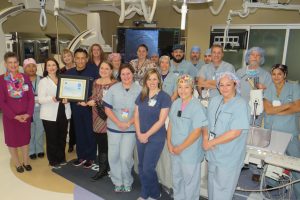
It takes a large team of dedicated professionals to earn the Chest Pain Center with Primary PCI (Percutaneous Coronary Intervention) with Resuscitation designation as a result of effectively diagnosing, treating and caring for those experiencing chest pains. Front row: Peggy Mortenson, Chief Operating Officer/System Vice President Clinical Operations; Sabrina Lillard, CV Coordinator; Dr. Musa Khan, Medical Director of CHI St. Luke’s Health-Memorial Lufkin’s Chest Pain Center; Stacy Garcia, CV Service Line Administrator; Melissa Smith,Cath Lab Coordinator; Kayla Thompson, CV Coordinator; Allison Laird, RT(R), Cath Lab; and Angelia Venegas, RN, Cath Lab. Second row: Amylee Casis, RN, Cath Lab; Anita Gottlieb, System Director of Quality; Julie Newkirk, Trauma Coordinator; Connie Benge, RN, Cath Lab; Kasey McLelland, Quality Analyst; Teri Ener, RT(R), Cath Lab; Robby Thompson, Cath Lab Director; Bobby Simms, RT(R), Cath Lab; and Vanessa Ramirez, RN, Cath Lab. Back row: Mark Bryan, RT(R), Cath Lab; Alex Sanchez, RT(R), Cath Lab; Cory Smith, RN, Cath Lab; and James Micheletti, RT(R), Cath Lab.
“Obviously we are proud of the hard work and dedication that goes into earning this kind of designation, but it’s more than just a plaque to hang up on the wall,” said Shawn Barnett, CHI St. Luke’s Health-Memorial COO and Lufkin President Shawn Barnett. “The reason why this is so important for our community is that if you’re experiencing chest pain and you come to Memorial, you know you’re getting the best care possible. Our staff has a higher level of expertise in dealing with patients who show signs of a heart attack.”
Right now, the full Chest Pain Center with Primary PCI with Resuscitation Accreditation is the highest designation given by the Society of Cardiovascular Patient Care (SCPC), and CHI St. Luke’s Health-Memorial is the only hospital between Tyler and Houston to receive the prestigious accreditation.
By achieving SCPC’s Chest Pain Center with Primary PCI with Resuscitation Accreditation status, CHI St. Luke’s Health-Memorial demonstrates expertise in the following areas:
⦁ Integrating the emergency department with the local emergency medical system
⦁ Assessing, diagnosing, and treating patients quickly
⦁ Effectively treating patients at low risk for acute coronary syndrome and no assignable cause for their symptoms
⦁ Continually seeking to improve processes and procedures
⦁ Ensuring the competence and training of Accredited Chest Pain Center personnel
⦁ Maintaining organizational structure and commitment
⦁ Constructing a functional design that promotes optimal patient care
⦁ Supporting community outreach programs that educate the public to promptly seek medical care if they display symptoms of a possible heart attack
“Memorial emphasizes the importance of standardized diagnostic and treatment programs that provide more efficient and effective evaluation, as well as more appropriate and rapid treatment of patients with chest pain and other heart attack symptoms,” said M. Musa Khan, M.D., Medical Director of CHI St. Luke’s Health-Memorial Lufkin’s Chest Pain Center. “We also help to promote a healthier lifestyle – before they ever make it to us – in an attempt to reduce the risk factors for heart attack.”
Teacher Amanda Malone, center, receives her $3,890 grant from Lufkin Education Foundation members this morning. She was surprised by the Prize Patrol who delivered the check at Trout Primary.
Lufkin High School cheerleaders and drumline members paraded their way into several Lufkin ISD campuses this morning as the Prize Patrol awarded several teachers with grants to fund their educational projects.
Trout Primary Teacher Megan Frederick, back right, poses with her class as they celebrate the grant she was awarded this morning from the Prize Patrol.
“It’s such an honor and privilege to reward all of these teachers,” Co-captain Cheerleader Caroline Chance said. “I know they work hard and they really need the grant. I think it’s going to help advance their education and the education of those students as well.”
Members of the Prize Patrol, created by Lufkin Education Foundation, awarded 13 teachers in grants totaling $37,087.82 to fund projects at different campuses in the school district. Trout Primary in particular was celebrating today as this was their first year to receive a grant, and not only did they receive one, they received three grants in total.
Trout Primary Teacher Amanda Malone was awarded $3,890.00 for a Rock Climbing Wall project, Teacher Megan Frederick was awarded $2,096.56 for an Outdoor Classroom project, and Teacher Katie Yeary was awarded $4,979.15 for an Alternative Seating Redesign Will Make Our Students Shine project.
LHS students Keynnon Medlack, left, and Roberto Hernandez give a thumbs up as they celebrate with the Prize Patrol.
“Our plan is to make an outdoor area for the whole school,” Frederick said. “We are hoping to make an amphitheater type, where it goes up, so everybody can see, and have an experiment table in the front so we can do all sorts of learning whether it’s science, social studies, whatever curriculum we want to do out there. (We) just want to have a special place where anybody can go and learn a little bit more.”
Superintendent LaTonya Goffney called the event “powerful” and was excited to see the hard-work the teachers put in, specifically the hard work the teachers put in at at Trout.
“They were intentional in brainstorming and thinking about something that could add value to their campus and help our kids to learn and to have a more engaging experience,” Goffney said. “They did the work and consequently they were awarded more than any other campus.”
Another school celebrating was Lufkin High School, as Teacher Erin Kay, along with the math department, received the largest grant of $5,000 for their Limitless Innovation project.
Students pose with LHS cheerleaders during this morning’s celebration.
Chairman of the Math Department Melissa Huffty explained that the money will go towards an innovator hub that will work with students’ TI Nspire Handheld calculators. It will allow the students to increase procedural fluency, practice coding, solving real world problems, and engineering 21st and 22nd century solutions.
“Our education foundation is fewer than four years old, we started it when I transitioned in 2013,” Goffney said. “We spent that first year putting a steering committee together, to see if this was even feasible, and to see the manifestation of that vision is just amazing.”
Here is a list of all the winners along with their grants and project titles:
Vada Hughes and Suzy Jungmann – $4547.95 – Mobile Make Faire: TInkering with Technology
Rebecca Tucker – $2,719.57 – Full STEAM Ahead with MakerSpace
Amber Barnett – $1,572.25 – “Plyo Play Circuit” Stimulating the Mind/Body Connection through Movement
Teresa Roe – $1,256.00 – Surgery is “Suite”
Erin Kay – $5,000 – Limitless Innovation
Amanda Malone – $3,890.00 – Rock Climbing Wall
Jana Richardson – $3,438.84 – Get On the Move with Learning
Laura Yuja – $3,619.77 – Drum Fit
Elli Williams – $407.73 – STEAMing LEGOS
Gustavo Monsante – $2,110.00 – Ultimate Guitar Club
Megan Frederick – $2,096.56 – Outdoor Classroom
Tonya Turnage – $1,450.00 – “Alive” – Self Regulation through Biofeedback
Katie Yeary – $4,979.15 – Alternative Seating Redesign Will Make Our Students Shine
For more information on the Lufkin Education Foundation, visit lufkineducationfoundation.org.
I love the holiday season! One way our family spreads love and holiday cheer is by making handmade gifts for our neighbors and friends.
Let me show you how easy this Hot Cocoa Neighbor Gift Idea was to put together with a little help from American Greetings.
American Greeting is having fun this holiday season. They are making it easy for people to “Elf” their friends, neighbors, coworkers, favorite teachers, and family. You may wonder what “Elfing” is. Well, let me tell you. It’s creating a small gift using a festive bag or small basket filling it with M&M’s or other holiday treats, an American Greetings card or even this hot cocoa gift jar, and then leaving the gift on a neighbor’s porch or on a teacher’s desk with a cute printable. You can print out this cute “You’ve Been Elfed” tag right {HERE}! You can also find a poem to go along with it and an “I’ve Been Elfed” hang tag to hang on their door, too.
Alright, let me show you how easy these are to put together.
Craft supplies:
Mason jar
American Greeting wrapping paper
American Greeting tissue paper
American Greeting curling ribbon
American Greeting curly bow
Paper clips or mini clothespins
Adhesive
Cardstock
Paper trimmer
Mini hole puncher
Small chalkboard circles
Vinyl lettering and snowflakes
Fine tipped scissors
hot cocoa ingredients: 1/2 cup hot cocoa powder
1/2 cup mini marshmallows
1/2 cup chocolate chips
Soft peppermints
If you’ve read my blog before you know that don’t always use wrapping paper to wrap presents. It’s a craft supply, too. I’ve used wrapping paper to make a cute photo memory board and a fun sticker collection book. For this project I chose some fun snowman wrapping paper from American Greetings.
I cut out the snowmen using some fine tipped scissors and then glued them onto some cardstock.
I added some fun vinyl snowflakes.
Then I punched two small holes with a mini hole punch at the top.
Layer all of your hot cocoa ingredients into your jar.
Put on the lid, tie the tag on with some curly ribbon, and clip on the “add warm milk” tag.
Stick your hot cocoa in a fun gift bag, attach the You’ve Been Elfed tag, and leave it on a neighbor’s front porch.
Editor’s Note: Marijuana has become a hot topic among East Texans as multiple states across the nation voted on legalizing the drug for recreational and medical purposes on election day, which was just weeks ago. The issue soon become a topic of discussion in the newsroom as we each gave our two cents on the matter. So, we decided to take the debate to the streets of East Texas. Over the next few weeks we will be talking with those who are in support of legalizing marijuana and those who want to keep it illegal. As Texans, it is not something that was on our ballot this year, but without a doubt it will be in the future. It is now the time to become educated on the issues and decide what your stance will be. Please email us to voice your opinion on the matter at info@texasforestcountryliving.com.
We sat down with Nacogdoches resident Jared Cates, a marijuana reform activist and a founding member of Nac NORML, to discuss his opinion on marijuana and why he supports legalizing it.
Keep reading for the experiences Jared had to come to his conclusions on the debate of marijuana.
TFCL: Tell me about yourself. Jared: My name is Jared Cates. I am a 33-year-old father, motorcycle technician, and marijuana reform activist.
TFCL: What is your opinion on marijuana? Jared: The worst thing about marijuana is the consequences of getting caught with it. Period.
TFCL: What is Nac NORML? Jared: Nac NORML is the local chapter for the National Organization for the Reform of Marijuana Laws. We work with state representatives to bring positive change to Texas’ outdated marijuana laws.
TFCL: How did you get involved with Nac NORML? Jared: I helped found the local chapter in the spring of 2014 to give our community a local voice in the fight for marijuana reform.
A photo of Jared Cates.
TFCL: Why did you join? Jared: I became active with marijuana reform because I cannot stand idly by and watch people suffer unnecessarily from the prohibition of marijuana. Many people see the hypocrisy and the harmful nature of our current drug laws but do not stand up and take action to change them. I was one of those people until my mother was diagnosed with breast cancer in 2010. At that point, there was enough evidence to support marijuana use as a way to minimize the harmful effects of chemo and radiation, and some studies suggested that marijuana may even be a more effective treatment for cancer, itself. It was at this point that I became more vocal in my support for meaningful marijuana reform.
TFCL: Why do you think marijuana should be legalized? Jared: The reasons for marijuana prohibition in the 1930s were strictly based on racism against African Americans and Latinos. Nixon’s acceleration of the “war on drugs” was an effort to further marginalize African Americans and “hippies.” The truth of the matter is that marijuana prohibition has cost taxpayers trillions of dollars and ruined countless lives, and despite the incredible investment we, as a nation, have made on the war on drugs, marijuana use remains at the same levels. It has also been repeatedly proven to have significant medicinal benefits. At some point we must ask the question, “What is the justification of maintaining marijuana prohibition?”
TFCL: Have you had personal experience to help you come to that realization? Jared: The first time I tried marijuana, I knew that what we had been told about this plant was a lie. From there, many thousands of studies have proved that marijuana has many medicinal properties and is, in fact, safer than alcohol and tobacco for recreational use. To this day, the most damaging effect marijuana has had on my life was being arrested at 18-years-old for misdemeanor possession.
A photo of a Marijuana plant.
TFCL: What would you say to someone who provides the argument that legalizing marijuana is just a ploy to get kids to smoke it? Jared: I would say that that is an incredibly ignorant statement with absolutely no basis in fact or logic. In fact, in states where marijuana use is legal, teen use has dropped significantly because legal dispensaries check IDs. If folks really cared about the safety of children, they would ensure that marijuana production and sales are regulated by the state.
TFCL: Do you feel like there are any cons to legalizing it? Jared: We do not have a simple test, like a breathalyzer, to determine if someone is driving under the influence of marijuana. THC, the psychoactive chemical compound in marijuana, can stay in your system for weeks after using. Therefore folks could be subject to arrest and conviction of DWI without actually being intoxicated at all.
TFCL: Is there anything else you would like to add to the discussion? Jared: In states like Colorado, we have seen many positive results from the legal sale and distribution of marijuana. As I stated earlier, teen use is down. Drug overdoses from harmful opiates have also dropped by a significant 25 percent. Many veterans with PTSD (Post traumatic stress disorder) and other injuries have benefited greatly from its therapeutic qualities. Children who were having hundreds of seizures a day now live happy and healthy lives, free from harmful pharmaceuticals. Police departments, jails, and the court system are no longer bogged down arresting, housing, processing, and trying cases against non violent offenders, allowing them to focus on violent crimes and criminals. Tax revenue from the legal sale of marijuana has been incredibly beneficial, as well.
For more information on Nac NORML, visit nacnorml.com.
Part 2 in our discussion of legalizing marijuana will feature Kevin Sabet, head of Smart Approaches to Marijuana (SAM). He served in the White House as the Obama Administration’s Senior Advisor at the White House Office of National Drug Control Policy.
We interviewed Kevin to learn more about his stance on the debate of marijuana and to learn more about SAM. Check back Saturday to read our discussion with Kevin.