Home Blog Page 665

Understanding Plant Nutrients and Fertilizers

0

Many gardeners in our area have made the trip to the local nursery this spring to purchase fertilizer for their lawn or garden. Standing in front of the array of options can be daunting to say the least.

There are 20 essential chemical elements (plant nutrients) known to be required for plant growth. These elements can be supplied by either organic or commercial inorganic fertilizers. Strangely, the most heavily utilized nutrients are not purchased or applied. The three most utilized nutrients are carbon, hydrogen, and oxygen. These big three come from just the air and water that exist naturally around most every plant. Nitrogen from organic and inorganic sources is the fourth plant nutrient.

These four (carbon, hydrogen, oxygen, and nitrogen) make up 95% of plant solids.

The other 16 essential elements, iron, calcium, phosphorus, potassium, copper, sulfur, magnesium, manganese, zinc, boron, chlorine, molybdenum, cobalt, sodium, silicon and vanadium, are supplied to plants by the soil. With the exception of nitrogen and phosphorus, most alkaline, clay type soils usually contain enough of these elements for vegetable production. In acid sandy soils, nitrogen, phosphorus, potassium, calcium, magnesium and, at times, sulfur and boron may need to be added for successful crop production. Cobalt, sodium, silicon, and vanadium have been proven essential for only a few plants.

Fertilizer bags are labeled with at least three numbers. These numbers list the percentage of nitrogen (N), available garden-1176406_1280phosphate (as P2O5) and soluble potash (as K2O). These numbers represent nitrogen, phosphorous and potassium, commonly referred to as N-P-K. However, these elements are symbolically represented as N-P2O5-K2O. For example, if we have a 100 pound bag of fertilizer labeled 10-10-10, it contains 10 pounds of N, 10 pounds of P2O5, and 10 pounds of K2O.

The other 70 pounds is filler or carrier which is important to help spread the fertilizer evenly and avoid burning plants with too much fertilizer. A 100 pound bag of fertilizer labeled 0-20-10 would contain no N, 20 pounds of P2O5, 10 pounds of K2O and 70 pounds of filler or carrier. The other 70% consists of filler material, usually an inert material like clay. Other parts of the nutrient carrier may be other elements associated with the nitrogen, phosphorous, and potassium such as hydrogen, oxygen, calcium, and chloride.

Nitrogen is a major nutrient of all plant life and of all the elements required for plants to grow, nitrogen is given the most credit for making plants green and vegetative. Without nitrogen, plants will appear yellow and will produce less growth. If nitrogen had a personality, I’d call it fickle and flighty – unable to hold a job or stay in any long term relationship. Honestly, nitrogen’s natural state is as a gas. It wants to be free and, well, be a gas. We simply want it to stay in the soil in a form that a plant ca
n absorb it.

flowers-1174127_1280Phosphorous would be the fella that you invited over to your house to watch a ballgame that just doesn’t know when to leave. Though the nutrient is crucial for seed germination as well as root, flowering and fruit development, you can easily get too much of this guy. He can stay way past his time and will get in the way. Indeed, too much phosphorous in the soil with bind up other nutrients and keep them from even being available for plants to take up.

Of the list of other nutrients, there are many times that certain chemical nutrients will play a major role. Too little calcium be a major factor in blossom end rot on tomatoes. Pecan trees respond very well to zinc, but only when sprayed on the leaves. Clovers respond well to a little boron yet too much can be toxic!

So, just how much and what kind of fertilizer should your lawn, garden, hay meadow or other field need? One can only make an educated guess without getting your soil tested. Testing costs $10 per sample. Soil test bags and forms can be downloaded by searching “SFA soil sample form” or are available from your local  County Extension office.

Standpipe Hosts Poetry Grand Slam

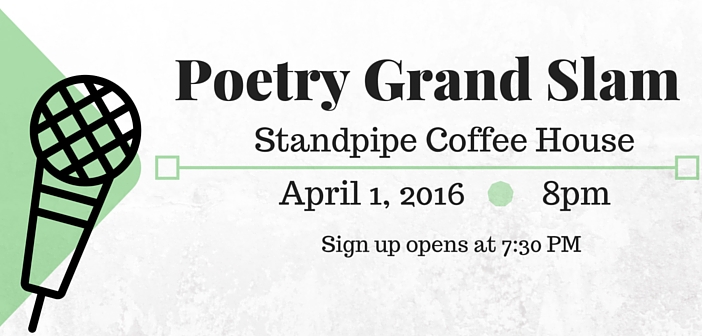
Standpipe Coffee House, located in downtown Lufkin on First Street, will host a poetry Grand Slam presented by Mike Guinn Entertainment on April 1, 2016. The free event begins at 8 p.m. and is open to any person in East Texas of any age to present their original work either in the competition or during an open mic session.

Presented the first Friday of every month from February to October, the Slam has been running for two years. “I create a safe place on the mic,” Guinn said. “An environment where [participants] can feel safe and gain confidence from the audience. I try to provide information about publishing and copyright. I don’t charge anything.”

The slam includes an open mic portion where anyone can stand up and read their original work or perform music they have written. All material must be family friendly since the event is open to the public.

After the open mic, the competitive part of the Grand Slam begins. Participants in the competition must sign up between 7:30 p.m. and 8 p.m. on Friday night. “As long as the participant is on time, they will be able to enter,” Guinn said.

Participants must prepare and read three original works to be performed in under 5 minutes. During their performance, the participants are judged by selected members of the audience, some of which have experience in writing and some who do not.

The winner of the competitive portion wins $75 and a chance to be the feature poet for the next slam. As the feature poet, the winner would be invited to present several of their works, sell any merchandise, and be an onstage mentor for the other participants.

Other Featured Poets are brought in from Dallas, Houston, and surrounding areas. The Featured Poet for Friday is Jessie Riley, an SFA student majoring in theater.

For participants, the slam provides more than just a place to grow as a writer and presenter; it is also a place for writers to connect with editors, publishers, and fans.

Participants such as Emily Lollar, winner of the January 2016 slam and featured poet in February 2016, made contacts through the slam, and now she has a book of her work published called “Life, Sex, and an Empty Coffee Mug.”

Lollar began writing 5 years ago, and she participated in the very first slam in 2014.

“It was pretty crazy, honestly,” Lollar said. “I never thought I was that good and was surprised when I won. Being feature poet was amazing and terrifying. Everyone is looking at you as you read poem after poem and pour your heart out to them.”

Lollar says she will definitely be participating in the next few slams.

Megan Harbuck is the winner of the February 2016 slam, and she began writing when she was five years old. She began participating in the slams in 2014, and described how she had worked very hard to improve her writing, and it was an “absolutely amazing feeling” for her to win a slam.

“I kept stumbling over myself because it almost felt like there was an expectation of me,” Harbuck said. “There wasn’t, of course. There’s no judgement in poetry.”

Harbuck said she will continue to participate in the slam and plans to participate in other slams around Texas as well.

Guinn found Standpipe after searching the East Texas area for a venue for the Poetry Grand Slam. He messaged the Coffee Shop on Facebook, and kept up a correspondence with owner Ben Harbuck until the Grand Slam was born.

Guinn, with a bachelor’s degree in social work from Stephen F. Austin State University and a master’s degree in social work from the University of Texas in Arlington, became a child abuse investigator for the state of Texas. One day, in 1997,he came home from a particularly hard case and sat down to write. Guinn has been writing ever since.

Guinn is the founder of Mike Guinn Entertainment. His home town of Jacksonville is right here in East Texas. For any questions or additional information, contact Mike Guinn at (972)-704-5001 or www.mikeguinn.biz.

Poetry Grand Slam Coming To Standpipe Coffee House

0

Standpipe Coffee House, located in downtown Lufkin on First Street, will host a poetry Grand Slam presented by Mike Guinn Entertainment on April 1, 2016. The free event begins at 8 p.m. and is open to any person in East Texas of any age to present their original work either in the competition or during an open mic session.

Presented the first Friday of every month from February to October, the Slam has been running for two years. “I create a safe place on the mic,” Guinn said. “An environment where [participants] can feel safe and gain confidence from the audience. I try to provide information about publishing and copyright. I don’t charge anything.”

The slam includes an open mic portion where anyone can stand up and read their original work or perform music they have written. All material must be family friendly since the event is open to the public.

After the open mic, the competitive part of the Grand Slam begins. Participants in the competition must sign up between 7:30 p.m. and 8 p.m. on Friday night. “As long as the participant is on time, they will be able to enter,” Guinn said.

Participants must prepare and read three original works to be performed in under 5 minutes. During their performance, the participants are judged by selected members of the audience, some of which have experience in writing and some who do not.

The winner of the competitive portion wins $75 and a chance to be the feature poet for the next slam. As the feature poet, the winner would be invited to present several of their works, sell any merchandise, and be an onstage mentor for the other participants.

Other Featured Poets are brought in from Dallas, Houston, and surrounding areas. The Featured Poet for Friday is Jessie Riley, an SFA student majoring in theater.

For participants, the slam provides more than just a place to grow as a writer and presenter; it is also a place for writers to connect with editors, publishers, and fans.

Participants such as Emily Lollar, winner of the January 2016 slam and featured poet in February 2016, made contacts through the slam, and now she has a book of her work published called “Life, Sex, and an Empty Coffee Mug.”

Lollar began writing 5 years ago, and she participated in the very first slam in 2014.

“It was pretty crazy, honestly,” Lollar said. “I never thought I was that good and was surprised when I won. Being feature poet was amazing and terrifying. Everyone is looking at you as you read poem after poem and pour your heart out to them.”

Lollar says she will definitely be participating in the next few slams.

Megan Harbuck, a high school sophomore, is the winner of the February 2016 slam. She began writing when she was five years old. She began participating in the slams in 2014, and described how she had worked very hard to improve her writing, and it was an “absolutely amazing feeling” for her to win a slam.

“I kept stumbling over myself because it almost felt like there was an expectation of me,” Harbuck said. “There wasn’t, of course. There’s no judgement in poetry.”

Harbuck said she will continue to participate in the slam and plans to participate in other slams around Texas as well.

Guinn found Standpipe after searching the East Texas area for a venue for the Poetry Grand Slam. He messaged the Coffee Shop on Facebook, and kept up a correspondence with owner Ben Harbuck until the Grand Slam was born.

Guinn, with a bachelor’s degree in social work from Stephen F. Austin State University and a master’s degree in social work from the University of Texas in Arlington, became a child abuse investigator for the state of Texas. One day, in 1997,he came home from a particularly hard case and sat down to write. Guinn has been writing ever since.

Guinn is the founder of Mike Guinn Entertainment. His home town of Jacksonville is right here in East Texas. For any questions or additional information, contact Mike Guinn at (972)-704-5001 or www.mikeguinn.biz.

Exercise keeps muscles, and you young

A University of Guelph professor has uncovered the “secret” to staying strong as we age – superb fitness.

Geoff Power found elderly people who were elite athletes in their youth or later in life – and who still compete as masters athletes — have much healthier muscles at the cellular level compared to those of non-athletes.

His research was published recently in the Journal of Applied Physiology.

The study compared world-class track and field athletes in their 80s with people of the same age who are living independently. There have been few such studies of aging and muscle weakening in masters athletes in this age group.

“One of the most unique and novel aspects of this study is the exceptional participants,” said Power, who joined U of G’s Department of Human Health and Nutritional Sciences last fall.

“These are individuals in their 80s and 90s who actively compete in world masters track and field championships. We have seven world champions. These individuals are the crème de la crème of aging.”

The study found that athletes’ legs were 25 per cent stronger on average and had about 14 per cent more total muscle mass.

In addition, the athletes had nearly one-third more motor units in their leg muscles than non-athletes.

More motor units, consisting of nerve and muscle fibres, mean more muscle mass and subsequently greater strength.

Geoff Power 2 Prof. Geoff Power

With normal aging, the nervous system lose motor neurons, leading to a loss of motor units, reduced muscle mass, less strength, speed and power. That process speeds up substantially past age 60.

“Therefore, identifying opportunities to intervene and delay the loss of motor units in old age is of critical importance,” Power said.

Power led the study as a visiting PhD student from Western University and the Canadian Centre for Activity and Aging at McGill University. He joined U of G last fall after a three-year post-doc at the University of Calgary.

In another recent study, published in the American Journal of Physiology – Cell Physiology, he looked at muscle fibre samples from the same elite athlete/non-athlete group.

Power studies healthy aging from cells to the whole body. “Exercise is definitely an important contributor to functional performance,” he said, adding that even non-athletes can benefit. “Staying active, even later in life, can help reduce muscle loss.”

But, he adds, “we cannot rule out the importance of genetics.” He said further research is needed to determine whether muscle health in elite athletes comes from training or genes.


Can video games improve health outcomes in children?

The videogames for health (G4H) field is pursuing innovative, potentially highly effective methods for changing behaviors and affecting health outcomes in children, but more research, defined guidelines and targeted funding are needed to drive game design, determine optimal use, and minimize possible adverse effects, according to a white paper published in Games for Health Journal: Research Development, and Clinical Applications, a peer-reviewed publication from Mary Ann Liebert, Inc.. The article is available free for download on theGames for Health Journal website until April 30, 2016.

A team of leading games for health researchers representing the Institute of Digital Media and Child Development Working Group on Games for Health, with lead author Tom Baranowski, PhD, Editor-in-Chief of Games for Health Journal, from USDA/ARS Children’s Nutrition Research Center, and Department of Pediatrics, Baylor College of Medicine, Houston, TX, collaborated on the white paper entitled “Games for Health for Children–Current Status and Needed Research”.

The authors review what is currently known about G4H, including game design and how they can target specific behaviors and health-related factors such as games intended to reduce anxiety before surgery, to promote physical activity, or to educate about health. They also examine the implications of using G4H for child development. The article emphasizes the need to overcome cost and technology barriers that could impede access to G4H, and proposes the need for guidelines for children, parents, educators, clinicians, policymakers, and technologists related to factors such as screen time and game development.

“The available evidence reveals that Games for Health are very promising to prevent and treat obesity, reduce stress, prevent smoking, and contribute to many positive health outcomes among children. This White Paper offers a road map for the activities that need to occur to achieve that potential,” says Dr. Baranowski.


Family Game Night at the Public Library-Tabletop Games at the Public Library

The Judy B. McDonald Public Library invites the community to Family Game Night on Friday, April 1st at 6:00 p.m.  This afterhours event will transform the library for a family-friendly evening of fun including life-sized board games, indoor mini-golf, Jeopardy and more.  “The library is dedicated to holding events that appeal to a wide audience,” says Crystal Hicks, assistant library director. “Family Game Night has something for everyone, both children and adults.”  Light refreshments will be served.  The event is free and no registration is required.  Please call 936-559-2970 for more information.

The Judy B. McDonald Public Library invites community members of all ages to join in Tabletop Games with the next meet-up on Monday, April 4th at 5:30 p.m.  Tabletop Gaming is an age-old communal and family activity, and there are many new and exciting games to challenge all skill levels.

Join old friends or new for a gaming evening with such favorites as Forbidden Island, Ticket to Ride, King of Tokyo, Munchkin, Settlers of Catan and more for teens and adults.  Younger kids can play Apples to Apples, Clue, Monopoly or any of the other games the library provides.  If you have a game, but you’d like to find new challengers, feel free to bring it along. Gamers will meet on the first Monday of each month this spring. The event is free and there is no registration required.

The Friends of the Library are on Facebook (as Judy B. McDonald Public Library) and Twitter (as @friendsofnacpl).


Another Brandon Belt Hit?

0

Hudson’s own Brandon Belt is featured in the latest San Francisco Giants TV commercial. He is always good for a laugh and doesn’t surprise us at all in this “rebranding” spot!

Another Reason to Break the Habit: Smoking Alters Bacterial Balance in Mouth

Smoking drastically alters the oral microbiome, the mix of roughly 600 bacterial species that live in people’s mouths. This is the finding of a study led by NYU Langone Medical Center and its Laura and Isaac Perlmutter Cancer Center to be published online March 25 in the ISME (International Society for Microbial Ecology) Journal.

The researchers say their analysis is the most comprehensive to date to examine the effects of smoking on the make-up and action of bacterial species in the human mouth based on precise genetic testing.

Recent work in the field links imbalances in microbial populations in the gut to such immune disorders as Crohn’s disease, as well as to some gastrointestinal cancers. Experts estimate that more than three-quarters of oral cancers are tied to smoking, but it remains to be seen whether smoking-related microbial differences in the mouth contribute to disease risk.

“Our study is the first to suggest that smoking has a profound impact on the oral microbiome,” says study senior investigator and epidemiologist Jiyoung Ahn, PhD.

“Further experiments will be needed, however, to prove that these changes weaken the body’s defenses against cancer-causing chemicals in tobacco smoke, or trigger other diseases in the mouth, lungs, or gut,” says Ahn, an associate professor at NYU Langone and associate director of population sciences at its Laura and Isaac Perlmutter Cancer Center.

Microbiome Bounces Back

The NYU Langone team relied on mouthwash samples from 1,204 American men and women whose health is already being monitored as part of larger ongoing cancer risk studies funded by the National Institutes of Health and the American Cancer Society. Study volunteers were all age 50 or older and included 112 smokers, 571 former smokers (among whom 17 percent had quit within the past 10 years), and 521 people who never smoked. The team then used genetic tests and statistical analyses to tell apart the thousands of bacteria in each study participant’s mouth.

Importantly, the investigators found that the oral microbiome of smokers differed significantly from that of people who had never smoked and those who had quit smoking. The team also found that the oral microbiome of smokers bounces back after they quit smoking, with all former smokers (who had not smoked for at least 10 years) showing the same microbial balance as nonsmokers.

More than 150 bacterial species showed significantly increased growth in the mouths of smokers, while another 70 showed sharp decreases in growth. For instance, smokers had relatively fewer species of Proteobacteria (at 4.6 percent of overall bacteria in the mouth), than nonsmokers (at 11.7 percent), with Proteobacteria shown to be involved in the breakdown of toxic chemicals introduced by smoking. By contrast, smokers had 10 percent more species of Streptococcus than nonsmokers, with Streptococcus known to promote tooth decay.

Postdoctoral fellow and study co-lead investigator Brandilyn Peters, PhD, cautions that study data did not enable researchers to tell how long it actually takes former smokers to rebalance their oral microbiomes after they stop smoking. But, she adds, further experiments are planned to determine the precise timeline for microbiome recovery.

Ahn says their goal is to identify what happens biologically from smoking-related changes in the oral microbiome. The team also plans to investigate how these smoking-related changes might influence risk for various cancers of the mouth and other parts of the body.

Newswise