Home Blog Page 679

10 Tips to Stick with Your New Year’s Weight Loss Resolutions

0

Millions of Americans will make the resolution this New Year to lose weight. But goal setting is the easy part. Staying on the weight loss track and maintaining that weight loss is where the challenges begin.

Here are 10 tips to help you stick with your weight loss resolution this New Year and beyond.

• Drink up: Hunger and thirst can often be confused, so stay hydrated. But remember, beverages are not a place to splurge on a ton of calories. Drink water. For a flavor boost, add fresh fruit slices or mint leaves.

• Snack mindfully: It is all too easy to derail an otherwise flawless diet by binging at snack time. Be mindful of your snacks, and make sure they offer nutritional value and are designed to keep you satisfied until your next meal.

• Sleep: Studies show a link between sleep deprivation and excess pounds. While there are many theories as to why this is, at the very least, getting enough sleep will promote clear-headed, healthful choices throughout the day.

• Jumpstart your weight loss: Studies show that early weight loss is a predictor of long-term success. Look for programs that keep you motivated, like Nutrisystem Turbo10, which delivers up to a 10-pound weight loss and up to five inches lost overall in the first month of dieting.

• Eat small: Research suggests that eating smaller, balanced meals throughout the day promotes greater weight loss and maintenance. Schedule meals every two to three hours, six times a day.

• Get moving: Exercise doesn’t have to be daunting! Get started with 10-minute sessions, three times a day. Movement sets your metabolism in motion so make sure it’s a consistent part of your weight loss efforts.

• Eat out, right: Restaurant portions can be monstrous. Set aside half the meal and save it for later. Avoid key menu terms like “breaded,” “fried,” “crispy,” and “smothered.” At buffets, fill your first plate up entirely with greens before moving on to other options.

• Embrace setbacks: Sometimes diets get temporarily thrown off course by a missed workout or a second slice of birthday cake. Rather than throwing in the towel entirely, view the setback for what it really is, a temporary hiccup.

• Be accountable: Keep a food and exercise diary to reinforce good habits. Log food, drinks, activity, weight and more to stay accountable.

• Seek support: Weight loss and maintenance is no cakewalk. Turn to weight loss counselors, dietitians and online communities for support with your weight loss journey. The counselors at Nutrisystem for example, are available seven days a week. For more information, visit Nutrisystem.com.

With the right attitude and the right tools, you can make 2016 the year you finally lose the weight for good.

(StatePoint)

6 Ways To Talk About Money With Your Family

0

When we think about money, let’s be honest – we’re not talking about just money, but also a host of related consequences and deeply felt emotions, says retirement specialist
Lee Stoerzinger.

“Money cuts to the emotional roots of every human issue,” says Stoerzinger, a
CERTIFIED FINANCIAL PLANNER™, head of Lee Stoerzinger, Inc.,
(www.leestoerzinger.com
) and author of “On The Back Burner.”

“In my years of advising, I’ve come to understand that when we talk about money, we’re layering in fear, spirit and soul. When we strip away the facts and figures, money is all very emotional. We can’t really make progress until we understand those emotions. I have found that most people don’t necessarily want to be rich—they just don’t want to be poor. Isn’t that what we all want – security?”

Stoerzinger, who says he began to see money in a new way after adopting two children from Haiti and who has helped streamline adoption efforts for other Haitian children to
American families, offers ways adult children may speak to their retired or retiring family members about money.

• Start by appreciating storytelling. We communicate with one another through storytelling, and if you want to learn more about yourself, then listen to your family stories. Don’t be afraid to get your parents talking – about how they met, their first or worst job, what the economy was like when they were younger, etc. For many, talk about money is tough because families often are not communicative in general. Get to know your folks better. While you have gotten older and developed your own sense of self, you may be shocked to learn how much you have in common. Appreciate the stories and try to make for a comfortable environment, such as dinner.

• Be true to your feelings. Let your parents know how you really feel (the good and the not so good). Your feelings will outlive your parents. Let them out now, while there is time to resolve them. Clear things up and be honest. It’s good to do some spiritual housekeeping.

• Appreciate their plight and express compassion. Let them know you recognize the efforts they have made in this world. It’s very powerful to be able to say to someone, “I understand.” Everyone has sins, mistakes, failures, pain and guilt. Though you were not around to observe, your parents endured broken hearts and tough circumstances, too. They did the best they could. Let them know you “get it.” You may not approve of their actions, but you can certainly understand them.

• Be thankful out loud with gratitude. These are, after all, the people who toilet trained you. Thank them for giving you life. Think of the good times and appreciate the opportunities they provided. Vacations, education, special outings, bicycles, time together, a room of your own—let them know how grateful you are for these things. “I’m willing to bet there were times when you as a child were neither loveable nor available,” Stoerzinger says. “Their love is ultimately unconditional.”

• Apologize and make amends. We’re all capable of being mean. Whatever it is, take responsibility for your actions. A genuine “I’m sorry” allows two people to talk through a situation. This will be hard, but you won’t regret it. Sometimes it’s better to be kind than right.

• Let forgiveness in. Resentment gets us nowhere. Forgiveness is humbling in any relationship, and it helps to say, “I love you so much and I am willing to set aside my pride in order to remain in your company.” Let’s move on to more important things. Forgiveness keeps us together, even when opinions clash. In the case of profound hurts, forgiveness can be a way to heal and move on. The pain may never be resolved, but at least we can gather our dignity.

About Lee Stoerzinger

Since 1993, Lee Stoerzinger, CFP®, has dedicated his professional life to the study of finance, and to helping people become financially independent. His perspective on “true wealth” involves celebrating what we already have, honoring our commitments and helping those who need it most. After graduating from the University of Wisconsin-Eau
Claire in 1992 with a bachelor of arts in cumulative finance, Lee began his career as an independent financial representative at his firm, Lee Stoerzinger, Inc.,
(www.leestoerzinger.com).
 Lee is a registered rep with SII Investments, Inc. A self-proclaimed “student of the world,” especially faith, history and politics, he spends much of his time trying to figure out “what it all means.” He savors his time with his wife, two children and a wonderful community of genuine friends.

The Perfect Wine to Bring to a Holiday Gathering: It’s All About the Food

0

I became infamous at Le Cordon Bleu in France (at least in my own mind) on a relatively quiet and peaceful classroom day of wine tasting. I am on stage but the theater is a dimly lit classroom in the 15th Arondissement of Paris and I am an American widow with three grown children wearing a uniform that matches my nine other youthful women classmates. Can I succeed at performing the international protocols of a flawless 7-minute wine analysis that ends with a perfect food and wine pairing while standing in front of my peers, professor and the man from Margaux?

With a grimace, and a bit of pride, I always think back to this life-changing moment in the spring of 2012 when I was preparing for intensive wine exams. After studying ten months in Paris at Le Cordon Bleu’s first year of wine management, I still had my doubts about performing the 7-minute wine analysis and, if given the choice, would rather have performed the 7-minute AB workout even if it entailed wearing my spandex shorts in front of my other twenty classmates.

My classmates snickered, but I think they were secretly happy that I broke the traditional standards of food and wine pairing that day. It certainly opened the doors to the steps I follow when it comes to choosing the perfect wine for holiday gatherings.

The internationally accepted rules of a wine tasting analysis chronicle in detail the visuel, or visual; olfactif or aromatic; and gustatif or taste of a particular wine, analyzing the future of the wine in terms of age, serving temperature, whether to carafe or decant, and finally, what dish to pair with the wine—all in 7-minutes or less. And the key ends with unlocking the door to choosing the correct wine for your meal.

I hold the glass of 2009 Chateau Kirwan Bordeaux in my hand like a singer ready to begin a melody. “This bouncy and forward 2009 Bordeaux from Chateau Kirwan, which is predominantly Cabernet Sauvignon blended with Merlot, Petite Verdot, and Cabernet Franc,” I exclaim, “could be paired with a lovely garlic-rubbed grilled leg of lamb served with roasted rosemary potatoes and sautéed green beans with toasted pine nuts . . .”

Monsieur Professor is proudly smiling at me and begins to clap with my other nineteen classmates and the man from Margaux.

“Or,” I sheepishly announce over the first seconds of applause, “it could be paired with a thin-crusted pizza covered with caramelized onions, crispy pancetta, sautéed shitake mushrooms, and Gorgonzola cheese.”

The clapping stops abruptly, “Why you do that!” Monsieur Professor shouts at me after my offbeat pairing suggestion. “You just gave perfect wine analysis and then ruined it by your food pairing . . . pizza, mon Dieu, not with Chateau Kirwan from Margaux!”

I genuinely want that bottle of Chateau Kirwan from Margaux with pizza. Ce n’est pas chouette (that’s not cool) for a traditional French food and wine pairing but for me, an American, it is.

I suggest using my basic pairing principles—that so abruptly disturbed my French classroom that day—to explore and have fun with food and wine pairings during the holidays. By matching a wine that’s either similar or opposite to the dish or ingredients being served, you can produce delectable and unique pairings. It’s all about the personal adventure when it comes to food and wine pairing.

white-wine-848268_640I pair wine using a simple technique that I learned from a famous sommelier in France. “Wine pairing should be looked at like we look at couples,” he shared. “There are two types of couples in this world. There are the couples who are similar to one another and make each other whole almost like being one person and then there are the couples who are completely opposite and one would never put them together.”

Yet both couples work together and form a powerful bond…

1. Is this wine similar to the dish?
Ex: A heavy beef stew with lots of pepper and bay leaves would have flavors similar to a peppery, earthy red wine like a Cabernet Sauvignon or a spicy Pinot Noir. The bold aromas and flavors of the wine are similar to the strong and spicy ingredients in the stew.

2. Is this wine opposite to the dish?
Ex: A creamy white sauce over pasta would pair well with a nice Sauvignon Blanc. Why?
The acidity in the wine is opposite from the creamy, smooth sauce and actually subdues and balances both flavors.

In pairing traditional holiday dishes, use the basic concepts above (try on your own first) and if you get stumped here are some cheat notes:

  • Turkey (Dark Meat): Merlot, Zinfandel
  • Turkey (Light Meat) Chardonnay, Pinot Noir, Viognier
  • Chicken: Beaujolais, Chardonnay, Pinot Noir, Riesling, Rioja
  • Lamb: Bordeaux Blend, Cabernet Sauvignon, Merlot
  • Salmon/Seafood/Shellfish: Chardonnay, Riesling, Sauvignon Blanc, Pinot Noir
  • Pizza: Bordeaux Blend, Merlot, Cabernet Sauvignon, Syrah, Zinfandel, Sauvignon Blanc
  • Macaroni & Cheese: Chardonnay, Sauvignon Blanc, Rioja
  • Hamburgers: Merlot, Rose, Zinfandel, Syrah

Be bold, brave and thankful that your pick does not include the man from Margaux. Simply take that adventurous wine leap believing that your personal palate will always catch you. And even if your palate fails you with the hours of thought you put into that special holiday food and wine pairing, who cares, try again later. Toss out the old ideas about failure and embrace it as your best friend because, when it comes to wine, there is always another chance to get creative with another even more provocative pairing.

About Paula Moulton
A viticulturist, award-winning winemaker, and published author with over 25 years of experience in the wine industry, Paula Moulton has worked with wine talent such as Joel Peterson of Ravenswood Winery, Mike Benziger of Benziger Family Winery, and Jean-Luc Thunevin (Bordeaux’s Bad Boy wine). She has appeared on the Today Show, CBS, NBC, ABC, FOX, CRN, and other major media outlets as an author and wine industry leader. Moulton holds a BA from U. C. Berkeley in Rhetoric, an AS in viticulture from Santa Rosa Junior College, and a Wine Management degree from Le Cordon Bleu, Paris, France. Learn more about Moulton at www.paulamoulton.com.

Caring for Elderly Relatives: Making it Easier on Your Family

0

It can be difficult for families when an elderly loved one starts to weaken physically and mentally. While nursing homes are an option, most are extremely expensive, and most seniors would prefer to remain in familiar surroundings. Fortunately, there are now more choices available that can provide seniors the freedom to continue living safely in their own home.

The average cost of an assisted living facility is $43,200 annually, and the cost of a nursing home with private room can cost over $90,000 a year, according to the 2015 Genworth Cost of Care Survey. Such a huge, ongoing expense can have an enormous impact on the average family, whether they have prepared financially or not.

“Even for families where such costs are not prohibitive, parents are often reluctant to leave homes filled with years of memories, and be placed into an unfamiliar environment, living with strangers,” says health care systems expert Jack Zhang, President and CEO of the fast-growing health technology company, Vitall Inc.

Caring for older parents and relatives doesn’t necessarily need to involve relocation or spending tens of thousands of dollars annually. Zhang says there are a few important things to consider.

Communication Updates

New technologies make looking after and staying connected to the seniors in your life easier and more affordable. For example, HeyMomDad, the world’s first two-way communication and wellness monitoring system, allows loved ones to see and hear in real-time that elderly relatives are safe — simply by opening an app on their smartphones.

Seniors need only press one button to talk to loved ones, notify them that help is needed, or to just say hello. Likewise, with one tap, users can instantly see, hear and talk back to parents through the high-quality HD video and two-way audio component. The camera can be controlled through the smartphone and directed to any location in the room, permitting a 270-degree view. It also includes night vision optics for clear viewing in dark rooms.

Beyond Monitoring

“Most seniors are reluctant to call 911 in an emergency because they’re embarrassed or don’t want to cause a fuss or incur an expense — which can be as high as $1,200, even for false alarms where paramedics were dispatched,” says Zhang.

HeyMomDad gives seniors two different alert options. They can choose to alert only family and friends, or alert family, friends and 911. In addition, the HeyMomDad Bed Monitor tracks heart rate, breathing rate and movement at night.

Maintaining Independence

For many seniors, one of the most difficult parts of aging is the loss of independence.

When possible, families should consider making homes senior friendly, adding safety bars in the shower and bath, eliminating tripping hazards, improving lighting in hallways and outdoor walkways, and making kitchens more accessible with countertops and cabinets that can rise or lower with the push of a button.

And new two-way communication and monitoring systems can add further peace of mind. More information can be found at www.HeyMomDad.com or 1-800-352-0887.

Before making big decisions about your parents and aging relatives’ housing and care, take new innovations into consideration. These alternatives can save your family thousands of dollars, give you peace of mind and improve your family’s quality of life.

(StatePoint)

What You Need to Know About Winter Driving

0

Winter can be an especially perilous time to be on the roads. Snow, ice, fog and longer nights present challenges to drivers that can lead to crashes.

People do less driving in winter, yet we have more crashes per mile driven. Some 10,780 people were killed in car crashes between December and March in 2013 — fully one-third of the total for each year. Non-fatal collisions also occur with greater frequency in winter months.

You may be an ace behind the wheel when the sun is shining and roads are dry, but driving in winter weather can be a different story. Drivers need to recalibrate and adjust their driving for winter road conditions.

“Travel can be treacherous when roadway surfaces are compromised during winter storms,” says Deborah A.P. Hersman, president and CEO of the National Safety Council (NSC). “The good news is that in-vehicle technologies can help drivers by providing advance warnings and preventing loss of control.”

NSC and the University of Iowa recently partnered to launch a campaign called MyCarDoesWhat, to educate drivers about vehicle safety technologies designed to prevent crashes. The MyCarDoesWhat campaign offers three major pieces of advice for driving in wintry conditions:

• Slow down. This is the golden rule of winter driving. Drivers frequently underestimate how long it takes to brake and how difficult it can be to steer on slippery roads.

• Do not use cruise control when driving on slippery surfaces.. It will diminish your control over the car and reduce your reaction time in the event of a skid.

• Bridges and overpasses freeze before roadways, so be alert in cold weather when approaching a bridge.

While a careful and skillful driver is always a vehicle’s best safety feature, many safety technologies can help prevent or reduce the severity of winter-related crashes.

They include:

• Anti-lock braking systems (ABS) help drivers maintain control by preventing wheels from locking up. Your ABS works differentlythan traditional brakes, and requires you to drive differently too. It delivers and releases precise braking pressure to each wheel as needed, so you shouldn’t pump the brakes when you have ABS. Just hold them down firmly and look and steer in the direction you want to go. They may buzz and vibrate when the ABS has activated.

• Traction control helps you accelerate without spinning out on slippery surfaces.

• With electronic stability control, your car’s computer helps sense when you may be losing control around a corner or curve and can stabilize your car if it begins to veer off your intended path.

• Adaptive headlights adjust to changing roadway conditions — such as curves — to provide optimum illumination along the roadway during the long winter nights and periods of low daytime visibility.

“Driving in snow and ice requires much more focus on the conditions and an ability to adapt to an ever-changing, slippery environment,” says Daniel McGehee, director of the Transportation and Vehicle Safety Program at the University of Iowa.

Research shows that most consumers are unsure about how some potentially life-saving vehicle safety technologies work. To get better acquainted with your car’s features and learn important winter driving skills, visit MyCarDoesWhat.org on Twitter and Facebook for videos and tools.

With the right knowledge and skills, you can make your winter journeys safer.

(StatePoint)

Thrill of Hope: A Dog’s Key to the True Meaning of Christmas

0
Shirelle, Doug Green's Husky-mix that inspires us to find the miracles of Christmas all around us. (Photo: Doug Green)

I was walking Shirelle, my husky-mix, through the chilly neighborhood, taking in the holiday decorations. Some charming, but most of them atrocious, completely missing the true meaning of Christmas. Which of course is the virgin birth of the foretold Messiah, along with carols and love, eggnog parties and trees with stars, which all together means what exactly?

“What do you think it means?” I asked the mutt.

She ignored me, as usual, focusing on smells and potential sounds around the corners.

“I mean, Hanukkah and Kwanza still make sense. But after all this time, and all we’ve done to it, there still seems to be some core meaning to Christmas that we all yearn for, regardless of religious beliefs. We see it in kids sometimes, but what exactly is it?”

She suddenly lunged against the leash, almost pulling me over, and started barking to raise the saints. A man across the street was walking his Maltese, and Shirelle was giving her usual zealous reaction to a foe she could devour without chewing.

“What’s your problem, Shirelle?” I groused. “It’s not such a big deal.”

But she disagreed. Completely, which got me thinking. For me, that little dog was no big deal. But to Shirelle, for some unknowable reason, it’s stop-the-presses cataclysmic.  Could she be answering my question about the yuletide?

Think about it. A few years ago, astronomers came across likely evidence that, a couple thousand years before, Jupiter and Venus appeared so close together in our skies that they looked like a giant star – an occurrence that might well have been the Star of Bethlehem.

And today, if a young woman were admitted to a hospital with a pregnancy, with proof she’d never been inseminated, the medical profession would consider it an anomaly, a case for study, and it would most certainly end up a plot point on a few nighttime medical dramas.

But the Star in the East and the Virgin Birth were and are considered miracles, because the people at that time saw them as such. The shepherds and wise men saw those planets and determined they’d seen a miracle expressing new hope. A sign of the most important event in history.

Just like Shirelle, ecstatic at the idea of a new tail to sniff, pulling on me as if it were, well, the most important event in history.

Isn’t that miracle of hope the constant of the holiday? The pre-Christian winter solstice rituals celebrated the idea that winter wasn’t the end; that, in cold darkness, faith promises the coming of spring. Even our modern traditions of gift-giving, mall Santas, and saturated advertising all suggest that there’s something amazing just around the corner so you better not pout, and you better not cry!

Here’s this knucklehead dog by my side, who lives in that mindset all the time, always checking for what miracle, what new hope, is ahead. While we, jaded and overwhelmed, wish we could feel that too. Could a pooch teach us something about how to achieve it?

The answer is yes, but verbally-challenged tailwaggers don’t present lectures. Rather, like Bing Crosby reforming the sinners and fuddy-duddies in Going My Way, a pup achieves this through example, by simply being herself. (Though admittedly, Crosby also had the ability to sing that “Would you rather be a mule” song.  But we’ll have to make do with what the mutt can offer here.)

Canine Miracle Awareness isn’t instant; it takes steps. Maybe it’s best to think of it as an Advent calendar, but one with just four windows. Once you’ve mastered what’s in one, you get to move to the next.

The first opens to reveal the world around you. Compared to dogs, we got gypped in the sense-of-smell department. When we walk outdoors, we’re likely to be hit by only one or two smells, not the four-star menu a pooch sniffs. But we have eyes to put theirs to shame. So the next time you’re on a busy city sidewalk, take a moment and look around.  After all, any pup can tell you – there’s a miracle on every street, not just 34th.

And as you do, like those ancient stargazers, note what most affects you. Perhaps you’ll be struck by the sight of a beautiful woman in a lovely outfit, a rare car, or a great window advertising a sale.

But then let your brain run – aren’t all windows miraculous? Who came up with the idea of how to make glass, and how did they do that? Isn’t every car amazing, with the technological precision it takes to run an engine? And isn’t every person a miracle? Their lives, their minds, their struggles, their achievements?

In truth, every new thing you see out there is astounding, if you let yourself realize it. Each is a beautiful gift, from…well, if you choose to believe so…from Santa Claus.

Crack open the next window, and you’ll see things that you don’t like at all. Or at least, so you think.

Because dogs’ smaller brains keep them living in the moment, they are far less ruled by preconceptions than are we. We plan for a picnic and state the day was ruined by rain. A dog plans to go outdoors, is surprised by precipitation, and then relishes the new smells the moisture creates.

So many of our favorite modern Christmas songs tell of this. Rudolph’s nose causes him nothing but shame, till it’s valued for the miracle it is. Snow and cold cause colorless misery, until one appreciates the winter wonderland and Jack Frost nipping at your nose.  And, the most popular of all, tells of Irving Berlin’s melancholy at spending December 24th in warm colorful Beverly Hills instead of trapped in a frozen blanket like the ones he used to know.

Instead of sitting back and waiting for a miracle to come in the way you want, why not sniff around and discover the ones resplendent in all your annoyances and disappointments.

When you’ve graduated from windows one and two, you can bend open the next panel, to approach a dogs’ true state of grace: seeing miracles in the everyday. Like Jimmy Stewart realizing how much he loves his plain home town and dysfunctional family and friends, or Scrooge breaking past his inner pain and embracing the people he’s feared and despised, you now can live surrounded by awe and majesty – right where you are.

Once you’ve tasted that, you have the right to break open the final portal, which will simply show your heart – which now explodes puppylike at every reunion with your family and friends, with the unbridled Home Alone ecstasy that what was lost has returned, what was gone forever is back, a thrill of hope the weary world rejoices.

What do you think? Do you want to go Shirelle’s way, living life fully in joy at the miracles around her? Or would you rather be say…a Grinch?

You see, you could be swingin’ on a star. Even if you’re on a leash.

About Douglas Green
Douglas Green is a psychotherapist, specializing in helping kids and teens build lives they can be proud of. He is also the creator and writer for AskShirelle.com, which helps kids, teens, parents, and others around the world with advice from the point of view of a friendly dog, and is the author of The Teachings of Shirelle – Life Lessons from a Divine Knucklehead. Learn more about Green at www.CavalleriaPress.com, and connect on Facebook and Twitter.

Commission Awards Lufkin Four New Projects

0

LUFKIN – The Texas Transportation Commission met and approved funding for 65 projects statewide at a monthly meeting in Austin Thursday, with four located in the Lufkin District totaling $12.3 million.

Planned work for each project includes:

Houston County

A $3.1 million construction project on FM 3151 will reconstruct and widen the pavement from FM 1280 to FM 230 and will continue for 4.6 miles. Drewery Construction will serve as contractor for the project.

Nacogdoches County

A $295,401 project designed to improve guardrail will be located on US 59 at two locations, from 2.5 miles south of Rusk County to US 259 and from SL 224 to Angelina County. 3LW Management will serve as contractor for the project.

Shelby County

A $1.2 million project to safety treat fixed objects along the roadway is located on SH 7 and will continue for 4.4 miles east of FM 2913 to US 96. L.C. Jordan & Son will serve as contractor for the project.

Various Locations in the Nine County Area

A $7.6 million project that includes sealcoating the roadway on various roadways in the nine county Lufkin District (Angelina, Houston, Polk, Nacogdoches, Sabine, San Augustine, San Jacinto, Shelby and Trinity) was approved.  Clark Construction of Texas will serve as contractor for the project.

Motorists are urged to use caution as they drive through these work areas as construction begins. Obey reduced speed limits, warning signs and use caution with workers and equipment nearby.

For more information, contact Rhonda.Oaks@txdot.gov or (936) 633-4395.

Nacogdoches Kid Fish 2016

0
NACOGDOCHES, TEXAS — Gather the family and come over to Lake Side Park at 4800 Pearl St on Saturday, January 23, 2016 from 9-2 pm for the City of Nacogdoches Parks and Recreation and Suddenlink’s annual Kid Fish tournament.
Thanks to our partners from Texas Parks and Wildlife, the lake will have a full supply of Rainbow Trout for the kids to catch. Kids aged 1 to 16 compete for prizes in categories such as, Biggest Trout, Smallest Trout, Biggest Fish (any species caught) and Heaviest Stringer.
We hope to see you there, ready to reel in some fun times and tackle the competition!
For more information, come by the C.L. Simon Recreation Center, located at 1112 North Street in Nacogdoches, or give us a call at (936)-559-2960.

Fruit In Your Christmas Stocking

0

Do you remember if Santa ever left you oranges, or even an apple, in your stocking? I do.  The cool stuff was on top and the remainder of my brother’s and my stockings was, indeed, fruit.

I remember as a child growing up that every Christmas Eve when we were asleep, Santa Claus would pay us a visit and leave behind an assortment of gifts.  It’s funny that Santa never wrapped our gifts, but he did for my friends down the street.  Hmm…   Wrapped gifts were from mom and dad, and grandparents.

Almost forgotten, after finding Santa’s gifts each year, were the stuffed stockings.  As I got older, the smaller items that can be put into a stocking have become more and more interesting to me as some wonderful gifts are truly smaller in size.

But the fruit!  What’s up with that?

Without fail each of us would find our stockings filled with oranges, tangerines, the occasional apple, assorted nuts, and maybe some chocolates.  While I was eager to eat the candy, I never paid much attention to the fruit and nuts.

I remember once asking my parents why Santa would think that giving us groceries (fruit and nuts) was such a good idea.  Although I don’t remember their exact answer, it went something like this:  “Santa has been leaving fresh fruit, nuts and candy in children’s stockings for hundreds of years.”

Long ago, these items must have been considered wonderful treats because there was no way to get fresh fruit and nuts all over the world year-round.  For all but the very wealthy, this Christmas gift was the only fresh fruit that they would get to enjoy all winter and well into the spring.

If you conduct some cursory research, it appears the custom of oranges actually began in the 1880s with the advent of the cross continental railway system.  By the twentieth century, Santa Claus, working with the local seasonal availability of fresh oranges around winter time, made it possible for most children to get a fresh orange, or other fruit, at the bottom of their stocking on Christmas.

So if that explains how, where did the idea of putting fruit in a stocking truly originate?  For that answer we need to go back a bit further to St. Nicholas, the precursor of Santa Claus.

Born in a village on the shore of what is now part of Turkey, he inherited a fortune but spent his life helping the poor and the persecuted, and eventually became a bishop in the new Christian church.

As the story goes, Bishop Nicholas learned of a poor man with three daughters who had no dowries and hence could not find suitors to marry them.  The next night Nicholas returned and tossed three bags of gold for the daughters’ dowries through the chimney, which happened to land in the stockings of the three maidens which they had hung to dry in front of the fireplace.

The bags of gold turned into balls of gold which are now symbolized by oranges.  Bishop Nicholas is often portrayed in pictures wearing the red ceremonial robes and miter (or headdress) and holding the staff of a bishop, as well as holding three gold balls, gold coins, or pieces of “gold” fruit.

So, you can be assured I’ll be checking my family’s stockings for oranges.  Perhaps we may event find the “Halo” brand of mandarins.  Those Halo fruits are quite tasty.

The Texas Tenors Return to the Temple Theater

0

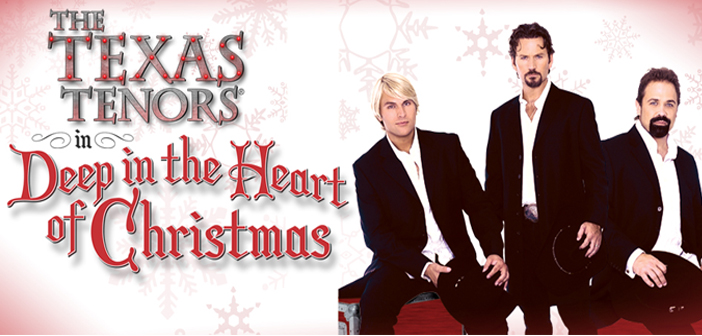
LUFKIN, TX. THE TEXAS TENORS will ring in the season at the Temple Theater Monday, December 21, 7:30 pm, with a special holiday presentation ‘Deep in the Heart of Christmas.’ From Arkansas to Arizona – every stop on the 2015 Christmas tour has sold-out and Lufkin Texas is no exception. “I think everyone who saw The Texas Tenors here the first time in September 2014 wanted tickets for their Christmas show,” stated Executive Director Tracy Pinkerton, “so when tickets went on sale on August 3rd, the show was sold-out within 24 hours.” Since their whirlwind debut five years ago on America’s Got Talent, this Texas trio, including pop singer Marcus Collins, opera singer John Hagen, and country singer JC Fisher have won the hearts of millions becoming America’s favorite tenors. Deep in the Heart of Christmas strikes a holiday chord with songs such as “What Child Is This”, “White Christmas” and “Mary Did You Know?”

Tickets are priced from $45-$55 (Premium/Box $60), and the box office has a ‘waiting list’ for people still wanting tickets. Typically, any unsold tickets go on sale for half-price beginning one hour before performance time. “For sold out shows like The Texas Tenors, the box office will sell RUSH tickets at the door starting at 6:30 pm for $20 each,” said Kristie Bailey, Box Office Manager. “The purchaser may go into the theater at 7:25 pm and sit in any empty seat. If they cannot find a seat, they bring their ticket back to the box office for a $20 refund,” Kristie added. Angelina Arts Alliance proudly welcomes THE TEXAS TENORS back to Lufkin along with show sponsor, City of Lufkin. 2015-2016 15th Anniversary Season sponsors are Georgia- Pacific and CHI St. Luke’s Health Memorial.

For more information on the 2015-2016 Performing Arts Series visit the Temple Theater Box Office on the Angelina College Lufkin campus, Monday through Friday 11 am – 5 pm or call (936) 633-5454. Go online at www.angelinaarts.org, the Arts Alliance website for details and video clips from the entire season. Follow Angelina Arts Alliance on Facebook for late-breaking news, photos, videos and ticket giveaways.