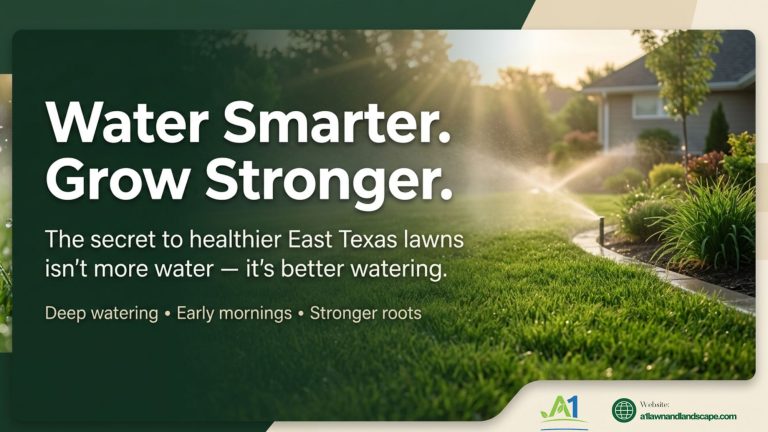
Watering is one of the most important — and most misunderstood — parts of East Texas lawn care. Too little water and grass struggles. Too much water and lawns fall prey to fungus, shallow root systems, and surprisingly high water bills. In an area like Lufkin and Nacogdoches, where humidity is high and rainfall is unpredictable, finding the right balance makes a dramatic difference in how lawns look and perform through the summer.
Most East Texas lawns do best with roughly one inch of water per week, including rainfall. In hotter stretches, that may need to climb to 1.25 or 1.5 inches. But the total amount is only part of the equation. How that water is applied often matters just as much as how much is delivered, and it’s usually where homeowners go wrong.
Deep, infrequent watering is the gold standard. Watering a little bit every day trains roots to stay near the surface, where they’re most vulnerable to heat and drought. Watering deeply — enough to soak several inches into the soil — encourages roots to grow downward, where moisture is more consistent and temperatures are cooler. Two or three deep waterings per week almost always outperform seven light ones.
Timing is another critical piece. Early morning, generally between 4 a.m. and 9 a.m., is the best time to water. Wind is usually minimal, evaporation is low, and grass blades have time to dry as the day warms. Evening watering, by contrast, often leaves grass damp overnight — an open invitation for brown patch and other common East Texas lawn diseases.
A few simple checks can confirm whether watering is actually reaching where it needs to go. Pushing a long screwdriver or probe into the soil after watering is a useful test: it should slide in easily to about six inches. Grass that takes on a bluish-gray tint or holds footprints after being walked on is another sign that deeper watering is needed. Placing a small container in the sprinkler zone can also help track how much water each session actually delivers.
Flowerbeds often need slightly more water than lawns, especially newly planted beds. Drip irrigation and deep hand-watering are typically far more efficient than overhead sprinklers, which lose significant moisture to evaporation and often wet foliage in ways that encourage disease.
Irrigation systems themselves deserve regular attention. Clogged heads, broken lines, misaligned sprinklers, and overspray onto pavement quietly waste enormous amounts of water every week. A short inspection several times during the growing season often identifies small issues before they turn into large ones.
Smart watering isn’t about running sprinklers more often — it’s about using water in a way that trains grass to be stronger, healthier, and more self-sufficient. Lawns that are watered deeply, early, and consistently tend to look better, resist disease more effectively, and cost less to maintain throughout an East Texas summer.
Author: Billy Forrest