


Home Blog Page 148

New School Year Brings Safety Reminders

0

LUFKIN – A new school year is about to begin and TxDOT is calling on everyone to be extra cautious in school zones and around school buses to help keep students safe. 

As drivers encounter school buses on the road and students loading and unloading at area schools, motorists are urged to stay alert and remember that with the new school year, congestion increases on the roadway.

The most common causes of crashes on the roadway are driver inattention, speeding and failure to yield the right of way. Driving in a school zone or near a school bus brings additional challenges to drivers. TxDOT urges motorists to slow down, pay attention and follow all traffic laws to keep children safe and avoid costly fines and tickets as parents, teachers and students prepare for the new school year.

“As parents and teachers prepare for the new year, motorists should refresh themselves on safety tips and laws concerning school zones and school buses,” said Rhonda Oaks, public information officer. “We also want to urge parents to review these tips with their school children, whether those children are elementary age or in college.”

Back-to-school safety tips include:

Driving in School Zones  

Stay alert to new traffic patterns around schools that may have changed since last school year. 

Put your phone away. Using a handheld electronic device while driving in an active school zone is against the law. 

Stop and yield for people in crosswalks. 

Always obey school zone speed limit signs. Remember, traffic fines increase in school zones. 

Drop off and pick up children in your school’s designated areas, not the middle of a road. 

Keep an eye on children gathered at bus stops. 

Watch for children who might dart across the street or between vehicles. 

Drivers Sharing the Road with School Buses  

Follow at a safe distance, keeping in mind that school buses make frequent stops. 

Always stay alert for children around buses and remember that they may not always look for vehicles before crossing the street. 

Stop for flashing red lights or a stop sign on a school bus, unless you are traveling on the opposite side of a divided highway from the school bus. If traveling the same direction as the school bus, stop and continue your trip once the bus has moved, the flashing lights stop flashing, or the bus driver signals to pass. 

First offense violations can lead to a fine of up to $1,250. 

Children Walking or Biking to School  

Use sidewalks. If there’s not a sidewalk, walk on the left side of the street, facing traffic. 

Cross the street only at intersections or marked crosswalks. Look left, right, and left again before proceeding. 

Always obey crossing guards. 

Make eye contact with drivers before crossing the street. Never assume a driver sees you. 

Look for traffic when stepping off a bus or from behind parked vehicles. 

Always wear a helmet when riding a bicycle. 

Don’t be distracted by electronic devices that take your eyes and ears off the road. 

Follow all traffic rules, signs, and signals.     

For more information, contact Rhonda.Oaks@txdot.gov or call (936) 633-4395. 

AgriLife Extension Adds Honey Bee Specialist in Overton

0

Slater’s 18 years of experience meets industry requests to improve Texas beekeeping programs

Garrett Slater, Ph.D., has been hired as the new Texas A&M AgriLife Extension Service honey bee specialist and assistant professor in the Texas A&M Department of Entomology to support state commercial and hobby beekeepers.

Head and shoulder photo of Garrett Slater, Ph.D. He is wearing a dark blue coat with a light blue shirt.

 Garrett Slater, Ph.D., will provide beekeeping expertise and programming relevant to Texas. (Texas A&M AgriLife)

The new statewide position expands AgriLife Extension’s growing beekeeping program and was supported by funding from the Texas Legislature, secured with the help of the Texas Beekeepers Association.

Slater has 18 years of beekeeping experience, including 10 years in commercial beekeeping and pollination services in North Dakota. Headquartered at the Texas A&M AgriLife Research and Extension Center at Overton, his position will be 75% AgriLife Extension and 25% Texas A&M AgriLife Research, serving beekeepers around the state, including major metropolitan areas like Dallas/Fort Worth, San Antonio, Austin and Houston.  

“Texas is seeing a dramatic increase in beekeeping, and I was hired to create an AgriLife Extension program to support both new and advanced beekeepers,” Slater said. “I am here to educate and inform them with applied science and research.”

Strategic Support for Texas Beekeepers

Phillip Kaufman, Ph.D., professor and head of the Department of Entomology, Bryan-College Station, said Slater’s position is part of a strategic move by AgriLife Extension to provide a holistic, statewide apiculture program for Texas.

Kaufman said the Texas Legislature also included funding for two-and-a-half positions under Slater’s program. This provides additional funding for Molly Keck, AgriLife Extension entomologist, Bexar County, who has been heavily engaged with the agency’s beekeeping outreach, including the Beekeeping 101 program. Additionally, two new program specialists will be hired and stationed in Fort Worth and Eagle Lake.

“Beekeeping is a rapidly emerging agricultural enterprise for commercial operators and hobbyists,” Kaufman said. “Dr. Slater’s position and the subsequent hiring of those program specialists will help amplify AgriLife Extension’s engagement across Texas apiculture. We look forward to seeing Texans reap the benefits of this investment in our capacity to provide science-based knowledge and expertise in support of sustainable beekeeping practices.”

Kaufman expects the additional program specialist positions to be filled later this year.

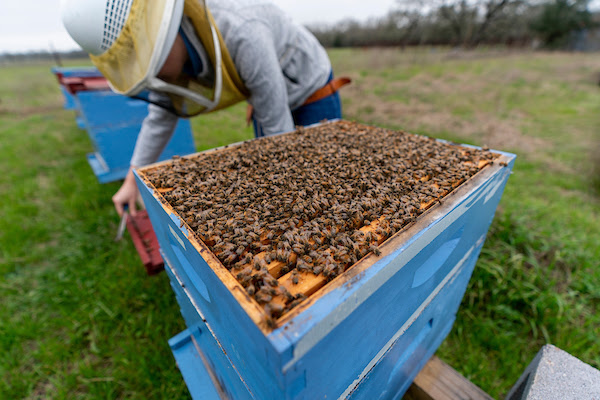
A bee hive box with the top removed exposing thousands of honey bees.

 Beekeeping is booming in Texas. Slater will provide expertise to Texans across the spectrum of demand, including commercial and hobbyists involved in honey production and pollination services to amateur beekeepers seeking tax exemptions. (Courtney Sacco; Laura McKenzie/Texas A&M AgriLife)

Beekeeper Becomes A Scientist

Slater grew up around commercial beekeeping. He earned bachelor’s and master’s degrees in biology from North Dakota State University and a doctorate in entomology from Purdue University.

He spent two years as the technology transfer team lead and directly supported 30 commercial beekeepers in North Dakota and Texas for the Bee Informed Partnership at the University of Minnesota. He most recently worked as a postdoctoral fellow at the U.S. Department of Agriculture Agricultural Research Service Honey Bee Breeding, Genetics and Physiology Lab in Baton Rouge, Louisiana.

Slater said his position is poised to improve and expand AgriLife Extension programs dedicated to beekeepers, including honey production and pollination services, at all scales and skill levels. He hopes collaborations with established beekeepers, beekeeping organizations, state agencies and other academic institutions alongside Texas A&M AgriLife researchers and specialists can propel innovation and sustainable success across the industry and agriculture that its services support.

“I am a beekeeper who became a scientist,” he said. “My goal is to serve Texas beekeepers and help them improve colony health, reduce losses and make their operations sustainable. I’m most passionate about the ability to work with beekeepers to impact their businesses and the industry.”

Would you like more information from Texas A&M AgriLife?

Visit AgriLife Today, the news hub for Texas A&M AgriLife, which brings together a college and four state agencies focused on agriculture and life sciences within The Texas A&M University System, or sign up for our Texas A&M AgriLife E-Newsletter.

For more resources including photo repository, logo downloads and style guidelines, please visit the Resources for Press and Media.

Power Hour with the Chamber (Polk County)

0
Date and Time Information:
Tuesday, Aug 6, 2024
8:00 AM – 9:00 AM CDT
Location:
Chick-fil-A
1821 Hwy 190 W
Livingston, TX 77351
Fees/Admission:
Dutch
Website:
The Chamber
Contact Information:
936.327.4929
Send Email

Business After Hours Hosted by Axley & Rode, LLP (Polk County)

0

Date and Time Information:
Thursday, Aug 1, 2024
5:30 PM – 6:30 PM CDT

Location:
Kathie’s Kitchen
508 N Washington
Livingston, TX 77351

Website:
The Chamber

Contact Information:
936.327.4929
Send Email

Rescind Water Conservation Notice

0

The mechanical malfunctions that occurred at the Surface Water Treatment Plant on July 29, 2024, have been effectively resolved, resulting in the full restoration of the Public Water System’s operational status. Preventive measures are being implemented to mitigate the risk of similar malfunctions in the future.

Any anticipated fluctuations in water pressure across the system have been successfully addressed through the commendable efforts of our Water Operators and independent service providers. NO BOIL WATER NOTICES WERE REQUIRED.

We wish to extend our sincere appreciation for the patience and understanding demonstrated by the community and commercial entities during this period. Your collaboration has been pivotal as we diligently worked to address the emergent challenges, both presently and prospectively. Thank you for your ongoing collaboration and support as we steadfastly uphold our commitment to ensuring the reliability and safety of our water supply system.

Thank you for your continued cooperation and support as we remain committed to ensuring the reliability and safety of our water supply system.

Water Conservation Notice: Mechanical Issues at Treatment Plant

0

Due to unforeseen mechanical malfunctions at the Surface Water Treatment Plant, the Public Water System kindly requests that individuals conserve water through this Wednesday. Officials request that residents reduce or cease lawn irrigation during this period as well. We anticipate potential temporary water pressure fluctuations across the water systems during this period.

The Public Water System greatly appreciates the patience and understanding of the community as we diligently work to address these matters. Thank you for your cooperation.

Walmart & Lufkin Coca-Cola Join Forces with The Salvation Army for Day of Caring

0

Lufkin, Texas (July 29, 2024) – Walmart and Lufkin Coca-Cola will be partnering with The Salvation Army of Lufkin on Tuesday, July 30 to organize a Day of Caring. This collaborative effort aims to make a positive impact on the community by engaging in various projects, including landscaping, beautification initiatives and kitchen renovations.

Captain Jenifer Phillips, Corps Officer of The Salvation Army of Lufkin, expressed her gratitude for the support received from the two companies. She stated, “We are so grateful to Walmart and Lufkin Coca-Cola for their support. Through their Day of Caring, they are helping us in so many ways. We are excited to continue this partnership for years to come.”

The Day of Caring event will bring together volunteers from Walmart, Lufkin Coca-Cola and The Salvation Army to work on multiple projects throughout the day. The focus will be on enhancing the local community and providing assistance where it is needed the most.

Walmart, known for its commitment to corporate social responsibility, is dedicated to making a positive difference in the communities it serves. By partnering with The Salvation Army, Walmart aims to extend its reach and impact, ensuring that those in need receive the support they deserve. Lufkin Coca-Cola, a prominent beverage company in the region, is equally enthusiastic about joining forces with Walmart and The Salvation Army for this Day of Caring. Together, they will contribute their resources and expertise to create a lasting impact on the community.

The projects undertaken during the Day of Caring will not only enhance the physical appearance of the community, but also provide a renewed sense of hope and support to those who rely on The Salvation Army’s services. The Salvation Army hopes to uplift the community and inspire others to get involved in similar initiatives. From landscaping to kitchen renovations, the volunteers will work tirelessly to create a better environment for all.

Walmart, Lufkin Coca-Cola and The Salvation Army are excited to come together for this Day of Caring and are committed to making a lasting impact on the Lufkin community. Through their collective efforts, they hope to inspire others to get involved and create positive change in their own neighborhoods.

For more information about the Day of Caring or to find out how you can support The Salvation Army of Lufkin, please contact Captain Jenifer Phillips at 936-223-6624 or visit their website at www.salvationarmylufkin.org.

Angelina College Weekly Update 

0

Hey, sports fans,

We’re in our last couple of weeks of the “Calm Before the Storm.” Our Lady Roadrunner and Roadrunner athletes are reporting to the campus soon, and soccer will kick off the preseason in fewer than two weeks.

Yes, it’s time to get the balls rolling.

Here’s what’s coming up: 

AC Basketball Hosting Showcase for Incoming High School Seniors

Angelina College Basketball will host an invitation-only showcase for incoming high school seniors on August 2 at Shands Gymnasium. The camp runs from 9 a.m. until 4 p.m. and is designed to allow those Class of 2025 student-athletes an opportunity to showcase their skills in front of college coaches.

More importantly, considering the ever-changing landscape of collegiate athletics and the recruiting process, coaches will be on hand to provide guidance for those hoping to play college basketball. 

The session is “Invite Only”, but anyone interested can check out the following link:

https://www.eventbrite.com/e/ac-basketball-2024-summer-showcase-tickets-923982224707?aff=erellivmlt

For the full story and event description, click this link:

https://angelina.prestosports.com/general/2023-24/releases/acbbsummershowcase2024

AC Soccer Teams Release 2024 Schedules:


AC’s beautiful soccer complex is about to get busy.

Both the Lady Roadrunners and Roadrunners have released their schedules for the upcoming 2024 season, and the teams will combine for at least 12 home dates with at least six home doubleheaders, with more home matches possible according to postseason seedings. 

Both the women’s and men’s schedules now are posted on the AC Athletics website (www.angelinaathletics.com). 

Women’s schedule link: https://angelina.prestosports.com/sports/msoc/2024-25/schedule

Men’s schedule link: https://angelina.prestosports.com/sports/msoc/2024-25/schedule

The Lady ‘Runners’ first home appearance is a pre-season match scheduled for Saturday, Aug. 10 against Brookhaven College, with kickoff scheduled for 11 a.m. at the AC Soccer complex on the AC campus.

The men’s first home action features back-to-back pre-season matches against Texas A&M-San Antonio (4 p.m. on Saturday, Aug. 24) and Western Texas (6 p.m. on Tuesday, Aug. 27).

All AC Soccer regular-season home games will be live-streamed on TSBN Sports (a free streaming service for fans), with most of the conference road games also available for streaming. 

Reminder: Admission to ALL Angelina College Athletics sporting events is free. 

Guy Davis Golf Tournament Date, Location Set

The 17th Annual Guy Davis Golf Tournament has a date now, along with a temporary change in location.

The tournament, hosted by the Roadrunner Foundation, serves as the biggest fundraiser for all our AC Athletics programs.

This year’s tournament will take place on Saturday, August 17, with the pre-tournament kickoff dinner taking place starting at 6:30 p.m. on Friday, August 16.

Because of the ongoing course renovations at Crown Colony Country Club – the usual site for the tournament – this year’s golf will take place at the Neches Pines Golf Course in Diboll, Texas.

Crown Colony Country Club still will serve as the site for the kickoff dinner.

Reminder: The teams fill up quickly, and there IS a limit to the number of teams allowed to participate. Those wishing to register teams should visit the following link:

https://guydavis.golfgenius.com/pages/10616287421299441260

AC Softball, Baseball Post Fall Schedules

A new year brings new days for all our sports, and now the Angelina College Lady Roadrunner softball and Roadrunner baseball teams are showing they’re ready to roll.

Both softball and baseball have posted their “Fall Ball” schedules for the next few months.

Click the links for each sport to view the schedules:

Lady Roadrunner Softball: https://angelina.prestosports.com/sports/sball/2024-25/schedule

Roadrunner Baseball: https://angelina.prestosports.com/sports/bsb/2024-25/schedule

Changes, Upgrades Coming to AC Athletics Web Site, Social Media

We’re gonna need a bigger website. 

Angelina College Athletics’ official website (www.angelinaathletics.com) and all related social media will be getting a massive, much-needed overhaul over the summer. Joining our staff are some true website and graphics wizards, and they’re going to help with the redesign and upkeep of all our forms of internet and social media presence going forward. 

Our tentative launch date for all the new-look websites is mid-September. That’s when we’re hoping to reveal the new website, along with all the revamped (and possibly reborn) social media sites. For now, the “old” website will continue to post information. 

In the meantime, we’ll be posting on all those sites to make everyone aware of the coming changes. Some of the current sites need only a little updating, while others may have to disappear completely in order to make room for the new version.

As always, we’ll keep you updated all the way up until the big date. 

For any other information, contact Gary Stallard at gstallard@angelina.edu. 

We’ll see you at the games.

Gary Stallard
Email: gstallard@angelina.edu.
Phone: (936) 465-4614

Sabine National Forest Timber Sales Invested in Sabine and Shelby Counties

0

HEMPHILL, Texas—Sabine and Shelby counties received $657,492 for county road improvement projects from timber sale profits on the Sabine National Forest through the Good Neighbor Authority partnership. 

The Good Neighbor Authority, a USDA Forest Service program fostering partnerships with state forestry agencies for forest stewardship practices, allowed Texas A&M Forest Service foresters to conduct forest management practices on the Sabine National Forest—ultimately producing this timber sale. This partnership began in 2019. 

Jordan Herrin, Texas A&M Forest Service Regional Operations Chief, explained that Texas A&M Forest Service foresters utilized selective forest thinning practices on the national forest, which is a recommended method by both forest services compared to other methods like clear-cutting. 

“Selective forest thinning is conducted when trees reach a size where they are competing against each other for nutrients, water and sunlight,” said Herrin. “Forest thinning gives way for more nutrients and resources to be directed to the healthiest trees remaining. The thinning improves forest health and lessens the likelihood and impacts of destructive insects across the landscape.” 

Funds from the profit of timber sales through this partnership have been directed to Sabine and Shelby counties, due to the national forest’s location in these counties, for approved road improvements.  

“The Good Neighbor funds allowed Sabine County to purchase road material for shared Forest Service roads,” said Daryl Melton, Sabine County Judge. “Currently, Sabine County helps maintain over 100 miles of Forest Service roads. These roads are a vital part of our county. We are so thankful for this program.” 

Leaders from Sabine and Shelby counties expressed that their relationship was strengthened through this partnership, and it will continue as more timber sales occur.   

“Shelby County appreciates the Good Neighbor Authority program for awarding funds to assist in maintaining the Forest Service roads located in the county,” said Allison Harbinson, Shelby County Judge. “We appreciate the partnership between USDA Forest Service and Shelby County and look forward to future projects to benefit the Sabine National Forest and the citizens of Shelby County.” 

State and national forests are owned and operated by state and federal forestry agencies respectively, and they are utilized as experimentation and demonstration models for the public and other foresters and researchers.  

“The partnership between Sabine County, Shelby County, Texas A&M Forest Service and USDA Forest Service is a great example of government working together for the betterment of the public,” said Kimpton Cooper, USDA Forest Service Forest Supervisor. “The use of Good Neighbor Authority has proven to be a winning situation for our local communities and for maintaining healthy forests and for what those forests provide.” 

The forest management practices used in this collaboration effort also emphasize forest sustainability efforts with strategic stand planting, closely monitored forest health, systematic timber harvesting and the utilization of wood and profits after harvesting.  

“By using sustainable forest management methods on state and federal forest lands, it is our goal to demonstrate innovative practices to landowners and forest managers across the state and region,” said Herrin. “Improving the forest health on the National Forest has positive impacts on both public and private forestlands across East Texas.” 

The funds presented are from the timber harvested from two stands consisting of 500 acres in the Sabine National Forest. Harvesting these 43,625 tons of timber began in October 2019 and was completed Dec. 15, 2023.  

Another Good Neighbor Authority timber sale on the Sam Houston National Forest is ongoing. A Good Neighbor Authority timber sale on the Davey Crockett National Forest is being prepared with an anticipated sale in October 2024.  

Summer Thunderstorms and Fish Die-Offs in Ponds 

0

I have had no less than three inquiries this week about massive fish die-offs in local ponds. Pond owners have been alarmed by a shore lined with dead fish. There are always questions about fish diseases or potential toxins, but the cause is a lack of oxygen resulting, oddly, from our recent cool fronts and resulting rain. 

These fish die-offs are the consequence of a pond “turning over”. Each year, pond owners experience massive die-offs of their largest fish from a pond that has decreased oxygen from a turnover.

A common way for ponds to turn over is for a thunderstorm to cause the waters to mix. A turnover event occurs when the upper layer of water cools down from a cold front. A cool snap or a thunderstorm with wind and hard rain can cool the warm surface water making it heavy enough to sink and mix with the oxygen-deficient bottom layer. The net result is a dilution of the oxygen and an increase in the demand for oxygen from decaying organic matter stirred up from the bottom. 

The most serious pond problem during a turn-over is oxygen depletion. Here’s how many of these turn-overs happen. During hot summer weather, surface water becomes less dense as it absorbs heat and floats over a cooler, denser layer of water that is very low in oxygen. 

All the oxygen in a typical pond is produced by aquatic plants, algae, rain splashing, or wind action is in the upper, warmer layer.  The two layers may not mix for weeks at a time, especially in deep ponds. Meanwhile, all the oxygen is depleted in the lower, cooler layer by the biological and chemical activities that take place there as a result of decomposition.

When a turn-over occurs, the surface of the pond often becomes streaked with gray, black, or brown colors. The color of the water may eventually become totally brown, gray, black, or even milky. A distinct foul smell from the rotting organic matter (that was previously on the bottom) may also be noticeable. 

Using surface aerators can help resolve low-oxygen situations. An aerator like the ones used on catfish farms can provide a refuge. In deep ponds, it will not aerate the whole pond or de-stratify the pond’s temperature and oxygen layering, but it will save fish. Fountains rarely will provide enough aeration of surface waters to help a severe depletion.

These turnover events cause the most catastrophic fish kills in ponds. Fundamentally, there are two options: increase the oxygen level or reduce the demand for oxygen by reducing the number of fish. A rule of thumb for ponds is to have no more than 1,000 lbs. of fish per surface acre. Most ponds in our part of the world are much less than one acre.  If yours is only a quarter acre, then keeping more than 250 lbs. (following the rule) is risking massive losses.  

Just how many fish does one have in their pond can be difficult to tell. If you have recently stocked your pond with fish, you may be able to determine the total pounds of fish in a pond. However, on older ponds where fish have been stocked for years, perhaps decades, the natural reproduction of fish populations could make this determination nearly impossible.  Unlike a pasture with livestock grazing, we simply cannot visually determine the stocking rate. 

One can reduce the fish numbers by… just going fishing and cooking what you catch!  Do not toss back anything. If it is too small to eat, throw it over the pond dam and for other wildlife to eat.  By doing this, you will lower the fish population and lessen the level of oxygen needed to keep everything alive. Don’t think of catching 10-20 fish. Think more about removing at least a hundred pounds worth to make a significant impact. 

The other practice to consider is the installation of an aerator that can be run at night and during extended periods of cloudy days. An aerator is good insurance against fish kills and is a piece of equipment that commercial fish producers need to have. That area of oxygenated water near the aerator will help the fish survive until the pond recovers from a low oxygen period. Fountains and other attractive options are used by folks who have no intentions of raising fish commercially but want to add to the beauty of their pond. 

Choosing the right type of aerator is important. In an urgent situation where the pond has been turned over, a surface aerator needs to be used to correct the problem. The attractive fountains can be of help but don’t do enough in severe oxygen depletion situations.  A bottom-style ‘bubbling’ aerator is recommended at the start of the year to keep the entire water column mixed so fish can utilize the entire pond throughout the year.

Finally, check your ponds early in the morning as oxygen levels will be at their lowest at sunrise. If you notice slow, sluggish fish swimming at the surface, it is time to go fishing and remove the excess demand.