

Home Blog Page 635

The Annual Armyworm

0

Each year, we can fully expect to see the devastating Fall Armyworm make it’s appearance in our hay meadows. Unlike their name, they tend to start making their damage in mid to late summer. Earlier weather patterns would appear to me to set up conditions ripe for their appearance. And with such a potential economic pest out there, it bodes well to be prepared.

From research and field observation, the fall armyworm does not apparently overwinter here. Moths fly north from south Texas each year to re-infest this area. Outbreaks can occur in late summer and fall, and follow periods of rain which create favorable conditions for eggs and small larvae to survive. The earliest occurrence one producer told me he saw them was July 4th.

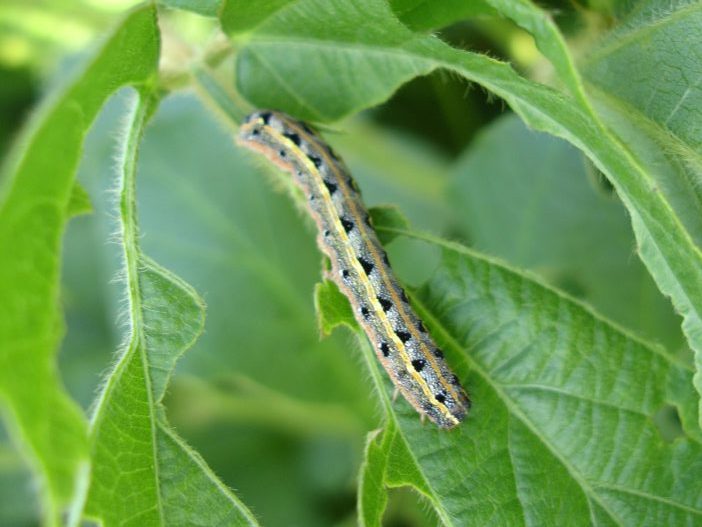
Armyworms are very small at first, causing little plant damage, and as a result, infestations often go unnoticed early on. Larvae feed for 2-3 weeks and full grown larvae are about 1 to 1 2 inches long. Armyworms consume 80% of their total food intake during the last few days of development.

Once larvae are greater than 3/4 inch, the quantity of leaves they eat increases dramatically. During the final 2-3 days of feeding, armyworms consume 80% of the total foliage consumed during their entire development. For this reason, extensive feeding damage can occur in a few days.

Development from egg to adult requires about 4 weeks during the summer and is longer during cool weather. There are several generations a year. Development ends with cold weather in November.

Given their immense appetite, great numbers, and marching ability, armyworms can damage entire fields or pastures in a few days. Once the armyworm completes feeding, in tunnels into the soil about an inch and enters the pupal stage.

A full grown armyworm tunnels into the soil and transforms to the pupae, an inactive, non-feeding stage. In 7-10 days, the moth emerges from the pupa and starts its cycle anew.

The key to managing fall armyworms is to detect infestations before they have caused economic damage. Often, landowners will notice large numbers of cattle egrets on a hay meadow. Though the birds are easy to spot, this may be too late.

The best way I’ve heard to detect armyworms is to regularly scout pastures early in the morning while there is plenty of dew on the grass. Wear your black rubber boots and walk thru fields, or drive thru them on your ATV with a foot dragging off to the side, looking for small caterpillars on your boot. Affected pasture grass may have a ragged look, different from grazed or mowed grass.

Fall armyworm larvae feed primarily during the night and during cloudy weather. Later during the day, look for armyworms under loose soil and fallen leaves on the ground.

The density of armyworms sufficient to justify insecticide treatment will depend on the stage of crop growth and value of the crop. Seedling plants can tolerate fewer armyworms than established plants. Infestations of 2-3 armyworms per square foot may justify treatment.

Hot, dry weather and natural enemies limit armyworm populations. Insect parasites such as wasps and flies, ground beetles, and other predators help suppress armyworm numbers. However, these natural factors can be overwhelmed when large numbers of migrating moths lay tens of thousands of eggs in a field.

There are a number of insecticides labeled for armyworm control in pastures. Remember that approved insecticides can kill non-target insects. Do not allow drift across fences to areas with blooming plants as beneficial pollinators will certainly be harmed.

Here are the names of some good control products: Karate Z, Lambda-Cy, Mustang Max, Tombstone Helios, Warrior II, Baythroid XL, Dimilin 2L, Prevathon, Besiege, Malathion, and (of course) the variety of Sevin products.

Always read and follow all label instructions and restrictions on any pesticide use.

Cary Sims is the County Extension Agent for agriculture and natural resources for Angelina County. His email address is cw-sims@tamu.edu.


Back-to-School Checklist for Families with Asthma

0

For the more than six million children living with asthma nationwide, gearing up for another school year involves much more than picking out a new pencil case and backpack. Asthma is the third leading cause of hospitalization among children in the U.S. under the age of 15 and one of the main reasons that students miss school due to illness, with more than 10 million lost school days every year.

With better asthma management, children are able to feel healthy and safe, and are ready to learn. For a full toolkit and free resources, visit Lung.org/asthma-in-schools.

To get ready for a successful school year, the American Lung Association alo recommends this back-to-school checklist for families with asthma:

1. Schedule a check-up with your child’s physician.

Use your yearly check-up to create or revise your Asthma Action Plan, check the effectiveness of asthma medication and dosage, and get prescriptions for back-up medications for your school nurse, coaches, after-school programs and other individuals helping with your child’s care.

2. Assess your child’s readiness to self-carry medication.

All 50 states have laws that allow children to self-carry and use their asthma inhalers at school. Use the American Lung Association’s Self-Carry Assessment Tool to see if your child is ready to carry and self-administer his or her asthma medication, which can save precious time, as well as ease concern if your child has an asthma episode at school.

3. Set up an appointment with your school nurse.

Remember to bring in your updated Asthma Action Plan and back-up medications. Take this time to sign all required medical forms and talk about whether your child can self-carry his or her own quick-relief inhaler, and how to manage any asthma emergencies that may happen during the school year.

4. Talk to your classroom teacher.

Take a moment to talk to your child’s teacher about his or her asthma, what triggers might bring on an attack and what to do in an emergency — whether that is to head directly to the school nurse or use a quick-relief inhaler.

5. Introduce yourself to the PE teacher and any coaches.

Kids with asthma shouldn’t have to miss out on playing outside or participating in gym class! You can quickly put minds at ease by talking about exercise-induced asthma, ways to manage symptoms and what to do in an emergency.

6. Have fun!

There’s a lot to do at the start of the school year, but it can also be exciting to see old school friends and prep for a whole new year. Make sure to take a deep breath and enjoy!

Texas Prepaid Tuition Program Enrollment Deadline Approaches

0

The deadline is July 31 for Texas families to enroll their newborns in the Texas Tuition Promise Fund® and prepay for all or some future tuition and school-wide required fees at Texas public colleges and universities. Newborns are children younger than one year at the time of enrollment.

Under the Texas Tuition Promise Fund, the state’s prepaid college tuition program, participants can purchase tuition units and lock in costs based on today’s prices.

“For Texas families concerned about rising tuition costs, now is a good time to start planning early and consider enrolling your newborn in this program,” Texas Comptroller Glenn Hegar said.

Enrollment at 2015-16 prices closed Feb. 29 for children older than one. The next annual enrollment period begins on Sept. 1 and is based on Texas public college and university tuition and school-wide required fees for the 2016-17 school year.

Complete plan information, including plan description and agreement, current prices, enrollment forms and more is available online at this website, or by calling 1-800-445-GRAD (4723), Option 5.

Purchasers should carefully consider the risks, administrative fees, service, and other charges and expenses associated with the contracts. This includes plan termination and decreased transfer or refund value. Purchasers should read these documents carefully before purchasing a contract.

Participation in the plan does not guarantee admission to any college or university.

Open Season For All Angelina Arts Alliance Shows Begins Soon

0

Open Season on all single tickets for all shows of the 2016-2017 Performing Arts Series and Family Funday Series go on sale Monday, Aug. 1 at 11 a.m. This is the fourth year that tickets for all performances have gone on sale at once. The Angelina Arts Alliance is celebrating 16 years of bringing the very best from the world of performing arts to East Texas. The line-up includes an iconic Broadway musical, an array of award-winning singers and musicians and, two shows that will be ‘firsts’ to appear on the Temple Theater stage – Illusionist Rick Thomas and the Fort Worth Symphony Orchestra. The 2016-17 Performing Arts Series Sponsors are Georgia – Pacific and CHI St. Luke’s Health Memorial.

“In years past, the non-subscription seats or single tickets would go on sale for each show 30 days before show date” explained Tracy Pinkerton, executive director. “Now, people can make one stop and purchase tickets for two or three shows at once, and our patrons love that convenience.”

She added, “Giving tickets as gifts has gotten more popular, as people give pairs of tickets for all occasions like birthdays, anniversaries, Christmas, and Mother’s Day. It is a great way to ‘Shop Local’ and give a unique, one-of-a-kind personal experience.”

Besides Rick Thomas and FWSO, the 2016-2017 season includes: Jimmy Webb, America’s Songwriter, A Wynonna & The Big Noise Christmas, Neil Simon’s Barefoot in the Park, 42nd Street – National Broadway Tour, and Ernie Haase + Signature Sound – The Inspiration of Broadway, featuring Broadway legend J. Mark McVey.  

Kristie Bailey, Box Office Manager, advised, “By purchasing tickets online through our website there is no line and no busy signal, and even though there is a $6 per seat service charge, it is simple to ‘click’ and pick your seats.”

For popular shows like Wynonna, she recommends starting your online search in the balcony where you will find the most seats to choose from. She added “If you prefer to shop in person, the box office opens at 11 a.m. So stop by or call.”

By visiting the Angelina Arts Alliance website you will be able to review the entire season, learn details about each show and the performers, as well as check dates and ticket prices.     

To purchase tickets online go to www.angelinaarts.org, call the box office at (936) 633-5454, or visit the Temple Theater box office in person Monday – Friday, 11 a.m. to 5 p.m. on the Angelina College campus in Lufkin. Follow Angelina Arts Alliance on Facebook for late-breaking news and ticket giveaways.

Sabine County Recycling Center To Close

0

Saturday, July 23, is one of the 24 days Sabine County residents will have a means to drop off their recycling. The Sabine County Recycling Committee has been on site at the Precinct 1 Barn on Edwards Road in Hemphill every second Wednesday and Fourth Saturday to accept and process recycling.

However, the days to recycle at the center are now numbered. The recycling center is set to close on November 26.

The center has been open for eight years and manned entirely by a staff of volunteers. The volunteers came together and decided they were unable to continue this process because of a lack of volunteers.

In order to smoothly go through the process of closure, the center will be accepting less and less recycling as the closing date approaches. August 27 will be the last day for collecting mixed paper goods and all cans. October 12 will be the last day for collecting #1 and #2 plastics. November 26 will be the final day the center is open.

The committee asks residents to not bring their recycling when the site is closed, and they offer their help to residents while the site is open. The committee is made up of volunteers from the community, and first began in 2008.

Your Regional Fishing Report

0

Week of July 20, 2016

Bob Sandlin
Water lightly stained; 85–89 degrees; 0.22′ low. Black bass are fair on shad pattern deep diving crankbaits and Carolina rigged worms. Crappie are slow on minnows. White bass are good on slabs. Catfish are fair on trotlines.
Caddo
Water stained to muddy; 85–91 degrees; 0.50′ high. Black bass are fair on hollow body frogs and weightless Senkos. Crappie are fair on minnows and jigs. Catfish are fair on trotlines and prepared bait.
Conroe
Water murky; 82–86 degrees; 0.67′ low. Black bass are good on watermelon soft plastics and white spinnerbaits. Striped bass are fair on white striper jigs. Crappie are good on minnows over brush piles. Catfish are good on stinkbait and shrimp.
Fork
Water stained; 86–90 degrees; 0.91′ low. Black bass are fair on Carolina rigged Flukes, football jigs and deep diving crankbaits. White and yellow bass are fair on minnows. Crappie are fair on minnows and jigs. Catfish are fair on trotlines and rod and reel.
Houston County
Water stained; 86–90 degrees; 0.37′ low. Black bass to 4 pounds are good on green pumpkin football jigs and crankbaits in brush in 14–20 feet. Crappie are very good on live minnows over brush tops in 15 feet. Bream are slow. Channel and blue catfish are good on trotlines baited with shad or perch.
Water stained; 2.90′ high. Black bass are good on football jigs, topwaters and Carolina rigged worms. White bass are slow on slabs. Crappie are fair on minnows. Catfish are slow on trotlines and prepared bait.
Livingston
Water stained; 84–88 degrees; 0.17′ high. Black bass are fair on spinnerbaits and crankbaits. Striped bass are fair on crankbaits and Rat–L–Traps. White bass are fair on slabs, troll tubes, and pet spoons. Crappie are fair on minnows. Blue catfish are fair on shad. Yellow catfish are slow.
Martin Creek
Water lightly stained; 88–93 degrees; 0.98′ low. Black bass are fair on bladed jigs, Senkos and hollow body frogs. Crappie are fair on minnows. White bass are fair on minnows. Catfish are good on trotlines.
Monticello
Water stained; 86–92 degrees; 0.06′ low. Black bass are fair on hollow body frogs and drop shot worms. Crappie are fair on minnows. Catfish are slow on trotlines and cut shad.
Sam Rayburn
Water murky; 83–87 degrees; 0.41′ high. Black bass are good on watermelon spinnerbaits, crankbaits, and soft plastic worms. White bass are fair on slabs and minnows. Crappie are good on minnows and pink tube jigs. Bream are fair on nightcrawlers. Catfish are good on trotlines baited with live bait.
Steinhagen
1.27′ high. No report available.
Toledo Bend
Water murky; 82–86 degrees; 0.55′ low. Black bass are fair on watermelon topwaters and shallow running crankbaits along shorelines. Striped bass are slow. White bass are fair on minnows and white spinnerbaits. Crappie are slow. Bream are good on crickets and nightcrawlers off docks. Channel and blue catfish are good on trotlines baited with live bait, stinkbait, and shrimp in 25–30 feet. Yellow catfish are slow.
Wright Patman
Water muddy; 20.91′ high. No report available.

Your Freshwater Fishing Report

0

Week of July 20, 2016

ALAN HENRY
Water clear; 87 degrees; 2.2’ low. Black bass are good early on topwaters, later watch your fish finder – fish are schooling under water and can be caught on rattle–back spoons up to 50 feet deep. Crappie are fair at night under lights. Catfish are fair on juglines.
AMISTAD
Water murky; 85–89 degrees; 24.13’ low. Black bass are good on watermelon crankbaits, spinnerbaits, and soft plastics. Striped bass are fair on shad and chartreuse topwaters. White bass are fair on slabs and small spinnerbaits. Channel and blue catfish are good on nightcrawlers, liver, and shrimp over baited holes. Yellow catfish are fair on trotlines baited with live perch. Everyone in a boat must have a Mexico fishing license (if fishing the Mexico side) whether fishing or not.
ARROWHEAD
Water fairly clear; 85–89 degrees; 0.69’ low. No reports on black bass. Crappie are slow on jigs and minnows in the shallows. Catfish are good on worms and stinkbait.
ATHENS
Water lightly stained; 86–91 degrees; 0.24’ low. Black bass are fair weightless Senkos and football jigs. Crappie are good on minnows. Catfish are good on trotlines and cut shad.
BASTROP
Water murky; 83–87 degrees. Black bass are slow. Crappie are slow. Channel and blue catfish are slow. Yellow catfish are slow.
BELTON
Water murky; 81–85 degrees; 17.36’ high. Black bass are slow. Hybrid striper are slow. White bass are slow. Crappie are slow. Channel and blue catfish are slow. Yellow catfish are slow.
BOB SANDLIN
Water lightly stained; 85–89 degrees; 0.22’ low. Black bass are fair on shad pattern deep diving crankbaits and Carolina rigged worms. Crappie are slow on minnows. White bass are good on slabs. Catfish are fair on trotlines.
BONHAM
Water lightly stained; 85–89 degrees; 1.03’ low. Black bass are good on topwaters, Texas rigged worms and deep diving crankbaits. Crappie are good on brush piles in 10–12’. Catfish are good on cut shad and prepared bait.
BRAUNIG
Water murky. Black bass are good on crankbaits and watermelon soft plastics near the dam. Striped bass are good on liver, shad, and gold spoons along shorelines. Redfish are fair on perch and shad in the reeds. Channel catfish are good on shrimp, cut bait, and nightcrawlers. Blue catfish are fair on stinkbait.
BRIDGEPORT
Water stained to lightly stained, 84–89 degrees: 0.29’ high. Black bass are good on squarebill crankbaits and topwater poppers. Crappie are good on minnows. White bass are fair on slabs. Hybrid striper are good on slabs and topwaters. Catfish are slow on prepared bait.
BROWNWOOD
Water murky; 82–86 degrees; 0.25’ low. Black bass are good on chartreuse/white spinnerbaits and soft plastic worms over brush piles in 15–25 feet. Hybrid striper are fair on shad at night. White bass are fair on Li’l Fishies and slabs. Crappie are good on minnows and chartreuse tube jigs. Channel catfish are good on trotlines baited with cut bait and shrimp. Yellow catfish are slow.
BUCHANAN
Water murky; 81–85 degrees; 0.19’ low. Black bass are good on topwaters, Chug Bugs, and Texas rigged watermelon soft plastics. Striped bass are good on Rat–L–Traps and swim baits. White bass are fair on minnows and Li’l Fishies around brush. Crappie are fair on minnows. Channel catfish are fair on shrimp and stinkbait. Yellow and blue catfish are good on goldfish and perch upriver.
CADDO
Water stained to muddy; 85–91 degrees; 0.50’ high. Black bass are fair on hollow body frogs and weightless Senkos. Crappie are fair on minnows and jigs. Catfish are fair on trotlines and prepared bait.
CALAVERAS
Water murky. Black bass are good on chartreuse spinnerbaits, crankbaits, and soft plastics near the jetty. Striped bass are fair on silver spoons and striper jigs near the dam. Redfish are fair on live perch and tilapia along the shoreline. Channel and blue catfish are excellent on live bait, shrimp, and shad. Yellow catfish are slow.
CANYON LAKE
Water murky; 82–86 degrees; 0.85’ high. Black bass are good on topwaters, Rat–L–Traps, and watermelon soft plastics along shorelines. Striped bass are slow. White bass are fair on minnows and Tiny Traps early and late. Smallmouth bass are fair on smoke grubs, and dark crankbaits early. Crappie are fair on minnows and pink tube jigs. Channel catfish are fair on liver and shrimp. Yellow and blue catfish are fair on goldfish and perch.
CEDAR CREEK
Water lightly stained; 86–90 degrees; 0.58’ low. Black bass are fair on Texas rigged craws and shakeyheads on docks with brush. White bass are fair on slabs. Hybrid striper are good on slabs. Crappie are good on minnows. Catfish are fair on trotlines.
CHOKE CANYON
Water murky; 82–86 degrees; 22.05’ low. Black bass are good on chartreuse spinnerbaits and crankbaits, and watermelon soft plastics. White bass are slow. Crappie are fair on minnows. Channel and blue catfish are fair on liver and shrimp. Yellow catfish are fair on live bait.
COLEMAN
Water murky; 83–87 degrees; 0.31’ low. Black bass are good on watermelon soft plastic worms and chartreuse topwaters. Hybrid striper are fair on live bait. Crappie are fair on minnows and white tube jigs. Channel catfish are good on trotlines baited with live perch and nightcrawlers. Yellow catfish are slow.
COLETO CREEK
Water murky; 98 degrees at the hot water discharge, 88 degrees in main lake; 0.57’ low. Black bass to 5 pounds are good on green pumpkin soft plastic worms and crankbaits in 8–10 feet. White bass are slow. Crappie are good on minnows and blue tube jigs in 10–12 feet. Channel and blue catfish to 9 pounds are fair on live perch and cut bait in 8–10 feet. Yellow catfish are slow.
COLORADO CITY
20.89’ low. No report available.
CONROE
Water murky; 82–86 degrees; 0.67’ low. Black bass are good on watermelon soft plastics and white spinnerbaits. Striped bass are fair on white striper jigs. Crappie are good on minnows over brush piles. Catfish are good on stinkbait and shrimp.
COOPER
Water stained to muddy; 0.57’ low. No report available.
FAIRFIELD
Black bass fishing reported as significantly improved. TPWD discontinued stocking the lake after the fish kill in September 2011. Redfish survived the kill in limited numbers.
FALCON
Water murky; 85–89 degrees; 30.82’ low. Black bass are good on crankbaits, jigs, and Carolina rigged magnum flukes. Striped bass are slow. Crappie are excellent on live minnows and chartreuse tube jigs. Channel and blue catfish are excellent on shrimp, shad, and cut bait. Yellow catfish are slow. Everyone in a boat must have a Mexico fishing license (if fishing the Mexico side) whether fishing or not.
FAYETTE
Water murky. Black bass are fair on spinnerbaits and small Rat–L–Traps. Channel and blue catfish are good on minnows and cut bait over baited holes.
FORK
Water stained; 86–90 degrees; 0.91’ low. Black bass are fair on Carolina rigged Flukes, football jigs and deep diving crankbaits. White and yellow bass are fair on minnows. Crappie are fair on minnows and jigs. Catfish are fair on trotlines and rod and reel.
FT. PHANTOM HILL
Water murky; 84–88 degrees; 0.01’ high. Black bass are fair on topwaters, chatterbaits and Texas rigs. Crappie are fair on jigs and minnows. Catfish are fair to good on cut bait.
GIBBONS CREEK
Water murky. Black bass are fair on watermelon soft plastic worms and lizards. Crappie are fair on minnows and white tube jigs. Catfish are good on live bait.
GRANBURY
Water murky; 82–86 degrees; 0.04’ low. Black bass are fair on watermelon spinnerbaits and crankbaits. Striped bass are fair on watermelon soft plastics. White bass are slow. Crappie are fair on minnows. Catfish are good on minnows, nightcrawlers, and shrimp.
GRANGER
Water murky; 81–85 degrees; 0.83’ high. Black bass are fair on Rat–L–Traps and watermelon soft plastics. White bass are fair on pet spoons and small spinnerbaits early and late. Crappie are good on minnows and chartreuse tube jigs in 10–15 feet. Blue catfish are good on juglines baited with perch and shad. Yellow catfish are slow.
GRAPEVINE
Water stained to muddy; 85–90 degrees; 4.23’ high. Black bass good on Texas rigged soft plastics and shakyheads. White bass and hybrid bass are slow on slabs. Crappie are fair on minnows. Catfish are fair on trotlines.
GREENBELT
32.26’ low. No report available.
HOUSTON COUNTY
Water stained; 86–90 degrees; 0.37’ low. Black bass to 4 pounds are good on green pumpkin football jigs and crankbaits in brush in 14–20 feet. Crappie are very good on live minnows over brush tops in 15 feet. Bream are slow. Channel and blue catfish are good on trotlines baited with shad or perch.
HUBBARD CREEK
Water off color; 85–90 degrees; 0.81’ low. Black bass are fair to good on buzzbaits and Pop–Rs early, later switching to Texas rigs, Carolina rigs and jigs. Crappie are fair to good on jigs and minnows. Catfish are good on nightcrawlers and live shad.
JOE POOL
Water lightly stained; 84–89 degrees; 0.08’ high. Black bass are good on Texas rigged creature baits and bladed jigs. White bass are fair on slabs. Crappie are good on minnows. Catfish are good on prepared bait.
LAKE O’ THE PINES
Water stained; 2.90’ high. Black bass are good on football jigs, topwaters and Carolina rigged worms. White bass are slow on slabs. Crappie are fair on minnows. Catfish are slow on trotlines and prepared bait.
LAVON
Water stained; 86–90 degrees: 0.27’ low. Black bass are slow on buzzbaits, wakebaits and bladed jigs. White bass are fair on slabs. Crappie are fair on minnows. Catfish are good on trotlines.
LBJ
Water stained; 82–86 degrees; 0.72’ low. Black bass are fair on watermelon soft plastic worms and lizards, and on chartreuse Rat–L–Traps. White bass are slow. Crappie are good on minnows and blue tube jigs over brush piles. Channel catfish are good on liver and stinkbait. Yellow and blue catfish are good on trotlines baited with live perch.
LEWISVILLE
Water stained; 85–90 degrees; 1.64’ high. Black bass are good on Texas rigged craws and topwater walking baits. White bass are fair on slabs. Crappie are good on minnows. Catfish are good on trotlines.
LIVINGSTON
Water stained; 84–88 degrees; 0.17’ high. Black bass are fair on spinnerbaits and crankbaits. Striped bass are fair on crankbaits and Rat–L–Traps. White bass are fair on slabs, troll tubes, and pet spoons. Crappie are fair on minnows. Blue catfish are fair on shad. Yellow catfish are slow.
MACKENZIE
72.82’ low. No report available.
MARTIN CREEK
Water lightly stained; 88–93 degrees; 0.98’ low. Black bass are fair on bladed jigs, Senkos and hollow body frogs. Crappie are fair on minnows. White bass are fair on minnows. Catfish are good on trotlines.
MEREDITH
58.37’ low. No report available.
MONTICELLO
Water stained; 86–92 degrees; 0.06’ low. Black bass are fair on hollow body frogs and drop shot worms. Crappie are fair on minnows. Catfish are slow on trotlines and cut shad.
NASWORTHY
84–89 degrees; 1.05’ low. Black bass are fair to good on Zara Spooks early, later switching to Texas rigs, jigs and wacky rigs. No reports on crappie. Catfish are fair to good on nightcrawlers and cut bait.
NAVARRO MILLS
Water murky; 83–87 degrees; 0.75’ high. Black bass are slow. White bass are slow. Crappie are slow. Channel catfish are slow. Blue catfish are slow. Yellow catfish are slow.
O.H. IVIE
Water stained; 86–90 degrees; 34.02’ low. Black bass are fair to good on weightless flukes, jigs, medium running shad pattern crankbaits and Texas rigs. Crappie are fair to good on minnows and jigs. Catfish are fair to good on live bait.
OAK CREEK
Water stained; 84–88 degrees; 10.85’ low. Black bass are fair on topwaters early, later switching to Texas rigs, crankbaits and jigs. Crappie are fair to good on minnows and jigs in the shallows. Catfish are fair on chartreuse (use Worn–Glo) nightcrawlers.
PALESTINE
Water lightly stained; 85–89 degrees; 0.50’ low. Black bass are good on Texas rigged craws and squarebill crankbaits. Crappie are fair on minnows. Hybrid striper are good on slabs and topwaters. White bass are fair on slabs. Catfish are fair on trotlines and cut shad.
PALO DURO
54.16’ low. No report available.
POSSUM KINGDOM
Water off color; 84–90 degrees; 0.04’ high. Black bass are fair on wacky rigs, Texas rigs, jigs and drop shot rigs. Crappie are fair to good on split shot weighted live minnows. White bass are fair to good on Road Rooster Tails. Striped bass are fair on live shad. Catfish are fair to good on nightcrawlers and cur bait.
PROCTOR
Water murky; 82–86 degrees; 0.30’ high. Black bass are slow. Striped bass are slow. White bass are slow. Crappie are slow. Channel and blue catfish are slow. Yellow catfish are slow.
RAY HUBBARD
Water stained; 85–90 degrees; 0.12’ low. Black bass are fair on football jigs, medium and deep diving crankbaits. Crappie are fair on minnows. White bass are good on slabs. Hybrid striper are good on slabs. Catfish are fair on trotlines and prepared bait.
RAY ROBERTS
Water stained; 85–90 degrees; 0.34’ high. Black bass are fair on deep diving crankbaits, football jigs and Carolina rigged Flukes. White bass are good on slabs and minnows. Crappie are slow on minnows and jigs. Catfish are fair on trotlines and cut shad.
RICHLAND CHAMBERS
Water stained; 84–90 degrees; 0.07’ high. Black bass are slow on Texas rigged creature baits and topwaters. White bass are fair on slabs. Hybrid striper are good on slabs. Crappie are fair on minnows and jigs. Catfish are good on trotlines and prepared bait.
SAM RAYBURN
Water murky; 83–87 degrees; 0.41’ high. Black bass are good on watermelon spinnerbaits, crankbaits, and soft plastic worms. White bass are fair on slabs and minnows. Crappie are good on minnows and pink tube jigs. Bream are fair on nightcrawlers. Catfish are good on trotlines baited with live bait.
SOMERVILLE
Water murky; 84–88 degrees; 12.61’ high. Black bass are slow. Hybrid striper are slow. White bass are slow. Crappie are slow. Channel and blue catfish are slow. Yellow catfish are slow.
SPENCE
54.14’ low. No report available.
STAMFORD
0.3’ low. No report available.
STEINHAGEN
1.27’ high. No report available.
STILLHOUSE
Water murky; 83–87 degrees; 4.38’ high. Black bass are slow. White bass are slow. Crappie are slow. Channel and blue catfish are slow. Yellow catfish are slow.
SWEETWATER
Water off color; 83–89 degrees; 22.33’ low. No report available.
TAWAKONI
Water stained; 87–91 degrees; 0.08’ low. Black bass are good on hollow body frogs, flipping jigs and Texas rigged craws on docks and lily pads. White bass are good on slabs. Hybrid bass are good on slabs. Crappie are good on minnows. Catfish are fair on trotlines and rod and reel.
TEXOMA
Water stained to muddy; 85–89 degrees; 1.38’ high. Black bass are good on topwaters, crankbaits and Texas rigged worms. Crappie are good on minnows. Striped bass are good on slabs. Catfish are slow on trotlines.
TOLEDO BEND
Water murky; 82–86 degrees; 0.55’ low. Black bass are fair on watermelon topwaters and shallow running crankbaits along shorelines. Striped bass are slow. White bass are fair on minnows and white spinnerbaits. Crappie are slow. Bream are good on crickets and nightcrawlers off docks. Channel and blue catfish are good on trotlines baited with live bait, stinkbait, and shrimp in 25–30 feet. Yellow catfish are slow.
TRAVIS
Water murky; 84–88 degrees; 1.04’ low. Black bass are slow. Striped bass are slow. White bass are slow. Crappie are slow. Channel and blue catfish are slow. Yellow catfish are slow.
WALTER E. LONG
Water murky. Black bass are slow. Hybrid striper are slow. White bass are slow. Crappie are slow. Channel and blue catfish are slow. Yellow catfish are slow.
WEATHERFORD
Water stained; 0.87’ low. No report available.
WHITE RIVER
Water stained; 84–89 degrees; 17.81’ low. No report available.
WHITNEY
Water murky; 82–86 degrees; 0.05’ low. Black bass are slow. Striped bass are slow. White bass are slow. Crappie are slow. Catfish are slow.
WRIGHT PATMAN
Water muddy; 20.91’ high. No report available.

Back-To-School Tips To Get Kids To Brush Regularly

0

As the new school year moves near, many parents are left with the age-old struggle of how to get their child to brush their teeth regularly before heading off to the bus stop each day. The good news is that for those parents who put in the effort, their kids will usually develop good oral hygiene habits. Prior to the school year beginning, parents can start working on helping their child develop good daily brushing habits.

“It’s important that parents get kids started young with good oral hygiene habits,” explains Dr. Bruno Sharp, a fourth-generation dentist who created a line of natural fluoride-free products called Dr. Sharp Dentistry, and is celebrating his 10th year as a Natural Oral Care provider. “For some families it may seem like a tall task, but it’s one that is important enough to keep working on. Most kids will come around and stick with the habits that they are being taught.”

Here are some back-to-school tips for helping kids establish good morning oral hygiene habits:

  • Teach them why. Discuss the reasons why they need to brush regularly, so they know why they are doing it. You can make this easier and still keep it age-appropriate by picking up some kid’s books about brushing, too. Make it fun. When parents make brushing time fun, little kids are more likely to want to participate. Have a brushing song or fun routine that goes along with getting the job done each day.
  • Give them rewards. Kids love to get rewards, even if it’s a sticker added to their sticker chart. Once they meet their brushing goals, take them to the store to pick out a book. This will help to keep reinforcing the habit. Praise their efforts. Rather than focusing on what they fall short of or miss, stick to keeping it positive and giving kudos for the parts they do well. They can always go back and improve areas missed, but positive reinforcement goes a long way.
  • Help and hold accountable. Up until kids are around 8-9 years old, parents may need to keep going into the bathroom with them to ensure proper brushing is being done. While it may seem like a pain, it’s helping them to establish lifelong habits that will benefit them greatly in the long run.

“The last thing parents want to do before school each day is to argue with their kids about brushing their teeth,” added Dr. Sharp. “When you make a plan and stick to it, you are usually going to be more successful in getting them to create the brushing habit. It’s all about looking after their best interest.”

Another issue that parents should be aware of with school coming back is fluorosis, which is marked by changes in the appearance of the tooth’s enamel. According to the Centers for Disease Control and Prevention (CDC), children eight and under are at risk for the condition, because they still have adult teeth under their baby teeth. Dentists such as Dr. Sharp are warning parents to avoid fluoride for their children because of the potential health risks, as well as fluorosis.

Common sources of fluoride, according to the CDC, include toothpaste (which also come with a fluoride warning label right on the label), drinking water that has been fluoridated, and other oral hygiene products, such as mouthwash. They also recommend that parents not allow children to swallow toothpaste that contains fluoride, yet they advise that unintentionally swallowing it can lead to a greater amount being ingested than intended. Dr. Sharp, however, recommends that parents avoid fluoridated toothpastes altogether in an effort to remove the risks associated with children ingesting fluoride.

Dr. Sharp Natural Oral Care now offers their product line in small, convenient travel size options. His product line includes children’s toothpaste, adult toothpaste, fresh mint mouthwash, and dental tape. All products are safe to use, made in the USA, and are gluten-free, have no artificial colors or flavors, are vegan, non-GMO, alcohol-free, fluoride-free, and cruelty-free. Plus, they help whiten teeth and have xylitol, which is a natural sweetener that also helps to fight off cavities. The products are safe for the entire family. To learn more about Dr. Sharp Natural Oral Care products or see where they can be purchased, visit the site at this website.

Nacogdoches Pokemon Go Players Invited To Sidewalk Discussions

0

City of Nacogdoches residents are invited to share ideas to help shape the future of our community in regards to connectivity, walkability, and sidewalks while taking advantage of the new sensation, Pokemon Go. As part of this game, a lure module will be placed at City Hall on Friday July 22, 2016 from 11:00 a.m. to 1:00 p.m to attract citizens and gain feedback on these topics.

Since residents walk on the sidewalks as part of the game, the City of Nacogdoches hopes players will attend this event and tell the city about their experiences on the sidewalks throughout town.

Last week, the City of Nacogdoches invited all residents to a face-to-face discussion about sidewalks in our community. The discussion was held at Nacogdoches High School as part of the #cityofnac discussion series. The event was attended by over 30 residents.

The average Pokemon Go player is in his or her mid to late twenties. Due to this, the City of Nacogdoches hopes to be able to gain a new perspective on sidewalks and walkability from a another age group and different audience.

“Our goal of the #cityofnac discussion series is to make sure a well rounded opinion is formed in order to create the best sidewalk ordinance possible. By engaging this new audience, we hope to achieve this goal,” Amy Mehaffey, Main Street and Communications Director said.

“Overall this sidewalk discussion is important because we need to begin a two-way conversation to allow city leaders and community members to understand what’s needed in Nacogdoches,” Steve Bartlett, City Engineer said.

A third discussion series session regarding sidewalks will be held on August 9 in order to begin defining specific, ordinance-related verbiage for the future proposed ordinance

Carranza Puppet Show Comes To The Livingston Library

0

The Carranza Puppets will perform at Livingston Municipal Library with a new hand puppet program called “The True Story of Little Red Riding Hood” Wednesday, July 27 at 10:30 a.m.

This version of the old folk fairy tale teaches viewers to hear both sides of a dispute before they decide who is right. It is told from the wolf’s point of view instead of Little Red’s. As the story comes alive through the use of puppetry and color, viewers will get the other side of the famous tale.

Partake of a bit of fantasy as the story reveals what the wolf says really happened with much humor and audience participation.

The Carranza Puppeteers have been doing shows for children since 1977. They are dedicated to performing puppet and marionette shows that are educational and entertaining. Original music is made for each year’s set of shows.

More information on Carranza Puppets can be found at this website.