Lufkin area residents now have a new and innovative option for healthcare with the launch of Go Med Mobile, a freestanding clinic offering a modern approach to urgent care. By integrating mobile and telehealth services, Go Med Mobile provides a patient-first experience that is centered around convenience, accessibility, and quality healthcare.
Go Med Mobile offers a wide range of services, including primary care, BioTe pellet therapy, DOT exams, IV hydration, weight loss services, and drug screenings. The clinic’s innovative model combines traditional in-clinic care with telehealth options and mobile visits, allowing patients to receive care at home, work, or wherever it’s most convenient. This focus on patient needs allows Go Med Mobile to reduce the time and hassle often associated with traditional healthcare visits, putting control back in the hands of the patient.
“Go Med is designed to put the patient first by bringing care to where it’s needed. Convenience and quality care don’t have to be separate expectations when it comes to healthcare, especially for those with children or elderly family members who are unable to easily make in-person visits,” said Jennings Naranjo II, APRN FNP-C, owner and chief clinician at Go Med Mobile.
The clinic’s mobile services include sick visits, sutures, urgent care, and IV therapy, with appointments available via televisit or in-person house calls. The traditional healthcare model—marked by crowded waiting rooms and time-consuming clinic visits—is being left behind in favor of a system where care can be brought directly to patients in the comfort of their own homes. In addition to mobile services, Go Med Mobile offers a patient-centered in-clinic experience designed for efficiency and personalized care.
“You should not have to leave your home when you’re sick,” Naranjo explained. “Time and access should never be barriers to health and well-being. We’re using technology to increase access to quality care in East Texas, and I’m excited to help expand the region’s commitment to being a medical hub.”
Go Med Mobile’s unique care model aims to make healthcare more accessible to all by accepting both insurance and cash pay options. New patients are currently being accepted, with the clinic’s grand opening scheduled for October 1, 2024.
About Go Med Mobile
Go Med Mobile is transforming healthcare in East Texas by offering convenient, high-quality care through a combination of house calls, telemedicine, and in-clinic services. By leveraging modern technologies and prioritizing patient needs, Go Med Mobile provides a hassle-free healthcare experience designed to fit into the lives of busy families, individuals, and those with limited mobility. Whether in-clinic or at home, Go Med Mobile is dedicated to making healthcare more accessible, affordable, and patient-centered.
For more information or to schedule an appointment, visit www.gomedicalmobile.com or call 936-634-6334.
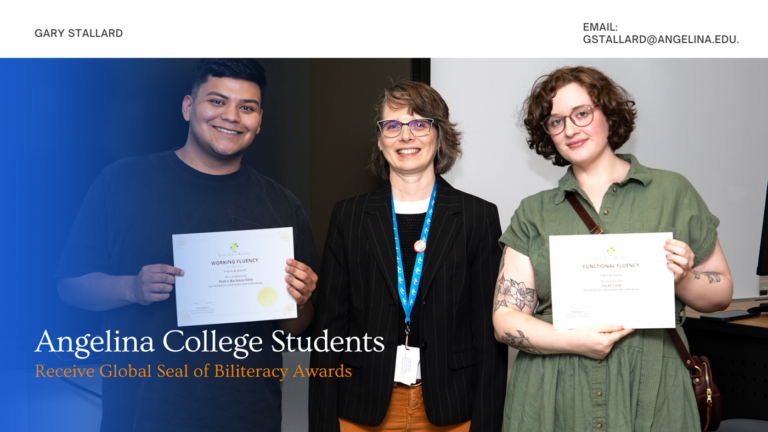
New Program Assists Students in Earning International Credential As the world continues to connect through global marketing, bilingual education and other forms of international outreach, the need for those able to exhibit proficiency in more than one language becomes even more pronounced.
This year, Angelina College Spanish instructor Dr. Annette Gillum found a way to ensure students who wish to do so are able to earn an extremely valuable credential in that very area.
On Friday, Gillum presented three AC students the Global Seal of Biliteracy, a credential awarded in 50 different countries and recognized internationally. Those students – Pedro Barboza-Soto, Sarah Cook and Savannah Bragg – earned the seal through a series of language proficiency tests.
“Students have to prove they’re biliterate in at least two languages, and that goes beyond being bilingual,” Gillum said. “The exam tests proficiency in reading, listening, speaking and writing.
“We’re presenting them with certificates now, but the students can also register and receive digital badges which are extremely useful in gaining employment and scholarships.”
Gillum said this group marked the first time she’d administered the tests as this is a new program for Angelina College. Those three were students in her Spanish class, and Gillum offered the proficiency testing in lieu of a final exam in her class.
“These students were with me for a few semesters, but I just started mentioning this to them back in the spring,” Gillum said. “I asked who would be interested in participating in this, and they wanted to do it.
“This is our first time doing this, but I want to start publicizing it to get more people interested.”
Gillum added that the program also will benefit for whom English isn’t their first language; those individuals can learn proficiency while earning the Global Seal of Biliteracy at the same time.
In addition, considering the large number of international students enrolled and attending on the Angelina College campus, along with the college’s desire to serve entire communities, Gillum said she hopes to see the participation grow to include faculty members as well.
“We’re looking to see where we can take it from here,” Gillum said. “Some students know languages other than Spanish, so we’re looking to open up the test to accommodate those students.
“We’d love to involve our faculty as well. We’re a Hispanic-serving institution here at Angelina College, and it would be great to be able to say we have instructors with the Global Seal of Biliteracy. We’re still working out how to make all of this grow.”
For further information regarding the Global Seal of Biliteracy program, contact Annette Gillum at agillum@angelina.edu.
LUFKIN – While fall and winter give Texans a much-needed reprieve from the summer heat, the change in seasons also brings fewer daylight hours, making it harder for drivers to see pedestrians and keep them safe.
October is the deadliest month for pedestrians, with 80 pedestrians dying in Texas traffic crashes in 2023. In the Lufkin District in 2023, there were 48 traffic crashes involving pedestrians, resulting in 13 pedestrian fatalities and 13 pedestrian serious injuries.
“As the fall and winter months usher in shorter days and less light, pedestrians are at increased risk on our roads,” TxDOT Executive Director Marc Williams said. “Drivers may struggle to see pedestrians in lower-light conditions and must stay alert to avoid preventable collisions. Likewise, pedestrians can take extra precautions to be seen by drivers when walking after dark.”
TxDOT is taking to the streets with its Be Safe. Drive Smart. Campaign during October’s National Pedestrian Safety Month, reminding drivers to slow down and watch for people walking.
TxDOT’s educational campaign includes TV and radio spots, billboards and digital advertising. TxDOT will also bring 34 street teams—walking billboards wearing safety messages—to areas that saw the greatest number of pedestrian fatalities last year. The street teams will be deployed in places where motorists and pedestrians share the road.
TxDOT encourages everyone to follow the safety tips below to prevent a deadly crash.
For drivers
Stop and yield for pedestrians in crosswalks.
When turning, yield the right of way to pedestrians.
Put your phone away before you begin driving and stay alert, so you’re prepared if pedestrians enter your path.
Be cautious when passing stopped buses or other vehicles that can block your view of pedestrians.
Follow the posted speed limit and drive to conditions.
For people walking
Cross the street only at intersections and crosswalks. Look left, right, then left again before crossing.
Make eye contact with drivers before crossing. Don’t assume traffic will stop for you.
Follow all traffic and crosswalk signals.
When walking, put away electronic devices that take your attention off the road.
Stay visible. Wear reflective materials or use a flashlight at night.
Be Safe. Drive Smart. is a key component of #EndTheStreakTX, a broader social media and word-of-mouth effort that encourages drivers to make safer choices while behind the wheel to help end the streak of daily deaths. Nov. 7, 2000, was the last deathless day on Texas roadways.
AUSTIN – Governor Greg Abbott has appointed Dakota Marks and reappointed Emily Hunt, D.N.P. to the Statewide Health Coordinating Council for terms set to expire on August 31, 2029. Additionally, the Governor has named Yesser Zeid, M.D. chair of the Council. The Council ensures health care services and facilities are available to all Texans through health planning activities. Based on these planning activities, the SHCC makes recommendations to the Governor and the Texas Legislature through the Texas State Health Plan (TSHP). The Council also provides overall guidance in the development of the TSHP, submission of the plan to the governor, and promoting the implementation of the plan.
Dakota Marks of Huntington is an account executive with Townsquare Media. He is a member of the Nacogdoches County Chamber of Commerce, Lufkin/Angelina County Chamber of Commerce, Angelina Rotary Club, and the Nacogdoches Jaycees. Additionally, he serves as a volunteer instructor for Junior Achievement of Angelina County and a coach for the Huntington Youth Softball Association.
Emily Hunt, D.N.P. of Houston is the director of advanced practice providers for the Texas Children’s Urgent Care and a part-time faculty instructor at Baylor University Louise Herrington School of Nursing. She is a member of the American Academy of Pediatrics and the National Association of Pediatric Nurse Practitioners. Hunt received a Bachelor of Science and Master of Science in Nursing from the University of Iowa and a Doctor of Nursing Practice from Rush University.
Yasser Zeid, M.D. of Tyler is the CEO, president, and medical director of Zeid Medical Group, PLLC and chief medical officer at Huntsville Memorial Hospital. He is a fellow of the American College of Obstetricians and Gynecologists and a member of the Texas Medical Association (TMA), American Medical Association, International College of Surgeons, and American College of Healthcare Executives. Additionally, he is former chairman of TMA Committee on Maternal and Perinatal Health. He has served as a gubernatorial appointee on the Statewide Health Coordinating Council since 2016. Zeid received a M.B.B.Ch., Bachelor of Medicine and Surgery, from Ain Shams University, Master of Science in Health Care Transformation from The University of Texas at Austin and is expected to receive a Master of Healthcare Administration from Trinity University in August 2025.
Electricity rates in Texas can often seem unpredictable, especially with fluctuations in monthly bills and ever-changing energy prices. For businesses and homeowners alike, understanding how these rates are determined is crucial to managing costs and making informed decisions about your energy provider.
In Texas, the energy market operates under the Electric Reliability Council of Texas (ERCOT), which manages the flow of electric power to more than 26 million customers. So, how exactly are electricity rates set in this dynamic and complex market? Let’s break it down by the key factors that influence pricing.
1. Supply and Demand
The foundation of electricity pricing in ERCOT’s competitive market is supply and demand. When demand for electricity is high (such as during a hot Texas summer when everyone is running air conditioning), prices tend to rise. Conversely, when demand is lower (during milder seasons like fall and spring), prices usually decrease.
On the supply side, the available generation capacity from power plants (both renewable and non-renewable) plays a role. When supply is plentiful, and there are no major disruptions, prices remain stable or low. However, any imbalance—such as power plant outages or reduced output from renewable sources like wind and solar—can drive prices up.
2. Natural Gas Prices
In Texas, natural gas is a significant driver of electricity prices since it’s the primary fuel used for power generation. As natural gas prices fluctuate, so do electricity rates. When natural gas prices increase due to global market conditions, geopolitical events, or changes in domestic production, electricity rates tend to follow suit.
Texas is fortunate to have abundant natural gas resources, which generally helps keep prices lower than in many other states. However, any surge in natural gas prices can still affect the cost of generating electricity, which is then passed on to consumers.
3. Weather and Seasonal Fluctuations
Weather is one of the biggest variables influencing electricity rates in the ERCOT market. Extreme temperatures—whether from a blistering summer heatwave or an unexpected winter freeze—cause demand for electricity to spike as consumers and businesses increase their heating or cooling usage.
These periods of high demand often lead to a rise in prices due to the strain on the grid. Additionally, weather conditions impact the availability of renewable energy sources. For instance, cloudy days can reduce solar power generation, while calm days can limit wind power production, leading to increased reliance on natural gas or other fossil fuels.
4. ERCOT Grid Conditions and Market Design
ERCOT operates an energy-only market, which means that power generators only get paid for the electricity they produce and sell. This structure encourages competition but can also lead to volatility in pricing, particularly when grid conditions are tight.
If ERCOT anticipates potential grid strain, it can call for conservation efforts or even enter into emergency conditions, which may cause a temporary price spike. These situations highlight the need for grid reliability and efficient generation capacity to meet demand without significantly increasing costs.
5. Regulatory and Policy Changes
While Texas has a deregulated electricity market, meaning consumers can choose their energy provider, certain policies and regulations still impact electricity rates. For example, rules about renewable energy integration, grid improvements, or environmental regulations can affect the costs for power generators, which may then be passed on to end users.
Texas has also seen efforts to increase grid reliability following extreme weather events, such as Winter Storm Uri in 2021. Any changes to grid reliability requirements or incentives for weatherizing infrastructure could influence future electricity rates.
6. Your Choice of Provider and Plan
One of the unique advantages of Texas’s deregulated market is the ability to choose your electricity provider and the type of plan that fits your needs.
Electricity rates vary depending on the provider, the plan (fixed-rate or variable-rate), and the contract length.
Fixed-rate plans offer price stability, locking in a consistent rate over a set period. This can help you avoid fluctuations in market prices.
Variable-rate plans fluctuate with the market, which means you could see lower rates during times of lower demand but also be exposed to higher prices when demand spikes.
At Amerigy Energy, we help you navigate these options and find the best plan for your home or business, ensuring you’re not overpaying for electricity.
Transparency You Can Trust
Understanding how electricity rates are determined in the ERCOT market can feel overwhelming, but it’s crucial for controlling your energy costs. At Amerigy Energy, we believe in transparency, offering competitive rates that reflect the current market while providing you with personalized service.8
Our goal is to help you make informed decisions that align with your energy needs, whether you’re looking to switch providers or simply understand why your bill fluctuates. Contact Amerigy Energy today to explore how we can help you secure the best electricity plan for your business or home.
This article is part of a regular weekly column provided by Amerigy Energy, your trusted partner for residential and commercial energy solutions across East Texas.
Finalists for the 2024 Texas Downtown’s President’s Awards Program have been announced. For over 30 years the awards program has recognized outstanding projects, places, and people of Texas downtowns.
The Old Wettermark Building/ Roma’s Italian Kitchen has been selected as a finalist for Best Renovation/ Restoration/ Rehabilitation. The building at 124 E. Main in Nacogdoches was originally purchased and built to be a branch of the Wettermark State Bank. The plot was purchased in 1896, and the building was designed by Diedrich Rulfs. The bank was successful for several years, but after the cotton market crashed, Ben S. Wettermark, former mayor and prominent businessman, stole the contents within the bank and fled to South America. Over the next century, this building was home to multiple businesses including barber shops, a pool hall, and drug stores. In 2022, the building underwent a major renovation to become a restaurant with apartments on the second floor. Now, the new Roma’s Italian Kitchen is a bustling restaurant that has quickly become a go-to spot for dinner or happy hour.
Texas Downtown was established in 1985 to connect and serve communities that are committed to downtown vitality. The organization is an independent, statewide nonprofit that represents cities and towns of all sizes, economic development corporations, chambers of commerce, local associations, small businesses and individuals.
We are so happy to be recognized as one of three finalists for the 2024 Texas Downtown’s Presidents Award Program”, said Kim Crisp, owner of the building. “Our family has had a long legacy of living in Nacogdoches Texas, and we believe that each renovation helps breathe life back into our beautiful downtown main street and ensures future success for businesses located there.
Over one hundred entries were submitted in several categories from communities across the state. Categories include: Best Commercial Interior, Best Renovation/ Rehabilitation/ Restoration, Best New Construction, Best Public Improvement, Best Promotion, Best Downtown Business, Best Downtown Partner, Best Economic Game Changer, and Resiliency Award.
Winners will be announced on Wednesday, October 29th at the Awards Gala, in conjunction with the 2024 Texas Downtown Conference in Abilene, TX.
As a finalist, The Old Wettermark Bank Building/ Roma’s Italian Kitchen is eligible to win the People’s Choice award as well. The People’s Choice Awards allows the public to vote on their favorite downtown project, organization and small business in Texas. 2024 People’s Choice Awards voting will be open through 5 p.m. Friday, October 4 in Texas Downtown’s Facebook photo album that will be pinned to the top of the page.
For more information about the President’s Awards, the Texas Downtown Annual Conference, or other programs of the Texas Downtown Association, please visit
HUNTSVILLE, Texas – Texas A&M Forest Service hosted the fourth annual Sisters in Fire event on Saturday, Sept. 28, at Sam Houston State University Bearkat Camp. Twenty-three young women between the ages of 12 and 18 from across 23 Texas counties participated.
“For the fourth year, we’ve shown young women the comradery, integrity and excitement that comes with a career in wildland firefighting and natural resource protection,” said Heather Gonzales, Texas A&M Forest Service Program Specialist. “We strive to make Sisters in Fire engaging, educational and fun every year and incorporate new activities and experiences. I loved seeing the laughter and teamwork from girls who were mostly strangers only a few hours before. It’s a reminder for all of us to take a step back and appreciate the work we get to do every day in serving the state of Texas.”
Participants were split into squads, or teams, for the day and rotated through four stations. Each station introduced them to various topics and skills relating to the wildland firefighting profession, including how to suppress wildfires with fire engines, bulldozers, chainsaws and hand tools. They also learned leadership and communication skills that are critical for wildland firefighting crews.
“Starting the chainsaw was hard, but once I got it to start and got to hold it and pull the trigger, I felt so strong,” said Charlie, Sisters in Fire participant.
At this year’s event, a Fire Boss from Dauntless Air, an amphibious aircraft frequently used on Texas wildfires, made two water drops to demonstrate the vital coordination between aerial firefighting resources and ground personnel during a wildfire incident. Participants were also able to interact and board a Texas Parks and Wildlife Department helicopter—a craft commonly used to haul buckets of water to provide pinpoint water drops or conduct initial attacks on remote wildfires.
“Most people only see aircraft as a part of commercial travel, but showing these young women and their families how important and unique these firefighting aircraft are introduces them to other paths,” said Cassidy Ince, Texas A&M Forest Service Fixed-Wing Program Coordinator. “These participants may be the next generation of our fire aviation professionals, and we will lean on all of them to protect our communities in the future.”
Participants put everything they learned to the test during the final event of the day—a prescribed fire demonstration. While the instructors burned a small area of grass, the young women answered questions and applied what they learned to a real-world scenario.
According to the U.S. Fire Administration, women account for a small percentage of career firefighters, including 5% of all career firefighters, 11% of volunteer fire service and 12% of federal wildland firefighters.
“Getting to show the participants how all of the skills they learned all day work together during the prescribed burn is a great feeling,” said Britney Stinson, Texas A&M Forest Service Resource Specialist. “Seeing all of the participants and their families realize how all of these firefighters from multiple states and agencies can come together, make a team, and successfully lead an event is one of my favorite parts of the event.”
The Sisters in Fire event was hosted in cooperation with Texas A&M Forest Service, USDA Forest Service, Texas Parks and Wildlife Department, U.S. Fish and Wildlife Service, The Nature Conservancy, Texas Intrastate Fire Mutual Aid System, Texas A&M Natural Resources Institute and Kansas Forest Service.
“Getting to not only work with other women with careers in the outdoors but to teach other young women is phenomenal,” said Kimberlee Peterson, Texas A&M Forest Service Woodland Ecologist. “Getting to see these young women realize they can have a career in natural resources is my favorite part of the event every year.”
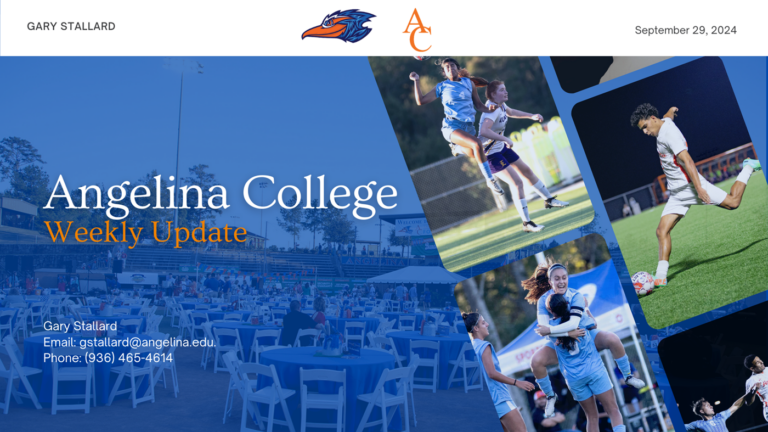
This week saw our Lady Roadrunner soccer team run its win streak to two straight games, our basketball and softball teams hold their respective media days. In addition, the Angelina College Foundation held its 5th Annual Dinner at the Diamond – only one of the most creative and important events in the entire East Texas area.
Here’s a quick rundown of the week’s events, along with what’s coming up next:
Lady Roadrunners Earn Two-Match Win Streak
AC’s ladies followed last Friday’s win at Blinn College with their biggest win of the season, a 4-1 victory over No. 16 LSU-Eunice on Friday.
With team captain Tannia Diaz lost to an injury, the Lady ‘Runners posted a pre-game tribute before running out on the pitch and over the Lady Bengals. Nerea Garcia got the rout rolling with a goal just two minutes into the match, taking a feed from Estephany Aguilar and looping the ball over the LSU-E keeper.
Following a Lady Bengals equalizer in the 26th minute to leave the teams even at the half, AC’s Camila Rico benefitted from another Aguilar assist for a 2-1 lead. The Lady ‘Runners then benefitted from an LSU-E own goal – with Paula Suarez the main instigator on the score – and Aguilar capped the win with a goal (off a feed from Suarez) with just 37 seconds remaining in the match.
With the win, the Lady ‘Runners (4-4, 3-3) retain possession of first place in the Region XIV South Zone.
AC’s ladies host Texas Southmost College in a Tuesday matinee scheduled for a 2 p.m. kickoff at the Larry Phillips Family Sports Complex on the AC campus.
The Lady ‘Runners then travel to Jacksonville College on Friday for another 2 p.m. start against the Lady Jaguars.
Both matches are scheduled for live streaming on TSBN Sports.
No. 9Roadrunner Soccer Beats Ranger, Drops Heartbreaker to Coastal Bend CC
The Roadrunners picked up a convincing 2-0 win on Tuesday against Ranger College, getting goals from Abdallah Traore (38th minute) and Elias Taj (23rd minute). Max Juhl and Elden Reneau earned the assists on those goals.
On Friday, however, the ‘Runners dropped a heartbreaker at home to conference rival Coastal Bend Community College, with the lone score a Cougar penalty kick with just eight minutes remaining in the match. A highly contested battle saw the Roadrunners just miss on several scoring opportunities, dropping AC to 6-2, 4-2 on the season.
AC’s men will host Southmost College at 4:30 p.m. on Tuesday before traveling to Jacksonville College on Friday for a 4:30 p.m. kickoff.
Both of this week’s matches will be live streamed on TSBN Sports.
Baseball Hosting Home Game on Thursday
The Roadrunner baseball squad continues its fall schedule with a home game this Thursday (Oct. 3) against Spartan Post Grad.
First pitch is scheduled for 2 p.m.
AC Basketball Schedules Now Available
We may be several weeks away from the opening tip for basketball season, but both the Lady Roadrunners and Roadrunners now can boast of having their schedules posted and ready to rock.
The Lady Roadrunners will host a home scrimmage against Western Gulf Collegiate at 6 p.m. on Monday, Oct. 28 at Shands Gymnasium. AC’s ladies will open the regular season on the road at the McLennan Classic scheduled for Nov. 1 and 2. The Lady Roadrunners then host their first home game at 6 p.m. on Wednesday, Nov. 6 against Hill College.
On the men’s side, the Roadrunners will spend some scrimmage time in Fort Worth for the JUCO Jamboree (Oct. 11-12) and at the GASO Jamboree in Carrollton (Oct. 20). AC will host a home scrimmage against Legacy at 7 p.m. on Wednesday, Oct. 23 at Shands Gymnasium.
AC’s men open the regular season on Saturday, Nov. 2 against Strength ‘N Motion in a home game scheduled for a 4 p.m. start.
AC Athletes Assist on Dinner at the Diamond
(Dinner at the Diamond photos by Jessica Deel; Men’s Soccer photos by Clara Sonet)
The Angelina College Foundation held its 5th Annual Dinner at the Diamond fundraiser on Saturday, and the event received huge assists from AC athletes.
The unique ceremony features a full dinner and auctions held on the field at AC’s Poland Stadium – the home of the baseball Roadrunners. The event raises funds for such AC student services as the Food Pantry and other emergency student funds.
Former major league baseball player Brandon Belt and his wife Haylee have served as contributing sponsors for years, and Belt on Saturday met with several members of the ‘Runner baseball team.
In addition, AC athletes manned the games for soccer, basketball and baseball.
(Dinner at the Diamond photos by Jessica Deel; Men’s Soccer photos by Clara Sonet)
Finally, as a fitting touch, the musical performance came from none other than Hayden Baker – a former All-Conference shortstop with the Roadrunners who now makes his home in Nashville, where he’s considered a major up-and-comer in the music business. Baker played selections from his recent album “Barley Getting By,” which features an appearance from music legend Brad Paisley.
(Dinner at the Diamond photos by Jessica Deel; Men’s Soccer photos by Clara Sonet)
After the event, Baker and former teammate Dylan Murphy (the current Roadrunner assistant baseball coach) caught up with a game of catch in the outfield.
New-Look Website is Up and Running
If you haven’t given it a peep already, check out our new-look website (www.angelinaathletics.com). While we’re proud of the result, we’re also still working to build some key components, and those will take some time. In addition, we’ve already encountered some minor (and expected) glitches, but we’re working through those as quickly as we can.
In the meantime, we’re thoroughly enjoying the cool new look along with the easier-to-navigate pages.
We’d love to hear your feedback. Feel free to email Sports Information Director Gary Stallard (gstallard@angelina.edu) or Manager of Athletics Operations Brett Reeves (mareeves@angelina.edu) with your comments.
Live Streaming Reminder:
All AC Athletics regular-season home games will be live streamed on TSBN Sports (a free streaming service for fans), with most of the conference road games also available for streaming. (This does not include baseball and softball fall games, as those are not considered official games.)
Once TSBN posts its schedules, AC fans simply need to visit the AC Athletics web site, look at the scrolling schedule in the middle of the page and click the blue “Video” link.
TSBN also offers an app great for smart phones, devices and smart TVs. (You’ve GOT to see those matches and games on the big screen.)
Reminder: Admission to ALL Angelina College Athletics sporting events is free. Any link offering streaming for a fee is a scam.
Upcoming schedules:
Tuesday, Oct. 1:
Lady Roadrunners vs. Southmost College, 2 p.m., Larry Phillips Family Sports Complex on the AC campus.
No. 9 Roadrunner Soccer vs. Southmost College, 4:30 p.m., Larry Phillips Family Sports Complex.
Thursday, Oct. 3:
Roadrunner Baseball vs. Spartan Post Grad, 2 p.m., Poland Stadium on the AC campus.
Friday, Oct. 4:
Lady Roadrunner Soccer at Jacksonville College, 2 p.m. in Jacksonville, TX
No. 9 Roadrunner Soccer at Jacksonville College, 4:30 p.m. in Jacksonville, TX
Empowering East Texas: Joseph Caesar’s Legacy of Financial Transformation
In the heart of Lufkin, Texas, a community leader is making a profound impact on the financial futures of East Texans. Joseph Caesar, founder of the Legacy Institute for Financial Empowerment (LIFE), is on a mission to help families break free from the cycle of poverty by providing the tools and knowledge necessary for long-term financial independence.
Founded nearly a decade ago, LIFE is more than just an organization—it’s a lifeline for many low to moderate-income households across East Texas, particularly within the African American and Hispanic communities. What began as a local initiative has now expanded to serve individuals and families from Houston to Washington, D.C., proving that the work happening here in Lufkin resonates far beyond our region.
The Vision Behind LIFE
Joseph Caesar’s journey to founding LIFE started with a realization—too many people, particularly young adults, lack basic financial knowledge that could change their lives for the better.
“There’s a gap in understanding when it comes to finances,” Caesar explains. “Many don’t know about disability insurance, life insurance, or how to properly plan for the future, and that gap can keep families stuck in a cycle of financial struggle.”
In response, Caesar created LIFE to fill that gap, offering tailored programs that address both immediate financial needs and long-term planning. Through its two main departments, the organization provides comprehensive financial services and workforce development programs, all aimed at helping people gain control over their finances.
Practical Solutions for Everyday Challenges
The Financial Opportunity Center at LIFE offers one-on-one financial coaching, small business development services, income support, and employment coaching. The center also provides access to the LIFE Empowerment Fund, a small-dollar loan program designed to help individuals avoid the trap of payday loans and high-interest debt.
Meanwhile, the LIFE Works initiative focuses on career advancement, offering training and apprenticeship programs in high-demand fields like carpentry, information technology, and landscaping. These programs equip participants with the skills they need to secure stable employment and improve their financial standing.
Innovation and Growth
Not content with simply offering traditional financial services, Caesar launched LIFE Tech in 2019, a program designed to give East Texans a leg up in the fast-growing tech sector. From providing tech-related training to fostering entrepreneurship, LIFE Tech is an example of how the organization is always evolving to meet the changing needs of the community.
“As technology continues to play a larger role in all industries, it’s important that we equip people with the tools they need to succeed,” Caesar explains. “We want to make sure our community isn’t left behind in this digital age.”
Building Homes and Futures
Looking to the future, Caesar is focusing on an even larger goal: affordable housing. Over the next several years, LIFE plans to develop a portfolio of affordable rental properties and eventually help families transition into homeownership.
“Our aim is to move clients from financial stability to homeownership,” Caesar says. “We want to build homes and help people take that step toward creating generational wealth.”
For Caesar, this work is personal. With an MBA in Finance from the University of Houston and over two decades of experience in the investment industry, he felt a calling to return to his roots and give back to the community that shaped him. “I want to see more people who come from backgrounds like mine involved in investing, whether it’s in the stock market or real estate,” Caesar reflects.
A Community-Focused Mission
LIFE’s success is built on a foundation of trust and transparency. By actively engaging with local stakeholders, churches, and community leaders, Caesar ensures that the organization’s mission aligns with the needs of East Texas residents. “The support we’ve received from the community has been incredible,” he says. “It’s proof that when you invest in people, you invest in the future of the entire community.”
Through LIFE’s work, individuals and families aren’t just learning to manage their finances—they’re gaining the confidence and skills to build better futures for themselves and their children. From financial literacy workshops to job training and now affordable housing, LIFE is truly transforming lives in Texas Forest Country.
A Brighter Future for East Texas
As LIFE continues to grow, one thing remains clear: Joseph Caesar’s commitment to empowering his community is unwavering. Whether through financial coaching, workforce development, or future housing projects, Caesar’s vision is to ensure that everyone in East Texas has the opportunity to break the cycle of poverty and build a more secure future.
For more information about LIFE and its programs, visit legacyinstitute.org or call 936-209-2085.
One of the more common insects affecting livestock is the horsefly. Much larger than a typical house fly or stable fly, horseflies can grow to be just over an inch and have a terrible bite.
I noticed them first in unusual numbers while driving slowly through a local national forest as I was studying the area for our upcoming hunting season. My truck was surrounded by enough of these flying insects that, for a moment, I thought I may have stirred up a hornet’s nest. Making sure to keep my windows up, I stopped to identify what was buzzing and hitting my truck. It was horse flies.
Since then, I’ve received calls from area residents about these ornery flies, where they come from, and how to control them.
Entomologists have identified 52 species of horseflies. They range in size from 3/8 to just over 1 inch long and vary in coloration by species. Some are all black while many have colored patterns on their abdomens and wings.
Few flies can be confused with horse flies as there are very few other tough flies which are capable of biting man and animals. They commonly feed on cattle and horses. Other mammals at times are certainly part of their diet, and given the chance, they certainly can pester humans.
Horse flies are significant livestock pests with their painful and persistent biting behavior. Heavy attacks can lead to reductions in weight gains of beef cattle, reduced milk yield, reduced fed utilization efficiencies and hide damage from the puncture wounds. Horses under attack will be irritable and distracted by trying to avoid being bitten.
Their biting activities can be annoying in outdoor areas, as the bites can be very painful and remain swollen for several days. Yet while this fly may be ‘quite annoying’ to people, their incessant attacks on livestock can cause them to lose weight. Additionally, their biting and feeding is capable of mechanically transmitting animal diseases, including viruses, bacteria, protozoans, and nematodes of animals.
Like the mosquito, only adult female horse fly species are attracted to man and animals in search of a blood meal. The female mouthparts are modified for piercing and sucking blood. Male horse flies are nectar feeders and often hover at certain times of the day, presumably to attract females and maintain a territory.
Once the females have had enough ‘blood meals’, they will lay eggs later in the season. Females often lay eggs in specific locations, such as on vegetation overhanging water. Eggs are laid in masses that darken to brown or black before larvae hatch out and drop to the ground or into water.
Their larvae are generally whitish, spindle-shaped, and develop through six to thirteen stages (instars) over one or more years before pupating. Larvae have chewing or tearing mouthparts; adult Larvae live in species specific habitats, although most are aquatic, semi-aquatic or terrestrial. They are generally predaceous and cannibalistic, feeding on other insect larvae and earthworms
Come spring, horse fly larvae will pupate and begin emerging as adults in late spring and summer. Unlike many common horse flies typically have one generation per year.
Controlling them is difficult. One author suggested that adult horse and deer flies can be ‘collected by swinging an insect net around one’s head’. This activity could be accomplished while walking through an infested area, such as along a wooded path, near swampy areas, on the beach or other bodies of water at the right time of the year.
Special traps developed by researchers, called malaise traps, are baited with a source of carbon dioxide (such as dry ice), and visually attracting objects (simply a black plastic sheet or sphere) are very effective for obtaining large numbers of the flies. This set up may be quite effective at a farm/ranch or large outdoor venue.
Using topical pesticides is ineffective due to horse fly behavior, but short-term control is possible. Aerial applications (fogging) and treating for the larvae are ineffective. The best option is to provide shelter for the animals and people, or pasturing livestock away from infested areas.