Join us for the February Power Networking Breakfast at The Heart Institute of East Texas on Friday, February 23 at 8 AM at 310 Gaslight Blvd., Lufkin.
We’re honored to have Dr. Ravinder Bachireddy share his expertise on matters close to our hearts – literally! Gain valuable insights, connect with others, and empower yourself to prioritize your heart health.
Thank you to our Presenting Sponsor – Angelina College SBDC and our February Sponsor – The Heart Institute of East Texas.
Paho Mann employs unique techniques in his approach to art. The Arizona artist creates tabletop arrangements from discarded technology and then photographs them as still-life presentations, generating eye-catching images – and conversation starters.
Some of Mann’s works will be on display in an Angelina College exhibition running Feb. 26 through April 4 in the Angelina Center for the Arts Gallery on the AC campus. An artist’s reception and talk will take place from 6-7:30 p.m. on Tuesday, Feb. 27 in the ACA foyer.
This image, titled “Spiderman Camera,” is an example of the works scheduled for display in artist Paho Mann’s exhibition running Feb. 26 through April 4 in the Angelina Center for the Arts Gallery. An artist’s reception will take place from 6-7:30 p.m. on Tuesday, Feb. 27 in the ACA foyer. (Contributed image)
According to a release, Mann utilizes a combination of traditional photographic approaches, 3D scanning and removal of “temporary photogrammetry software files” before creating his own digital images showing the distortion and reconstruction of the original scene. The focus, according to the release, is to “provide fluidity and conversation between computer vision and human vision.”
This image, titled “Mickey Mouse Camera,” is an example of the works scheduled for display in artist Paho Mann’s exhibition running Feb. 26 through April 4 in the Angelina Center for the Arts Gallery. An artist’s reception will take place from 6-7:30 p.m. on Tuesday, Feb. 27 in the ACA foyer. (Contributed image)
Mann currently serves as an Associate Professor of Photography at the University of North Texas. Galleri Urbane in Dallas represents the artist. Mann received his Master of Fine Arts degree from Arizona State University.
From the artist’s bio:
“Paho Mann’s work has been included in exhibitions at the Arizona State University Art Museum (Tempe, AZ), Tucson Museum of Art (Tucson, AZ), Walker Art Center (Minneapolis, MN) and the Carnegie Museum of Art (Pittsburgh, PA) among others. Mann’s work is included in the collections of the Tucson Museum of Art, the Museum at Texas Tech University, the Nerman Museum of Contemporary Art and the City of Phoenix Public Art Program.”
The gallery and reception will be open to the public. Admission to both the exhibition and reception are free.
For further information regarding the exhibition, contact Angelina College Art Curator Le’Anne Alexander at lalexander@angelina.edu.
For other information regarding Angelina College events, contact Krista Brown at kbrown@angelina.edu.
ARTIST’S PROJECT STATEMENT:
Paho Mann investigates the personal and cultural relationships to objects we collect to address shifting values, perceptions, and memory. In the project, Fragmented Cameras, Mann used a consumer-grade 3D scanner to scan historic and obsolete cameras ranging from early stereoscopic cameras to first-generation iPhones. These images explore connections between new and historic imaging technologies. Often, the use of an emergent technology results in some deterioration in quality – in using consumer grade 3D scanning technology the scans often depict objects as fragmented versions of themselves, almost as if they have exploded. This becomes a metaphor for the constant transition of photographic technology and the use of new technology to comment on increasingly obsolete formats of historic image making. The new technology displaces the old, reflecting a tempestuous relationship between the two.
From its inception photography has been thought of as a way to replicate human vision, making copies of the real. This link to the real is intertwined with photography’s relationship to new technology, resulting in various possibilities of how to depict reality. But photography’s fixed vantage point always shows only one possibility of reality or truth. Stereoscopic cameras were an early example of a new technology shifting expectations of how photography replicated human vision, attempting to expand this singular vantage point of a photograph to include the depth and physicality associated with human perception. Among the cameras Mann scanned for this project are several stereoscopic cameras ranging from early 19th century examples to 20th century disposable kodak film 3D cameras. As these historic cameras become more obsolete so do the ways that they claim to represent the world.
In the studio, Mann imports the 3D scans into Photoshop, a traditional 2D image editing software. Here he adds colorful backgrounds using color swatches from photography studio backdrops and by sampling the colors of the original cameras. Mann manipulates lighting inside the software, much like a product or portrait photographer would do in a lighting studio. The 3D scan is cropped to reflect the aspect ratio of the original camera.
Mann sees historic ties between the desires embedded in the stereoscopic cameras to the dual-camera often found in our cell phones to computational photography and the virtual worlds made available through 3D scanning technologies. Through his practice of allowing the 3D scans to glitch, Mann calls attention to the way lens-based media only mediates, but never truly represents reality.
AUSTIN, Texas – While winter is the ideal time to prune trees, pruning after recent droughts and freezes may cause more damage than good this year.
“Pruning always adds stress to trees because it opens wounds that need to seal, so if a tree is already stressed, it’s best to avoid unnecessary pruning this year,” Demian Gomez, Texas A&M Forest Service Regional Forest Health Coordinator. “Especially avoid pruning for aesthetics and controlling growth if a tree is already showing signs of stress.”
For oak trees specifically, all wounding, including those produced by pruning, construction activities, livestock, land clearing, lawnmowers, string trimmers and storms should be painted over to produce a physical barrier and prevent the spread of oak wilt.
Oak wilt is one of the deadliest tree diseases in the United States, killing millions of trees across 76 counties of Texas.
Any new wound on oaks can be an entry point for infection. Small insects, called sap beetles, move spores of oak wilt fungus to new trees and are very active in late winter and early spring. Because of this, pruning or wounding trees should be avoided from February through June and no matter the time of year, all oak tree wounds should be painted immediately.
“Prevention is key to stopping the spread of oak wilt,” said Gomez. “With wounds being the best entry point for the pathogen, landowners should avoid pruning or wounding trees from February through June.”
Oak wilt is caused by the fungus Bretziella fagacearum. The fungus invades the xylem, the water-conducting vessels of the trees, and the tree responds by plugging the tissues, resulting in a lack of water to the leaves, slowly killing the infected tree.
All oaks are susceptible to oak wilt. Red oaks are the most susceptible and can die in as little as one month after being infected. Live oaks show intermediate susceptibility, whereas white oaks are the least susceptible, but they are not immune to infection.
Oak wilt can spread two ways – above ground by sap-feeding beetles or underground through connected roots.
The disease spreads above ground by sap beetles more rapidly in late winter and spring because of high fungal mat production and high insect populations. During this time, red oaks that died of the disease last year may produce spore mats under the bark. With a fruity smell, these mats attract small, sap-feeding beetles that can later fly to a fresh wound of any oak tree and infect it, starting a new oak wilt center.
The second way oak wilt can spread is underground by traveling through interconnected root systems from tree to tree. Oak wilt spreads an average of 75 feet per year by the root system. This occurs primarily in live oaks and is responsible for the majority of spread and tree deaths in Central Texas.
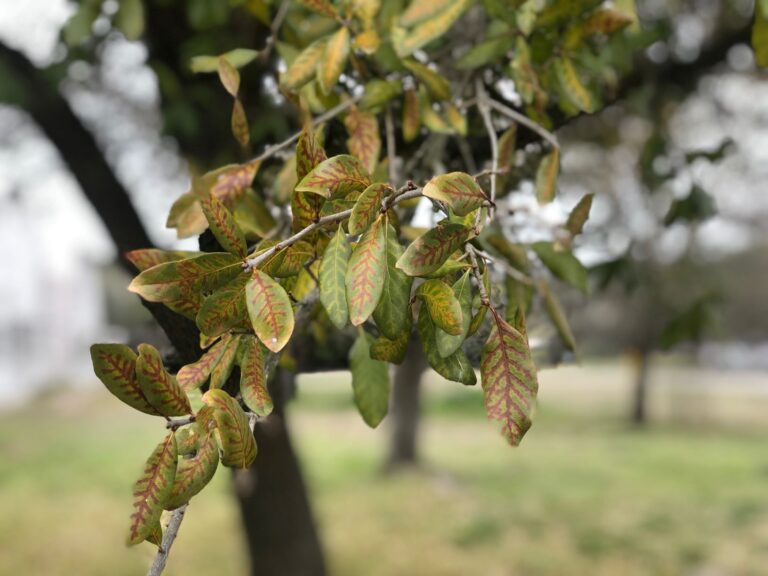
Oak wilt is often recognized in live oaks by yellow and brown veins showing in leaves of infected trees, known as veinal necrosis. This time of year, it may be difficult to diagnose oak wilt due to seasonal transitioning of oak leaves in the spring – when evergreen oak trees shed their old leaves while simultaneously growing new leaves. The signs of oak wilt can be seen on a majority of leaves when a tree is fully infected. Landowners should contact a certified arborist if they are unsure if their tree is infected.
“For red oaks particularly, one of the first symptoms of oak wilt is leaves turning red or brown during the summer,” said Gomez. “While red oaks play a key role in the establishment of new disease centers all oaks can move oak wilt through root grafts, particularly live oaks.”
To stop the spread of oak wilt through the root system, trenches can be placed around a group of trees, at least 100 feet away from the dripline of infected trees and at least four feet deep, or deeper, to sever all root connections. Another common management method for oak wilt is through fungicide injection. The injections only protect individual trees injected and best candidates for this treatment are healthy, non-symptomatic oaks adjacent to and up to 75 to 100 feet away from symptomatic trees.
Other ways to help prevent oak wilt include planting other tree species to create diversity in the area; avoiding moving firewood; and talking with neighbors about creating a community prevention plan for oak wilt. Infected red oaks that died should be cut down and burned, buried or chipped soon after discovery to prevent fungal mats that may form.
Not only is saving oak trees important for our ecosystem and health, but also for property values and community aesthetics. Loss of trees due to oak wilt can reduce property values by 15 to 20 percent.
Some cities and municipalities, including Austin, the City of Lakeway, Dallas, Houston, San Antonio and Round Rock, have oak wilt programs in place with municipal foresters dedicated to managing the disease. Texans can also contact their local Texas A&M Forest Service representative with any questions about this devastating disease.
New landowners or landowners with a new water well often have questions on the quality of their water that they want to use in the home, garden or to water livestock.
There can be a wide variety of water quality, especially water from private wells. And what makes water suitable for drinking has little to do with water that is good for irrigation in the garden and, furthermore, is different from what is good for pets and livestock.
Drinking water, technically called “potable water”, needs to be able to be consumed without causing harm to us. Most of the drinking water tests will solely look for the presence of coliform bacteria. Surprisingly coliform bacteria will not likely cause illness, yet it’s presence in drinking water indicates that disease-causing organisms (pathogens) could be in the water system. Most pathogens that can contaminate water supplies come from the feces of humans or animals.
Irrigation water used on plants is concerned with the amount of nutrients or salts, pH, bacteria, or more. Some water sources may be naturally high in nutrient concentrations that, while one would think could be beneficial, may have too much of something that harms plants. The pH of water can also be extremely acidic or alkaline and affect the plants or certainly the soils in which the plants are growing. Bacteria in water can adhere to the surface of the plant and then cause problems when ingested.
Irrigation water can have too high a salt concentration and be problem for some growers. Indeed, the primary water quality concern is salinity levels since salts can affect both the soil structure and crop yield. Now almost all waters contain some dissolved salts and trace elements that were the result of natural weathering from rocks and minerals on the surface and underground.
If you live in and around Angelina County, you can submit drinking water samples to the Angelina Neches River Authority’s (ANRA) lab for analysis. There are two common tests that I’ve know many to use. First is a microbiology Coliform/E. coli test. This is only $25. The other is their “Basic Water Scan Package” that looks at 12 parameters (such as alkalinity, chloride, fluoride, nitrates, nitrites, pH sulfate, hardness, and more, in addition to these metals: calcium, copper, iron, magnesium, manganese, zinc, and lead.
If you are interested in more information on either of these tests, reach out ANRA at 936-632-7795 or email the lab at lab@anra.org. ANRA does plenty other testing that may be of interest. Their full website can be accessed at www.anra.org.
Reading their very informative website, ANRA advises that if a well has been flooded from the recent unusually high rainfall should be disinfected and tested before being used.
If you are looking to examine irrigation water, consider the Soil, Water, and Forage Testing Laboratory at the Texas A&M AgriLife Extension Service in College Station, Texas. They offer five water tests ranging from the $25 routine analysis to a $75 test that covers metals, heavy metals, and the routine analysis.
These water tests can analyze samples from wells or standing water that are being considered for use with livestock, irrigation of crops, aquaculture, or domestic use. You can reach the Laboratory at Texas A&M at (979) 321-5960 or email the lab at soiltesting@ag.tamu. Their full website can be accessed at https//soiltesting.tamu.edu.
Years ago, I remember helping the ladies at the Monastery of the Infant Jesus in Lufkin. It was just prior to Y2K and they had questions about the water in the well they used. There were two water sources: an old shallow well and Lufkin city water.
Now the water from the old shallow well was much preferred because it tasted much better than Lufkin’s water. But the well water had a problem. It killed everything in the vegetable garden.
We ran a number of tests on both water sources. Both passed the test regarding bacteria with high marks. No problems there.
But on the irrigation test, the old shallow well had high levels of the element boron and thus was harming plants. Boron is a mineral found everywhere in food and the environment. In fact, some folks take boron supplements to build strong bones and for other health benefits. Yet, too much boron in the soil will harm plants.
Indeed, Lufkin’s municipal water passed the irrigation test with high marks, proving itself an excellent source of both drinking and irrigation water.
What was also interesting is that not more than half a mile away is a blueberry farm that has a private well for irrigation. Now blueberries are notorious for demanding high quality irrigation water.
The blueberry farm’s water had never been tested but the successful growth of the orchard was evident. The difference? The new well was much deeper and drew from a completely different underground water source.
I hope you have never have need to test water for use in your home, garden or agricultural operation. If you do, or have a suspicion that you do, there are these options provided above to be of help.
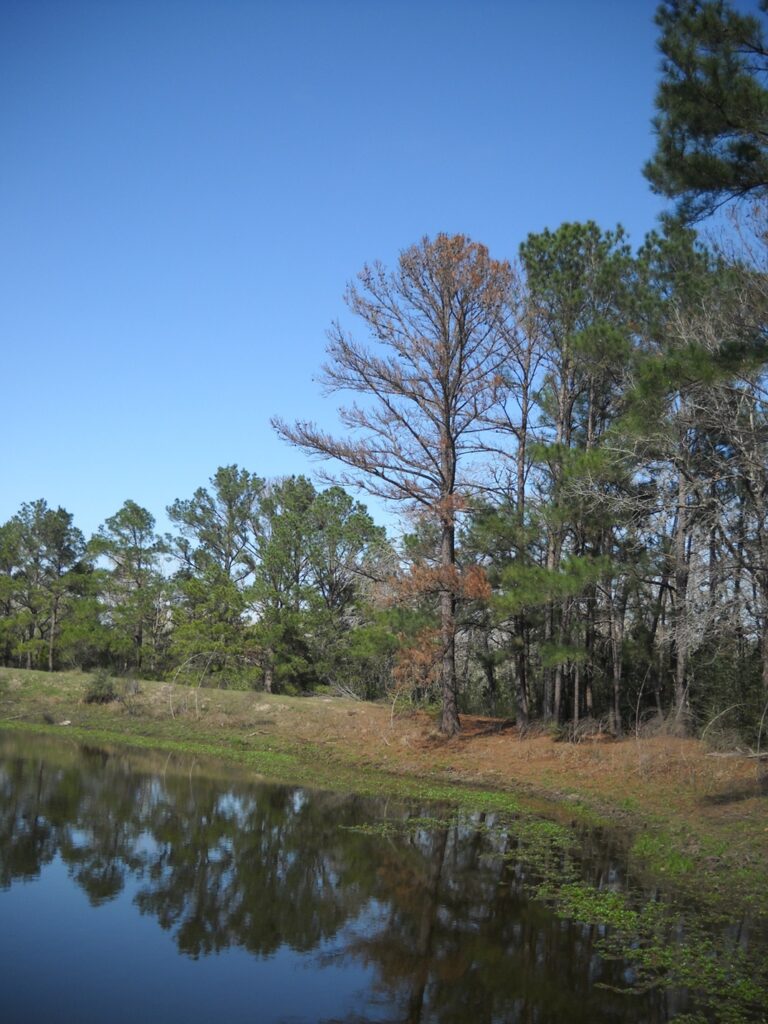
COLLEGE STATION, Texas—With three consecutive years of severe weather conditions throughout Texas, including extended hard freezes and droughts, East Texas trees have become vulnerable to secondary threats. These threats include cedar bark beetles, Ips engraver beetles, hypoxylon canker and cedar rust fungi.
Trees experience threats like insects and diseases regularly, and when a healthy tree encounters these stressors under positive conditions, they can show little to no reaction to the threat. However, environmental conditions such as droughts, extreme winter weather and new construction development can add primary stress to the trees. As the trees encounter prolonged stress under these factors, they become more susceptible to secondary threats.
Ben Plunkett, Texas A&M Forest Service District Forester, explained that many secondary factors, like insects and fungi, can almost always be found in forests throughout the state, but healthy trees are not as threatened by them and do not indicate an infection.
“We can relate these secondary factors of trees to human bacteria,” said Plunkett. “If we cultured every tissue on our body, we would probably find bacteria, but it will only turn ‘toxic’ under certain conditions. Trees respond similarly in that weakened trees will see an increase in reaction to the fungi and insects.”
Environmental conditions can affect trees for years and decades to come. For instance, Plunkett noted that the droughts of 2011 and 2015 are still oppressing the surviving trees today.
Allen Smith, Texas A&M Forest Service Regional Forest Health Coordinator, reiterated this sentiment. “The trees are under such severe stress that it takes one little additional factor like a cedar bark beetle to push the tree into mortality,” said Smith.
Common fungi spread among cedars in Texas are cedar rust fungi. Most commonly seen as cedar-apple rust or cedar-hawthorn rust, these fungi are not deadly but can cause irreversible damage. These fungi can cause leaf discoloration and “bleeding” cankers. Cedar-apple rust is recognized by its distinct reddish-brown galls around young branches and twigs that resemble the size of a golf ball.
Among the current most threatening fungi to weakened hardwood trees in East Texas is hypoxylon canker. Symptoms of hypoxylon canker can include browning of the leaves and sloughing of bark, which exposes a gray or black fungus on the sapwood of the stem or major limbs.
Threatening insects to weakened trees currently include Ips engraver beetles and cedar bark beetles. Symptoms of Ips engraver beetles occur in pine trees and include discolored crowns, dying branches and numerous white to reddish brown pitch tubes on the bark. Adult Ips beetles are cylindrical, measuring approximately 3/32” in length with a black to reddish brown color.
Symptoms of cedar bark beetles occur in cypress and juniper trees and include the discoloration and dropping of leaves; twig and branch decline; and small exit holes present on the bark of trunk or limbs which are sometimes accompanied by “sawdust” around the boring or tree. Adult cedar bark beetles are approximately the size of a grain of rice with cylindrical bodies and a reddish colored back.
In closing, Smith noted that many of the trees that appear to be dying may experience significant recovery this spring. The warmer, wetter and more stable weather conditions of the spring will take environmental stress off the trees, allowing them more strength and immunity toward secondary factors.
If Texas residents notice repeated or widespread tree abnormalities in their community, Texas A&M Forest Service local foresters are able to inspect and address specific concerns. Find your local forester here: https://tfsweb.tamu.edu/contactus/location-search/
Another busy week with Angelina College Athletics, with four of our teams in action both at home and on the road. In addition, one of our Lady Roadrunners earned a big conference honor for her recent play.
Following is a recap of the week, along with the coming week’s schedules.
Lady Roadrunner Basketball
Photo credits: Gary Stallard
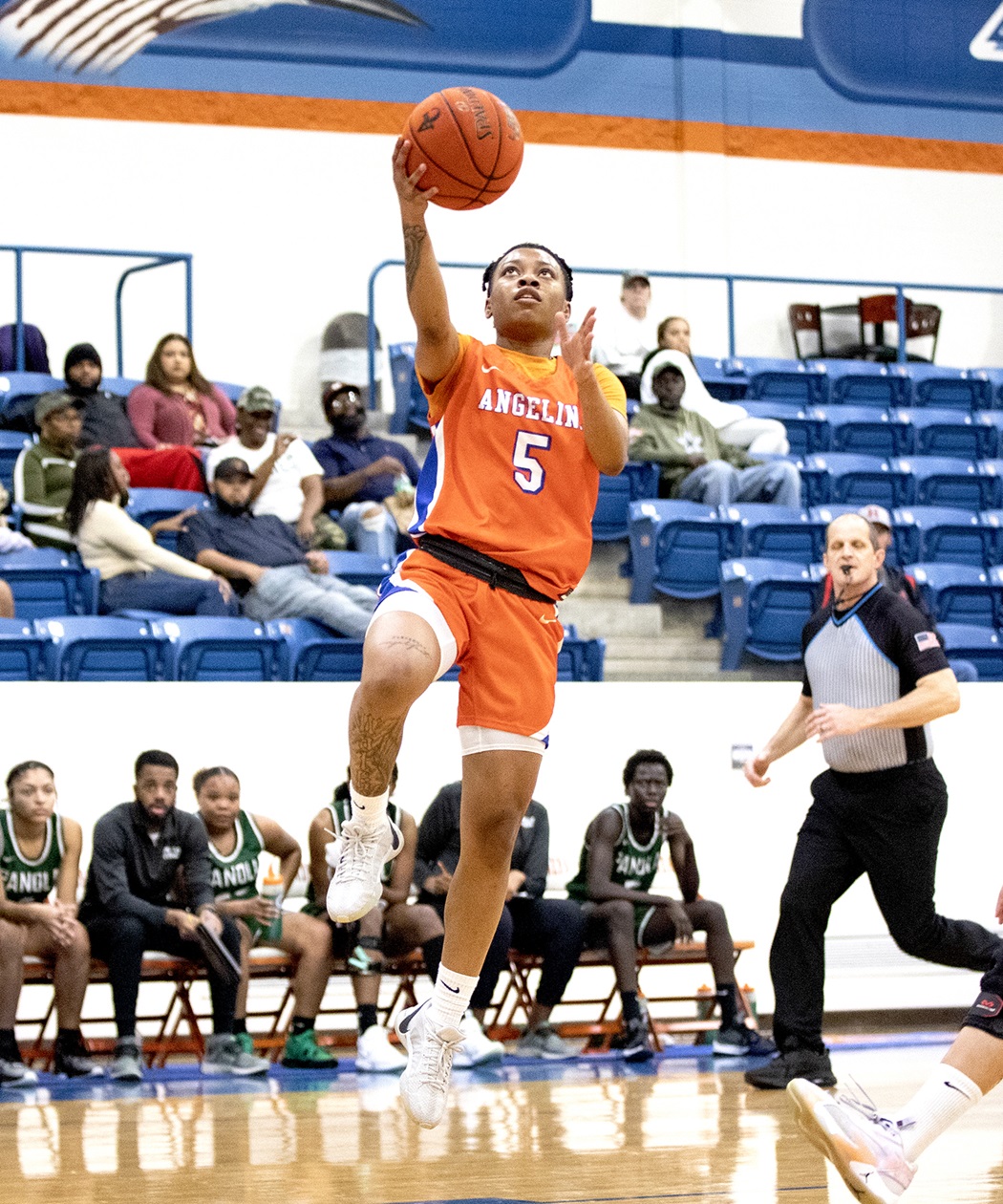
Byron Coleman’s Lady Roadrunner basketball team is on a roll, having won four straight games in conference play by an average winning margin of 18.5 points per game. AC on Wednesday blasted Coastal Bend Community College on the road, taking the 93-68 win over the Cougars. Amyria Walker and Marie Kenembeni scored 20 points each to lead the Lady ‘Runners, with Kenembeni adding 11 rebounds to finish with the double-double. India McMahon and Alecia Rivera-Scott pitched in with 10 points each.
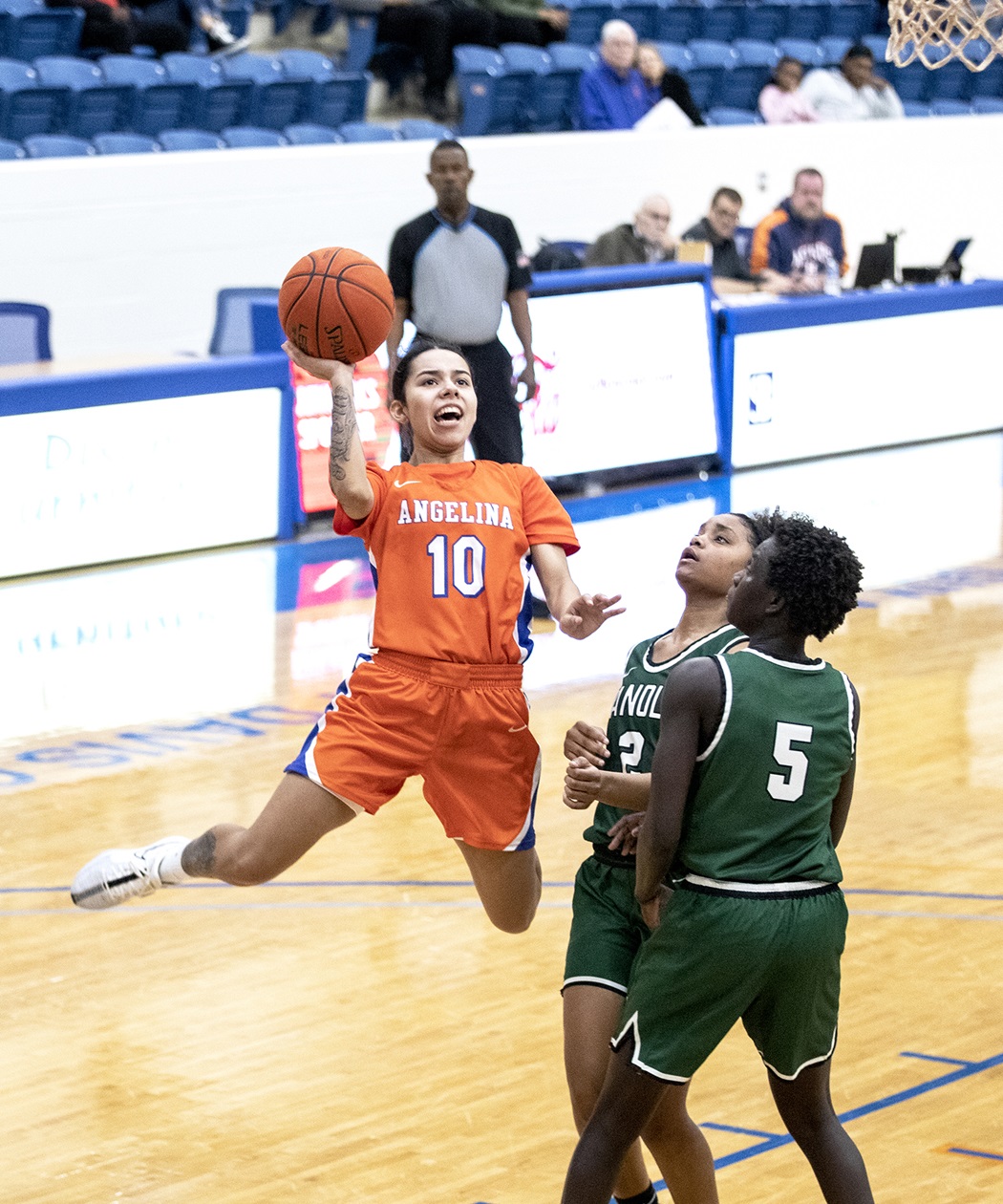
On Saturday, AC’s ladies handled the Panola College Fillies in a 77-60 win at Shands Gymnasium. Kenembeni led the way with 24 points and nine rebounds, while Walker and Janay Quinn added 15 points each.
The wins this week moved the Lady Roadrunners to 15-7, 7-1 record – good enough for first place in Region XIV. AC gets Wednesday night off before traveling to Kilgore College on Saturday for a 2 p.m. tipoff.
Roadrunner Basketball
Photo credits: Maria Andrade
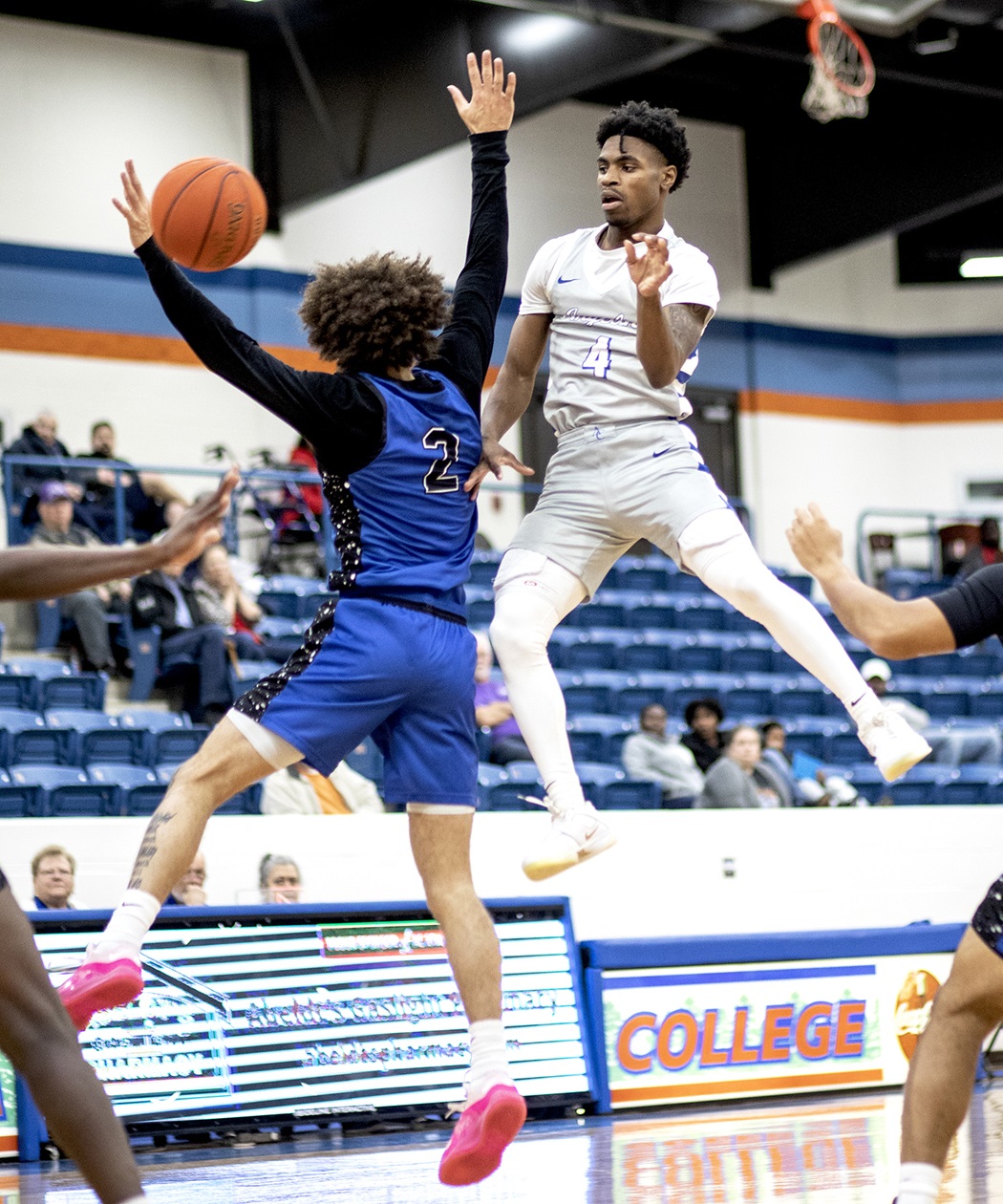
The AC men won big at Lamar State College-Port Arthur on Wednesday, beating the Seahawks 94-77 in Port Arthur. Xavier Owens led a balanced scoring attack with 19 points, followed by Patrick Johnson with 17 points, Eddie Evans with 14 points and Morgan Baldwin with 12 points.
The ‘Runners’ four-game win streak ended on Saturday, however, with an 84-66 win to a strong Blinn College team. AC’s Evans led the team with 14 points, while Cade Holzman and Nehikare Igiehon scored 11 points each.
Despite the loss, the Roadrunners are still in third place in Region XIV’s South Zone at 15-7, 6-5. AC will travel to Beeville on Wednesday to take on Coastal Bend CC at 7:30 before returning on Saturday for a home matchup against Victoria College starting at 4 p.m.
Roadrunner Baseball
Photo credits: Gary Stallard
Following AC’s doubleheader sweep of the Galveston Whitecaps this past Sunday, the Roadrunners hit the island in Galveston to take on the same Whitecaps in yet another twin bill.
Game 1, originally scheduled for seven innings, turned into a four-hour, 12-inning marathon, with the ‘Caps walking it off in the bottom of the 12th for the 5-4 walk-off win. AC’s Hayden Hupe homered in the loss, with Spencer Alexander, Dalton Mullins and Sam Hardcastle also driving in runs. AC would drop the nightcap in equally heartbreaking fashion, losing by a 2-1 final score.
The team next plays on Saturday at Temple College in a doubleheader scheduled for a 1 p.m. first pitch.
Lady Roadrunner Softball
Photo credits: Gary Stallard
AC softball head coach Brette Kohring said at the beginning of the season that her young team – 16 freshmen and just three sophomores – was going to experience a learning curve, with those newcomers needing time to adjust to speed of the game at this level.
And while the Lady ‘Runners may be learning on the fly, they’re showing they’re willing to battle it out with good teams.
AC opened its 2024 season with a doubleheader at Tyler Junior College against a talented Lady Apache team. AC fell 13-0 in the opener, but showed fight in the nightcap, hanging tough before falling by a 7-2 final.
The Lady ‘Runners then hit the road to Youngsville, LA for Thursday’s and Friday’s Mardi Gras Invitational, where the team would play four games in two days. After coming up just short to Mississippi Gulf Coast CC in a 6-5 loss – on a three-run walk-off homer, no less – AC dropped a 7-2 decision to Southwest Mississippi Community College.
But on Friday, the Lady Roadrunners posted their first win of the season, getting two homers and four RBI from Skyler Martin to take down Hinds CC by a 10-8 score. AC finished the Invitational with 6-0 loss to Pearl River CC.
AC’s ladies will host their home opener on Monday, facing Kilgore College in a doubleheader starting at 1 p.m. at Lady Roadrunner Field.
Lady ‘Runner Basketball’s Amyria Walker Conference Player of the Week
Amyria Walker of the Lady Roadrunner basketball team this week earned Region XIV Player of the Week honors after yet another big week for the sophomore from Burleson, Texas.
Walker averaged 20 points, five rebounds and six assists in games against Tyler Junior College (a 72-57 AC win) and at Paris College, a 76-58 win for the Lady Roadrunners.
Walker all season has alternated between the No. 1 and No. 2 spot among Region XIV scoring leaders; she currently is averaging 19.9 points per game, which includes hitting 30.1 percent of her three-point tries and a 70 percent rate from the free-throw line.
With the conference honor, Walker has been submitted for national recognition as well.
Little Lakers Showing up Big
Photo credits: Gary Stallard
An area youth basketball team, the Little Lakers, has been showing up to AC hoops games, and not only are they adorable, they’re LOUD. A big thank you to the team’s parents and coaches for bringing those little guys and gals along to cheer on our Lady Roadrunners and Roadrunners.
TSBN Live Streaming
As mentioned before, TSBN Sports now handles all our Angelina College Athletics streaming needs. The TSBN crew will stream nearly all our home games in every sport, and because of their wide reach throughout our conference, AC fans will be able to catch several road games as well.
In addition, TSBN Sports offers an app for downloading. That way, one can watch the games on computers, cell phones and other devices, as well as on a smart TV.
Finally, fans can log onto the Angelina College Athletics web site (www.angelinaathletics.com) and view the scrolling schedule on the right-hand side of the page. If TSBN is streaming a game, there’ll be a blue “Video” link underneath the day’s game.
WARNING: Every time we post anything on our Facebook pages, the scammers come out of the woodwork like cockroaches, posting fake links in the “Comments” sections. We try to catch, block and delete those as they pop up, but just remember that any time we know we’re going to have live streaming in a game, we’ll mention it in the original post. Anything added below the post is a scam.
This Week’s Schedule:
Lady Roadrunner Softball:
Monday, Feb. 5: AC vs. Kilgore, DH (doubleheader) starting at 1 p.m., Lady Roadrunner Field on the AC campus.
Wednesday, Feb. 7: AC at Bossier Parish CC, DH starting at 1 p.m. in Bossier City.
Saturday, Feb. 10: at the McLennan Tournament at Waco, TX. AC vs. Crowder College, 12:30 p.m.; AC vs. Tyler JC, 3:30 p.m.
Sunday, Feb. 11: AC at McLennan College, DH starting at 12 p.m. in Waco.
Roadrunner Baseball:
Saturday, Feb. 10: AC at Temple College, DH starting at 1 p.m. in Temple.
Roadrunner Basketball:
Wednesday, Feb. 7: AC at Coastal Bend CC in Beeville, tipoff at 7 p.m.
Saturday, Feb. 10: AC vs. Victoria College, 4 p.m. at Shands Gymnasium
Lady Roadrunner Basketball:
Saturday, Feb. 10: AC at Kilgore College, 2 p.m. in Kilgore.
Photo credits: Men’s basketball photos: Maria Andrade All other photos: Gary Stallard
Governor Greg Abbott has appointed Layne Thompson as the District Attorney of the 159th Judicial District in Angelina County, for a term set to expire on December 31, 2024, or until his successor shall be duly elected and qualified. Layne Thompson of Pollok is an attorney, former of counsel for Mike Love & Associates and former vice president of Thompson Cattle Company.
Thompson was sworn in this afternoon by District Judge Bob Inselmann with his wife Cathy at his side.
Previously, Thompson served as an assistant district attorney for the 159th Judicial District Attorney’s Office and the Harris County District Attorney’s Office. He is a member of the State Board of Texas, Texas Bar Foundation, and the Angelina County Bar Association and is a former member of the Houston Bar Foundation and former treasurer of its Health Law Section.
He is chairman of the Angelina Arts Alliance, former board president of the of the Naranjo Museum of Natural History, former president of the Kiwanis Club of Lufkin, and former board vice president of the Museum of East Texas. Additionally, he is former board president of Casa de Esperanza de los Ninos and former board member of the American Red Cross Texas Gulf Coast Region. Thompson received a Bachelor of Science from The University of Texas at Austin and a Juris Doctor from The University of Texas School of Law.
Also sworn in at the ceremony was Nicole Lastrocco. She will serve as assistant district attorney.
They will both officially start their duties in the morning.
LUFKIN – New speed limit signs will be set next week in a major construction project, lowering the work zone speed limit on US 59 near the cities of Burke and Diboll in Angelina County.
The speed limit on US 59 at the northern and southern end of the Diboll Relief Route construction project near US 59 will be lowered in each direction. On the north end of Diboll near Burke, the speed limit will be lowered from 55 mph to 45 mph. On the south end of Diboll, the speed limit will be lowered from 60 mph to 50 mph.
“As work for this project moves closer to US 59, it is important to lower this work zone speed limit,” said Rhonda Oaks, public information officer. “There are trucks, equipment and workers entering the work area from US 59 at these locations and motorists need to reduce speed and stay alert as this major project continues.”
Work on the Diboll Relief Route in coming days includes dirt work on embankments at the FM 1818 South Bridge header, the US 59 Direct Connect, and ditches through the work area. Crews will continue to cement and lime treat subgrade on the northbound lanes from Lumberjack Road and the FM 1818 turnarounds. Crews will also continue to place asphalt on the southbound middle lane at locations on the south end of the project, and work on bridge decking at the FM 1818 and Lumberjack Drive bridges. Seeding, sodding ditches, and working on silt fencing and rock will continue. Rip rap will be placed at various locations, and work on concrete safety end treatments will continue.
As this work progresses, lane closures are anticipated on FM 1818, as well as shoulder closures on US 59. Conner Road remains closed during this construction with Morris Road set as a detour.
The Diboll Relief Route is an 8-mile construction project that began in April 2020, and is on schedule to be completed in 2025, weather permitting.
Sacyr Construction USA, LLC, is serving as contractor for the $140.8 million construction project. The project consists of the construction of a new freeway location on US 59 in Angelina County, from FM 2108 to 1.1 mile south of White Oak Creek. Work includes construction of the new freeway, grading, structures, concrete pavement, and freeway signage.
Motorists are urged to reduce speed and obey the new work zone speed limit. Stay alert for moving equipment, workers and vehicles moving near the lanes of traffic. Fines double when workers are present.
Leadership is a challenging task. Guiding teams and entire organizations to success requires a broad set of abilities that take time and dedication to develop fully. After decades of learning as a leader and now a coach, I’ve pinned down the five most critical skills that set genuinely great leaders apart from the rest. Mastering these five key areas is essential for any manager or executive seeking to maximize their impact.
Communication
Strong communication skills serve as the foundation for effective leadership. Leaders must convey their vision, goals, and strategic priorities to their teams. This ensures everyone is working towards the same objectives. Leaders must also listen actively, seeking to understand the needs and perspectives of their employees. Open and frequent communication builds trust and transparency. Poor communicators often need to rally their teams around a coherent strategy.
Self-Awareness
Truly influential leaders have a strong sense of self-awareness. This includes understanding their personal strengths, weaknesses, values and overall leadership vision. Self-aware leaders know when to rely on their abilities or delegate to others with different strengths. Leaders who lack self-awareness often lack self-confidence. Additionally, self-awareness enables leaders to identify areas requiring self-improvement – a lifelong learning process.
Strategic Thinking
Strong strategic thinking skills empower leaders to analyze their competitive landscape, identify threats, and recognize opportunities. Leaders must think beyond day-to-day operations to determine innovative ways of positioning their organization for long-term success. Poor strategic thinkers often get trapped fighting fires rather than envisioning their ideal future. Influential leaders develop a strategic plan and roadmap to guide decisions and resource allocation.
Execution
Generating innovative ideas means little without the ability to execute. Strong leaders surpass their peers by skillfully aligning people, processes, and resources to fulfill strategic objectives. This requires outstanding project management skills and the ability to motivate teams and resolve roadblocks. Leaders with poor execution skills often need help to actualize their vision.
Adaptability
The business world moves fast. New technologies emerge, competitors threaten your market share, and crises arise. In this dynamic environment, leaders must remain flexible and willing to evolve their strategies based on changing external and internal conditions. Adaptability also means tailoring your leadership style to fit the needs of different people and teams. The most successful leaders identify early warning signs that signal when a shift in direction is necessary. They see change as an opportunity, not a threat.
Developing strengths in communication, self-awareness, strategic thinking, execution, and adaptability can transform anyone into an empowered leader able to navigate complex challenges. Mastering these human-centered capabilities separates truly exceptional leaders from the rest. They fuel innovation, spark breakthroughs, and enable teams to achieve more than they ever thought possible. With dedication and practice, anyone can forge these skills and elevate their leadership capacity to new heights.
From the moment I received the Down Feather Pillow from FluffCo, I knew my sleep was about to transform. The pillow arrived in a vacuum-sealed bag, exuding quality and care right from the packaging. As I released it from its confines, it expanded and fluffed up instantly, showcasing its superior materials and design.
The first thing that struck me was the absence of any off-gassing, a common issue with many new pillows. Instead, the FluffCo pillow greeted me with a fresh scent reminiscent of a luxurious 5-star hotel room, setting the stage for the indulgent experience ahead. Crafted with meticulous attention to detail, the Down Feather Pillow from FluffCo is a masterpiece of comfort and luxury. Its 300 thread count and double-needle edge sewing speak volumes about its durability and premium construction. The pillow cover, made of 100% cotton, felt soft and inviting against my skin.
But it’s the filling that genuinely sets this pillow apart. The white duck on the outer layer provides a cloud-like softness, while the white duck feathers inside offer the proper support and structure. This unique combination creates a sleeping experience that’s both plush and supportive, catering to various sleeping preferences and positions.
As someone who values ethical and sustainable sourcing, I was impressed to learn that the FluffCo Pillow adheres to the Responsible Down Standard (RDS), ensuring that the materials are sourced responsibly. This commitment to quality and ethics is evident in every aspect of the pillow.
During my first night with the Down Feather Pillow, I experienced what can only be described as a sleep revelation. The firm version of the pillow, recommended for side sleepers like myself, provided the perfect loft and support, cradling my head and neck in blissful comfort. The pillow maintained its shape throughout the night, eliminating the need for constant fluffing.
The cooling and breathability of the pillow were exceptional. Thanks to the Tencel fabric pillow protector, I enjoyed a cool and comfortable sleep without the need to search for a cool spot. The pillow’s responsiveness, moldability, and pressure-relieving qualities further enhanced my sleeping experience, making me feel truly rested and rejuvenated in the morning.
In conclusion, the Down Feather Pillow from FluffCo is not just a pillow; it’s a ticket to hotel-quality sleep every night. With its luxurious materials, thoughtful design, and ethical sourcing, it’s clear why the FluffCo Pillow stands out as the best luxury pillow in the market. If you’re looking for a pillow that offers unparalleled comfort, support, and a touch of elegance, the FluffCo Down Feather Pillow is the perfect choice.
TFCLiving was shipped a pillow at no charge for this review. The review is given without compensation to TFCLiving. The writer receives no compensation from FluffCo or affiliate monies. She is allowed to keep the item review. TFCLiving does receive a commission upon purchase from any links on the TFCLiving websites. See Disclaimer at the bottom of our Home Page for further information.