

Home Blog Page 18

Four New Cultural Districts Approved in Brownsville, Edinburg, Galveston, and Lufkin

0

AUSTIN, Texas – September 3, 2026 – The Texas Commission on the Arts (TCA) has approved the designation of four new cultural districts. Cultural districts are special zones that harness the power of cultural resources to stimulate economic development and community vitality. These districts can be focal points for generating business, attracting tourists, stimulating cultural development and fostering civic pride. The new cultural districts are: the Edinburg Arts District, the Galveston African American Cultural Heritage District, the Lufkin Cultural District, and the Mitte Cultural District in Brownsville. These designations bring the total number of cultural districts in Texas to 61.  

The Texas Commission on the Arts is the only body able to officially designate cultural districts on behalf of the State. Cultural districts are marketable tourism assets that highlight the distinct identity of a community and encourage in-state, out-of-state, and international visitors. Cultural district development helps a community boost its economy while realizing other cultural and civic benefits. The outcomes of cultural districts extend beyond the arts and benefit all members of a community. Official designation allows cultural districts and qualifying resident arts organizations to be eligible to apply for significant Cultural District Project funding through TCA.  

The Edinburg Arts District is positioned along Interstate 69 (US Highway 281), a major trade corridor. At the center of the district is the Edinburg Arts, Culture & Events (ACE) Center, a state-of-the-art facility with classrooms, a dance studio, gallery space, and a ballroom supporting classes, performances, and festivals. The cultural district has a robust calendar of festivals, performances, and events that attract regional audiences throughout the year. Signature events include UTRGV’s Festival of International Books and Art (FESTIBA) and a series of City-led festivals, including the Edinburg UFO Festival, FridaFest, South Texas International Film Festival, and Los Muertos Bailan Day of the Dead celebration. These assets, combined with the district’s proximity to the US-Mexico border, create a culturally rich environment shaped by shared history, traditions, and public art. 

On the edge of the Gulf stands the Galveston African American Cultural Heritage District (GAACHD). This newly designated district in Galveston, the birthplace of Juneteenth, is rich with history, culture, and the arts. In between its north south borders of the beach and the Emancipation Trail, GAACHD is activated year-round through a diverse schedule of cultural events, festivals, performances, educational programs, heritage celebrations, and community gatherings that engage residents and visitors alike. Programming regularly occurs throughout the district’s museums, parks, performance venues, beaches, galleries, and public spaces, creating consistent opportunities. This area has historic and boutique lodging, beachfront accommodations, locally owned restaurants, breweries, nightlife venues, cultural gathering spaces, and coastal attractions that enhance the visitor experience while reflecting the unique character of Galveston. 

The Lufkin Cultural District is located in East Texas, 140 miles north of Houston. This walkable community is where art is woven into the everyday experience. The Museum of East Texas, which provides free public access to exhibitions, educational programming, classes, workshops, and community art experiences, is the cornerstone of this creative hub. The historic Pines Theater, Angelina Arts Alliance, Angelina Community Theatre, Lufkin Art Guild, Lufkin Creative, and the Lufkin Limners provide year-round creative programming that activates the city. Beyond these anchor institutions, the Lufkin Cultural District offers restaurants, stores, public art, artist studios, galleries, and opportunities for artists to earn an income while making art accessible to the public. The district is an ever-growing community and an artist cultural destination in East Texas. 

At the southernmost tip of Texas, where the United States and Mexico meet, the Mitte Cultural District celebrates the rich history, creativity, and cultural heritage of the borderlands. The district fosters a vibrant and collaborative arts ecosystem encompassing visual arts, performing arts, dance, music, film, literary arts, public art, culinary arts, and heritage traditions. Major cultural assets include the Mitte: the Cultural Center, the Children’s Museum of Brownsville, Camille Playhouse, the Brownsville Historical Association, the George Ramirez Performing Arts Center, and numerous galleries and creative spaces. Public art is a defining feature of the district, highlighted by Murals in the Mitte, a collection of twenty murals connected through an interactive bilingual GPS-guided audio experience. Home to more than twenty collaborating arts and cultural organizations, the district showcases artists whose work reflects the history, resilience, and vibrant culture of the border region. 

“We are pleased to highlight the wonderful work these cultural districts are already doing to attract visitors to their communities, and to enhance the quality of life in our great state,” said Gary Gibbs, executive director of TCA. “Their applications to the designation process provided extensive information on their qualifications, and were considered through a highly rigorous review process. We congratulate them on this achievement.” For complete information on the Cultural Districts Designation Program, please visit https://www.arts.texas.gov/initiatives/cultural-districts/.  

In the future, each new cultural district will host an event where TCA representatives will provide a proclamation marking the official designation.  

About the Texas Commission on the Arts  

The mission of the Texas Commission on the Arts (TCA) is to advance our state economically and culturally by investing in a creative Texas. TCA supports a diverse and innovative arts community in Texas, throughout the nation and internationally by providing resources to enhance economic development, arts education, cultural tourism and artist sustainability initiatives. For more information on TCA and its programs, please visit arts.texas.gov.  

 ___________________________________________________________________________________________________________

Anina Moore
Director of Artist Services & Communications

The Psychology of Curb Appeal: What Your Yard Says Before You Say a Word

0

Taming East Texas Clay: Why Compost, Not Sand, Is the Secret to a Thriving Lufkin Lawn

There’s a moment that happens every time someone pulls into a driveway, walks up to an open house, or drives past a neighbor’s place on a Sunday afternoon. It happens fast, and it happens whether the person means for it to or not.

They look at the yard. And before anybody says a word, the yard has already started talking.

Most of the time we think about yard work in practical terms — mowing schedules, watering, what to plant where. But every now and then it’s worth stepping back and asking a different question: why does a well-kept yard matter so much to people? Why do we feel a small burst of pride pulling into a driveway with a clean, green lawn, and a little uneasy pulling up to one that’s overgrown and neglected — even when nothing is actually wrong?

It turns out there’s real research behind this. Some of it goes back decades, some of it is brand new, and all of it points to the same conclusion: your yard isn’t just landscaping. It’s communication.

The Money Side of the Story

Let’s start with the part most people want to know first — does curb appeal actually affect a home’s value, or is that just something people say?

It’s real. A study published in the Journal of Real Estate Finance and Economics found that homes with strong curb appeal sell for an average of 7% more than comparable homes with poor curb appeal. That’s not a marketing claim. That’s peer-reviewed research, based on actual sales data.

The professionals who work these deals every day agree, too. According to the National Association of Realtors, 97% of realtors believe curb appeal is important to attracting buyers, and 92% have specifically recommended that sellers improve their curb appeal before listing a home. When nearly everyone in an industry agrees on something, it’s worth paying attention to.

But the more interesting part isn’t the percentages. It’s the why behind them.

Why We Judge a House by Its Yard

Human beings are wired to size up an environment quickly, often without realizing they’re doing it. We look at a space and form an impression — safe or unsafe, cared-for or neglected, welcoming or not — almost automatically. And that impression doesn’t stay tied to the property. It transfers to the person who owns it.

A tidy, well-maintained yard signals competence. It signals conscientiousness. It signals that whoever lives there is invested in their community and can be counted on. A neglected yard sends the opposite message, whether or not that’s fair. We’re not always conscious we’re making these judgments, but we make them anyway — about the house, and about the people behind it.

This isn’t vanity or nosiness. It’s built into how humans process the world around them, and there’s some genuinely fascinating research explaining exactly why.

We’re Still Looking for Shelter — Even in the Front Yard

Back in 1975, a geographer named Jay Appleton proposed something called Prospect-Refuge Theory. The idea is that humans evolved in environments where survival depended on two things: being able to see danger coming from a distance (prospect), and having a safe, defined place to retreat to (refuge). Landscapes that offer both qualities together feel deeply, instinctively pleasing to us — even now, even though most of us haven’t had to worry about a predator sneaking up on us in a very long time.

Think about what that means for a front yard. A lawn with clear sight lines, defined borders, structured plantings, and a clean edge along the walkway — that’s prospect and refuge, working together. It feels right, even if the person standing there couldn’t quite explain why.

An overgrown yard with tall grass, sightlines blocked by unmanaged shrubs, and no clear sense of where the “safe” space ends and the wild space begins does the opposite. It creates a small, nagging sense of unease — not because there’s any actual danger, but because something in us, going back a very long way, doesn’t like not being able to see what’s there.

Why We All Love the Same Kind of Yard

There’s a related idea called the Savanna Hypothesis, put forward by researcher Gordon Orians in 1980. He proposed that humans have an evolved aesthetic preference for landscapes resembling the African savanna — open, park-like settings with scattered trees, water, and good visibility in every direction.

This goes a long way toward explaining why certain landscape features show up again and again, in yard after yard, region after region, culture after culture: open lawn areas, a single specimen shade tree standing apart from the tree line, a pond or water feature. These aren’t just design trends. In a sense, we’re recreating the landscape our species called home for most of its history, right there in our own front yards.

It’s part of why a well-placed shade tree and a stretch of open lawn just feels good to look at, even to people who couldn’t tell you the science behind it.

The Neighborhood Effect

Now here’s where it gets bigger than any one yard.

Back in 1982, criminologists James Q. Wilson and George Kelling wrote a piece for The Atlantic Monthly introducing what’s become known as “Broken Windows Theory.” Their argument, at its core: visible signs of disorder and neglect in a neighborhood signal that nobody is watching and nobody cares — and that signal can actually encourage further deterioration.

Applied to yards, this plays out as a very real feedback loop. A well-kept yard tends to encourage the neighbors to keep their own places up. Neglect, on the other hand, tends to spread the same way.

And it isn’t just a hunch. A 2025 study on physical disorder and neighborhood perceptions, published in the Journal of Urban Affairs, found that visible signs of neglect significantly increased people’s perceived sense of risk in an area — even in places where actual crime rates were low. Appearance shapes how safe a place feels more than the statistics do. Most people aren’t walking around with crime data in their heads. They’re reading their surroundings, and yards are a big part of what they’re reading.

Keeping Up With the Joneses Isn’t What You Think

There’s a phrase we’ve all heard — “keeping up with the Joneses” — usually said with a bit of an eye roll, like it’s about vanity or competition for its own sake.

But the psychology behind it is older and more human than that. Leon Festinger’s Social Comparison Theory, from 1954, is well documented: people naturally evaluate themselves by comparing themselves to the people around them. In a landscaping context, that’s the real engine behind wanting your yard to look as good as the one next door. It’s not pure vanity. It’s a genuine, deep-seated human need for belonging and community standing — wanting to feel like you’re pulling your weight on the street where you live.

There’s nothing wrong with that instinct. Most of us want to feel like a good neighbor, and a cared-for yard is one of the most visible, honest ways of showing it.

Good Yards Are Good Neighbors

Here’s the part that gets missed the most: yard care isn’t just about the person doing it.

A study from 2000 (Luttik) found that attractive views — including well-maintained gardens and green space — increased property values for neighboring properties by 5-12%. Not just the house doing the maintaining. The houses next door, across the street, down the block.

That’s worth sitting with for a second. When someone keeps their yard up, they’re not just investing in their own place. They’re contributing something real to the whole street — to the family next door, to the folks who walk their dog past that house every evening, to the overall feel of a neighborhood people are proud to call home. That’s a pretty good reason to care for a yard, separate from resale value or curb appeal scores. It’s simply good neighboring.

Here in Deep East Texas, that idea isn’t new. This part of the state has always understood that a community is built from individual choices — how you keep your fence line, how you wave at folks on your evening walk, how you take care of what’s yours so the whole street looks like somewhere people are proud to live.

What This Means for Your Yard

None of this is about perfection. Nobody’s front yard needs to look like a magazine cover. But understanding the psychology behind curb appeal helps explain why the basics matter so much — a lawn mowed on a regular schedule, edges kept clean and defined, healthy grass instead of bare or weedy patches, a landscape with some visible structure instead of one left to grow in without a plan.

Those aren’t just aesthetic choices. They’re signals — to buyers, to neighbors, and honestly, to ourselves, every time we pull into our own driveways.

The Bottom Line

A well-kept yard says something before anyone ever opens their mouth. It says someone is paying attention. It says they take care of what’s theirs. It says something about the kind of neighbor they are, and it does real, measurable good for the people around them — not just for their own bottom line.

That’s not just a nice sentiment. That’s decades of research in real estate economics, environmental psychology, and criminology, all pointing at the same simple truth: what we do with our yards matters more, and reaches further, than most of us ever stop to think about.

Author: Billy Forrest

Billy Forrest is a lawn care and landscaping professional with decades of hands-on experience serving homeowners across East Texas, and owner of A1 Lawn & Landscape in Lufkin.

Texas A&M Forest Service Offers Funding for Invasive Plant Management

0

COLLEGE STATION, Texas — Texas A&M Forest Service is launching a new cost-share program to help Texans manage invasive plants on their property.  

The Texas Invasive Plant Solutions Cost-Share Program will begin accepting applications Sept. 1. A total of $140,000 is available through the program to reimburse landowners, organizations and municipalities across Texas for 75% of eligible invasive plant treatment or removal costs, up to $7,000 per landowner. 

“Invasive plants are non-native plants that can negatively affect the economy, environment or human health,” said Lindsey Stone, Texas A&M Forest Service regional forest health coordinator. “In forest ecosystems, invasive plants can spread rapidly and compete with native vegetation for resources.” 

Applications will be accepted until available funding is exhausted. All approved treatments and removals must be completed before June 1, 2027, to be eligible for reimbursement. 

“When introduced to new environments, invasives can outcompete native species, disrupt ecosystems and cause significant ecological and economic damage,” said Stone. “This new cost-share program will help landowners remove unwanted invasives to improve overall forest health.” 

The program supports several methods of invasive plant management, including mechanical removal, herbicide application and prescribed burning. Mechanical methods physically remove vegetation through practices such as mowing, cutting or using heavy machinery. Chemical treatments use herbicides to kill or suppress invasive plants, while prescribed burning can reduce populations of some invasive plants and promote the growth of native species.  

The most effective approach can vary depending on the invasive species, property and site conditions. Program participants will work with their local Texas A&M Forest Service forester or woodland ecologist to develop a treatment plan and verify successful completion of the approved work.  

Personal labor costs and individual items exceeding $5,000 are not eligible for reimbursement.  

For more information about the Texas Invasive Plant Solutions Cost-Share Program, visit tfsweb.tamu.edu/grants-financial-assistance/landowner-grants/texas-invasive-plant-solutions-cost-share-program/.

Texas A&M Forest Service Contact

Lindsey Stone, 936-212-3519, lindsey.stone@tfs.tamu.edu 
Communications Office, 979-458-6606, newsmedia@tfs.tamu.edu

25th Anniversary of 9/11 (Houston County)

0

September 11 @ 11:00 am – 1:00 pm

Tomorrow, Friday, September 11, Mike’s Automotive is honoring the men and women who serve our community every day by providing FREE LUNCH to ALL FIRST RESPONDERS from 11:00 AM–1:00 PM.

Law Enforcement

Firefighters

EMS

Sheriff’s Office

…and all of the first responders who answer the call when our community needs them.

Women of Worship (Shelby County)

0

September 22 @ 6:00 pm – 8:00 pm

Come enjoy a ladies Bible Study with meal, games, and fellowship.

Location: 443 Moffitt Drive, Center, TX
Date & Time: September 22, 2026 at 6:00PM

Harvest Fest (San Jacinto County)

0

September 12 @ 10:00 am – 2:00 pm

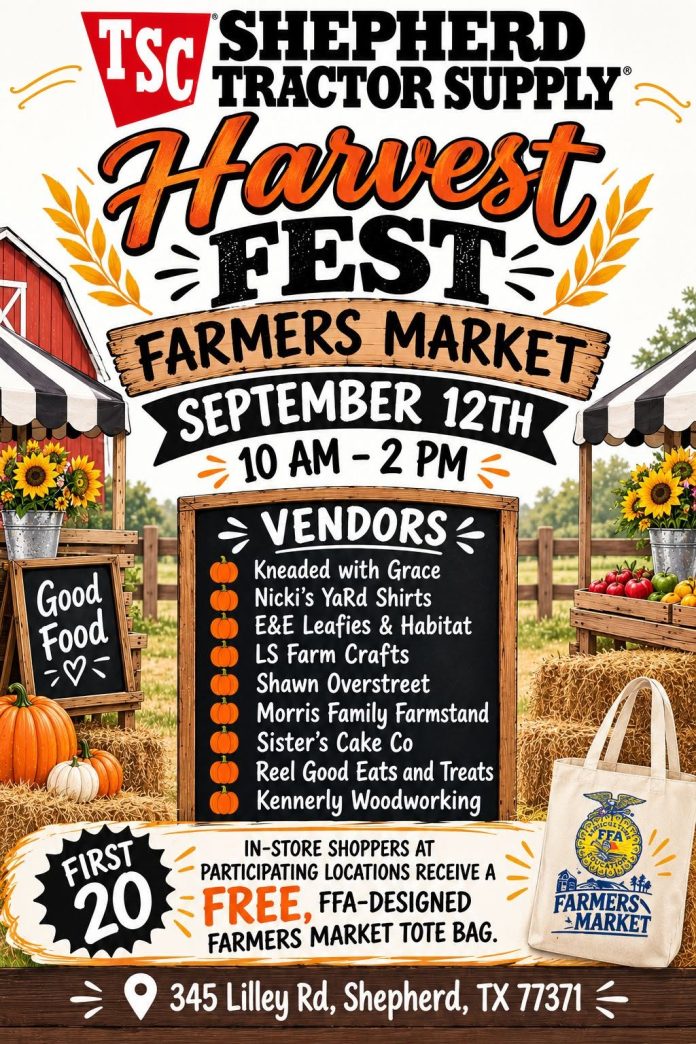
HARVEST FEST IS COMING TO SHEPHERD! 

 SHEPHERD TRACTOR SUPPLY FARMERS MARKET 

 September 12th | 10 AM – 2 PM

 345 Lilley Rd, Shepherd, TX 77371

Come out and SHOP LOCAL • SUPPORT LOCAL while enjoying a fun-filled Farmers Market featuring:

 OUR VENDORS:

 Kneaded with Grace

 Nicki’s YaRd Shirts

 E&E Leafies & Habitat

 LS Farm Crafts

 Shawn Overstreet

 Morris Family Farmstand

 Sister’s Cake Co

 Reel Good Eats and Treats

 Kennerly Woodworking

 FIRST 20 SHOPPERS!
The first 20 in-store shoppers at participating locations receive a FREE FFA-designed Farmers Market tote bag!

 Fresh finds, handmade goods, delicious treats, local businesses & more!

 Bring your family and friends and join us for Harvest Fest!

Veterans Day 2026 (Sabine County)

0

November 11 @ 9:00 am – 5:00 pm

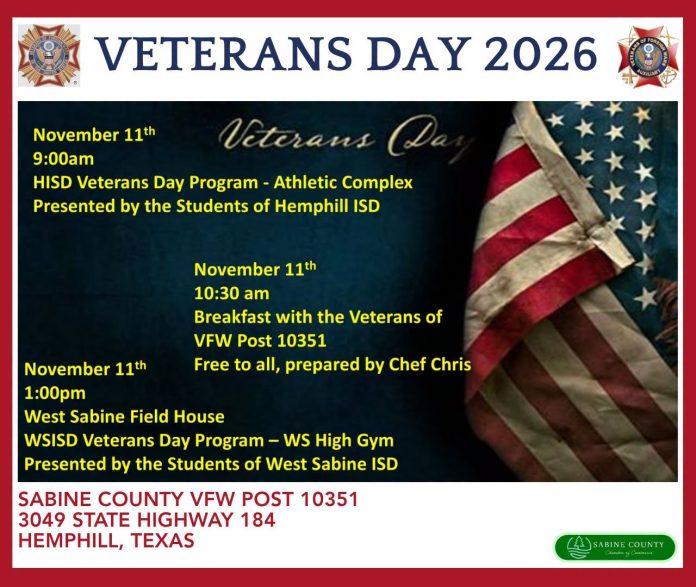
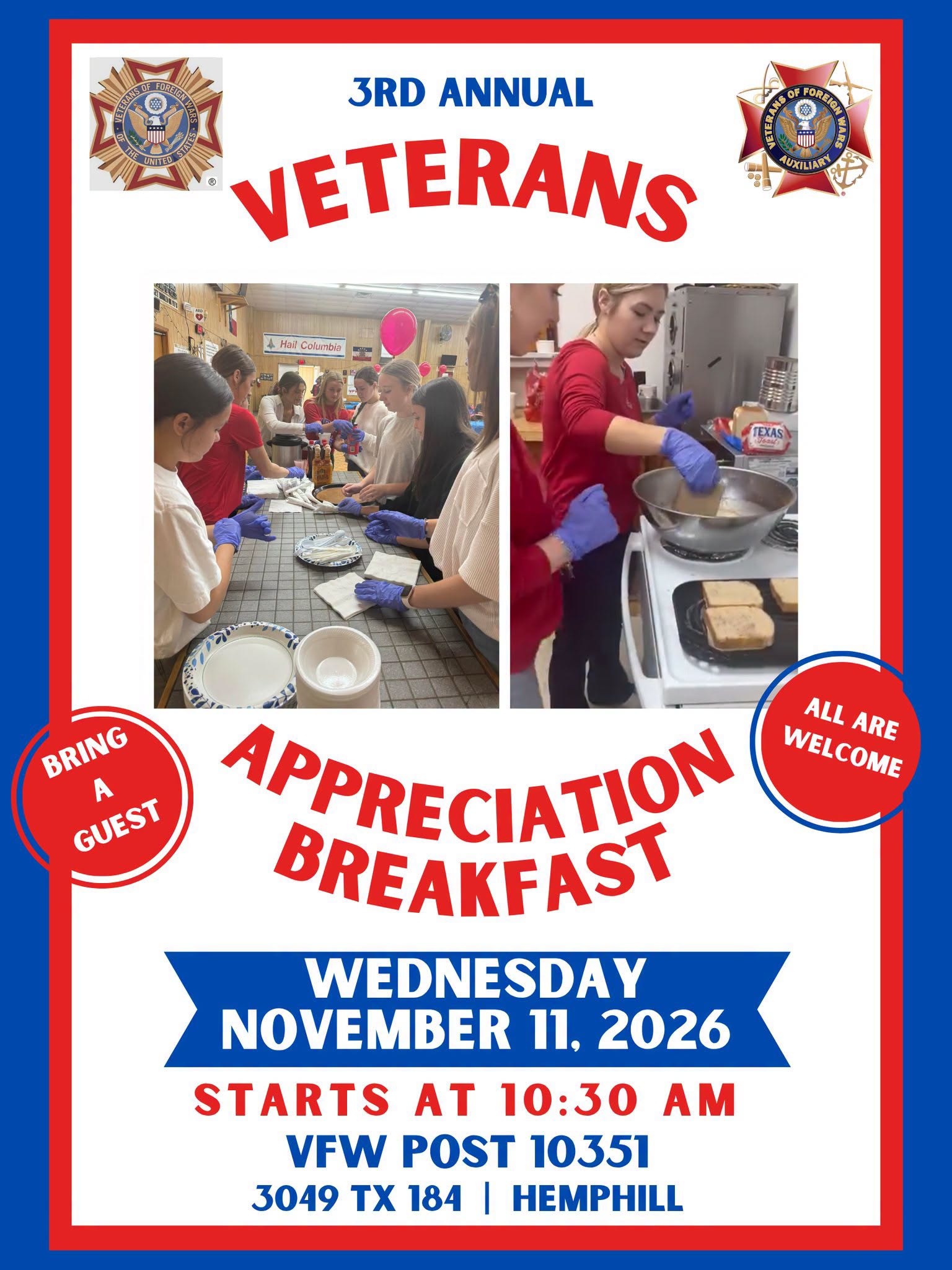
VFW Post 10351 Veterans Day Schedule:
Wednesday, November 11, 2026

• 9:00 AM at Hemphill ISD Athletic Complex

• 10:30 AM Free Breakfast at VFW – Everyone is invited to come and bring a friend

• 1:00 PM at West Sabine ISD High School Gym

FM 2259 Widening Begins This Month

0

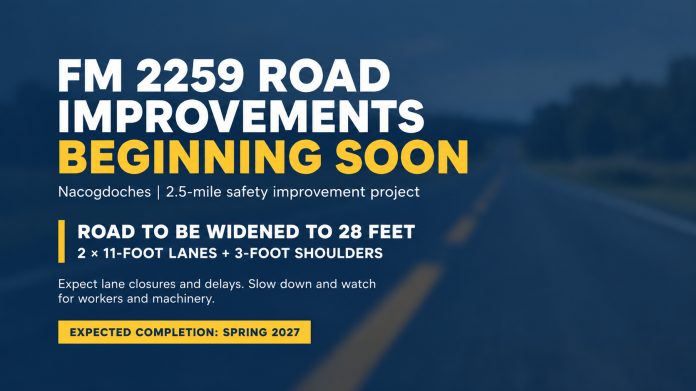
NACOGDOCHES – Work to widen and improve a portion of Farm-to-Market Road (FM) 2259, also known as Woden Road, in Nacogdoches will soon get underway.

Nacogdoches-based contractor Drewery Construction will begin setting signs and barricades in the coming days for the project, which extends 2.5 miles southeast of the intersection of FM 2259 and State Loop (SL) 224/Southeast Stallings Drive.

This safety-improvement project will widen this portion of the road to 28 feet, consisting of two 11-foot-wide lanes with three-foot-wide shoulders on both sides. New center and edge-line markings will improve visibility for drivers.

The project is expected to be completed in Spring 2027, weather permitting.

Travelers along FM 2259 should plan for delays and lane closures as work progresses. Slow down when approaching and travelling in this area. Stay alert for workers and machinery.

Angelina College, Blue Cross and Blue Shield of Texas, and National Fitness Campaign Provide Free Fitness for Everyone in Lufkin

0

FOR IMMEDIATE RELEASE

State-of-the-Art Outdoor Fitness Court® Coming to Angelina College

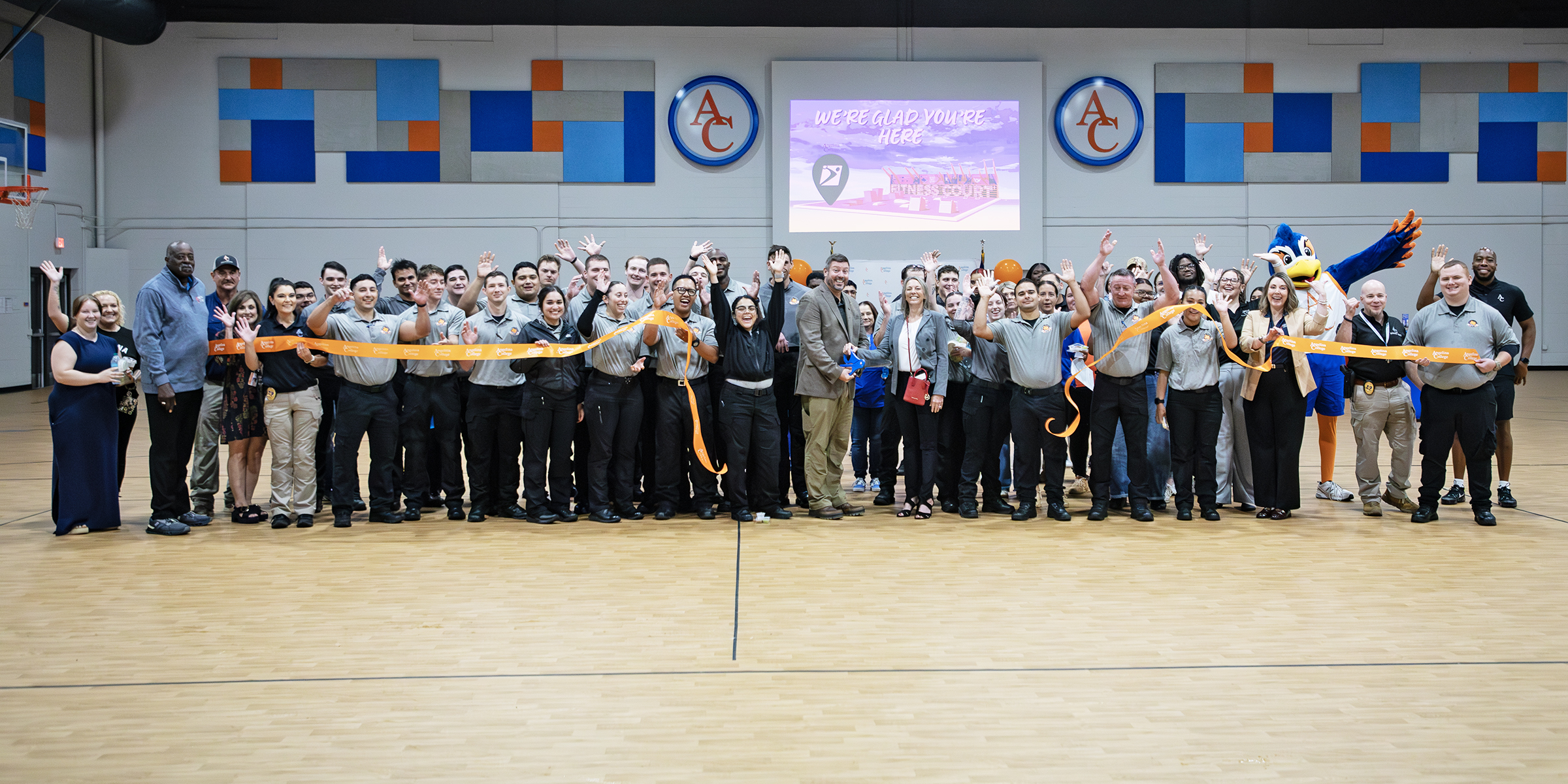
(Lufkin, TEXAS – August 19, 2026) — Angelina College, Blue Cross and Blue Shield of Texas, and National Fitness Campaign (NFC) today announced a partnership to bring an outdoor Fitness Court® and digital wellness programming to Angelina College. The Fitness Court®, located at behind the activity center, will open September 2nd at 10:00 AM with a ribbon-cutting ceremony.  

This Fitness Court®  was developed by Angelina College, Blue Cross and Blue Shield of Texas, and NFC to expand free access to high-quality workouts and create equitable access to exercise for communities across the region. The Fitness Court® is the world’s best outdoor gym, letting users leverage their own body weight to get a complete workout using seven exercise stations. 

Created for adults of all abilities aged 14+, the Fitness Court® workouts are adaptable for all fitness levels, allowing participants to move at their own pace. Users may also download the free Fitness Court® App, which acts as a coach-in-your-pocket and enhances the outdoor gym into a digitally supported wellness experience.  Angelina College is one of 50+ Campaign Partners building a network of Fitness Courts across the state, with the help of Blue Cross and Blue Shield of Texas. 

“We are proud to partner with Blue Cross and Blue Shield of Texas and National Fitness Campaign to bring this incredible resource to Angelina College and to Lufkin,” Dr. Michael Simon, president of Angelina College, said. “Our campus belongs to this community, and the Fitness Court gives us another opportunity to welcome the community onto our campus while supporting health and wellness. We encourage everyone to come out and take advantage of this new resource.”

“Physical activity is one of the simplest and most powerful ways to improve overall health,” Dr. Mark Chassay, chief medical officer at BCBSTX, said. “By investing in Fitness Courts across Texas, we’re creating more opportunities for people to move, connect, and build healthier, more equitable communities for the future.”

“We are excited to have Angelina College join us in the journey to improve health and wellness as we work to make a powerful and long-lasting impact on health outcomes and happiness by building healthy communities across America,’’ Mitch Menaged, founder of National Fitness Campaign, said. “The addition of the outdoor Fitness Court, along with digital wellness programming, demonstrates a tremendous commitment to the health and wellbeing within the Lufkin community.”

Residents are invited to attend the launch event on September 2nd at 10:00 AM to try the Fitness Court®. For more information, visit angelina.edu/news or contact Angelina College at 936-639-1301. For more information on Blue Cross and Blue Shield of Texas’s support of NFC, please visit https://www.nationalfitnesscampaign.com/texas. 

_____________________________________________________________________________________________________________

Angelina College

Angelina College, established in 1968, is a comprehensive community college serving East Texas and beyond. The College offers more than 60 degree and certificate programs, including academic transfer pathways, workforce and technical training, and continuing education opportunities. Angelina College is committed to providing accessible, affordable, and high-quality education that empowers students to achieve their goals. With flexible learning options, including many fully online programs, and a student-centered approach, Angelina College prepares learners for career success, university transfer, and lifelong achievement. 

About Blue Cross and Blue Shield of Texas
Celebrating 95 years of helping improve the health of Texans, Blue Cross and Blue Shield of Texas — the only statewide, customer-owned health insurer in Texas — is the largest provider of health benefits in the state, working with more than 168,000 physicians and health care practitioners, and 550 hospitals to serve eight million members in all 254 counties. BCBSTX is a Division of Health Care Service Corporation (which operates Blue Cross and Blue Shield plans in Texas, Illinois, Montana, Oklahoma, and New Mexico). Health Care Service Corporation is a Mutual Legal Reserve Company and an Independent Licensee of the Blue Cross and Blue Shield Association.

About National Fitness Campaign
Founded in San Francisco in 1979, National Fitness Campaign (NFC) is a wellness consulting firm that provides programs and services to cities, schools and sponsors. Our mission is to build healthy communities nationwide. The campaign delivers an integrated wellness initiative, centered around the Fitness Court®– the world’s best outdoor gym. National Fitness Campaign is preparing to welcome its 750th healthy community in 2026, as it continues to grow the country’s largest public-private partnership in support of wellness with the goal of building a Fitness Court® within a 10-minute bike ride of every American.  Learn more about National Fitness Campaign at nationalfitnesscampaign.com and follow along on Instagram, Facebook and LinkedIn.

Power Networking Breakfast (Angelina County)

0

September 25 @ 8:00 am – 5:00 pm

Start your Friday with breakfast, networking, and a little inspiration!

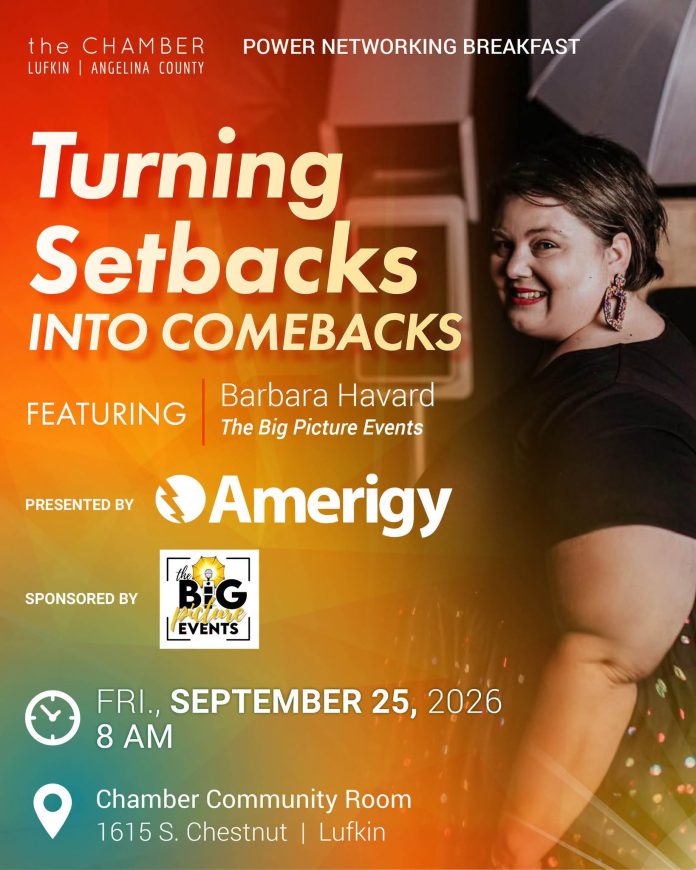
Join us for Power Networking Breakfast, presented by Amerigy Energy, on Friday, September 25 at 8 AM, as Barbara Havard of The Big Picture Events and our monthly sponsor shares “Turning Setbacks Into Comebacks.”

We all face moments when things don’t go according to plan. Barbara will share how to regroup, move forward, and turn those setbacks into opportunities for growth.

Come hungry, bring your business cards, and start your Friday with us!

Register to attend >>> bit.ly/PNB-0926