


Lufkin Education Foundation presents the 2022 Corporate Challenge Field Day. Thursday, September 15 from 5:30 PM – 7:30 PM. Egg Race, Tug of War, Sack Race, Hoola Race, 50 Yard Dash, and Hop Ball.
15th Annual Guy Davis Gold Tournament (Angelina County)

Come on down to the 15th Annual Guy Davis Golf Tournament on August 20th, 2022. You can watch, participate, or sponsor but those open spots won’t last long! Hurry and click here to sign up if you’re interested!
Picture from Lufkin Chamber of Commerce
Are You Ready for Texas Hurricane Season?
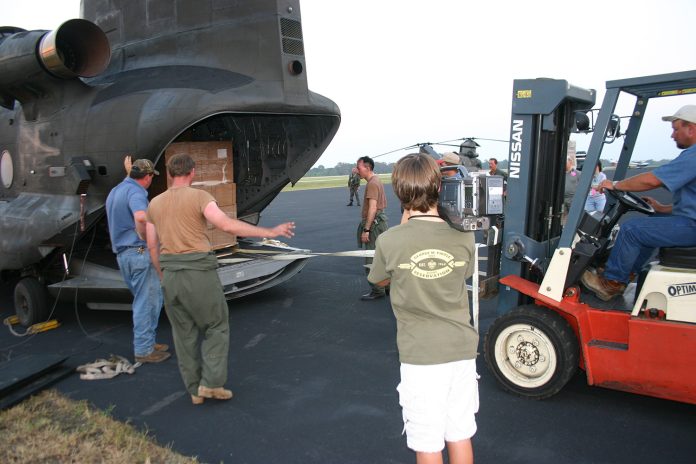
As we are well into Hurricane Season, many of us are wishing for a nice tropical storm to send use needed rain. Also, since we have been in this drought, many have become complacent with their readiness. If you have not already, you do need to check your hurricane preparedness – especially if you live in Texas. When a hurricane pops up is not the time to start getting ready. So, what should you do to get ready? Read on for some tips!
When is Hurricane Season in Texas?
The Atlantic hurricane season officially runs from June 1st to November 30th, but in Texas, we start preparing for hurricane season a little earlier. Our hurricane season usually starts in mid-April and runs through the end of October. That’s a pretty good chunk of the calendar, so it pays to be ready for the possibility of a major hurricane hitting our coast all the time.
There are a few things you can do to prepare for hurricane season. I’ll break some of them down further in this article:
1. Check your insurance coverage. Make sure you have enough homeowner’s or renter’s insurance to cover your belongings in the event of a hurricane.
2. Create or update your emergency kit. Your emergency kit should include items like non-perishable food, water, a first-aid kit, flashlights, and batteries.
3. Know your evacuation route. If a hurricane is heading our way, you may need to evacuate. Know ahead of time what route you will take and where you will go.
4. Stay informed. Keep up with the latest weather forecasts and advisories from the National Weather Service so you know when a storm is headed our way.
By following these simple tips, you can be better prepared for Texas hurricane season!
Make an Emergency Plan
When it comes to hurricane season, it’s important to be prepared. That’s why we’ve put together this handy blog post to help you make an emergency plan.
First and foremost, you should always have a plan in place in case of an emergency. That means having a designated meeting place for your family, as well as an evacuation route mapped out. It’s also a good idea to have a go-bag ready with all the essentials like food, water, and first-aid supplies.
Of course, every hurricane season is different, so it’s important to stay up-to-date on the latest forecast. Keep an eye on the news and weather reports so you know when a storm is headed our way. And finally, don’t forget to stock up on supplies like batteries and non-perishable food items. See Lee’s list below.
By following these simple tips, you can be sure that you’re prepared for anything hurricane season throws your way.
Flood & Storm Insurance Considerations
As we enter hurricane season in Texas, it’s time to start thinking about floods. Flooding is one of the most common and destructive types of natural disasters, and it can happen anywhere. Even if you live in an area that’s not prone to hurricanes, your home could still be at risk for flooding. That’s why it’s important to have a plan in place in case of a flood.
If you live in an area that’s prone to flooding, there are some things you can do to prepare. Make sure you have a plan for how you’ll evacuate if a flood is coming. Know where you’ll go and how you’ll get there. Have a bag packed with essentials like clothes, food, and water. And most importantly, make sure you have insurance that covers flooding. Most Homeowner policies DO NOT cover flooding.
If a flood does happen, there are some things you can do to minimize the damage. Move any valuables and electronics to higher ground. If your furniture is soaked, try to salvage it by taking it apart and drying it out piece by piece. And once the floodwaters have receded, start the cleanup process as soon as possible to prevent mold and mildew from taking hold.
Floods can be devastating
What to do a Hurricane
1. Know your evacuation route. Make sure you know how to get to a safe place if you need to evacuate.
2. Have a plan for what to do with your pets. Make sure you have a plan for how to keep your pets safe during a hurricane.
3. Stock up on supplies. Make sure you have enough food, water, and other supplies to last for several days in case you lose power or are unable to leave your home.
4. Keep important documents safe. Make sure you have copies of important documents like your driver’s license and insurance information in a safe place in case you need to evacuate.
5. Stay informed. Follow the instructions of local officials and stay up-to-date on the latest weather forecast so you know when a hurricane is coming and can take appropriate action.
Wrap It Up
With hurricane season upon us, it’s important to make sure we’re as prepared as possible. Luckily, the State of Texas is no stranger to hurricanes, and has a comprehensive plan in place to help keep residents safe. By following a few simple tips, you can ensure that you’re ready for whatever Mother Nature throws your way. Stay safe out there!
Lee’s Hurricane Preparedness List
1. Bottled Water & Non-Perishable Food Items
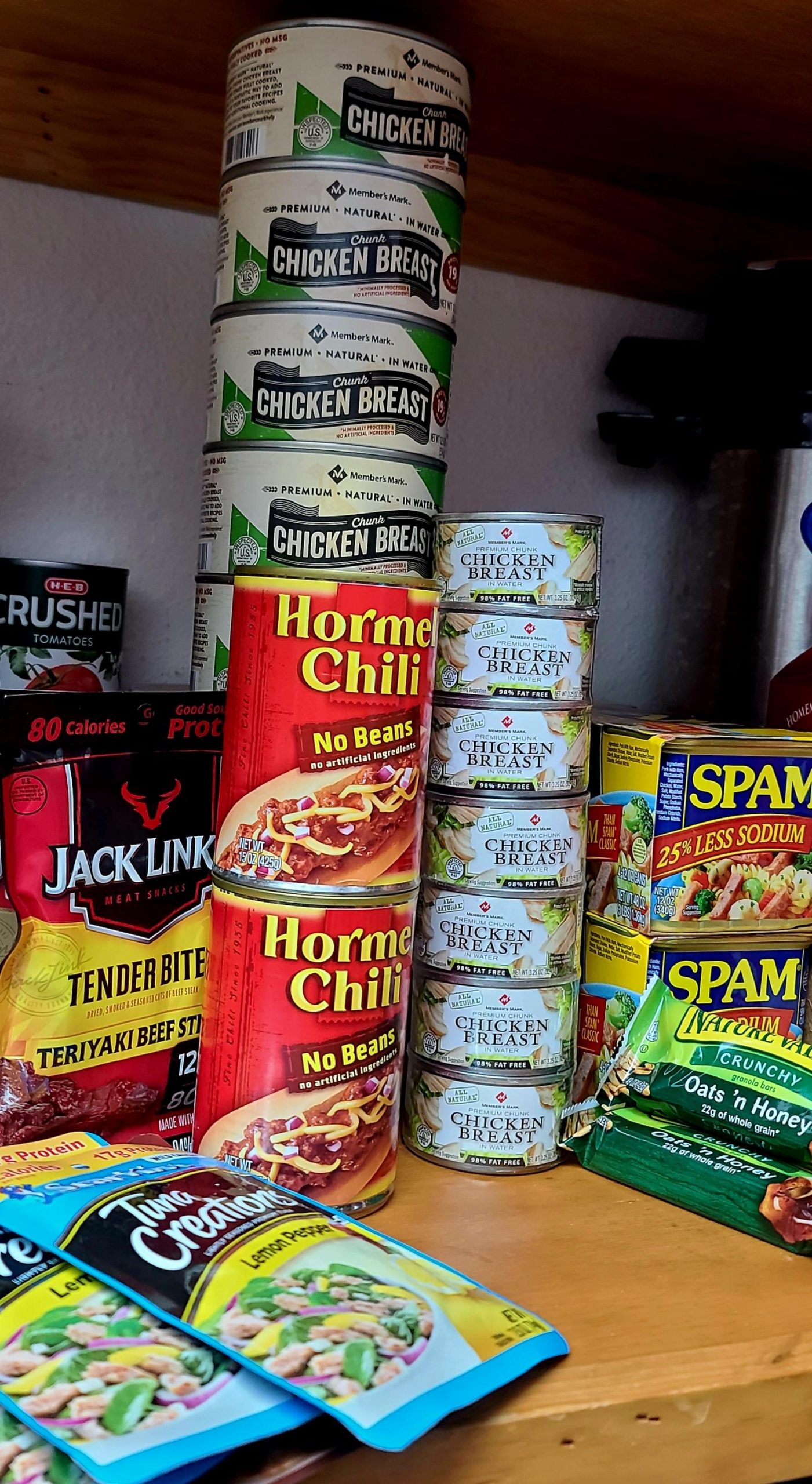
The most important things to have on your hurricane preparedness list are enough bottled water and non-perishable food items to last you and your family at least seven days. I recommend securing at least a three-week supply to ensure you’re covered.
It’s better to have more than you need because you can still use these items well after the storm passes. Here are our recommended items for your hurricane checklist:
- Bottled water (7-day supply minimum — one gallon per person, per day)
- Boxed juices and flavored drinks to mix it up
- Non-perishable foods (7-day supply).
- Ready-to-eat canned soups
- Canned vegetables, fruits and meats. I keep canned chicken, Spam and tuna
- Granola, protein or other high-fiber bars
- Peanut butter, jerky and other high-energy foods
Pro Tip: Avoid comfort and junk foods, such as chips and cookies, as they don’t provide you with adequate nutrition to stay properly energized.
2. Tools & Other Hurricane Supplies
If the power goes out, which it regularly does during hurricanes, you’ll need enough tools, batteries, and battery-powered devices to keep you comfortable after the sun goes down and without the electricity.
From emergency repairs to simply getting through the night without being bored, these tools and other supplies should be added to your hurricane checklist to get you through the storm.
- AA, AAA and D batteries
- Flashlight and headlamp (free up hands in the dark)
- Battery-powered radio with NOAA frequencies
- Battery-powered phone charger
- Pliers, hammer and nails, and screwdrivers with screws (Flathead and Phillips)
- Duct tape or another strong adhesive
- Plastic or paper cups, plates and utensils
- Plastic or glass storage containers
- Portable waterproof container (for important documents such as insurance policies, birth certificates and deeds)
- Board games and a deck of cards
- Generator
- Waterproof clothing/rain jacket
- Sleeping bags
- Clean clothes and blankets
- Candles
- Matches, lighters or waterproof fire-starter
- Tarps
Pro Tip: Avoid using real candles and risking further damage by investing in battery-powered candles with a charger that can be used when the power is out.
3. First-Aid Kit & Sanitation Items
If you sustain a minor injury a first-aid kit and compilation of sanitation items can help to prevent further injury and disastrous infections. Similar to your hurricane supply of water and non-perishable food items, you should also have a seven-day hurricane supply of all the following first aid and sanitation items.
- Adhesive and gauze bandages
- Gauze pads and adhesive cloth tape
- Hydrogen peroxide and antibacterial ointment
- Medical scissors and tweezers
- Aspirin, ibuprofen or acetaminophen
- Recently refilled prescription medications
- Non-latex gloves
- Antibacterial hand sanitizer, soap and hand wipes
- Insect repellent
Pro Tip: Keep your first-aid kit and sanitation items in a secure place inside a waterproof container just in case the rain waters get into your home.
Extra Fuel
Gas stations within hurricane-affected areas tend to run out of fuel days or weeks before the initial strike, so it’s imperative to ensure you at least have a full tank in your car in the days leading up to landfall. If you have the ability or plan to use a generator, fill up extra containers and keep them in a safe place for later use.
Do not use generators inside your home or garage or near doors, windows or vents, as they emit carbon dioxide, which can become lethal to humans if breathed in.
The safest way to prepare for a hurricane is to get far away from its expected path of destruction. This will ensure you and your family stay safe. After all, you can repair and replace your home and belongings, but you cannot replace your life.
PRO TIP: Buy the “Ethanol Free” gasoline. The shelf life is much longer and use a fuel preservative treatment. I rotate my gas cans as I use fuel for my lawnmower to always have fresh extra gasoline.

Soil Solarization

It seems that most gardeners are wrapped up with their spring gardens. It has been a tough year of heat and dry weather.
With the recent rains that some have been getting in my part of the state, many have moved on to a fall garden. Other gardeners have had enough of the summer heat and will be taking a break to start their fall/winter gardens much later.
For those who are taking a break and want to eliminate some of the weed seeds, disease, or nematodes, consider “solarizing” your garden.
I learned how home gardeners can solarize their soil several years back from my state vegetable specialist, Dr. Joe Masabni. Masabni states that soil solarization is a simple, safe, and effective means to control parasitic nematodes, soil borne plant pathogens (diseases), and some weed seeds. It offers an alternative to some organic and non-organic pesticides as well as the lengthy crop rotations now needed to control many damaging soil pests. In addition, this procedure should give good weed control in many situations.
Radiant heat from the sun is the lethal agent involved in soil solarization. A clear polyethylene mulch is used to trap solar heat in the soil. Over a period of several weeks to a few months, soil temperatures become high enough to kill many of the damaging soil pests and weed seed to a depth of nearly 8 inches.
Just how hot can it get? Results from studies in 2011 and 2012 indicate that when the ambient air temperature reached 99 degrees F, the solarized soil reached over 170 F. That’s hot enough to cook chicken.
To be clear, none of these pests will be completely eradicated from the treated area, but their numbers in the top layer (say 6 to 8 inches) will be greatly reduced, allowing fewer problems in following crops.
The soil to be solarized must be worked up to seed-bed condition–that is, cultivated until it’s loose and friable with no large clods or other debris on the soil surface. A garden tiller will eliminate clods or other debris that create air pockets that reduce heating of the soil and keep the tarp from fitting tightly over the soil surface. A clean, flat surface will also prevent the accidental puncturing of the thin plastic mulch by debris.
Make sure moisture levels are adequate for working the soil before laying the plastic. If the soil is dry, water the areas to be solarized before laying the tarp. Getting the soil wet at the beginning is crucial because most soil pests are more sensitive to high temperatures in wet soil than in dry soil. When possible, lay a soaker hose or drip irrigation lines under the tarp to maintain moisture levels during soil solarization.
You can use any cheap plastic painting “drop cloth”. Using two layers of thin plastic sheeting separated by a thin insulating layer of air will increase soil temperatures and the overall effectiveness of a solarization treatment. The edges of the sheets must be buried or otherwise secured to prevent blowing or tearing of the tarp by the wind.
For effective solarization, the edges of tarps laid over raised beds must be buried in the adjoining furrows. Due to the lower temperatures reached in those areas, expect some increase in pest and weed problems along the edge of the stripped mulches.
Long, hot, sunny days are needed to reach the soil temperatures required to kill soil borne pests and weed seed. The longer the soil is heated, the better and deeper the control of all soil pests and weeds will be. During our hot summers, a solarization period of 4 to 6 weeks should be all that’s needed to control nematodes and soil borne plant pathogens.
For those concerned about losing beneficial microbes, indeed you will lose them in addition to you unwanted pathogens. However, populations of beneficial, growth-promoting and pathogen-antagonistic bacteria and fungi quickly recolonize solarized soil with the addition of compost or adding a biological control component to soil.
If you have plans for a fall garden, this may give you a late start, but the results of letting our hot summer work for you can be fantastic.
Polk County Firefighters Receive $16,000 from Georgia-Pacific
Georgia-Pacific is hoping to give some relief to area firefighters as they continue to battle an active fire season in Texas. The extreme hot weather has resulted in fire departments seeing a significant spike in brush fires—and with limited resources—most volunteer fire departments are feeling the heat when it comes to keeping operations running smoothly during one of the driest seasons in the state’s history.
“Georgia-Pacific understands the vital role volunteer firefighters have in East Texas communities,” said Yana Ogletree, Georgia-Pacific Public Affairs Manager. “For many years Georgia-Pacific has invested in area volunteer fire departments, whether it is helping to purchase new tankers and life-saving equipment or funding training and operations.”
Recently the local building products company donated $16,000 to volunteer fire departments in Corrigan, Livingston, and Onalaska.
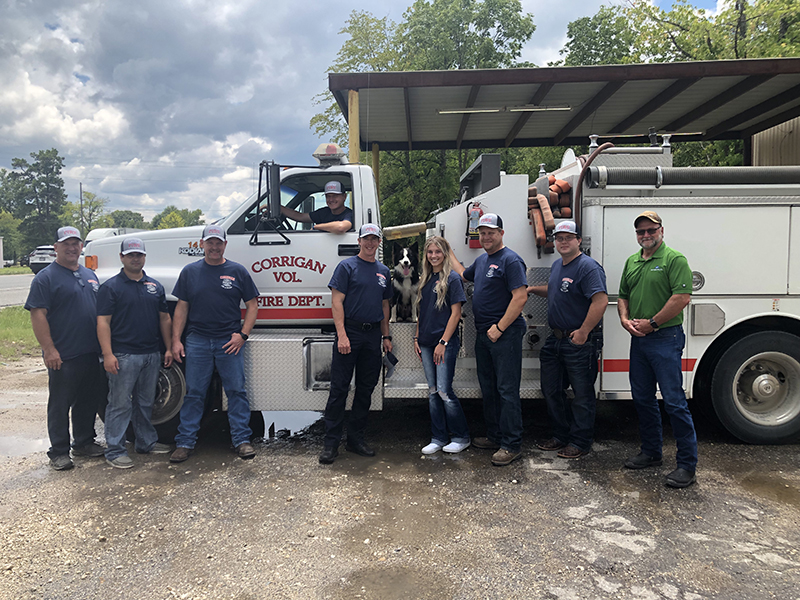
Receiving $10,000 from Georgia-Pacific, The Corrigan Volunteer Fire Department will use the money to upgrade their trucks. “These funds come at a time when we have been inundated with brush fires,” said Jimmy McDonald, Corrigan Volunteer Fire Chief.” “With limited equipment, high fuel costs, and outfitting firefighters with the appropriate equipment, we can use all of the donations we can get.”
Despite the financial challenges small volunteer fire departments face on a regular basis, Corrigan is planning for the future and is raising funds for a new facility. According to McDonald, the department has secured land which will eventually be home to a new fire department.
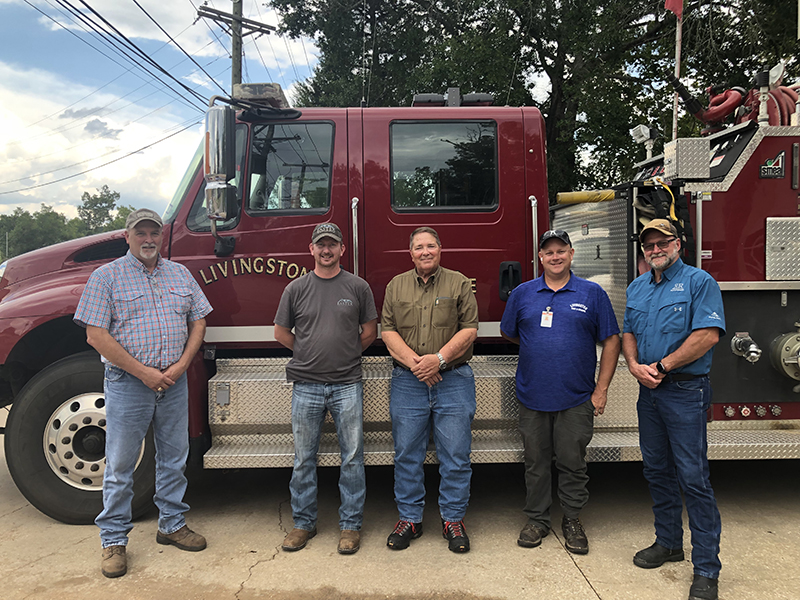
Georgia-Pacific is also donating $5,000 to the Livingston Volunteer Fire Department. With a 37-member force, Livingston firefighters cover not only the city of Livingston, but approximately 250 square miles of Polk County. “We actively work more than 500 calls each year while also providing backup to the other ten departments located within the county,” said John Haynes, Livingston Volunteer Fire Department Assistant Fire Chief. “Georgia-Pacific’s contribution is significant and greatly appreciated. The funds will help us obtain more rescue equipment and they will provide additional capital to purchase a new pumper unit.” Haynes says the new pumper truck, which will be used to take the pressure off an aging fleet, is scheduled to arrive in the fall.
Serving the Lake Livingston area, the Onalaska Fire Department is receiving a $1,000 donation from Georgia-Pacific to purchase equipment and training.
“Georgia-Pacific is a continuous supporter of local volunteer fire departments in Polk, Angelina, and Sabine counties. Georgia-Pacific is proud to partner with local firefighters who dedicate their lives to keeping our families, homes, and property safe. Thanks to their bravery and tireless efforts, we can all rest easier knowing help is only a phone call away,” said Ogletree.
School is Starting. Are you paying attention?

The Department of Public Safety in Texas reminds drivers to be prepared for the new school year. Drivers should know laws about driving near a stopped school bus and not texting while driving, and parents should be aware of safety rules that they could enforce on their children while they are in the car.
“Heading back to school is such an exciting time and we all need to work together to ensure everyone stays safe,” said DPS Director Steven McCraw. “Please, be cautious and do your part by talking to your kids about safety, reporting suspicious activity and by following traffic laws in and around school zones.”
DPS offers these tips for back to school safety:
- Give students extra room and don’t assume they are paying attention to traffic. Students are frequently distracted by mobile devices or listening on electronic devices and may not be paying attention to their surroundings.
- Don’t block a crosswalk when stopped at a red light or stop sign.
- Follow the directions of school crossing guards.
- Watch for children on bicycles traveling to and from schools.
- Reduce your speed when you spot a school bus and know children may unexpectedly step into the road without checking for oncoming traffic.
- Be careful around railroad crossings. School buses are legally required to stop at them.
- Know laws regarding school buses. According to Texas law, if a bus has alternating flashing red signals visible from the front or rear, drivers MUST stop before reaching the bus. Drivers can only proceed if the flashing lights are no longer activated, the driver signals you to proceed or the bus has resumed driving. Approaching drivers do NOT have to stop for a school bus that is operating a visual signal if the road is separated by a physical barrier or an intervening space. If a highway is only divided by a left-turn lane, it is not considered divided and drivers must stop for school buses.
- Drivers who illegally pass a school bus face fines up to $1,250 for the first offense. For people convicted of the offense more than once, the law allows for the person’s driver license to be suspended for up to six months. A ticket for this offense cannot be dismissed through defensive driving. Criminal charges are possible if a driver causes someone serious bodily injury.
- Always obey speed limits and traffic laws in school zones.
- Remember, texting while driving is illegal in Texas.
Texas also has some other safety tools available during the school year for students, parents, teachers and school administrators.
A critical resource for reporting suspicious activity in schools and communities in order to help prevent dangerous attacks is the iWatchTexas program. Download the free iOS or Android mobile app prior to the start of the school year. Tips can be reported via the website, the mobile app or by calling 844-643-2251. All reports are confidential. For information on how to use iWatchTexas, wtach the video below
The Texas School Safety Center is another useful tool for school security. The Texas School Safety Center has staff experienced in school safety and can provide technical assistance or training, conduct program evaluations or offer resources to schools. Classes are also available online for the community. The center is part of Texas State University, which offers valuable resources on school safety for parents and members of the school community.
Finally, on Sept. 1, 2021, DPS implemented the Active Shooter Alert System. In the event of a shooting at a school, is not just people near the school who will be notified. This tool uses cell phones, local broadcast media, and Texas Department of Transportation Dynamic Message Signs (DMS) to let people know what happening.
DPS will issue an Active Shooter Alert if a request meets their requirements. These include the active shooter being in the agency’s jurisdiction, determining that the alert would be useful to people near the active shooter, verifying the active shooter situation through a preliminary investigation by the requesting agency, and that it is also possible to identify the shooter’s last known location.
Use these resources to help work together to keep the kids of Texas Forest Country and al of Texas safe.
LANE CLOSURE PLANNED NEAR BUSY SL 287/ACCESS RAMP NEXT WEEK
LUFKIN – A lane closure is planned next week on SL 287 near a busy Lufkin on-ramp that will have traffic slowed or stopped during peak travel hours.
The work is planned near a new apartment construction site on SL 287 West for August 15 through August 19. The southbound outside lane will be closed near the access ramp at Feagin/Southwood Drive beginning at Southwood Drive and including the overpass. The on-ramp will remain open, and motorists are urged to yield to oncoming traffic in the single lane. Reduce speed and expect delays near the Southwood Drive overpass.
“This is a very busy section of roadway and the access ramp from Southwood Drive headed south toward US 59 will be affected also. Although it will remain open, merging into the single lane will require drivers to stay alert,” said Rhonda Oaks, Lufkin public information officer. “This driveway construction is being done by outside contractors constructing the apartments. TxDOT will monitor traffic and the safety of the closure throughout the week.”
Motorists are urged to stay alert and obey all traffic control in place. Stay alert for yielding, merging, or stopped vehicles. Motorists are urged to allow additional travel time or take alternate routes throughout the week.
For more information, contact Rhonda.Oaks@txdot.gov or call (936) 633-4395.
Bark Lice Infecting Trees
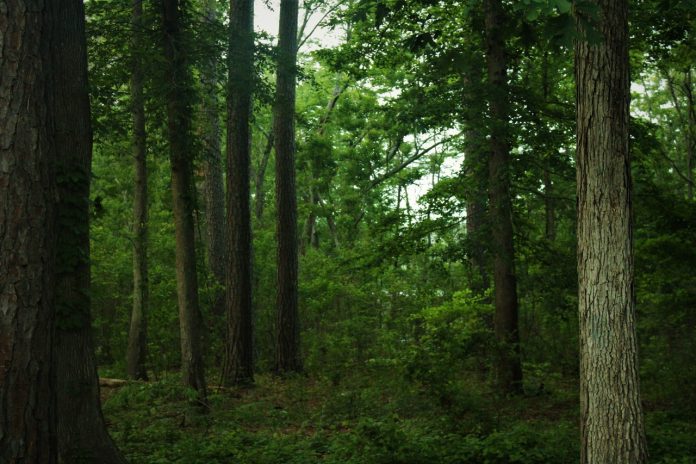
Recently, concerned homeowners have called about their tree’s trunks and limbs being covered in a webbing. The leaves are fine and not being consumed by the normal caterpillar culprits. But what is this webbing and will it hurt the trees?
The webbing is from a seldom seen insect commonly called bark lice. These small insects called barklice or psocids are completely harmless to the tree.
The insects are around during most years but are only noticed when population levels are high, and their webbing becomes more apparent. Because barklice cause no damage to the trees, no control is recommended.
The webbing, which can extend from the trunk into the foliage, is quite thin and fragile and is expected to disappear in a few weeks. Heavy infestations of bark lice seem to be associated with relatively long periods of high humidity.
Homeowners often express concern when they see the trunk and most limbs of their trees encased in a giant silken web. Under the webbing, you’ll find bark lice as a small, soft-bodied insect with long antennae. To those who are armchair entomologists, they may resemble aphids.
To be clear, even though these insects are called bark lice, they are not lice. They are not parasitic on anything, and they are not pests of humans or animals.
The adults are about 1/8th-inch long and possess two pairs of membranous wings that are held roof-like over the body when at rest. Bark lice have simple metamorphosis and go through three stages — egg, nymph, and adult. The nymphs resemble adults except they are smaller and lack wings. Barklice have chewing mouthparts and are considered a beneficial insect since they feed on fungi, spores, pollen, lichens, and other debris on the surface of a tree’s bark. In effect, they will clean your tree trunk and limbs of any debris.
Most importantly, they do not harm the trees they infest. The bark lice that produce the webbing on trees in Texas belong to the insect order Psocoptera and have the scientific name Archipsocus nomas. They can be found in all the southern states from Florida to Texas. Water oak (the semi-evergreen oak of the south) seems to be the most common tree on which the webbing is found.
They are not known to produce webbing on pine trees.
If you just absolutely feel the need to remove the webbing and get rid of these insects, use a hose-end sprayer with an insecticidal soap to wash away the webbing and eliminate the bark lice.
Cary Sims is the County Extension Agent for agriculture and natural resources for Angelina County. His email address is cw-sims@tamu.edu. The members of Texas A&M AgriLife will provide equal opportunities in programs and activities, education, and employment to all persons regardless of race, color, sex, religion, national origin, age, disability, genetic information, veteran status, sexual orientation or gender identity and will strive to achieve full and equal employment opportunity throughout Texas A&M AgriLife
Speed Limit Change Approved
LUFKIN – The Texas Transportation Commission in Austin has approved a speed limit change on SH 103 East in Angelina County. The updated signs are scheduled to be installed and the new limits are enforceable once signs are set.
The speed limit on SH 103 East will be reduced from 70 mph to 65 mph from just west of FM 326 and will remain at that limit for 1.06 miles where it will then return to 70 mph east of FM 326.
The reduction in speed will enhance the safety for traveling motorists through the area. The reduced speed limit is the result of an engineering and traffic investigation/speed study that determined a reasonable speed for this segment of the roadway based on several factors. The study met several markers for the reduction based on traffic in the area, number of crashes and adjoining roadways and driveways in the area.
Motorists are urged to stay alert and obey the new signage indicating the speed limit change. For more information, contact Rhonda.Oaks@txdot.gov or call (936) 633-4395.