


Home Blog Page 558

A Simple Spring Cleaning Checklist

0

It’s the time of year to roll up your sleeves and do some spring cleaning. Experts point out that it’s helpful to streamline the tools you use to do the job and the tasks you seek to accomplish.

“An all-purpose cleaner and a tough degreasing agent can be used in so many areas of the home,” said Jeff Devlin, a licensed contractor who’s appeared on several home improvement television shows. Devlin’s first tip: look to reduce the number of products in your cleaning arsenal. “Along with high-quality sprays and cloths, I use one all-purpose cleaner that also contains degreasing ingredients.”

Devlin, along with Mean Green and its line of heavy-duty, all-purpose cleaners offer these different strategies for critical areas of your home.

• Stove and range hoods: While you should be cleaning these areas regularly after food preparation, take this opportunity to conduct a more thorough cleaning. Spray cleaner directly on the mess for up to two minutes. Wipe clean with a sponge or cloth. Then rinse thoroughly with clean water.

• Sinks and countertops: Sinks and countertops can be a trap for food, grease, grime and soap scum. Generously spray non-porous surfaces with your cleaner then rinse with clean water.

• Stove exhaust filter: The grease buildup that collects on the stove’s exhaust filter can be a tough nut to crack. In a sink basin, mix 8 ounces of a concentrated multi-surface cleaner and 1 gallon of hot water and submerge the filter. Place the filter in a sink or dishpan and pour in concentrated cleaner to cover. Allow the filter to soak for 30 minutes. Drain the dishpan and rinse thoroughly with hot water.

• Floors: Give your floors a mopping. Mix 4 ounces of cleaning solution with 1 gallon of warm water. Apply with mop or sponge.

• Garbage cans and diaper pails: Bags often leak nastiness into the bottom of the garbage can, which can easily be missed when quickly replacing the bag. Turn your cleanser’s nozzle to spray and generously cover the can. Wipe or brush any areas that have any residue. Rinse thoroughly with clean water.

• Showers, tubs and tile: Use your cleaning agent at full strength and generously spray surfaces directly. Allow it to penetrate the soap scum for up to two minutes. Do not allow to dry. Wipe away with a coarse sponge or cloth. Rinse thoroughly with clean water.

• Toilets: Let’s face it. This isn’t anyone’s favorite job but it has to be done. Turn that nozzle to spray and generously spray the outside of the toilet. Wipe clean with a paper towel, then give a quick rinse.

• Patio: For patios, outdoor furniture, concrete, vinyl fences and siding, use the same cleaner outdoors: simply spray, then wipe clean with a cloth or sponge and rinse surfaces with clean water. While you’re at it, consider removing grease and grime from tools, engine parts, tires, sports gear and lawn equipment.

For efficiency, consider cleaning solutions that don’t require pre-cleaning, such as Mean Green Super Strength Cleaner & Degreaser, the strongest all-purpose cleaner available. More tips for getting your spring to-dos completed can be found at meangreendegreaser.com.

“Make spring cleaning simple and effective by using smart strategies on every surface of your home,” Devlin said.

(StatePoint)

3 Lesser-Known Benefits Of Flashing Your Amazing Smile

0

The Consumer Guide to Dentistry lists eight different components of a smile, practically from ear to ear, beginning with the frame (lips) and ending with the buccal corridor (that’s the dark space between the corners of the mouth and the upper teeth, for those who might not know).

While smiling might seem like a complicated process, especially when you consider that it takes anywhere from 11 to 17 muscles just to prop up both sides of your lips, the life benefits that smiling provides are immeasurable.

Smiling reduces stress hormone levels, taking on similar conditions to cortisol, adrenaline and dopamine, while increasing mood-enhancing endorphins.

“A beautiful smile is a combination of factors that communicate a sense of well-being to those who see it,” said Dr. Jamie Reynolds, an orthodontist, national and international lecturer and author of “World Class Smiles Made in Detroit” (www.AskDrReynolds.com). “A smile works on both the physical and emotional level to transfer positive feelings between the parties involved.”

It can also have the opposite affect.

“I’ve had some patients who are self-conscious about their smile, and it has seriously affected them,” Reynolds said. “It made them feel timid, hesitant or even like they were poor or not intelligent because their teeth were crooked.”

Here is a closer look at how your smile can directly affect your life:

Your longevity might depend on it.

A 2010 study by Wayne State University measured the span of smiles on Major League Baseball players from their 1952 trading cards. The study found that those who didn’t smile in their pictures lived an average of 72.9 years, versus 79.9 years for the players who did smile.

Smiling has therapeutic effects.

There are a number of therapeutic effects that smiling has on a person’s brain and demeanor, Reynolds said. Smiling reduces stress hormone levels, taking on similar conditions to cortisol, adrenaline and dopamine, while increasing mood-enhancing endorphins. British researchers found that one smile can provide the same level of brain stimulation as 2,000 chocolate bars, while lowering blood pressure at the same time.

Smiles are a universal language.

Non-verbal communication doesn’t always translate well between cultures. In the United States, for example, a thumbs-up signals that all is well. Try that gesture in Australia and the reaction might be a little different than expected, thanks to a vulgar meaning of the hand sign. Smiling at that same person, however, should give the recipient the intended positive response. In every culture and every country across the world, a smile means the same thing, essentially making it a universal language.

“If you have a smile you are proud of, you want to show it off to others,” Reynolds said. “I’d like to see everyone giving off honest, heart-felt smiles.”

Online Banking Tips

0

BBB offers safe banking tips for consumers during National Consumer Protection Week

Using a smartphone, tablet or computer to manage your finances is a convenient way to monitor your money from anywhere at any time. At the same time, it’s important to be cautious when checking your account balance online or with a mobile banking app.

According to the Federal Trade Commission, more than 9,600 complaints against banks and lenders were reported by Texas consumers in 2016. Also, bank fraud was ranked as one of the top five types of identity theft, with more than 3,900 complaints reported to the FTC.

This week, Better Business Bureau serving Central, Coastal, Southwest Texas and the Permian Basin is celebrating National Consumer Protection Week (NCPW), a national campaign aimed to educate and encourage consumers on a variety of topics, such as identity theft, safe banking practices and scams.

In recognition of NCPW, your BBB and the Federal Deposit Insurance Corporation (FDIC) offers the following safe banking tips:

  • Avoid “card skimming” at ATM machines. Card skimming occurs when scammers attach a device to an ATM machine or gas pump to “skim” the information on your debit or credit card when you swipe them. When combined with a hidden camera, the scammers are able to record your Personal Identification Number (PIN). To help protect yourself, examine the area surrounding the ATM for possible concealed cameras. Also, stand close to the machine when entering your PIN, and cover the keypad with your hand.
  • Use a credit card for online transactions. Avoid using a prepaid debit card or debit card – which is linked directly to your checking account—when purchasing online. According to the FDIC, debit cards are considered less beneficial than credit cards for major purchases or online buying because of the limited protections in cases of fraud.
  • Keep your transactions secure. Safeguard your bank account information, credit card numbers, Social Security number and other personal data when you use the Internet. Don’t use an unsecured Wi-Fi network, such as the networks open to the public in coffee shops and restaurants. Also, don’t send personal information or account numbers through regular emails or text messages.
  • Research any app before downloading it. Just because the name of the app resembles the name of your bank doesn’t mean that it’s the official app for the bank. It could be a fraudulent app designed to look like the real one. Make sure to download the app from a legitimate app store.
  • Secure your mobile device and the app. Depending on the type of mobile device or smartphone, most have technology now that requires a PIN number or fingerprint to unlock the phone. Whether you access your account through the bank’s website or mobile app, create a strong password and one that’s not easy to guess. The FDIC recommends a password contain combinations of upper and lowercase letters, numbers and symbols and a PIN with random numbers, and not the last four digits of your Social Security number. Write it down and keep it somewhere safe.
  • Be on guard against unsolicited emails or text messages appearing to link to a financial institution’s website. These could be phishing messages containing some sort of urgent request (such as a warning that you need to “verify” bank account or other personal information) or an amazing offer (one that is “too good to be true”) designed to lead you to a fake website. Scammers use this tactic to gain access to your personal information and other sensitive data.

For the latest news and information, follow us on watchyourbuck.com, Facebook and Twitter. To check out a company and find trustworthy businesses, visit bbb.org. Find other news story topics by visiting our Press Release News Center.

ABOUT BBB®: For more than 100 years, Better Business Bureau has been helping people find businesses, brands and charities they can trust. In 2015, people turned to BBB more than 172 million times for BBB Business Reviews on more than 5.3 million businesses and Charity Reports on 11,000 charities, all available for free at bbb.org. BBB serving Central, Coastal, Southwest Texas and the Permian Basin, which serves 105 counties in Texas, has offices in Austin, Waco, Corpus Christi, San Antonio, Midland, Bryan and Fort Worth. Your BBB is one of more than 100 local, independent BBBs across the U.S., Canada and Mexico.  

Blossoming Forth

0

From the Gulf Coast to the Big Bend each spring, wildflowers brighten the Texas landscape. State parks offer some of the best places to enjoy spectacular displays of bluebonnets, Indian paintbrushes and other native flowering plants.

Here’s a sampling of parks to visit:

Big Bend Country

Three-foot-tall Big Bend bluebonnets and colorful cactus blooms can be seen at the Big Bend Ranch State Park.

At Franklin Mountains State Park in El Paso, golden California poppies spread color across the slopes in March and April. For great views of the flowers, visitors can ride the Wyler Aerial Tramway.

Gulf Coast

Bluebonnets and other wildflowers bloom in abundance at Lake Corpus Christi State Park.

Bluebonnets and Indian paintbrushes surround the stately plantation house at Varner-Hogg Plantation State Historic Site.

Bluebonnets are bloom in abundance at Lake Corpus Christi State Park.

Hill Country

March and April are the best times to see fields ablaze with color at the Lyndon B. Johnson State Historic Site. Wildflowers include bluebonnets, Indian paintbrushes, firewheels and Mexican hats.

Highways lined with wildflowers lead to Enchanted Rock State Natural Area and Inks Lake State Park.

Panhandle Plains

A variety of flowers bloom from March through October along Palo Duro Canyon State Park’s 16 miles of roads. May and June are the best times to visit, when plants such as spiderwort, Texas thistle, yucca, Indian blanket and Mexican hat are in full flower.

Pineywoods

Flowering dogwood, redbuds and fragrant wisteria blossoms make springtime at Daingerfield State Park a beautiful time to visit.

Passengers on the antique Texas State Railroad see the region’s beautiful displays of flowering dogwoods in late March and early April.

Prairies & Lakes

Fort Parker State Park near Mexia boasts a wonderful wildflower season that runs from early March through June. Among the blooming plants are Indian blanket, standing cypress, phlox, ladies’-tresses, evening primrose and wine cups.

Bluebonnets and other spring flowers abound in Washington-on-the-Brazos State Historic Site.

South Texas Plains

Goliad State Park has wonderful displays of bluebonnets and Indian paintbrushes that bloom through April, as well as phlox, lantana and wine cups. Visitors can see concentrations of flowers along Highway 59.

Springtime visitors to Bentsen-Rio Grande Valley State Park will see dense growths of flowering shrubs such as blackbrush and cenizo. Wildflowers include sand verbena, sleepy daisy, wild phlox and huisache daisy.

During peak wildflower season, motorists can listen to recorded reports by calling the Texas Travel Information Hotline at (800) 452-9292.

No. 12 Trinity Valley Eliminates Lady Roadrunners

0
Angelina College’s Karley McHenry (13) fights through a hand check from Trinity Valley’s Rainey Kuykendall (32) during Wednesday’s game. (AC Press photo/Gary Stallard)
Angelina College’s Angel Darkus (11) drives around Trinity Valley’s Naomi Davenport (5) during Wednesday’s game. The No. 12 Lady Cardinals eliminated the Lady Roadrunners with a 71-57 win in Region XIV conference tournament action in Jacksonville. (AC Press photo/Gary Stallard)

A nationally ranked basketball team doesn’t need much of a window through which to squeeze for a win, and the No. 12 Trinity Valley College Lady Cardinals capitalized on such a window when they saw it in eliminating the Angelina College Lady Roadrunners 71-57 in Wednesday’s Region XIV conference tournament action in Jacksonville.

In a game many expected to end in a blowout, the Lady ‘Runners fought their way through a couple of Lady Cardinal runs to close to within eight points with a little more than three minutes to play in the game. However, three missed free throws and a missed field goal attempt from AC led to a six-point swing, and just like that, the Lady Cardinals were back in front by 14 points. Trinity Valley protected the lead late by hitting a pair of field goals in the final minute while holding the Lady ‘Runners to two free throws over the last three minutes to advance to the next round.

Angelina College’s Erin Sanchez (4) fights her way past Trinity Valley’s Naomi Davenport (5) during Wednesday’s game. The No. 12 Lady Cardinals eliminated the Lady Roadrunners with a 71-57 win in Region XIV conference tournament action in Jacksonville. (AC Press photo/Gary Stallard)

Charisma Shepherd led the Lady Roadrunners with 20 points, hitting five three pointers in the game. Sophomores Kennethah Harden added 13 points and Tyanna Barlow 12 in their final games with AC. Freshman Karley McHenry finished with six points.

Shakeela Fowler’s 19 points led the Lady Cardinals (25-5). Naomi Davenport pitched in with 16 points and Rainey Kuykendall 12 in the win.

AC sophomores Kathan Arvie and La’Neique Nealey also appeared for the final time in Lady Roadrunner uniforms.

The Lady ‘Runners end their season at 15-16 and head coach Byron Coleman’s 11th straight appearance in the post season.

AC’s men will continue their march through the tournament on Thursday, as the Roadrunners face the Trinity Valley Cardinals at 8 p.m. in Jacksonville.

The e-mail address for AC’s Sports Information Director is gstallard@angelina.edu.

All Tribes Converge on Conservation

0
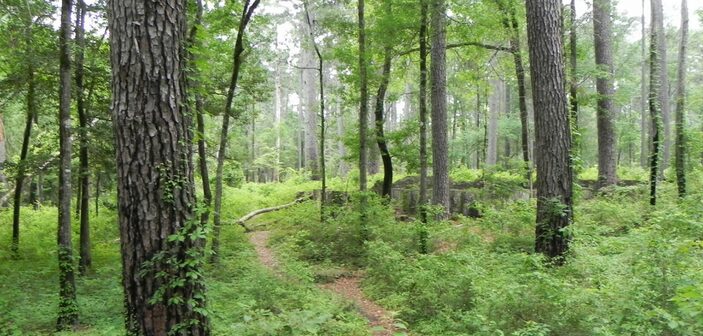
Angelina National Forest. Photo by Sharon Kerr.

Let’s start with a modern fable about three tribes, each with their own totem spirit, but all dedicated to Conservation.

The Native Planters were intent on weeding out invasive species and replacing them with only what grew in pre-modern times. They were hard workers with thick callouses who worked tirelessly.
The Moose tribe sought to restore herds to their original range, as the Creator surely intended. To their great delight, they found they could successfully introduce starter herds anywhere there is sufficient habitat, and that there is much public support for this iconic animal.

Now this is where the Native Planters and the Moose tribe came into conflict. Deep in the box canyons where the Native Planters had labored so long, the new herds followed the creeks and destroyed native vegetation.

Years of work torn up and trampled, said the Native Planters.

No, it cannot be so, claimed the Moose people. Moose and native plants always existed side by side until the Europeans came and changed everything. Surely what we are doing for the moose cannot be at odds with what you are doing for the plants. That doesn’t make sense.

Do you remember there were three tribes?

Quietly, the Wolf People ignored the two squabbling tribes and brought in grey wolves, a pair here, a pack there. And with that, the problem went away. Why? Moose herds don’t go in box canyons when there are wolf packs present.

The moral of this story is that it takes all of the tribes to make a successful Conservation plan.

Or, you could say, you need all the pieces to assemble a puzzle.

That story, which was told to me a long time ago, is a good illustration to keep in mind when you hear about the NFGT, National Forests and Grasslands in Texas. The US Forest Service will be holding meetings soon on their Forest Plan Revision.

Near Lake Sam Rayburn Dam. Photo by Sharon Kerr.

According to the USFS, the existing Forest Plan was written in 1996 and does not well represent best practices as currently understood.

For instance, everyone grew up listening to Smokey the Bear say Only YOU can prevent forest fires. Without much fanfare, Smokey now says Only YOU can prevent WILDFIRES.

This small change acknowledges what forest land managers have known for decades: prescribed burns – deliberately setting the woods on fire – is a good thing for lots of sound conservation reasons. And a control burn is one of the best tools to prevent catastrophic wildfires.

That’s not the only thing that needs to change, however. Whatever plans the Forest Service makes, they are tasked with juggling environmental impact, economic value and recreational use of vast swaths of East Texas.

Even those who don’t “use” the forest – neither do they hunt, hike or harvest – they still have a stake in this. They derive pleasure and comfort from forest lands even if it’s just driving through woods on their commute to work. They may not receive direct economic benefits from hunting, fishing or forest products, but East Texas economies depend on those industries for much of our income and taxes.

People who think harvesting trees is surely a sin doesn’t understand the life cycle of the forest. Not all woods are like the centuries-old Redwoods. Most pine trees (other than Longleaf) have a limited life span.

Our forests are not “virgin” in any sense. A hundred and fifty years ago, most of East Texas was cotton and sugarcane plantations. The pine forests that have replaced them are mostly fast growing, short lived pine species, a renewable resource that thrives best when it is renewed (harvested and replanted).

From an ecological standpoint, a young and growing forest “is probably one of the most cost-effective ways to mitigate climate change.” A geriatric forest does not absorb as much carbon, invites pests and diseases to thrive, and is a hazard in a wind storm.

All of these ideas must be weighed against scientifically-based best management guidelines to come up with balanced recommendations.

The first phase of forest planning is to hold meeting to assess what people want from these publicly held lands. Forest Country residents will be particularly affected by changes because four large National Forests are located here: Angelina, Davy Crockett, Sabine, and Sam Houston National Forests are all located in East Texas.

The Forest Service says you don’t need a degree in forestry or resource management to be involved. Bring your thoughts and concerns to share with the group. Speak up and say how you would like to see National Forests managed over the next 10-20 years.

If you want a gorgeous full-color guide to learn more, search online for A Citizens’ Guide to National Forest Planning, a USDA publication with 86 pages of glorious photography and a step-by-step description of the process that begins now.

It boils down to a 3-part process:

Assess – seek information from all parties on what is important to them.
Revise, develop, amend – using the best current science, find common ground.
Monitor –track and report how well the new plan meets goals.

When you’ve seen the overview, then come to an assessment meeting to be held in various locations from 6 to 8 p.m.:

March 22 – San Augustine Chamber of Commerce
611 W Columbia St., San Augustine, TX

March 27 – North Montgomery County Community Center
600 Gerald St., Willis (near Conroe)

March 28 – Sabine Ranger Station
5050 Hwy 21 East, Hemphill

April 5 – Davy Crockett Ranger Station
18551 State Highway 7 East, Kennard

April 6 – Pitser Garrison Convention Center
601 N Second St., Lufkin

For more information, visit fs.usda.gov/goto/texas/planrevision.

My Five Cents: An Update from Senator Robert Nichols

0

This Sunday begins daylight savings time. The Legislature is taking this very literally as we ‘spring forward’ into high gear with committee hearings and moving bills off the Senate floor.

Here are five things happening at your Capitol this week:

Doolittle Raiders

This week, the Senate not only acknowledged the upcoming 75th Anniversary of the Doolittle Raid on April 18, 1942, but also honored Lt. Colonel Dick Cole, who at 101 years old is the only surviving Doolittle Raider. The air raid by the United States on Tokyo, during World War II, was the first air strike to the hit the Japanese Home Islands. The strike served as notice that America would defend itself after the terrible attack upon Pearl Harbor.

Three of the raiders lost their lives when they were forced to abandon their bomber, three were executed after being captured by the Japanese, five were held prisoners of war until the surrender of Japan over three years later, with one dying from injuries due to abuse and mistreatment. I encourage you to take a moment to remember the Raiders on the 75th Anniversary for their bravery and courage.

CPS Overhaul

In response to Governor Abbotts’ emergency item, both the Senate and House Chambers have unanimously passed legislation for an overhaul of the state’s Child Protective Services department. Though the pieces of legislation vary, the intent of both is clear, to ensure we are protecting the most vulnerable children in our state. The Senate’s version creates a framework for CPS to partner with community based organizations on programs to help place children within the foster care system with family members. Agencies leaders are directed to look at working with faith based communities and advocate groups in devising plans to increase capacity in the foster care system. It lays out guidelines for investigations into allegations of child abuse and creates a timeline of when investigators meet children who were abused.

The House version implements many of the same things, but would move CPS from the Department of Family and Protective Services into a stand-alone agency, reporting directly to the Governor. These two bills will head to a conference committee in the next few weeks to work out the differences between the bills.

National Blue Alert

It is not often you see every member in the Senate co-author a specific bill. This is true for Senate Bill 1138, which gives authority to the Texas Department of Public Safety to operate and participate in the National Blue Alert system. This statewide system, is for suspects who allegedly have caused injury or death to a law enforcement officer.

In 2008, former Governor Rick Perry signed an Executive Order which created the Blue Alert System. Senate Bill 1138 will provide long term assurance the state will continue to participate in this program. Through the Alert System, the public will receive information regarding the suspected assailant, and will help facilitate tips and leads to law enforcement.

Preventing Improper Student/Teacher Relationships

The Senate has passed Senate Bill 7, which lays guidelines for dealing with improper relationships between teachers and students. Under the rules of this bill, a school principal or superintendent could be charged with a felony, punishable by up to two years behind bars, if they fail to report improper teacher conduct to authorities. It would also revoke pensions from teachers convicted of felonies involving a student.

School districts would be required to create guidelines on electronic communication between students and teachers. Schools board would be given authority to fire an employee if they have been convicted of a felony. This bill, which I believe is a great step towards ensuring the well-being of our students, will now head to the House.

Bill Filing Deadline

Friday, March 10 is a very important day at the Capitol as it is the bill filing deadline. Each legislative session is 140 days long and the 60th day is always the last day to submit bills. Over the remaining 80 days, bills will be discussed in committees and those that pass will be sent to the House and Senate floors.

Of course, very few bills make it successfully through this process to become law and the system is designed this way on purpose. The writers of the Texas Constitution envisioned a society with small government and little infringement on citizens’ rights by elected officials. Many years later, their vision is still being fulfilled.

Books Make Great Easter Gifts for Kids

0
StatePoint Media Service Photo Credit: (c) famveldman - Fotolia.com

Filling Easter baskets for the kids? Think beyond the typical sweets and treats and consider including books as well.

“All kids love books, even if they’re too little to read. For babies and toddlers, choose kid-sized books full of bright photos that they will love looking at again and again. There’s so much research showing how important reading is for a child’s development. You can build on it by making the experience fun for parents and their children,” says Rachel Barry, vice president of marketing and publicity at DK, a publisher of adult and children’s books.

This Easter, consider these seasonal selections.

Fun at the Farm

Cushioned, bumpy and shiny pages encourage sensory development, language skills and early reading skills. As part of DK’s Touch and Feel Series, “Really Feely: Farm” introduces babies and toddlers to a favorite pre-school subject: farm animals, including fluffy ducklings, woolly sheep, and a bristly pig.

Learning Adventure

Help build your baby’s identification and language skills. In “100 First Words,” photography and labels introduce primary concepts like shapes, colors and animals, and encourage pointing, naming, and talking.

Favorite Animals

A classic board book, “Baby Touch & Feel: Animals,” helps children develop their knowledge of animals while increasing the use of their senses. Babies will meet puppies, kittens, penguins and other animals throughout the pages of this book that features photographs and touch-and-feel textures.

Pop-Up Surprises

For children who love farm animals, consider an interactive book featuring flaps, touch-and-feel textures and incredible pop-out surprises. Promoting memory, imagination and parent-and-child interaction, “Pop-Up Peekaboo: Farm” enhances the reading experience.

Feel the Love

Celebrate love and promote sensory development and early language skills with this USA Today Bestseller, “Baby Touch & Feel: I Love You,” which features soft bunnies, fuzzy teddy bears, sparkly hearts and more. More kids’ books for Easter can be found at PenguinRandomHouse.com.

To make sure your Easter baskets include gifts that can be enjoyed beyond the holiday, include books that will become young readers’ all-time favorites.

(StatePoint)  Photo Credit: (c) famveldman – Fotolia.com

Eagle Eyes

0
The male American bald eagle is bringing in dinner for the evening. Photo by Allison Maxwell.

Bald eagles are America’s national bird because they are the physical embodiment of American strength, endurance, and independent nature. Ironically, we Americans, in our constant drive for progress, nearly brought our bald eagles to extinction.

DDT was a commonly used pesticide after World War II, which seeped into our waterways, settling in fish, a primary part of a bald eagle’s diet. The pesticide thinned bald eagle egg shells, resulting in fewer successful hatches. Efforts to breed bald eagles in captivity were unsuccessful, despite years of effort. DDT nearly ended the bald eagle’s existence on the planet.  

I grew up in the 60’s; we learned the bald eagles’ plight in elementary school. I grew up in Texas, and never expected to see a bald eagle in person. I thought they’d all be gone by the time I grew up.

We saw our first bald eagle over Lufkin spring of 2005. After that, I frequently saw them flying over town, often flying with turkey vultures. I’m a complete nature geek. I’d seen baldies at Kurth Lake and Lake Fork. But in 2010, after I learned there was a bald eagle nest actually in Lufkin, I went on the hunt.   

Seems like it’d be easy to find an eagles’ nest, doesn’t it? After all, bald eagles build the biggest nest of any bird in North America. 

But let me explain: I’m a natural blonde. It is the only explanation I can offer for the gaps in my thinking. I’m a relatively intelligent woman who often misses incredibly simple connections. My sense of direction is so askew, hubby says if my impulse is to turn right, I should automatically turn left. We often measure our road trips by the number of U-turns I make.  

I lost my job at the end of 2011, so I had lots of spare time for birding and photography – two of my favorite pastimes. With the help of local ornithologist, Louis Debetaz, I located the nest through binoculars, and sought a closer view. I spent hours driving and looking, finding only disappointment around every curve.  

Finally, I stopped and laid my head on the steering wheel in frustration. But my daddy didn’t raise no quitter. I took a deep breath, raised my head, and grabbed the wheel to make yet another U-turn. To my surprise, I looked up and saw two adult bald eagles perched on the largest bird’s nest I’ve ever seen. I actually jumped out of the car while it was in gear, my mouth hanging open. Thank goodness I managed to rescue the car before becoming a Darwin award winner. Can’t you just see that headline? “Woman killed by own car when awestruck by birds.”

Thus my obsession began.

Two American bald eagles at a nest near the lake at Ellen Trout Zoo. Photo by Allison Maxwell.

I’ve spent hours at the nest; this is my 5th spring with our Lufkin baldies. The nest had been there for 10 years when I found it. Lots of folks knew it was there, but the location is kept relatively secret to protect the eagles. I only give specific directions to those I trust not to hurt them. Most of our nest-watchers are photographers/birders. There have been two bald eagle shooting deaths in Texas in 2017 already. After I found out my YouTube videos were helping people find the nest, I quit posting them. My heart won’t allow me to bring harm to our baldies. It’s a privilege to have access to them.

Since bald eagles don’t fully mature until their 4-5th year and our nest has been active for at least 15 years, our bald eagles eagles are senior citizens. They leave the area in late May or early June. If you’re visiting Ellen Trout Zoo lake, cast a glance toward the upper branches of the pine trees on the far side of the lake. The baldies often perch in those trees during their mating period, and it’s fun to play, “Where’s the eagle?”  

Last fall, Mom returned with a new mate. Bald eagles mate for life, but will take a new mate if they lose one. After just a few visits, I recognized this was a new male. He’s a great hunter and provider, but this year Mom is doing the active parenting. Our eagles have had several disagreements over this. Nothing matches the magnificence of two eagles bickering. Their screams are piercing and can be heard for miles.

Eaglets are funny and remind me often of puppies. When they finally poke their heads up above the nest line, they look more like baby ostriches than eagles. They are gawky and awkward, lumbering and bickering like human siblings. There’s a lot of wing flapping, bragging about who can jump higher, and tug of wars over food. Often an eaglet will just fall over, jump up, and then act like nothing happened. You know what I mean, just like our pet cats do!

The eagles are as interested in humans as we are with them. There’s a lot of big earth-moving machinery near the nest. It’s noisy and loud, and the eaglets are fascinated by the back-up alarms. When the eaglets fledged that first spring, I leaped from my car (this time with the engine turned off). It was a very girly moment. I watched our first eaglet soar with tears running down my face. When my car door opened, the car beeped, and the second eaglet flew out to investigate. As he flew a foot over my head, it was breathtaking. Those talons are incredibly large and sharp up close!

An American bald eagle feeds its young. This was the first time Allison Maxwell saw the babies that were born early 2017. Photo by Allison Maxwell.

Over the past four springs, I’ve watched seven eaglets be raised to fledglings. We’ve only lost one eaglet. It takes a great deal of stamina, strength and energy for baldies to fly and hunt. A newly fledged bird doesn’t have the stamina required to travel great distances. Two years ago, two babies flew out, but only one came home. Every night after, the parents watched in that direction for him to come home.  It was a very sad moment for our eagles.

Right now, we’re watching two eaglets grow up. They like to show off their massive wing spans, which already equal their parents’. Our two are as tall as their parents, but significantly lacking in feathers!  It takes about 80 days for bald eagles to grow out their 10,000 feathers and reach the fledgling point.  

Over the years, I’ve shared our Lufkin eagles with other nature lovers. It’s a joy to watch someone’s face light up when these gorgeous birds flies overhead. I’ve taken more pictures than I can count, and killed three cameras in the process. I’ve seen mid-air battles with other adult eagles and hawks, and there are many juvenile eagles (possibly our previous fledglings) who visit the nest area.  

It’s an emotional investment, watching and admiring a wild animal as they raise their young. We never know if our bald eagles will return to Lufkin. Our eagles are not tagged; there’s no real records kept except our own observations. When one has a relationship with a wild creature, one never knows when that relationship will end. Most likely, you will not even know what happened when they disappear.

I wait with bated breath for our eagles’ return each September. I enjoy the relationship we have, and am happy sitting in a field, under a clear blue Texas sky, watching these magnificent creatures. When the relationship ends, I will remain eternally grateful for this gift from God.

Roadrunners Hold off Jacksonville to Advance in Conference Tournament Opening Day

0
Angelina College’s Corinthian Ramsey (0) drives past Jacksonville’s Nate Nihimy (22) during Tuesday’s opening round of the Region XIV conference tournament in Jacksonville. Ramsey made big plays late to help the ‘Runners advance with a 76-71 win over the Jaguars. (AC Press photo/Gary Stallard)

Sophomore Corinthian Ramsey came off the bench to knock down a pair of critical three pointers to help lead the Angelina College Roadrunners to a 76-71 win over the Jacksonville College Jaguars in Tuesday’s opening round of the Region XIV conference tournament in Jacksonville.

Ramsey’s three with 6:11 to play tied the game at 59-59; his trey with 38 seconds to play extended AC’s lead to a comfortable six-point margin, allowing the ‘Runners to hold off the hometown Jags.

Ramsey also assisted on big threes from Robert Lewis and Kyndall Powell in the final moments, finishing the game with 11 points, four assists and two steals. Robert Lewis led AC with 14 points, Powell finished with 13 and Jason Towery pitched in a double-double in a reserve role, scoring 10 points and pulling down 11 rebounds.

Ben Nakwaasah led the Jaguars with 31 points; Nate Nihimy added 12.

The Roadrunners (21-10) will face Trinity Valley College at 8 p.m. on Thursday.

The e-mail address for AC’s Sports Information Director is gstallard@angelina.edu.