Home Blog Page 151

Cheers with the Chamber (Angelina County)

0

Join us Thursday, April 11, from 5:30 PM to 7 PM for Cheers with the Chamber hosted by Court Appointed Special Advocates – CASA of the Pines, Harold’s House East Texas Alliance for Children and Family Crisis Center of East Texas.

April is Child Abuse Awareness Month and these organizations have joined forces for a special event dedicated to celebrating their efforts, raising awareness, and fostering change.

Come join us at Crown Colony Country Club to expand your network, exchange ideas, foster connections, and enhance your business growth. Remember to bring your business cards.

See you there!

Always Read the Label

As spring is in full force and we spend more time outside in pastures, gardens, or other green spaces, an observant eye will notice unwanted pests.  As is common, our office gets a number of calls and walk-ins about pest problems in the yard, garden, pasture, and other sites.  The question is two-fold: what is it and what can I do about it.

Once identified there are (typically) a few options on how to control the pest, whether the pest is a weed, insect, disease, or something else.  But with the control options and great products at our disposal, they won’t do what they are meant to if we don’t read and follow the label. 

True, labels are great for putting one to sleep.  Also true, I’m the guy who wants to skip the instructions when assembling furniture. 

Nonetheless, if you have armyworms in your hay meadow, fleas in the yard, duckweed in the pond, downy mildew on your Crepe Myrtles, gummy stem blight on your tomatoes, or smartweed in the pasture, the recommended “solution” won’t do you much good if you don’t follow the label.

The pesticide product label gives you important information about how to use the pesticide effectively and safely. Read the label before you buy the product and each time before you use the product.

You may only use the pesticide on sites or crops listed on the label. For instance, the pesticide label will tell you whether or not you may use the pesticide inside your home. If you are treating a vegetable garden, be sure the label says you can use the pesticide on your garden crop.

In the home landscape, there are turf and ornamental pesticides may not be used in food producing vegetable gardens. The label may tell you what plants should not be treated because of the chance of injuring the plant, or under what conditions you may, or may not, apply the pesticide.

The pesticide label also tells you about special precautions you must take when you use the pesticide. These include keeping people, and especially kids, safe. It will also include statements warning about not contaminating foods, feeds and water; not applying pesticides when it is windy; or not allowing the pesticide to drift or runoff.

The pesticide label will contain a signal word that will generally indicate how toxic the product is to humans. There are three signal words: CAUTION, WARNING or DANGER. Signal words will usually be in capital letters. Least toxic products carry the signal word CAUTION. Products with the signal word WARNING on the label are more toxic. The most toxic pesticides have the signal word DANGER on their labels.

The pesticide label lists personal protective equipment (PPE) and clothing that you must wear when mixing and applying pesticides. The label will also tell you how long you must wait until you can reenter a treated area, or how long you must wait to harvest food plants after an application. It provides first aid information under a section called “Statement of Practical Treatment” or “First Aid.”

The pesticide label will also tell you how to store the product safely, and how to dispose of the empty container or unused pesticide properly.

Always remember to read and heed the six most important words on the label: “KEEP OUT OF REACH OF CHILDREN.”

Please, always READ and follow the label directions exactly.

Five Things You Should Do If Traveling to See the Eclipse

A rare total solar eclipse will fill the skies from Texas to Maine on April 8, immersing people along its path into darkness. Millions are expected to travel to see the rare phenomenon and the American Red Cross has steps people should follow if planning a trip to see the eclipse.

  1. Pack an emergency kit in case you get stuck in traffic or can’t find a place to stay. Include water, non-perishable food, a flashlight, a battery-powered radio, a first aid kit, medications, supplies for an infant if applicable, a multi-purpose tool, personal hygiene items including toilet paper, cell phone chargers, extra cash, blankets, maps of the area and emergency contact information. Make a plan for where you’ll stay overnight if needed.
  2. Check the weather forecast ahead of time and plan accordingly.
  3. Keep your gas tank full so you don’t run out while stuck in traffic.
  4. Let someone know where you are going and the route you plan to take to get there.
  5. Pick an easy-to-remember meeting location if someone gets separated from your group.

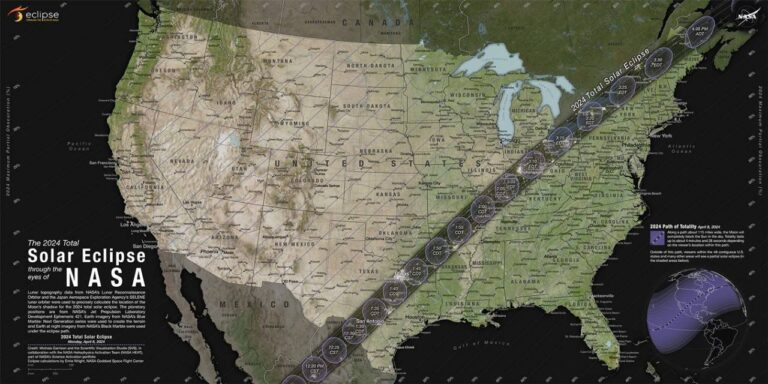
The eclipse will begin at sunrise over the Pacific Ocean, cutting through Mexico’s Pacific Coast at about 11:07 a.m. PT (8:07 a.m. ET) and then enter the U.S in Texas. The path goes through Oklahoma, Arkansas, Missouri, Illinois, Kentucky, Indiana, Ohio, Pennsylvania, New York, Vermont, New Hampshire and Maine. Small parts of Tennessee and Michigan will also experience the total solar eclipse. The eclipse will then enter Canada and exit North America around Newfoundland, Canada. Full details from NASA are available here.

Some 31 million people living along the eclipse path will witness the rare total solar eclipse, while people in all contiguous U.S. states will be able to see at least a partial eclipse. Compared to the most recent solar eclipse in Aug. 2017, the viewing path for the 2024 total eclipse is wider and passes over more cities and densely populated areas. The upcoming eclipse is also expected to last twice as long, for about 4.5 minutes. The next opportunity to see a total solar eclipse cross over the U.S. after April 8 is more than two decades away on Aug. 23, 2044, according to NASA.

RED CROSS GETTING READY With so many people expected to travel to view the total eclipse, there could be major traffic issues and potential fuel shortages. Communication systems may also experience disruptions due to heightened demand. As part of our regular collaboration for large-scale, public events, the Red Cross is coordinating with local emergency management agencies along the viewing path to respond if necessary.

In addition to the five safety steps above, you should download the free Red Cross First Aid app so you’ll know what to do if emergency help is delayed and the free Emergency app for weather alerts, open Red Cross shelter locations and safety steps for different emergencies. Choose whether you want to view the content in English or Spanish with an easy-to-find language selector. Find these and all of the Red Cross apps in smartphone app stores by searching for the American Red Cross or going to redcross.org/apps.

EYE SAFETY It is not safe to look directly at the sun without specialized eye protection for solar viewing. Viewing any part of the bright sun through a camera lens, binoculars or a telescope without a special-purpose solar filter secured over the front of the optics will instantly cause severe eye injury.

According to NASA, when watching the partial phases of the solar eclipse directly with your eyes, which happens before and after totality, you must look through safe solar viewing glasses or a safe, handheld solar viewer at all times. Eclipse glasses are NOT regular sunglasses. No matter how dark the lenses are tinted, regular sunglasses are not safe for viewing the sun. Safe solar viewers are thousands of times darker and ought to comply with the ISO 12312-2 international standard. More information is available here.

About the American Red Cross:

The American Red Cross shelters, feeds and provides comfort to victims of disasters; supplies about 40% of the nation’s blood; teaches skills that save lives; distributes international humanitarian aid; and supports veterans, military members and their families. The Red Cross is a nonprofit organization that depends on volunteers and the generosity of the American public to deliver its mission. For more information, please visit redcross.org or CruzRojaAmericana.org, or follow us on social media.

Drug-Free All-Stars Visit Woodland Heights Medical Center

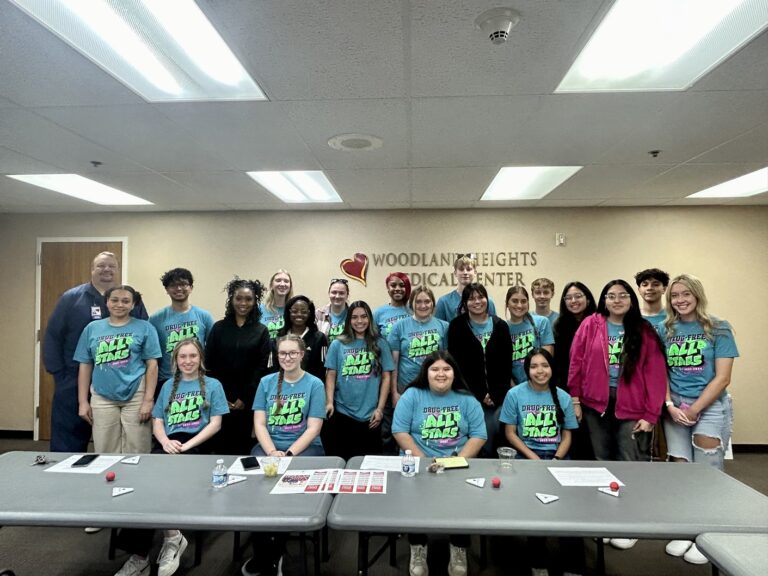
The Drug-Free All Stars of Angelina County, funded by a grant from TxDOT, are a group of high school seniors that serve as role models for the community by living an alcohol, tobacco, and drug-free life. For their March meeting, the Drug-Free All Stars visited Woodland Heights Medical Center and heard from Stephen Bennett, Director of Emergency Services. Mr. Bennett talked to the students about the impact substances have on the emergency room and the changes that he has seen in regards to the impact harmful substances have on the community. Mr. Bennett also advised the students to make safe choices as they approach graduation. The Coalition, Inc. appreciates Jennifer Stevens, Director of Marketing, and Stephen Bennett for making this meeting possible. Since 1988, The Coalition has focused on eliminating the use of harmful substances by affecting public policy, laws, attitudes, and behaviors, all to foster healthy life-long choices for the local community. For more information about the Drug-Free All-Star program, contact Abby Baker at The Coalition at 936-634-9308.

Texas Rural Volunteer Fire Departments Receive $1.3 Million in Grants

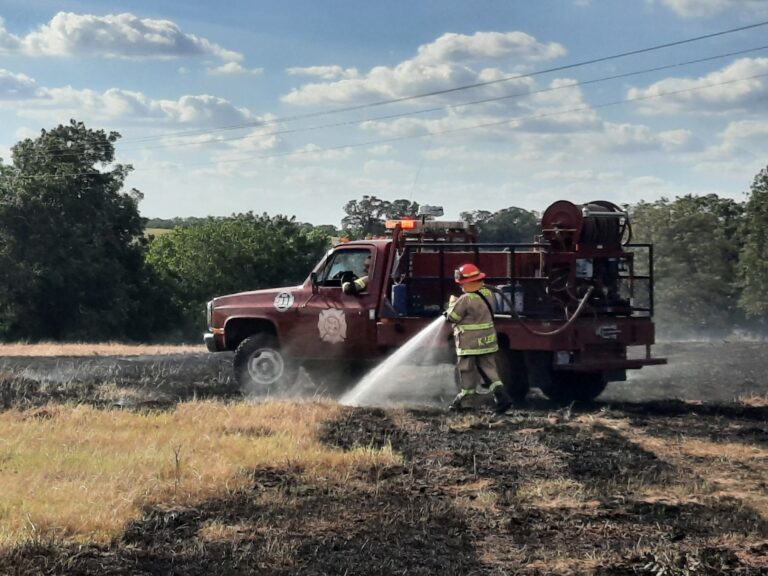
COLLEGE STATION, Texas – On Tuesday, April 2, Texas A&M Forest Service held the second of three funding meetings of fiscal year 2024 for the Rural Volunteer Fire Department Assistance Program, awarding 74 grants totaling approximately $1.3 million.

Grant funding from the program will help Texas rural volunteer fire department recipients from this allocation purchase equipment such as dry hydrants, fire and rescue equipment, personal protective equipment, and training aids.

Tuesday’s funding meeting continued the program’s purpose of assisting eligible volunteer fire departments in Texas.

“We work diligently to utilize all available program funds to assist fire departments in acquiring the necessary equipment and training to allow them to better protect life and property across the state of Texas,” said Jason Keiningham, Texas A&M Forest Service Capacity Building Department Head. “We’re proud to do everything in our power to help our partners in the fire service.”

The grants are applied for and distributed through Texas A&M Forest Service’s FireConnect website, providing Texas A&M Forest Service and rural volunteer fire departments with a streamlined grant portal and process.

The final funding meeting for fiscal year 2024 is tentatively scheduled for Wednesday, Aug. 14, 2024.

The Rural VFD Assistance Program, launched in 2001, provides grants to rural VFDs for firefighting vehicles, fire/rescue equipment, protective clothing, dry hydrants and firefighter training. Since its inception, the program has awarded more than $350 million to volunteer fire departments in Texas, including its award of more than $15 million to rural VFDs in October 2023. The Texas Legislature has allocated approximately $22 million to Texas A&M Forest Service for the fiscal year 2024 to award rural VFDs.

Click here for a list of grant recipients: FY24 Funding Meeting.

For more information on programs offered by Texas A&M Forest Service, visit TexasFD.com.

Lufkin District and State Preparing for Eclipse

LUFKIN — The Texas Department of Transportation is warning drivers to take extra caution on Monday, April 8, as a total solar eclipse will be visible throughout the state from late morning to early afternoon.

As this intergalactic experience comes front and center, out-of-state visitors and Texans traveling to get a perfect view are expected. This will cause heavier traffic on major roadways. Plan for delays, and longer travel times, and give yourself extra time to get to your destination before and after the eclipse.

TxDOT urges drivers wanting to view the eclipse to park their vehicle in a safe location and avoid stopping in the roadway or on the shoulder. Do not try to view the eclipse while driving. TxDOT has multiple safety rest areas and Travel Information Centers with safe places to park. Those locations and real-time traffic updates can be found at drivetexas.org.

“The Lufkin District is prepared to monitor the roadways and traffic on our major roadways throughout the day,” said Rhonda Oaks, public information officer. “We are all excited to watch this event, but safety is our number one goal, and we urge the public to also make it their goal to stay safe while driving before, after, and during the eclipse.”

The Lufkin District will also have crews traveling to assist as needed in the Bryan and Waco districts, as they are in the path of totality. Major roadways through the district that could see heavier than normal traffic are US 59, US 69, and US 96, but there could be additional roadways impacted.

TxDOT wants the traveling public to be aware of these safety tips the day of the eclipse:

  • Prepare your vehicle and yourself for extra time on the road. Check tire pressure and have water and snacks in your vehicle in case of heavy traffic delays.
  • Be calm and courteous on the road, slow down and be ready for increased traffic.
  • Dispose of all trash in a proper trash can. Don’t mess with Texas means don’t litter.

Highway message boards are set to warn drivers not to stop on the road or park on the shoulder. For more information, visit the eclipse web page at txdot.gov.

For media inquiries, contact Rhonda.Oaks@txdot.gov or call (936) 404-7485.

America’s Rose Garden 2024 Season Opens

SHREVEPORT, LA – The American Rose Center (ARC) will open for the 50th blooming season on Wed., April 3. The new hours of operation are Wed. – Fri, 9 a.m. to 5 p.m., and Sat. and Sun., 9 a.m. to 1 p.m. Admission to the gardens is $5 per person or $10 per family. Peak rose bloom season is expected between mid-April and mid-May.

The American Rose Society is also celebrating the 50th anniversary of basing its headquarters in Shreveport, La. They will have numerous special events to celebrate with details on www.Rose.org or the ARC Facebook page (https://www.facebook.com/AmericanRoseCenter/).  Spring events will run from mid-April to mid-May during the peak spring bloom. 

“If you haven’t visited the rose garden in some time, then you are in for a new experience,” said Executive Director Claire Bissell. “Our Great Garden Restoration is complete! The five-year, two-million-dollar project has transformed the gardens with circles that tell the story of the history of the rose in America.” 

The first garden event will be viewing the total solar eclipse on Mon., April 8 around lunchtime. The garden will be open especially for eclipse activities (weather permitting).

ARC has added more roses, trees, and other flowering plants throughout the property for visitors to enjoy – that translates into roughly 6,000 rose plants and 5,000 other plants including ornamental trees.

“We invite you to come out and stroll our garden during open garden hours,” added Bissell.  “It’s a great place for a morning walk for you and your friends, including canines. Our renovations will continue this year as we refresh and refurbish garden structures and features.”

Angelina College Visual Arts Students Opening Exhibition

Gallery Runs April 9-24

Angelina College Visual Arts students next week will celebrate their semester of artworks with an exhibition and reception taking place in the Angelina Center for the Arts Gallery on the AC campus.

The exhibition opens Tuesday, April 9 and will run through April 24. An artists’ reception takes place from 6-7:30 p.m. on Tuesday, April 9 in the ACA foyer.

Students from Le’Anne Alexander’s Intro to Design and Intro to Drawing courses will participate.

Drawing students at AC study still life, landscape, portraiture and expression using traditional techniques in charcoal, graphite, Conté crayon and mixed media. Drawing students focus on gaining an understanding of the foundational elements of art and principles of design while creating artworks in wet media, such as acrylic and gouache. 

Following is the list of artists (and listed hometowns) by course:

Intro to Design students:  Robin Assuncao (Livingston), Alessandro Colindres (Pollock), Zoey Galloway (Lufkin), Liz Godwin (Lufkin), Makenna Hankins (Lufkin), William Lawes (Lufkin), Yajaira Mendoza (Lufkin), Eva Menz (Lufkin), Pablo Morones (Nacogdoches), Grace Pivonka (Lufkin), Cass Sullivan (Nacogdoches), Marshal Thomas (Lufkin) and Dawn Williams (Lufkin).

Intro to Drawing students: Kevin Avilez (Lufkin), Aaron Evans (Lufkin), Seth Hamilton (Lufkin), Sydney Holder (Huntington), Jazavion Humphrey (Lufkin), Demi’Treanna Johnson (Lufkin), Febe Martinez (Lufkin), Melissa Mendoza (Lufkin), Alexander Oliveros (Nacogdoches), Robert Ramirez (Diboll), Issac Resendis (Lufkin), Alejandra Rodriguez (Lufkin), Ximena Ruiz-Duron (Lufkin), Dawn Williams (Lufkin) and Parker Winthrop (Lufkin).

Both the reception and the gallery are open to the public, and admission is free.

This acrylic on paper work from Angelina College art student Yajaira Mendoza is one of the works scheduled for display in the upcoming Angelina College Visual Arts Student Gallery scheduled to run April 9-24 in the Angelina Center for the Arts Gallery. (Contributed image)

For further information, contact Le’Anne Alexander at lalexander@angelina.edu.

Ken Brown Live (Trinity County)

0

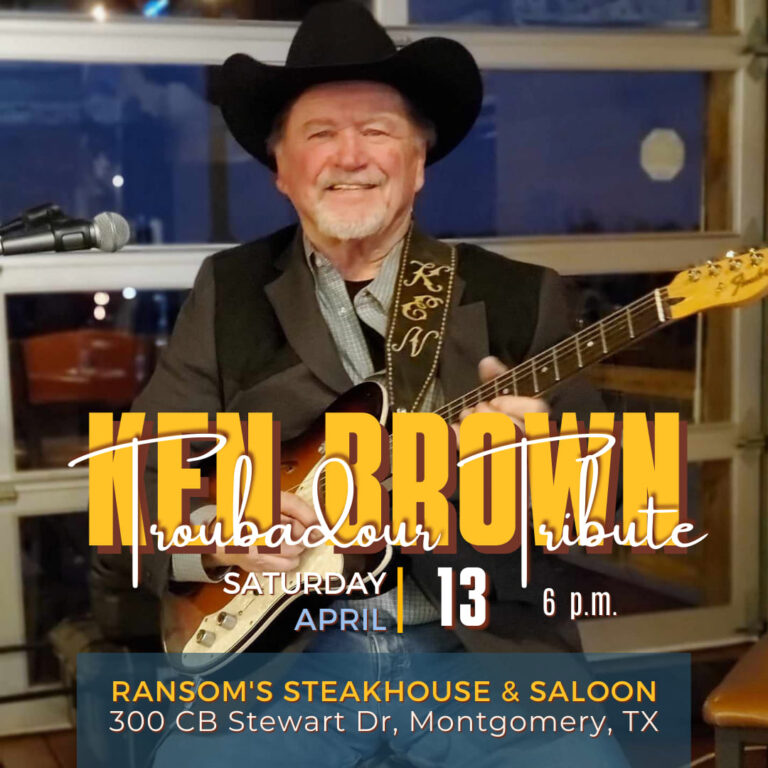
Ken Brown is a regional solo musician entertaining with his unique style of traditional country music– A crossover music artist from an array of genres. His integration of a variety of elements into the country genre has earned him his popularity with the mainstream audience.

You can hear Ken perform LIVE on stage at Ransom’s Steakhouse and Saloon off 105 in Montgomery for a night of traditional country music…KB Country presents a Tribute to the Troubadours!
“I can’t wait to see you there! Get to know my songs before the show!” Ken
LINKS

Karaoke at the American Legion (Nacogdoches County)

0

How are your pipes? Do you enjoy singing? You need to check out Karaoke night at the American Legion!

When: 1st Sunday night of every month @ 7:00 p.m.
Where: 1000 Brazos St. Crockett, TX