

Home Blog Page 182

Understanding Plant Nutrients – Micronutrients

0

Wrapping up this series on nutrients, we find ourselves dealing with the important nutrients that are needed in the smallest amount -micronutrients.

Also called trace nutrients in some literature, the essential micronutrient list consists of iron, chlorine, zinc, manganese, boron, copper, and molybdenum.

I was taught by a turfgrass professional that iron would give you the greenest turfgrass, without the extra growth that nitrogen gives you. Chlorine often surprises folks. I’ve never seen it as part of any fertilizer, as much of it is found naturally. Zinc is heavily used by pecan trees. To help pecan trees grow fully developed leaves, growers add zinc as a foliar spray. Most homeowners will try and put a fertilizer with zinc on the ground around their trees. Though some will be taken up, the foliar application is highly preferred.

Manganese should not be confused with magnesium. Manganese is necessary for photosynthesis. Boron is sometimes found missing for proper clover production. I once erroneously remarked that perhaps we should just add one pound of boron to each acre of clover we plant. Needed in such incredibly small quantities, adding that amount could prove disastrous. In fact, the only time I’ve seen ground-water kill gardens and lawns was when an old shallow well had too much boron in the water.

I have no interesting anecdotes for copper and molybdenum. I do often use molybdenum as an example in a sentence just to demonstrate how we don’t know all the inputs a plant may need.

All of these micronutrients are probably in your soil. You will certainly get them from the addition of organic matter, such as compost. I believe that one of the many reasons organic matter is awesome is because of the natural inclusion of these trace nutrients. You can also find molybdenum and the others on products such as Peters Plant Food and Miracle Grow.  I think those products are “miraculous” because they do contain the entire roster of plant nutrition in their bottle.

New to my knowledge of plant nutrition are four more nutrients that research states are needed by just a few plants. These ‘new to me’ ones include nickel, cobalt, silicon, and vanadium.  Nickel activates several enzymes and may even substitute for zinc and iron in some processes. Cobalt has been found through research to be beneficial to some plants though not essential in most species. Silicon makes this list, not as an essential nutrient, but as one that has been found in healthy plants as it aids with their structure.

Vanadium may be required by some plants, but a publication from 1999 by the United States Department of Agriculture also says it may just be “junk food” for plants.  More recent research states it can be toxic to at high levels. Perhaps more studies need to be conducted, but I would not worry about vanadium in your garden.

The study of plant nutrients is heavy on chemistry, biology, and the research is ongoing. You listen to what your grandparents told you what they used to put in their garden or imitate what your neighbor does for their successful lawn. But if you really want to get it right, spend the $20 and send in a soil test. If you are waiting for any recommendation on how much fertilizer to put out from this series, you won’t hear any from me. To get it right, really correct, you’ll need to submit soil sample. Texas A&M and many other land-grant universities have a form online that you can download and print, or you can easily get the form from your local Extension office. 

Jasper’s First Santa Run

0

ANNOUNCEMENT
The Santa Run on Saturday evening will take place unless the rain is absolutely pouring!

3 Categories:
Adult- $20
Kids- $10
Dogs- $5

Date/Time Information:
Saturday, December 23, 2023, from 5 pm to 7 pm

Location:
Sandy Creek Gazebo

Angelina College Releases Fall 2023 Dean’s List

0

Angelina College officials and faculty members are pleased to release the names of 150 students named to the Dean’s Honor List for the Fall 2023 semester.

To qualify for the Dean’s List, students must have enrolled in at least 12 semester hours of college-level work and have attained a grade point average of 3.5 with no grade lower than a “C”.

The names of students who make the Dean’s Honor Lists are posted at the end of each long semester.

Following is the list of recognized students divided by town or city of residency.

Bay City

Adonaia Curtis.  

Bellville

Isaac Yuna.

Brenham

 Ethan Jezierski and Mason Lampe.

Bryan

Halee Hernandez.

Center

Emily Cervantes.

Chester

 Cheryl Clack.

College Station

Christian Letendre and Mollie Morgan.   

Corrigan

Gerardo Vera.

Crockett

Lauren Cyr, Landon Graham, Ryan Lane and Ruth Perez.

Deer Park

Lorelei Graham.

Diboll

Hilda Herrera, Deandrea Ikpe, Tiffany Jackson, Skyler Martin, Yulie Valdez and Shelby White.

Douglass

Nicholas Hunter.

Groveton

 Juan Facio, Erick Hernandez and Lena Taylor.

Hemphill

Macy Holcomb, Briana Mitchell and Patricia Snodgrass.

Houston

Alicia Booker-Scott.

Hudson

Miller Clingamen and Jennifer Jimenez.

Huntington

Deysi Colon, Haley Drahos, Julia Garner, Edwena Gates, Troy Havard and Charity Napier.

Huntsville

Cooper Molnes.

Jacksonville

Frank Maldonado.

Jasper

Jessica Escalante.

Katy

Mark Henderson.

Kennard

Ava Barclay.  

Kirbyville

Carmen Key.

League City

Jacob Townsend.

Livingston

Robin Assuncao, Heather Battise, Destiny Hancock, Leslie Johnson, Zane Kramer, Billy Lewis, Timothy Makuakane, Stephanie Olvera, Keirrah Ramirez, Crystal Reddicks, Craig Taylor and Jaylee Wilson.

Lovelady

Marlen Sandoval.

Lufkin

 Elisabeth Acevedo, Leonardo Aguilar, Alondra Almaguer, Brenda Alvarado-Luna, Andy Barron, Candace Barron, Samuel Brockman, Kimberly Carbajal, Evelyn Castillo, Ke’Asiah Coleman, Kindal Conner, Fabian Cordero, Kelsi Davis, Chancy Dodd, Tasha Dodd, Nathaniel Encarnacion, Priscila Escobedo, Javier Flores-Garcia, Melanie-Garcia, Madeline Gipson, Maegan Gomez, Wyatt Greusel, Kaylee Guevara, Haley Guillen, Noah Havard, Tanya Head, Demi’Treanna Johnson, Sanvia Jones, Clara Keath, Kassidy Knapp, Joshua Little, Eliana Lopez, Damian Luna, Braysen Massie, Miley McHaney, Santos Mejia, Holli Minshew, Natalya Mitchell, Crystal Montoya, David Mullins, Lacilynn Myers, Joyce Olvera, Idaly Orta, Ashley Ray, Jacqueline Reyes-Gonzalez, Rudy Rios, Yamile Rios, Kiara Rodgers, Miguel Rodriguez, Samantha Saenz, Jesus Sandoval, Tanya Sexton, Avery Sullivan, Kristin Thacker, Jazlyn Thomas, Marco Torres, Matthew Townsend, Cecilia Vallejo and Guadalupe Villanueva.

Manizales, Colombia

Antonia Henao.

Medellin, Colombia

Ana Rendon.

Moscow

Natalya Soto.

Nacogdoches

Jose Almendarez, Bonnie Anderson, Emily Arriola, Omar Escamilla, Dylan French, Samantha Gresham, Yuan Huang, Jared Huber, Brittany Hutto, Cassidy Kelly, Banesia Payne, Jennifer Ramierez, Neftali Sauceda, Caleb Servin, Kristen Sisson, Ryleigh Swann and Avery Watson.

Pineland

Elijah Little.

Pointblank

Tiffany Carter.

Pollok

Kyle Coleman, Callie-Ann Kelsey and Harliey Womack.

Richmond

Samuel Hardcastle.

Rio de Janeiro, Brazil

Luan Rangel.

Rusk

Daniel Perez.

Sweeny

Noah Pate.  

Tomball

Makenzi Johnson.

Trinity

 Nicholas Brazeil and Madalynn Morrow.

Wiergate

Drew Marshall.

Yokohama, Japan

Shota Tokuhisa.

Angelina College Releases Fall 2023 President’s List

0

Angelina College officials and faculty members are pleased to release the names of 87 students named to the President’s Honor List for the Fall 2023 semester.

To qualify, students must have enrolled in at least 12 semester hours of college-level work and have attained a grade point average of 4.0.

The names of students who make the President’s Honor List are posted at the end of each long semester.

Following is the list, divided by town or city of residency, of students named to the President’s Honor List:

Alto

Arlet Castro and Jaycie Richardson.

Apple Springs

Ashley Contreras.

Brenham

Hayden Hupe.

Brookeland

Marissa Blanton.

Chireno

Jack Kilmer.

Colmesneil

Eric Davis.

Corrigan

Zackery Purvis.

Crockett

Christopher Hernandez.

Diboll

Caden Chambers, Cristian Compean, Mayra Medina, Dhwani Patel, Myriam Plascencia, Anna Romero and Heidi Wilsie.

Etoile

Lexie Mooney.

Garrison

 Jackson Ortiz and Madison Stokes.

Goodrich

 Gabriela Silva.  

Heredia, Costa Rica

Tannia Diaz.

Hudson

 Jimmy Cassels and Aubraysha Lacy.

Huntington

Alan Markley, Zahra Martinez, Chase Phillips and Jazmine Santoyo-Arias.

Laoag City, Philippines

Mir Raciv T. Tayamen

Livingston

 Brooke Pond and Christian Schanmier.

Lufkin

Kristina Aji, Julia Aleman, Spencer Alexander, Mark Jade B. Bagonoc, Alyssa Campbell, Alexis Chavez, Addison Chay, Whitney Cole, Ramiyah Cranford, Kassidy Denning, Adamari Escobedo, Isaac Estrada, Itzel Flores, Kathryn Gage, Naydi Gonzales, Jose Gonzalez, Marcus Hadnot, Robert Hansard, Maddyn Hartzog, Kanaan Holder, Elianna Jane B. Ilo, Madeline Johnson, Kallie Knierim, Chyenne Koller, Alexander Kuhne, Trinity Landin, Evelyn Maure, Taniya McCollough, Jesse McLain, Augustina Mezzano, Cy Ochoa, Mariela Palacios, Emily Sanchez, Teresita Santoya, Tess Scogin, Jordan Stringer, Khalil Sweats, Alexander Walker, Kaylee Washburn, John Weisenberger, Logan Wilkerson, Parker Winthrop and Emily Zheng.

Melbourne, Australia

Hatice Kahraman.

Nacogdoches

 Joshua Garcia, Diego Guerrero, Tiffany Jeanfavre, Hailey Porter, Brandon Rowell and Anahi Vazquez.

New Ulm

Ryan Lewis.

Pollok

 Leonardo Jacob and Sabrina Weathers.

San Augustine

Camden Boyette.

Somerville

Emma Kovasovic.

Spring

Kaetlyn Dunbar.

Warren

Phillip Thomas.

Zavalla

Antoinette Herberger.

Drug-Free All-Stars Complete Holiday Project Sticker Shock

0
Students sticker at the Diboll Brookshire Brothers. From left to right are Emily Awtrey, Ciara Harris, Abby Kerr, Chloe Wyatt-Chittum, Baylee Williams, Ti’ara Nieves, and Dulce Flores, Roxana Flores.

The Drug-Free All Stars of The Coalition, Inc. recently completed a holiday-themed Project Sticker Shock, in partnership with the Texas Department of Transportation, Brookshire Brothers, and other local businesses. In Texas, there is an estimated 95% increase in the number of alcohol-related crashes that occur during the New Year and holiday period in comparison to non-holidays. To combat this statistic, The Coalition and Drug-Free All Stars introduced a holiday-themed Project Sticker Shock focused on the prevention of drinking and driving. The Drug-Free All Stars placed stickers with information about the consequences of drunk driving on packages of alcohol at area Brookshire Brothers locations, Tobacco Barns, Walgreens (W. Frank location), and La Michoacana. The All Stars want to encourage responsible decision-making and make the community aware of the consequences of drinking and driving. “The holidays are all about family, friends, and sharing time with our loved ones, and Brookshire Brothers encourages our customers to celebrate as safely as possible throughout this festive season,” said Melissa Crager, Public Relations and Corporate Responsibility Manager for Brookshire Brothers. Thank you to all the businesses that participated in this year’s holiday-themed Project Sticker Shock.

Since 1988, The Coalition has focused on eliminating the use of harmful substances by affecting public policy, laws, attitudes, and behaviors, in order to foster healthy life-long choices for the local community. For more information about the Drug-Free All-Star program, contact Abby Baker at The Coalition at 936-634-9308.

Students sticker at the Huntington Brookshire Brothers.  Front row from left to right are Adrian Hernandez, Katy Howard, Avery Williams, Kendyl Metcalf, Chloe Napier, and Alayna Durham.
Central Drug-Free All Star Kristina Guardado, Ava Straughan, and Giselle Jaime sticker packages of alcohol in Brookshire Brothers Express in Pollok.
Zavalla Drug-Free All Star Erin Keely in front of the Zavalla Brookshire Brothers location for Project Sticker Shock.

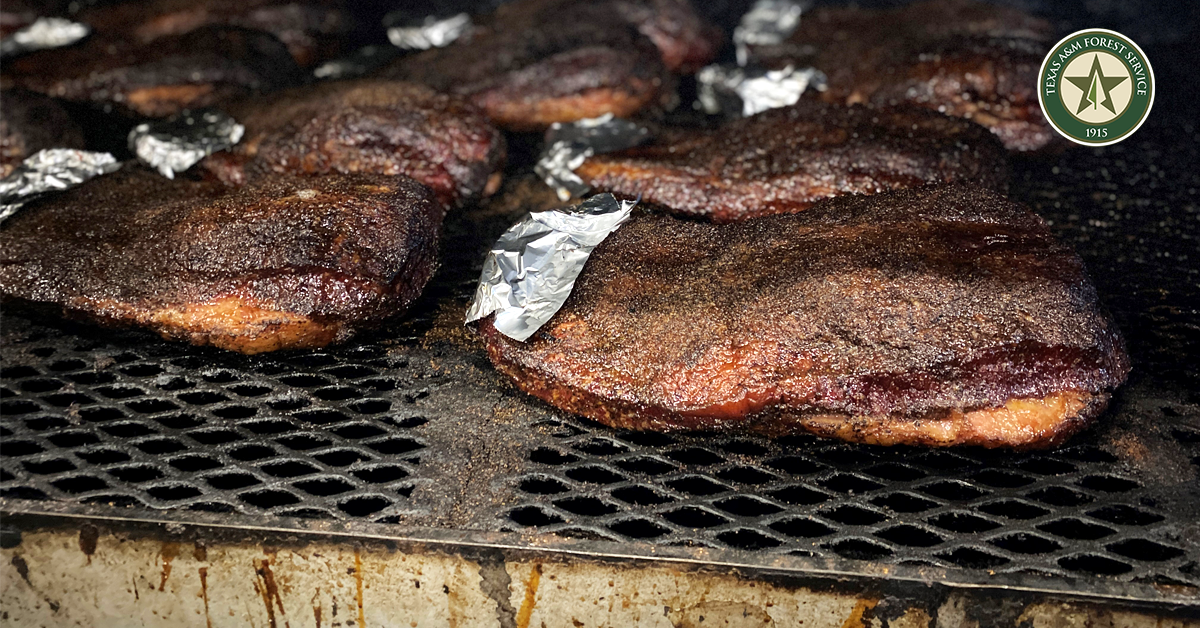
BBQ Smoking Market Evolves while Texas Trees Provide Smokey Flavor for All

0

COLLEGE STATION, Texas— For many, the smell of sweet, peppery BBQ smoke evokes many memories, traditions and flavors. Whether smoking for a tailgate or family and friends, BBQ never ceases to provide the inviting comradery of cooking.

Originating from leftover meat at meat markets smoked in the ground with hot coals, BBQ and meat smoking methods have evolved over centuries while never losing their value, only expanding it. More importantly, the tradition of meat smoking has made itself a staple in Texas, supporting thousands of farmers, ranchers, businesses, and timber and lumber operations throughout the state.

Most essential to the meat smoking process is the source of the smoke— wood. Traditionally, meat smoking utilized hot coals underground. As smoking methods continued to evolve, the use of split woods and wood chips, such as hickory and pecan woods, were introduced. These new methods invited the expansion of flavorful meats and a higher demand for the delicacy.

Now, the meat-smoking tradition has taken a new step with the introduction of processed wood pellets.

“The introduction of wood pellets into the BBQ market has allowed greater access to even the most novice smokers,” said Shane Harrington, Texas A&M Forest Service Senior Project Manager and Texas BBQ catering business owner. “The world of BBQ has exponentially grown in the last 10 years due to greater access to woods and with the creation of wood pellets and pellet smokers.”

Smoking pellets, often a byproduct of lumber production, offer sustainable forest management solutions by ensuring that every part of a tree is used in the secondary stages of production.

“The evolution of and higher demand for BBQ smoking products means that lumber producers have a new avenue for wood byproduct usage that they didn’t have before,” said Harrington.

Wood pellets are a product of chipped logs, branches, and excess lumber that are processed into wood fiber. The fiber is then passed under a magnet to ensure it contains no metal before it is dried, leaving only 6% of its original moisture, locking in powerful, earthy flavors. Last, the dried wood fiber is then pressed in a pellet mill under intense pressure to form the pellets made available to consumers.

Choosing a specific pellet group can be a difficult task when accounting for the flavor and heat given off by the pellets. This is why, after many creative tests, BBQ enthusiasts will blend together different wood pellet groups to ensure optimal flavor and consistent heat is present.

Among the most popular Texas woods to smoke with are hickory, oak, pecan and mesquite.

Hickory

Hickory wood is one of the hardest domestic hardwoods in Texas meaning that the temperature will be lower and will last longer. With hardwood comes lower smoking temperatures. To combat the lower temperatures of hickory wood, softer hardwoods like oak or mesquite can be added to add bursts of higher temperatures.

Hickory wood is known for its sweet, powerful smoke flavor. It is among the most popular when smoking pork, especially ribs and pork belly used for bacon.

Oak

With a lifespan that can span centuries and is known for its abundant production of acorns, oak trees serve as a staple of Central Texas.

Oak wood is a versatile wood for smoking. Due to its milder smoke flavor compared to hickory wood, oak wood can be paired with other woods such as apple or cherry. Many smokers combine hickory and oak woods when in search of a tamed-down hickory flavor.

Pecan

Serving as the Texas state tree, pecan trees provide many economic benefits to the Texas forestry industry. Pecan trees, either naturally produced or planted in a production orchard, can be found throughout the state.

Pecan wood is most widely used to smoke poultry. Adding a reddish tint to the meat, pecan wood locks in a mild sweet and nutty flavor.

Mesquite

For red meat lovers, mesquite wood offers a strong, earthy flavor that is sure to complement the natural flavors of the beef. Of the hardwood smoking options, mesquite provides one of the highest volumes of smoke.

Most often, mesquite wood is only used as a heat and flavor aid to other woods, as using it alone may result in a more bitter taste. Mesquite is best used to add color to meat and for times when you need a direct, quick smoke.

As Texans maintain the tradition of meat smoking, the forestry industry continues to embrace the sustainable technological advancements of wood production to provide flavorful wood and pellets for all to enjoy.

Capitol Update: Fostering Community Development and Resilience in Deep East Texas

0

As we approach the joyous occasion of Christmas, we’re immersed in the fanfare and pageantry that often surrounds the yuletide season. While, in many ways, we embrace the spirit of Christmas through gift-giving, cherished time with family, or even giving back to those in need, it’s my hope that we find time to be still and recenter on why we have reason to celebrate – Christ’s coming into the world so that He might offer up His life as a sacrifice for the sins of man.

“For unto us a Child is born, Unto us a Son is given; And the government will be upon His shoulder. And His name will be called Wonderful, Counselor, Mighty God, Everlasting Father, Prince of Peace” — Isaiah 9:6.

May this Christmas be filled with joy, peace, and an abundance of blessings for you and your loved ones.

With that, here’s an update from your State Capitol…

Capitol Update

The Texas General Land Office (GLO) recently announced  GLO (General Land Office) the approval of regional mitigation funds totaling over $48 million to be distributed across the Deep East Texas Council of Government (DETCOG) service zones, particularly in Tyler and Polk counties. These funds have been earmarked for eight critical infrastructure projects to foster greater economic and community development through enhancements in water facilities, improvements to road infrastructure and drainage, and the establishment of public community resource centers and shelters.

Polk County’s communities, including Onalaska and Livingston, are set to undergo transformative changes with funds allocated towards crucial street improvement projects. The county itself is set to receive an impressive sum of around $17 million. These funds will be utilized across a spectrum of improvements, encompassing water facilities, street enhancements, drainage system fortifications, and enhancements to road and water control systems at multiple key locations within the county.

Tyler County emerges as another beneficiary with an allocation of nearly $12 million, which will be utilized for the pivotal improvement of drainage systems, water infrastructure, and street enhancements. The installation of an emergency generator in the Colmesneil area exemplifies the comprehensive strategy undertaken to reinforce the region’s infrastructure, ensuring preparedness for future emergencies.

In addition to the projects I just highlighted, I’d also like to point out a prior allocation of funds to the City of Corrigan for water storage rehabilitation, and additional funds to the City of Ivanhoe for street improvements.

Together, these much-needed projects symbolize a commitment to the long-term resilience and prosperity of our Deep East Texas region.

As always, please do not hesitate to contact my office if we can help you in any way. My district office may be reached at (936) 634-2762. Additionally, I welcome you to follow along on my Official Facebook Page, where I will post regular updates on what’s happening in your State Capitol and share information that could be useful to you and your family: https://www.facebook.com/RepTrentAshby/.

Governor Abbott Celebrates More Reliable Power Added To Texas Grid

0
(PHOTO: Office Of The Governor, 12/14/23)

AUSTIN – Governor Greg Abbott today celebrated Texas’ efforts to add new, reliable power plants to support the state’s growing energy needs at Calpine Corporation’s (Calpine) Freestone County Energy Center expansion project announcement in Houston. This expansion project will bring more than 300 new jobs to Freestone County and 425 megawatts of new, dispatchable generation to the Texas electrical grid. These new, dispatchable megawatts accompany an additional 7,000 megawatts of dispatchable generation expected to come online in 2024.

“The bottom line is Texans need more electrical power,” said Governor Abbott. “We have a collective responsibility to make sure that we provide the power and electricity to support our growing state by adding new, reliable power plants like this one from Calpine. ERCOT, PUC, and power generators are better prepared this winter than ever before because I signed over a dozen laws to ensure they have the tools and strategies needed to generate more power and make our grid more reliable and resilient. This Freestone Energy Center expansion will ensure that reliable power is available in Texas no matter the weather, and I thank Calpine for choosing to expand their Freestone County facility.”

During his remarks, Governor Abbott touted Texas’ ongoing partnerships with energy companies to bring more reliable, dispatchable power to Texans across the state. The Governor also outlined proactive measures the Public Utility Commission of Texas (PUC), Railroad Commission of Texas, and Electric Reliability Council of Texas (ERCOT) have taken to ensure the Texas power grid is ready for winter, including: 

  • Requiring the most robust weatherization requirements in the nation, 
  • Deploying additional inspectors to ensure compliance of these requirements,
  • Identifying and mapping Texas’ critical energy infrastructure, 
  • Providing mechanisms for better coordination between state resources and personnel and the owners of these assets, and 
  • Incentivizing on-site redundant fuel supplies for dispatchable generation.

The Governor was joined by Calpine CEO Thad Hill, ERCOT President and CEO Pablo Vegas, and other energy leaders.

Calpine is America’s largest generator of electricity from natural gas and geothermal resources.

(PHOTO: Office Of The Governor, 12/14/23)

Understanding Plant Nutrients – Secondary nutrients

0

As we have previously discussed the three primary nutrients for plants (nitrogen, phosphorous, and potassium), the next category of plant nutrients are the ‘secondary’ nutrients. This list consists of calcium (Ca), magnesium (Mg), and sulfur (S).  

The main function of calcium in plants is to provide structural support to cell walls. Calcium serves as a secondary messenger when plants are physically or biochemically stressed. I bet many home gardeners have had blossom end rot on your tomatoes. This condition results from a lack of calcium and is exaggerated by alternating periods of water stress. Rapid early growth of the plants can cause the rot because the calcium is needed by the tomatoes when they are actively growing and the plants may not be able to take up sufficient calcium quickly enough through the roots.

To remedy this rotting problem, you likely used the “tomato rot stop” spray from the local garden center. This product is a liquid calcium that can be sprayed on the plant as a foliar fertilizer and will often fix the problem.

However, calcium, as a nutrient, should not be confused with or given the same credit as lime. We add lime to soils to reduce acidity and to provide calcium over time. All liming materials are inorganic materials containing calcium.  In our region we add lime (crushed limestone) which is calcium carbonate (CaCO3).  As it breaks down and reacts in the soil, lime both reduces the acidity and provides the needed calcium to the soil.

Magnesium is crucial to the photosynthesis process as well as activating several plant enzymes. Magnesium is easily added to the soil with dolomitic lime or other soluble sources when the pH is correct and lime is not needed.   

In plants, a common diagnosis for magnesium deficiency is yellowing between the leaf veins. The technical name for this is interveinal chlorosis. Cattle can be affected with a magnesium deficiency by a condition called grass tetany. Stockmen may see this when cattle are grazing rapidly growing grass deficient in magnesium, often in the spring. 

The last of the secondary nutrients is sulfur (S). In the soil, plants primarily absorb this nutrient in the form of a sulfate ion, SO4.  Sulfur is major building block in the chlorophyll process and with the development of proteins.

There are many sources of fertilizers that can add sulfur: ammonium sulfate, potassium sulfate, gypsum, and zinc sulfate. Adding sulfur, depending on the source, can certainly acidify the soil. It takes three pounds of lime to offset the acidification you get from adding just one pound of pure sulfur. This could provide a real conundrum when adding necessary sulfur to soils that are in the correct pH range.

Older gardeners have shared with me that they have used Epsom Salts as a fertilizer. I’ve heard several say, “that’s what my grandparents used in their garden.” And yes, Epsom salt is magnesium sulfate (MgSO4) – a natural mineral that would seem to solve two of the three secondary nutrients.  If you read some on of the online social media, it would seem it could save the entire garden!

But to be clear, this salt will not help blossom end rot. As mentioned earlier, that is from a lack of calcium and exacerbated by soil moisture fluctuations. In fact, adding Epsom salts to calcium deficient plants with this problem will make it even worse.

And if you are lacking in magnesium or sulfur, research-based information will not encourage you to use Epsom salt. I know that I have never seen a university’s soil report list Epsom salt as a solution.

Next time, we’ll wrap up this series as we look at the micronutrients. There are several and they are certainly needed in very small amounts.

Finally, if you are waiting for any recommendation on how much fertilizer to put out on your yard, garden, or field, you won’t hear any from me. To get it right, really correct, you’ll need to fill out a soil sample. Texas A&M and many other land-grant universities have a form online that you can download and print, or you can easily get the form from your local Extension office. 

Commission Approves Increased Speed Limit in Zavalla

0

LUFKIN – In a Tuesday meeting, Texas Transportation Commissioners voted to approve a speed limit increase on a new section of US 69 roadway through Zavalla.

The new US 69 roadway, including a bridge constructed over US 63 in the city limits of Zavalla, was part of a major construction project recently completed. The speed will be increased from 55 miles per hour to 65 MPH as soon as signs are set. Signage is expected to be set indicating the new speed by mid-January.

The increased speed will be in effect on US 69 through the project limits, including a section of the city limits of Zavalla. Signs will be posted also alerting southbound motorists of the speed limit increase approaching US 69 from SH 63. The higher speed limit is enforceable once signs are set.

For more information, contact Rhonda.Oaks@txdot.gov or call (936) 633-4395.