

Home Blog Page 356

TEXAS FORESTRY ASSOCIATION ANNOUNCES AIMIEE AUBIN AND APRIL ROSE AS FORESTRY INNOVATION AWARD RECIPIENTS

0
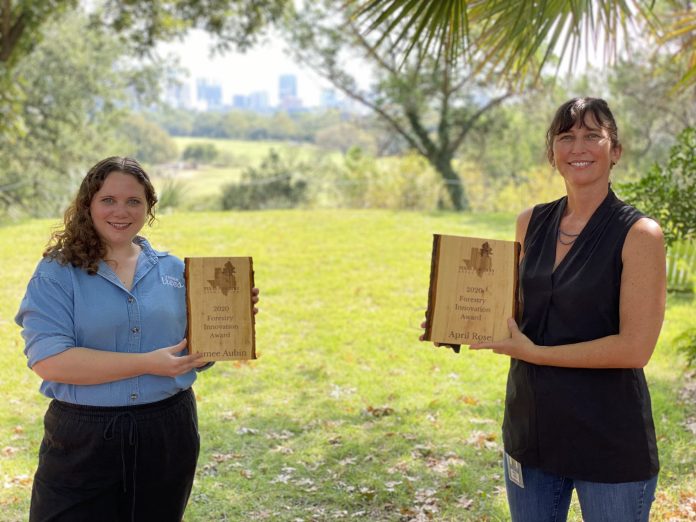
AWARD PHOTO: Rob Hughes, TFA Executive Director, presents the Forestry Innovation Award to Aimee Aubin (pictured left), City of Austin, Conservation Program Director; and April Rose, City of Austin, Forest Health Coordinator (pictured right); during TFA’s virtual annual meeting held Oct. 28-29, 2020, at their headquarters in Lufkin, Texas.
Texas Forestry Association (TFA) presented the 2020 Forestry Innovation Award to Aimee Aubin, City of Austin, Conservation Program Director; and April Rose, City of Austin, Forest Health Coordinator; during the Association’s virtual annual meeting held Oct. 28-29, 2020, at the TFA headquarters in Lufkin, Texas.
 
Both Aubin and Rose were instrumental in designing, developing, and delivering the 2019 Austin Urban Connections, a new program outreach of Teacher Conservation Institute (TCI), which focused on teachers of grades K-12 understanding how urban forests contribute to social, environmental, and economic well-being, as well as how to incorporate these topics into their classrooms.
 
“Aimee and April were indispensable in making the Teacher Conservation Institute a three-day event in Austin’s urban setting.” said Rob Hughes, Executive Director, Texas Forestry Association. “The new, more agile, flexible and relevant Urban TCI was a smashing success in introducing urban educators to Project Learning Tree and the sustainable forest product life-cycle.”
 
During the event, teachers interacted with local natural resource professionals who are experts in the ecosystems and landscape ecology of Austin. Hands-on learning, including field trips, resources and hands-on activities that help implement citizen science, career exploration, and field study were also presented. The educators received training in Project Learning Tree’s interdisciplinary environmental education curriculum designed to teach students critical and creative thinking.
 
“Incorporating an urban focus in the TCI curriculum was quite the undertaking, and a very necessary one,” said Hughes. “This Urban TCI model will be replicated in other metropolitan areas around the state in the years to come and will become an important pillar in the Texas Forestry Association’s educational and outreach efforts.”
ABOUT

Texas Forestry Association, the voice for forestry for over 100 years, promotes an economic, social and political climate that will advance forestry in Texas through education, political action and public relations, as well as serving the broad needs of the forest resource of landowners, producers and consumers, and to enhance and perpetuate the Texas forest resource.

Online Cessation Classes Starting November 10th

0

The Coalition, Inc. is hosting free online tobacco cessation classes for adults that want to quit tobacco. There are many benefits for people who quit tobacco, including reduced risk of tobacco-related diseases and early death. With support and encouragement, you can double your chances of successfully quitting. The Freshstart program can be your start to a new life without tobacco! This 4-session program is free for all participants and all materials are included. Online classes will be November 10th, 17th, 24th and December 1st from 6:00pm – 7:00pm. For more information, or to register, visit our Facebook group “Project Quit,” visit Project-Quit.org or call (936) 634-9308.

The Coalition, Inc. focuses on eliminating the use of harmful substances by affecting public
policy, laws, attitudes and behaviors, all in an effort to foster healthy life-long choices for the
local community. The Coalition is one of the oldest substance abuse prevention community
coalitions in the United States.

Time to Divide Bulbs and Perennials

0

This time of year is the perfect time to divide perennials and plant bulbs. If has been at least three years or longer since you have divided, it’s time to do it again!

Dividing gives you free plants to expand you beds or gift to friends. Coneflowers, day lilies, and all kinds of spring/summer bulbs are ripe for division now.

Be sure to lift the perennials and bulbs with a shovel or garden fork. Yanking them up can destroy the roots and ruin any hopes for a successful division. On perennials, take care to tease apart the roots if possible or, with many plant types, cut with a sharp knife or spade. Replant with a good amount of compost.

Replant your bulbs in groups to show the flowers off better than one solitary bloom. Plant larger bulbs in groups of at least 3, smaller bulbs with 5 or more in a group. Grouping also makes planting easier as you only dig one hole large enough for all bulbs you are planting. Spacing between bulbs is up to you, but remember, the closer together you plant them, the sooner you’ll have to dig up and spread them out again to maintain good flowering.

Bulbs should be planted with the flat end down and pointy end up. A great rule of thumb is to plant them 3 times deeper than they are tall. That means that the smaller Grape Hyacinth, and species tulip bulbs will be planted in holes 3-4” deep. The larger daffodil bulbs should be planted in holes 5-6” deep.

The really large crinum bulb is an exception to this 3-times rule. Simply plant that bulb with the stem just above the ground.

When planting bulbs, it would be good to mix compost or fertilizer into the soil at the base of the bulbs and into the soil when you cover them. Just like the rest of your garden, 3-4″ of mulch is good for bulbs. Water the bulbs well after planting to settle the soil.

Want to read a great book on bulbs that work in our area and throughout the south? Pick up a copy of The Bulb Hunter by Chris Wiesinger and William Welch. You may recognize Dr. Welch as an accomplished gardening author and long-time horticulture professor at Texas A&M. I’ve been fortunate to have him come and speak a couple of times at our programs.

Chris Wiesinger was a student of his that went on to develop a business from bulbs that he found neglected, yet thriving at old homesites, cemeteries, and other forgotten locations. Don’t worry, he always got permission before taking a specimen.

Chris’s story is the first half of the book and a tremendous description of bulbs that grow well around hear is the second half of the book.

After your naturalized bulbs are done blooming, they need to be left with their foliage on. The foliage feeds the bulb to produce the next year’s flowers. The attention you can give it is deadheading (removing the spent flowers) to help the plant use its energy in flower production. Leaves can be removed when it starts to yellow.

And a last bonus, most spring blooming bulbs do not need to be watered or receive any care in the summer.

Senator John Cornyn Leads Bus Tour Stop in Tyler, Urging Texans to GOTV!

0

Senator John Cornyn is traveling throughout the state this week leading up to Election Day – with a stop in Tyler TOMORROW – urging Texans to get out the vote. The senator will be joined by Representative Louie Gohmert, State Senator Bryan Hughes, and State Representatives Matt Schaefer and Cole Hefner.

Thursday, October 29, 2020

Tyler City Square

Tyler

9:25 a.m.

Despite contentious political times, Senator Cornyn is a calm, steady hand in Washington, DC. Though he is a top conservative lawmaker in DC, he is also routinely ranked as one of the most bipartisan and — as a result — most effective U.S. senators. His office was also recently awarded “Best in Constituent Services” by the Congressional Management Foundation. 

Senator Cornyn has delivered $20 billion in COVID relief to Texas – including $77 million to Tyler, where he recently travelled to visit with local leaders, and volunteered at the East Texas Food Bank.

These funds have supported our hospitals, first responders, schools and universities, local communities, small businesses, households and more. Senator Cornyn continues to push for more relief and just last week supported another COVID relief bill that included funding for unemployment benefits; $100 billion to schools; another round of PPP loans; and COVID testing, tracing and vaccine development. This bill was blocked by Senate Democrats led by MJ Hegar’s chief financial supporter, New York Senator Chuck Schumer. (MJ refused to comment on Schumer’s actions.) 

Click here for more on how Senator Cornyn has delivered for East Texas.

Jeff Reed Honored as Outstanding Leader

0

The director of DETCOG’s successful Family and Youth Services (FAYS) program, Jeff Reed has been recognized by the Texas Department of Family and Protective Services with the Outstanding Leader Award for 2020. The award presentation was made during DFPS’s annual Partners in Prevention Conference.

The DETCOG FAYS staff nominated Reed for the award, citing his outstanding leadership and support. He in turn credited his staff for his success.

“For the many years that I’ve done this program, almost 20 years as the director, I’ve learned a few things here and there,” Reed said. “One thing I’ve learned that’s so true is that if you get the right people from the start, and give them the right tools they need to get the job done and then get out of their way, they’ll get the job done, and they’ll do a good job. They don’t need to be micromanaged; they just need to have people that support them.”

FAYS aims to serve the family as a unit to build resilience and strengthen families to keep kids safe and families connected. Specialists work with the family to address issues that would affect unity. Services offered by FAYS include counseling, communication skills, anger management, conflict resolution, problem solving, parent education, referral services, crisis intervention and child abuse/neglect awareness.

“We need to remember that counselors are people too, and to form a team, a bond, a unified body that has each other’s backs, that works together,” Reed said. “Our counselors are people, people who have issues just like our clients. We need to be there for those people throughout the year. If you can do that, you give them a tool they can use to be a successful counselor, to have a successful program.”

Lonnie Hunt, DETCOG Executive Director, noted Reed’s award during the October DETCOG Board of Directors meeting. “The first time I met Jeff, it was obvious that he was a go-getter,” Hunt said. “A very passionate person, passionate about the work he does, and passionate about being successful for our organization and for the people we serve, which is really what it’s all about. We have a great team here, but every great team has got to have a leader, and Jeff Reed is that leader for our FAYS program.

A video produced by DFPS to recognize Jeff Reed during the Partners in Prevention Conference can be viewed at this link: https://vimeo.com/470674959/30dd701c6c.

Lufkin ISD Hosts Honor America Night Honoring Veterans and Active Members

0

Amid the Pandemic this year, Lufkin ISD Band will still be hosting Honor America Night to honor Veterans and Active members of the U.S. Armed Forces. The event will be on Saturday, November 7, 2020 at 7:00 p.m. at Abe Martin Stadium. The Lufkin Middle School band along with the Lufkin High School band will both be performing with music and marching.

Honor America Night takes time to recognize all members, active, veterans, and their families. At the end of the night, the event will conclude with a firework show.

Find out more at Lufkin ISD.

AC Instructor Grimes Named President of TADE Organization Provides Tools and Resources to College Instructors

0

Angelina College’s Aaron Grimes recently was selected president of the Texas Association of Developmental Education (TADE), which is the Texas chapter of the National Organization for Student Success (NOSS).

The Lufkin native, an instructor in AC’s School of Arts and Education, said TADE “exists to provide useful tools, resources and support to all college faculty and employees.”

“One of the most beneficial opportunities we provide is our state College Academic Support Programs (CASP) conference,” Grimes said. “We work with the Texas chapter of the College Reading and Learning Association to bring this quality conference to Texas every year.

“The element of developmental education, as any educator well knows, is in a constant state of flux and change, and the CASP conference addresses many of these changing issues in developmental education. We are proud to be the Texas state chapter of NOSS, and we are also proud of the fact that we are one of the largest chapters in the organization, serving a vast array of colleges across our state.” Grimes said his organization recently launched a new web site (www.casp-tx.org) in an effort to establish a web presence and “unify our processes and communicate more efficiently.”

“My main focus for TADE is to strengthen what we already have in place,” Grimes said. “We will substantially improve our conference and what it offers.”

NOSS, according to information located on its web site, “exists to assist educational professionals in making a positive difference in the lives of students.”

“The Texas chapter of NOSS pledges to do the same,” Grimes said. “TADE helps provide a quality professional conference that offers professionals the latest in research and tremendous opportunities to network with colleagues regarding what works best in post-secondary developmental education.”

Grimes earned his Associate of Applied Science degree from AC and his bachelor’s and master’s degrees from SFASU. Prior to arriving at AC as an instructor, Grimes was an English teacher at Nacogdoches High School for 10 years.

“I am following some extremely talented and innovative leaders,” Grimes said. “I consider it a great honor to have the confidence of the CASP board and membership in my leadership. This is a great opportunity to help provide direction and support to those involved in developmental education. Struggling students need support and guidance.

“I am reminded of something John Andrew Holmes said: ‘There is no exercise better for the heart than reaching down and lifting people up.’ We help get students to the next level.”

Texas A&M Forest Service launches TreeMD Application

0

Texas A&M Forest Service launched an application today to help users quickly identify the root of a tree’s problem, whether it be caused by insects, diseases or other factors.

The TreeMD application is part of the Texas Forest Information Portal, and its main feature is a diagnosis tool which allows users to quickly find results from TreeMD’s vast database. Users are prompted to enter the tree species, prominent symptoms exhibited or even the specific part of the tree that is being affected to help diagnose the problem. In the event there are still questions on the actual cause, users can upload pictures and connect with a professional.

“TreeMD was created when we saw a need to provide a rapid identification process of tree issues for landowners, homeowners and natural resource service providers,” said Sam Rhodes, Texas A&M Forest Service Staff Forester.

Users can filter lists of suspected causes by potential health problems. Once a pest or environmental factor has been selected, additional information, images and possible treatment options are provided by the user-friendly application.

“I love it,” said Sean Jacobson, City of Denton Planner. “I was able to easily find an answer within roughly one minute.”

While TreeMD is a useful tool in investigating potential tree problems, it is not intended to be a substitute for the recommendations and management planning of a professional service provider.

“One of the most frequent calls we get in the office is from landowners asking what is wrong with a tree,” Rhodes said. “This app was created to give users an initial start in diagnosing the cause of their sick tree.”

For users who need assistance in identifying their trees, there is an app for that too. Texas A&M Forest Service’s My Tree ID application helps identify tree species based on leaves, flowers, seed, bark or location using a key, descriptions and full-color images.

“We have a gallery of helpful tools available to Texans that are interested in natural resources and the great outdoors,” Rhodes said. “The Texas Forest Information Portal includes numerous applications designed to assist in everything from land mapping and forest markets to finding big trees and beautiful scenic views across the state.”

To access TreeMD directly, go to https://texasforestinfo.tamu.edu/TreeMD/. To view other Texas A&M Forest Service applications on the Texas Forest Information Portal, go to https://texasforestinfo.tamu.edu.

Colbert Sheard Receives Woodland Heights’ Nursing Excellence Award

0
Nursing Excellence Award winner Colbert Sheard, RN along with Drew Emery, CEO of Woodland Heights and Debra Taylor, CNO of Woodland Heights. (Photo Courtesy of Woodland Heights)

Woodland Heights Medical Center today announced that Colbert Sheard, RN, has been selected to receive its Nursing Excellence Award.

This peer-nominated award, created in honor of 2020 being the “Year of the Nurse,” and in recognition of the critical role nurses have played in treating patients throughout the COVID pandemic, was open to qualifying RNs and LPNs working in a direct patient care position who consistently demonstrate characteristics synonymous with nursing excellence.

Colbert was chosen for his outstanding contributions in the areas of patient experiences & innovation, demonstrated team player, mentor to the healthcare team and a leader during a crisis.

“Woodland Heights is fortunate to have many outstanding nurses like Colbert among its ranks. Nurses who deliver exemplary care, compassion and service, who understand the importance of teamwork and mentoring others, who can lead in times of crises, and who are true champions of promoting healthcare in our community,” said Debra Taylor, Chief Nursing Officer of Woodland Heights.  “With so much focus this year on the selfless efforts of front line heroes like Colbert, we are pleased to acknowledge the important contributions of our nursing professionals.”

Colbert joined Woodland Heights in June 2013 and in that time has positively touched so many lives. He constantly receives positive praise from our patients and other team members and exemplifies all of the qualities that one would want in a nurse. He has received numerous awards including the 2019 Nurse of the Year and the 2020 Velma Scott Award and he shows every day that he truly loves what he does.

In addition to receiving the Nursing Excellence Award itself, Colbert received a cash prize and quintessential book on nursing, written by Florence Nightingale in 1859, that remains relevant to today’s modern nursing attitudes and skills.                  

Raising Catfish in your Farm Pond

0

In the last couple of weeks I have assisted three property owners on how to raise catfish in their new or
existing pond.

First, let’s be clear that catfish do best in a pond that only has catfish. You’ll want to remove other
species, if practical, to get the maximum production from this endeavor.

Ponds are stocked with fish according to the surface acreage. It really doesn’t matter how deep your
pond is regarding productivity. Be sure to recognize exactly what size you have in front of you. While I
often hear “my pond is about an acre,” an acre is 43,560 square feet or about the size of a football field.
And not many ponds are truly that size or larger.

Let’s suppose that your pond is, if you measure it, is a little more than 10,000 square feet. That is
roughly 0.25 surface acres, a quarter of an acre. Without measuring, you can also think of a quarter acre
city lot that some homes are built upon. I’ve seen plenty of really small ponds that are 2,000 to 3,000
square feet. I have two on my farm that are indeed that small!

Without any inputs, the suggested stocking rate for a pond is 100 fish per surface acre. That means that
without you doing anything, we can expect your quarter-acre pond to hold 25 fish.

But you want to raise more? By simply fertilizing your pond (yes, similar to what you would do to your
garden), you could double the carrying capacity to 200 fish per surface acre. Doing our simple math,
that brings your quarter acre pond to 50 fish.

Still not enough? If you feed them daily with a quality floating fish feed (either by hand or with an
automatic feeder) you we can increase carrying capacity of catfish to 1,000 per surface acre or 250 for
our quarter-acre demonstration pond. Getting up to 250 will certainly give you a enough for a large fish
fry!

Both floating and sinking fish food pellets are available as catfish feed. While more expensive, the
floating feed is encouraged as allows it you to monitor how much the catfish are consuming.

Additionally, you can observe them for general health and vigor when they come to the surface to eat.
In general, you should not feed more than what the fish will consume in about 15 minutes.

For maximum growth, the stocked catfish should be fed once a day. Late afternoon or early morning is
preferable. There are several quality fish feeders that are almost identical to “deer feeders” except that
they send feed directionally, an important trait to get the feed into the pond and off of the bank or dock
that the feeder is setting on.

Fingerling catfish stocked in early spring should average at least 1 pound by the following fall if they
have been adequately fed. Before the following spring, at least half the year’s production should be
harvested. Failure to do so could result in more poundage of fish than the pond can sustain. Losses to
oxygen depletion are common in overstocked ponds each year, especially during the summer.
Catfish can be harvested by seining, trapping, trot lines, hook-and-line fishing, or a combination of these
methods.

However you decide to harvest your catfish, a properly stocked and well managed pond
makes catfish very easy to produce and is an excellent food source.