

Home Blog Page 392

SFA health science students, faculty members quickly adjust during pandemic

0

From course content and format to internship availability, students and faculty members in Stephen F. Austin State University’s health science program are experiencing huge changes due to the COVID-19 pandemic.

Students in this field are preparing for a variety of careers in public health education and health promotion in settings such as hospitals, governmental agencies, nonprofit organizations and work-site health promotion programs.

In their careers, they will be responsible for educating the public and raising awareness about local health issues. They also will address the needs of communities by assessing statistical data and using their findings to create health programs that tackle challenges such as flattening the curve during pandemics like COVID-19.

This academic degree provides a solid foundation for students pursuing health care careers requiring additional education: chiropractors, medical doctors, occupational therapists, physical therapists, physician assistants, professors and psychologists.

But before they can graduate, SFA’s health science students need to gain valuable experience through an internship that requires working at one of the many types of health care and medical sites drastically affected by COVID-19.

“That internship has been impacted the most out of all our courses,” said Dr. DawnElla Rust, professor in SFA’s Department of Kinesiology and Health Science.

“Of the 28 students enrolled in this course this semester, eight of them were able to complete all the requirements at their original sites,” she said. “However, 20 of them were asked to leave their sites — hospitals, clinics and other, nonessential sites — before their required hours and assignments were completed.”

Rust worked with Victoria Wagner-Greene, an instructor in the Department of Kinesiology and Health Science, to create alternative assignments for those 20 students, including writing a paper on COVID-19 and their personal experiences as health science interns.

Obtaining internship sites for the summer and fall 2020 sessions is also problematic, Rust said.

“Sites are not committing to internships, so we’re creating a range of solutions to accommodate individual students and ensure they can graduate on time,” she said.

Those solutions include writing papers, developing TED Talks and completing 50 hours of health science webinars.

Students and faculty members involved in other health science courses are adjusting to learning and teaching via online platforms like Zoom.

“I have never developed an online course, so it was all new to me,” Rust said.

But transitioning her face-to-face courses to online instruction also gave Rust the opportunity to tweak her course content.

“I tried to make each course COVID-19 relevant for the specific course and for the students.”

For example, the Core Concepts in Health course examines physical, intellectual, career/financial, sociocultural, environmental, emotional and spiritual health. In this course’s first online exam, Rust asked students how COVID-19 has impacted each of those health dimensions.

“Their responses were from the heart and amazing to read,” Rust said. “I have made a point to include stress-coping activities like ‘take a nature sit’ and ‘write a gratitude journal entry’ in this course.”

Rust’s Social and Emotional Health course focuses on how other people and our own emotions influence our health outcomes.

“Everything about this course has been tested,” Rust said. “The question raised is, ‘Can people and our connection with them influence our health from 6 feet away?’”

Dr. John Stewart, an assistant professor in the Department of Kinesiology and Health Science, added an online exercise to his Epidemiology and Core Concepts in Health courses in which students explored the global geographic distribution of COVID-19 cases, examined COVID-19 etiology and risk factors, and learned COVID-19 preventive measures.

For his Environmental Health and Ecology course, Stewart’s students explored the association between COVID-19 “lockdown” orders and lower air pollution levels.
“This learning exercise also identified COVID-19 as one of many infectious disease agents potentially present in health care facilities and other workplace environments,” Stewart said.

Rust is encouraging her students sheltering in place with their families to be “health ambassadors” by sharing what they’re learning in these and other health science classes with their families.

“Many of my students have indicated that they have family members on the front line, so they are well-versed in the safety procedures,” Rust added.

Students also are equipped with strategies to teach their family members how to tell the difference between fake news and real news. Rust has instructed her students to use the Centers for Disease Control and Prevention website at cdc.gov/coronavirus as their news source for COVID-19.  

As a “fix it before it’s broke” public health educator, Rust believes in primary prevention to help avoid disease and disability, such as getting enough exercise and eating healthy.

Secondary prevention focuses on detecting a disease early and preventing it from worsening, for example, controlling hypertension with prescription medication. Tertiary prevention reduces the negative impact of an already-established disease by restoring function, such as a heart attack patient participating in cardiac rehabilitation.

“I believe COVID-19 fast-tracked primary prevention and skipped to secondary and tertiary prevention,” Rust said.

She’s worried about a minority of the general public dismissing COVID-19 risks by not washing their hands, practicing social distancing and wearing masks.

“Some of the general public is obtaining their medical information from fake sources and not taking the risk seriously,” she added. “Tertiary prevention was not prepared for the need for medical equipment to restore health and reduce the spread of COVID-19.”  

Rust, who was diagnosed with Parkinson’s disease 10 years ago, also is concerned for people with chronic diseases who have been working hard to control those conditions but, with the tightening of medical resources, are now unable or unwilling to seek treatment.

“These chronic diseases are progressing in people, which, in turn, makes those people even more vulnerable to COVID-19,” she said. “A patient with Parkinson’s disease is not categorized as part of the population vulnerable to COVID-19, but the anxiety generated by the spread of the disease doesn’t help the immune systems in those with conditions like Parkinson’s.”

Rust hopes that the general public adheres to the recommendations of the Centers for Disease Control and Prevention and uses the pandemic as an opportunity to assess their own health and make improvements.

“This is the time for the general public to address health disparities and begin or continue healthy behaviors. Fix it before it’s broke!”

–Stephen F. Austin State University News and Media Center

5 Tips on How to Combat Loneliness During Social Distancing

0

As a result of the coronavirus pandemic, many people are staying in their homes to help prevent the spread of the disease. Feeling lonely from time to time is natural, but this unprecedented time of social distancing could lead to increased loneliness.

There are some easy ways to feel connected to others, even when you aren’t seeing them in person. Consider these tips from Dr. Doug Nemecek, Cigna chief medical officer for behavioral health.

• Use technology… but not too much. Social media is a favorite and easy way to stay connected to family and friends, but too much use can leave you feeling lonely. Cigna’s 2020 U.S. Loneliness Index found that 72 percent of very heavy social media users identify themselves as lonely. Balance technology use with disconnecting and taking time for yourself. Use real-time interactions with others, like video chats, to build meaningful connections and limit time spent passively scrolling social media. Read a book, take a walk or do a puzzle after screen time. It may help you feel more connected when you spend time online.

• Join a virtual club or group. There are plenty of resources available to find virtual book clubs, craft communities or even fitness challenges. You can start a new hobby, learn a skill or find others who are interested in the same things as you, remotely. Once the guidelines for social distancing are lifted, you’ll have new friends you can meet in person.

• Spend time outdoors. Simply leaving your house to take a jog around your neighborhood or to walk your dog a few blocks could improve your spirits, refreshing you for the next time you virtually connect with others.

• Ask those you reach out to how they’re really doing. How you connect with those in your network makes a significant difference in how lonely you feel. People tend to feel less lonely when connecting on a deeper level. Cigna’s study found that those who do not feel they have close relationships that give them emotional security and well-being have an average loneliness score of nearly 15 points higher than those that do. When video chatting with friends, ask them for their most honest response when you ask how they’re doing. Everyone will likely feel better for it.

• Rethink working hours. We spend approximately 90,000 hours at work over our lifetime, so how we spend that time will play an important role in how we feel overall. Improving your work-life balance and connecting with colleagues can reduce loneliness. Your employer may also benefit from you feeling less lonely. Lonely employees are less productive, produce lower quality work and miss more days of work. So, talk to your boss about slight changes you can make to how you spend your working hours. This could help you feel less lonely and benefit your company.

Being unable to spend time with others in-person will likely cause many of us to feel lonely, but there are ways to help lessen those feelings during this challenging time.

–Statepoint

Quarantine Reads for Health and Wellness

0

No doubt about it, quarantine has got us all looking for entertainment. If you’re the book loving type, as I am, this has been a chance to catch up on my reading backlog. Since the library has closed, I’m being forced to read the myriad of books I bought in the past, always with the best of intentions. Considering my torrid library affair, I feel like this might be a key character-building lesson for me.

Surprisingly enough, it has not been escapist fiction keeping my attention, but rather non-fiction titles meant to motivate, improve, and educate. Although the choice to read these books was not a conscious decision, it has struck me that our current shelter-in-place situation may be perfect for working on myself.

As a Certified Health Coach, I have always recommended creative pastimes like reading, writing, and journaling as outlets for life’s stressors. In revisiting my dusty shelves, I came across some titles that I wish to share with anyone also looking to improve themselves at this time. Each one is near and dear to my heart as they each played a significant role in who I am today, whether that is in my private or professional life. I hope these books resonate with you as well.

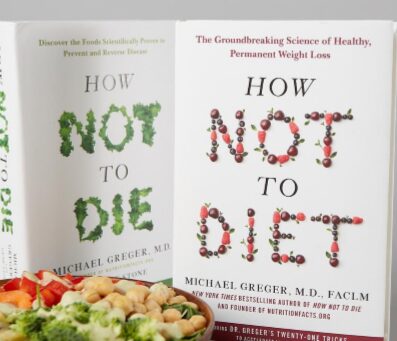
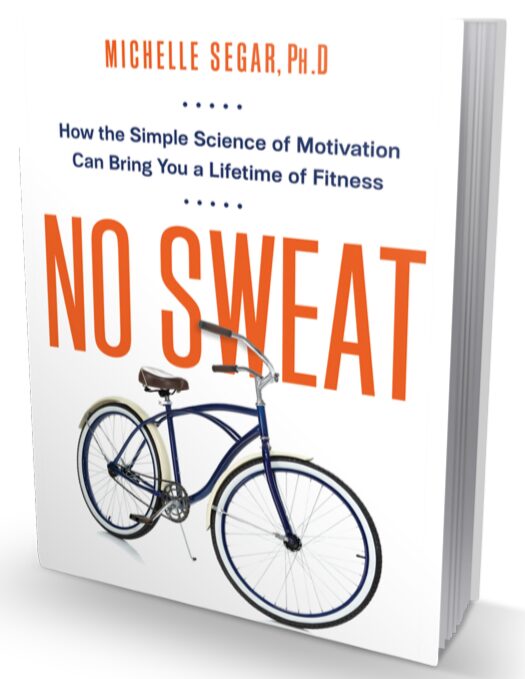
● For those trying to eat better: How Not to Die​ and ​How Not to Diet​ by Michael Greger, M.D., FACLM.​ If you’re not familiar with ​nutritionfacts.org​, Dr. Greger’s remarkable website, you should be. How does this guy find time in the day for all that he does? And if you haven’t guessed yet from the title of the books, Dr. Greger has a wonderful sense of humor and is all about getting facts straight. He is passionate about what plant-based eating can do for our health. In ​How Not to Diet​, the first half of the book is devoted to the causes of chronic disease in relation to our obsession with animal-based foods. In the second half, he puts plant-based eating strategies into play. In the sequel, ​How Not to Diet​, Dr. Greger’s out to change our perceptions on weight loss. He gives helpful tips for those struggling to lose weight and improve their health, while busting through the myths. ● For those trying to be more active: ​No Sweat​ by Michelle Segar, Ph.D. ​What more can you ask for than a book on exercise motivation when all the gyms are closed? Michelle Segar explores meaning, awareness, permission, and strategy, all mental states we must address to find our most active selves. Not only does the book present exercise ideas and practical tips suited for beginners, it brings attention to the bigger issue that our society’s expectations of what healthy and beautiful bodies should look like are a far cry from reality.

● For those trying to be more active: ​No Sweat​ by Michelle Segar, Ph.D. ​What more can you ask for than a book on exercise motivation when all the gyms are closed? Michelle Segar explores meaning, awareness, permission, and strategy, all mental states we must address to find our most active selves. Not only does the book present exercise ideas and practical tips suited for beginners, it brings attention to the bigger issue that our society’s expectations of what healthy and beautiful bodies should look like are a far cry from reality.

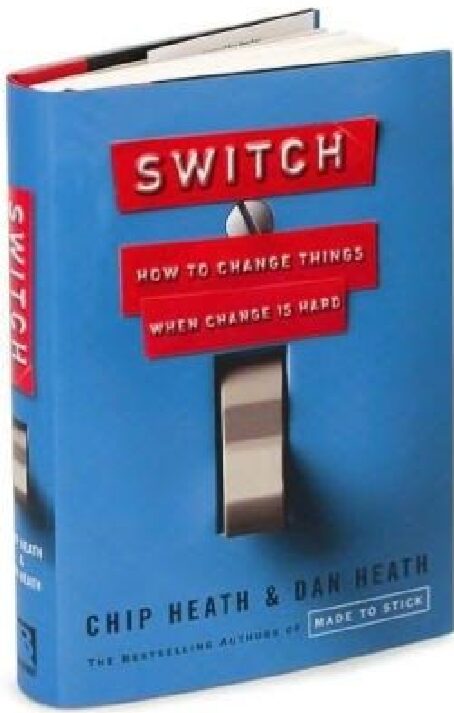
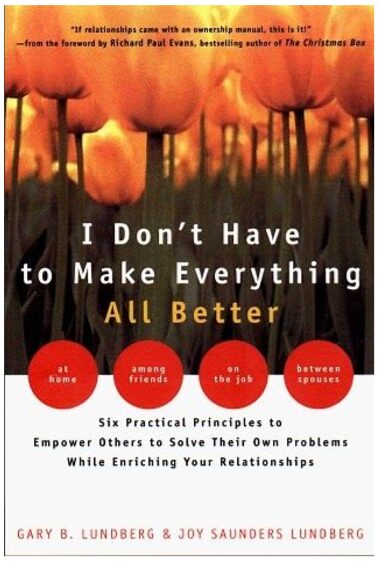
● For those who wonder why making change is so hard: Switch: How to Change Things When Change is Hard​ by Chip Heath and Dan Heath. ​This book is absolutely mind-blowing. It breaks down our mind into rational and emotional parts and delves into what part of ourselves is holding the reins at any time when it comes to decision making. Told in a variety of stories illustrating the concepts the brothers Heath are presenting, the book is fun to read and incredibly insightful. The imagery of the tiny man atop the huge elephant will never leave me. Confused? Read the book to find out. ● For those who are exhausted: ​I Don’t Have to Make Everything All Better​ by Gary and Joy Lundberg. ​And by exhausted, I mean emotionally over it. This book was recommended for Certified Health Coaches, who tend to be natural empaths, at a panel I once attended. I wondered at the time if there was a picture of me in the book. I do not hesitate to say that this book changed my life. After reading it, I became a better person in all my relationships. The strategies presented were easy to put into action and startlingly effective. Where once I went through life feeling like a drained battery, I learned how to help others help themselves. What an incredible experience!

For those who are exhausted: ​I Don’t Have to Make Everything All Better​ by Gary and Joy Lundberg. ​And by exhausted, I mean emotionally over it. This book was recommended for Certified Health Coaches, who tend to be natural empaths, at a panel I once attended. I wondered at the time if there was a picture of me in the book. I do not hesitate to say that this book changed my life. After reading it, I became a better person in all my relationships. The strategies presented were easy to put into action and startlingly effective. Where once I went through life feeling like a drained battery, I learned how to help others help themselves. What an incredible experience!

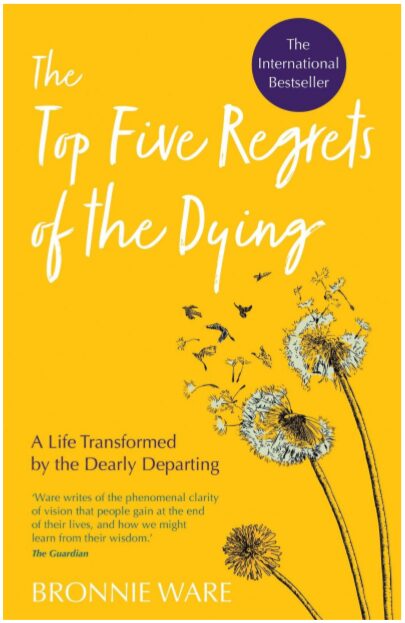
For those who need a little perspective: ​The Top Five Regrets of the Dying: A Life Transformed by the Dearly Departing​ by Bronnie Ware. ​Another mind-blowing book. I originally picked this up after attending a fitness convention seminar on happiness. I found the title intriguing and the idea that I could find happiness in its covers was irresistible. Ware is an Australian woman who worked in palliative care and wrote a memoir of her experiences after learning lesson after lesson from the “dearly departing.” Her book is remarkable, beautiful and heart-wrenching, but oh so hopeful. I don’t know about you, but I believe we could all use a dose of hope right about now.

Brittany Hall is the owner of Brittany Hall Certified Personal Training and Health Coaching LLC. She is an ACE Certified Personal Trainer (ACE-CPT), ACE Certified Health Coach (ACE-CHC), and ACE Mind Body Specialist, all earned with the American Council on Exercise (ACE). She also holds an advanced certification with the Cancer Exercise Training Institute (CETI) as a Cancer Exercise Specialist (CES). She was an attendee at the Active Lives: Transforming Our Patients and Ourselves conference presented by The Institute of Lifestyle Medicine at Harvard Medical School as well as the IDEA World Fitness Convention presented by the IDEA Health and Fitness Association. Her latest venture is as a POP Pilates instructor.

Texas State Parks Reopen for Day-Use

0

Texas State Parks will begin reopening for day-use only April 20 as part of a broader effort to begin reopening the state of Texas. Per Governor Abbott’s direction, new restrictions in effect include requiring visitors to wear face coverings and maintain a six-foot distance from individuals outside of their party, and prohibiting the gathering of groups larger than five.

 “As we navigate through these challenging times, it is essential that outdoor experiences and opportunities are available for Texas families. We have been diligently working with our partners in local communities across the state to help safeguard our state park visitors, volunteers and staff when they return to Texas State Parks,” said Carter Smith, Executive Director of the Texas Parks and Wildlife Department (TPWD). “During the temporary closure, our State Parks team has been cleaning and sanitizing park facilities, addressing routine maintenance projects, and ensuring requisite safety protocols are in place to ensure visitors have the best possible experience.”

Due to limited staffing, weather conditions and continuing construction projects, some state parks will not be open at the current time. Park visitors should check the Texas State Parks Alert Map regularly for the latest information about the status of individual parks. The resumption of overnight camping will be announced to the public once a date has been determined.

TPWD recommends visitors continue to adhere to local, state and federal travel restrictions and other guidance for safety and social distancing before traveling. Additionally, visitors are required to pre-purchase and print day-use permits through the Texas State Parks Reservation System before traveling to a park. Day-use reservations can be made online at www.texasstateparks.org or by calling 512-389-8900.

Visitors planning on coming to a state park are encouraged to bring all necessary provisions, such as hand sanitizer and face masks, with them in order to help local businesses have enough goods to properly serve their communities during this time. This will also help park staff have necessary supplies available for all guests during their stay.  

Anyone traveling to a Texas State Park should continue to follow Centers for Disease Control (CDC) public health recommendations and adhere to strict social distancing and cleanliness standards while in public spaces.  Those traveling to parks in rural areas should remember possible limits on available resources and local health care capacities.

Operational changes still in effect at parks include the suspension of all transactions at parks, equipment rentals and in-person interpretive programs. All group-use facilities, visitor and nature centers, headquarters and other enclosed spaces where people congregate will also remain closed.

Texas State Park Passes can now be purchased online through the reservation system or over the phone by calling the Texas State Park Customer Service Line at (512) 389-8900. For guidance troubleshooting issues with the reservation system or using Texas State Park Passes online, visit the reservation help page on the TPWD website.

For the latest information, please check the TPWD website.

SFA budget impacted by student refunds, CARES Act Funding

0
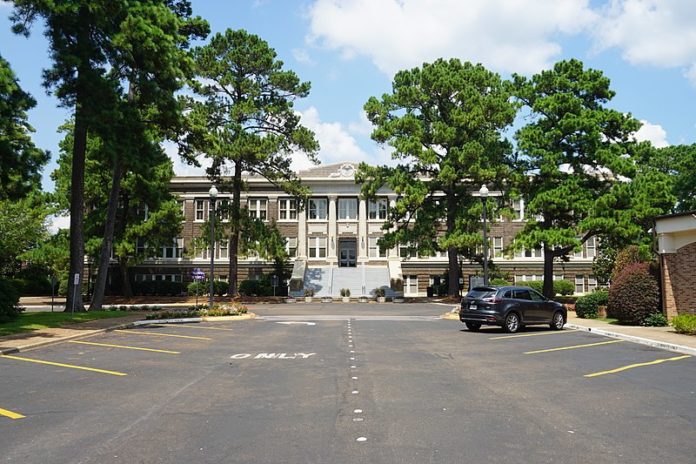
Courtesy of Michael Barera.

When Stephen F. Austin State University moved all classes online due to concerns regarding the impending impact of COVID-19, administrators immediately began calculating the best way to reimburse students for the money they had paid for housing, food service, and on-campus activities that would no longer be accessible. The university refunded approximately $9 million to students.

“Refunding this money to our students was not only the right thing to do, it was essential in order to assist our Lumberjacks and their families during this very difficult financial time. We are a family, and families help one another,” said SFA President Scott Gordon.

As of now, the institution is facing a loss of about $12 million, due to refunds, lost revenue from canceled events and the cost of moving classes online. This amount will continue to increase as restrictions continue, especially if the fall semester is impacted.

Collectively, Texas institutions of higher education were awarded more than $1 billion of the $14 billion available from the Higher Education Emergency Relief Fund, a part of the federal stimulus bill known as the CARES Act.
 
SFA has been allocated approximately $10.5 million from the CARES Act and will distribute the entire initial allotment of $5.2 million to students, according to Gordon. The funds are mandated for use as emergency aid for students dealing with coronavirus-related disruptions such as housing displacement, job loss or other hardship.

“This initial allotment cannot be used to fill the financial holes of the institution as a result of COVID-19” said Gordon. “We are pleased that these funds will be able to assist students who have a demonstrated need and are experiencing significant financial challenges.”

As for the university, there is hope that a second allotment of funds will be able to help institutions recover from this pandemic. Even so, according to Gordon, the funding will not completely offset the financial losses incurred during spring and into the summer – or the losses that are expected if restrictions continue into the fall semester.

“Thankfully, we had reserves for a rainy day,” he said. “However, this is not just a rainy day, it’s a downpour and we have a great deal of work to do to rebuild our reserves to the previous level.”

Gordon said the university will be looking at a variety of ways to recover financially.

“We will make the necessary decisions with a focus on keeping the best interests of SFA students, faculty, staff and our mission in mind,” Gordon said.

The university plans to provide information and resources soon for students who have been impacted by COVID-19, who have demonstrated need and are facing significant financial challenges due to the ongoing COVID-19 pandemic. 

–Stephen F. Austin State University News and Media Center

How to Make a Bacon Ranch Cheddar Cheese Ball

0

“To cheese, or not to cheese, 

That is the question.”

A question that I can definitely answer….You always cheese. 

Today, April 17, just so happens to be a momentous day that most people are not aware of, National Cheese Ball Day! And what better way to celebrate than with a cheese ball!

Cheese balls: The Queen of Appetizers. If you tell me that you haven’t gotten hungry at your neighbor, Ellie Mae’s, 3rd housewarming party of the year and eaten at least half a cheese ball out of boredom, then I’m here to call your bluff. 

I’m also here to give you a recipe that you’ll definitely want to eat at least half of just because it’s so delicious. Lucky for you, you don’t even have to be at Ellie Mae’s to eat it, you can make it yourself! 

BACON RANCH CHEDDAR CHEESE BALL:

Ingredients:

  • 16 ounces of cream cheese
  • 1 cup of shredded cheddar cheese
  • 2 tablespoons of Ranch seasoning mix
  • ⅓  cup of diced chives
  • 6 strips of cooked and crumbled bacon

Instructions:

  1. Mix all ingredients together
  1. Next, use  your hands to form the mixed ingredients into a ball
  1. Wrap ball in saran wrap
  1. Place in refrigerator for AT LEAST an hour
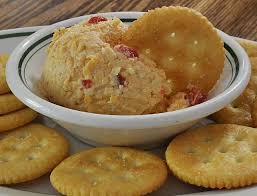
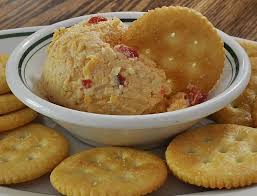
  1. Serve with a snack of your choice like celery, carrots, or crackers. 

You don’t need a special occasion to make this. These delicious treats are great snacks to dive into after a day of quarantining activities. So, enjoy with your family today!

Don’t Touch the Wildlife. Seriously.

0

With more people enjoying the outdoors and working from home this April, you may start to notice more wildlife in your backyard, neighborhood or surrounding area. Species including birds, deer and snakes are active this time of year and their young often stray or appear to be abandoned. But wildlife experts caution against lending a helping hand.

The deer fawning season begins in early to mid-May. A newborn fawn’s mottled coat and mother’s care usually hides them from predators. But as fawns mature, they shed these coats for a more adult color which causes them to catch the eye. With mothers leaving fawns for hours at a time, you may spot one lying alone in tall grass or in a brushy area.  Well-meaning people sometimes pick up these fawns, thinking that they have been abandoned by their mothers and need help. This is rarely the case.

Leave all young animals alone unless it is obviously injured or orphaned. To be sure, spend time observing the wild animal from a distance in order to make that determination. Staying too close may deter the mother from returning, so be sure to practice your social distancing skills. By interfering too soon, you may be doing more harm than good.

The same applies to young birds, who might be out of their nests but cannot fly. If the bird’s eyes are open, it has a coat of feathers and is hopping around, it is probably fine. Grounded fledglings will usually be up and flying within a few days.

If it is determined that a wild animal is sick or injured call the Texas Parks and Wildlife Department’s wildlife information line, (512) 389-4505, during business hours for a referral to a licensed wildlife rehabilitator. After-hours callers can get the names of rehabilitators from TPWD’s dispatch line at (512) 389-4848 or by checking the department’s web site.

Life Lessons: SFA professor shares his insight regarding economics, effects of COVID-19

0

NACOGDOCHES, Texas — In higher education, much emphasis is placed on transformative learning experiences. In fact, when administrators at Stephen F. Austin State University were drafting the university’s 2015-23 strategic plan, they assigned providing students with transformative learning experiences as the institution’s overarching goal.

Generally, these types of experiences are gained through internships, work study and study abroad activities in which students voluntarily participate. They provide the types of hands-on learning opportunities that help students acclimate to the world and their careers after graduation.

Recently, just about every college student worldwide has become actively engaged in a transformative learning experience as a result of the effects of COVID-19. Though there are many lessons to be learned from this pandemic, the lessons involving economics will be especially far reaching.

“Every person on the planet is making adjustments,” said Dr. Mikhail Kouliavtsev, department chair and professor of economics at SFA. “The uncertainty created by the virus is having a cross-cut influence on all sectors of the economy, affecting households, businesses and financial markets.”

With an estimated 67 million Americans working in jobs that are labeled as “high risk” for layoffs, Kouliavtsev offered some insight into several aspects of the world crisis, especially as it relates to economics.

Layoffs
Kouliavtsev recommends doing four things if you’ve been laid off.

  • Immediately file for unemployment. Most state unemployment offices are overwhelmed and understaffed, so delays are likely. The sooner you act, the faster you can get in the queue.
  • Talk to your landlord, mortgage lender, utility provider and/or credit card issuer. Many are offering some sort of bill “holiday” to help customers. If not, ask if they will be flexible. You won’t be the only one asking.
  • Focus on keeping everyone in your household healthy. Other expenses can be postponed.
  • Resist the urge to liquidate your retirement account. The penalty for early withdrawal added to the tax liability will eat a substantial chunk of your funds, which will be difficult to rebuild.

Stock market
Kouliavtsev believes the stock market will continue to bounce around as long as there is uncertainty about the pandemic or until we have hit the peak of new infections and deaths from COVID-19, and the health care system can manage the flow of the sick. When we know there are treatments and a vaccine in development, we will have a better idea of the timeline of this crisis, and then the market can begin to stabilize.

Retirement accounts
According to Kouliavtsev, those very near retirement likely already had most of their retirement funds out of the stock market and in something less volatile, like fixed-income bonds, before the crisis hit. For those who did not, postponement of retirement may be necessary to allow fund recovery. Kouliavtsev warns that panicking and selling investments now may have dire consequences, as those who have already lost due to the market plunge will miss the opportunity for fund recovery.

Stimulus package
“It will help, but it also will not be nearly enough,” Kouliavtsev said. “Hopefully, it is a down payment on a much larger investment the government will have to make to help the American people.” For individuals approved to receive the $1,200, Kouliavtsev believes it won’t go very far; especially when the median rent for a one-bedroom apartment in the U.S. is about $1,100, and many people have already been without income for more than a month. Another difficulty Kouliavtsev sees is making the stimulus package work in its intended fashion — to stimulate the economy — when stores, restaurants and service industries are closed, and people are instructed to stay home.

Paying for government spending
Significantly increasing government spending — as this stimulus package requires — without immediately raising taxes will mean running a large budget deficit. While this debt accumulation typically is a major concern for long-term growth, interest rates are at some of the lowest levels in history, practically zero. When taking inflation into account, rates are effectively negative, meaning the government can essentially borrow at no cost. In other words, if there was ever a time for the federal government to spend freely and not worry about the debt it accumulates it’s now. Because of the severity of the pandemic, it is important to focus on the “public” before we worry about “public debt.”

Investing
Kouliavtsev said typically, a significant plunge in the stock market is a good time to invest, if the investment is made with the long term in mind. As far as real estate, mortgage rates are low, and we are headed into summer, which generally signify a favorable time to buy. However, it is not easy to shop for a home due to the actual steps involved in buying — attending open houses, meeting with bankers and real estate professionals, etc., due to social distancing guidelines.

Job growth
Since many people have been in quarantine and isolated with only their computers and the internet to keep them company, Kouliavtsev believes the U.S. will see an increase in tech-related occupations, like coding and data science. He also said it will be interesting to see how health care will be affected. “It was already a sector that needed reforming before the COVID-19 pandemic,” Kouliavtsev said. “But it was primarily the cost of health care and insurance coverage that were the main issues. We are now seeing that having adequate hospital and ICU bed capacity may be just as important, as is staffing, including doctors, nurses and other health care workers. We may see a concerted effort to invest in health care more broadly, and that will expand the job opportunities in these careers.”

Impact on higher education
With most institutions switching to an online instruction format, students are not physically on campus, and therefore there is less revenue being generated from housing, meal plans and fees students pay for things like the use of on-campus computer labs, recreation facilities, library resources, etc. SFA will be refunding approximately $9 million to students for services like these for the 2020 spring semester. This type of revenue loss will hit higher education hard, especially private colleges. Kouliavtsev said there are some bright spots. We typically see higher enrollments in colleges and universities during recessions because scarce employment opportunities during economic downturns make people want to attain skills, certifications and degrees to help improve their employability. And, to the extent students and their families may want to stay close to home in these uncertain times, regional institutions, like SFA, may be in a good position to fulfill their missions — serving the region. SFA, for example, may be an excellent destination for students from the East Texas area who planned to attend college in Austin or College Station, but now want to stay closer to home.

Student adjustment
“I am quite impressed with how our students accepted foregoing their spring break, not being able to participate in study abroad trips in May and summer, and for some, not being able to attend their own commencement ceremony with their families,” Kouliavtsev said. “The transition to online classes is not easy — for students or professors — but it seems everyone understands the circumstances and is trying to make it work.”

Positive outlook
Eventually, things will return to normal — although our day-to-day lives may be forever altered. And as difficult as the past several weeks have been, Kouliavtsev said there are some positives to take away. First, we will have learned a great deal about how to manage a crisis. They don’t come around very often, but pandemics do happen, and we will be better equipped to handle the next public health crisis, know how much and what kinds of stimulus packages are needed, and have a better idea of the timeline involved. Second, some of the personal hygiene habits we have been encouraged to practice — regular and thorough handwashing, covering a cough, being mindful of face touching — may help us reduce the spread of other illnesses, including influenza. This could translate into substantial savings to employers from fewer people missing work, less strain on the health care system and fewer lives lost. Third, people quarantined to their homes are spending more time with their families, cooking and eating together, possibly learning new skills and taking online classes. “There is definite value in all of these activities,” Kouliavtsev said.

–Courtesy of SFA News and Media Center.

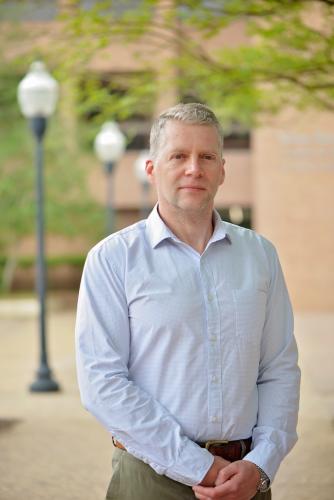
With the world focused on COVID-19 and its effects on health and the economy, Dr. Mikhail Kouliavtsev, department chair and professor of economics at Stephen F. Austin State University, offered some insight into several aspects of the world crisis, especially as it relates to economics.

On this Day, April 17, 1871- Legislature Approves Appropriation for Agricultural and Mechanical College

0

On this day in 1871, the state legislature approved a bill providing for the organization of the Texas Agricultural and Mechanical College (now Texas A&M University) and appropriating $75,000 for the construction of academic buildings and suitable accommodations. A committee selected a site near Bryan, now known as College Station, following the donation of 2,416 acres by local citizens. The college, the oldest public institution of higher education in the state, opened in October 1876 with 106 students and a faculty of six under President Thomas S. Gathright. By the year 2000, the College Station campus was the fifth-largest university in the nation, with more than 44,000 students, and the Texas A&M University System included nine schools across the state.

Do’s and Don’ts of Outdoor Fuel Use

0

With stay-at-home measures in place, you may find yourself with extra time for getting a jumpstart on outdoor seasonal chores.

But first, you’ll need to fuel up, as gasoline, kerosene and diesel fuel are all required for outdoor tasks like removing fallen tree limbs and power washing driveways. Follow this advice from the experts at Scepter to use fuel properly and safely.

Dispose of Old Fuel

“Safely dispose of any leftover fuel in containers from winter activities,” says Daniel Marshall, vice president of marketing and business development with Scepter. “Winter fuel is heavier, and a unique blend. Fuel available in spring and summer is different and should be used for lawn care and sporting equipment.”

You can safely dispose of a winter mix of gasoline, Marshall notes, by carefully funneling it into your car so that a small amount of remaining winter fuel will mix in with the gasoline in your larger tank.

Do’s and Don’ts

Before using fuel around the house, review this “do’s and don’ts list” with your family:

Do…

• Use fuel outside only, in well-ventilated areas where you won’t breathe in the fumes.

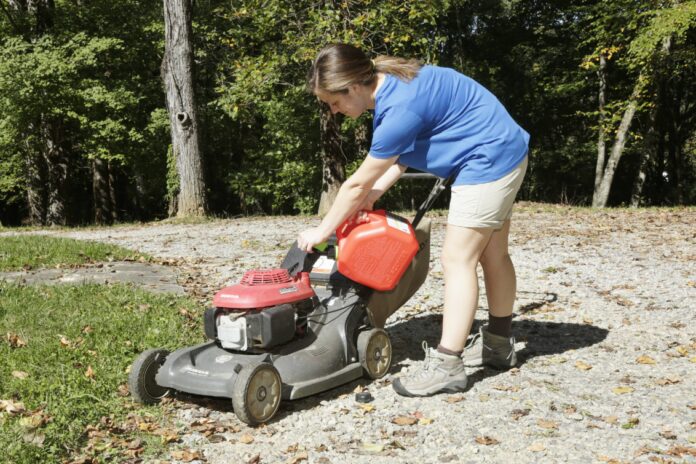
• Remove fuel containers from vehicles before refilling.

• Place containers on the ground a safe distance from vehicles when refilling.

• Touch the container with the gas dispenser nozzle before removing the container lid to ground the static electricity charge.

• Keep the nozzle in contact with the container when filling it to prevent build-up of static charge.

• Carefully wipe away fuel spills, either during the filling of the container or when using the container.

• Store fuel in their proper containers. Universally, red containers are for gasoline, blue are for kerosene and yellow are for diesel.

• Let a hot motor cool before adding more fuel.

Don’t…

• Siphon any type of fuel by mouth.

• Allow children near fuel containers.

• Store filled fuel containers in a vehicle or living space, like a home or trailer.

• Bring fuel containers near open flames, whether it be pilot lights or stoves.

• Bring, store or use fuel near any source of ignition.

• Smoke when using fuel or when near fuel containers.

• Remove or alter the FMD inside the opening of the container.

• Pour fuel directly onto or near a flame, coals or embers. Fuel should never be used to start or accelerate a fire.

• Use any type of fuel to kill ant hills or bee hives.

For additional tips, check out free safety videos online by visiting, Scepter.com/safety.

For a safe, productive season of outdoor activities and chores, be sure to always store and use fuel properly.