

Home Blog Page 425

PROJECT UPDATES AND WORK SCHEDULES FOR LUFKIN DISTRICT

0

LUFKIN – Motorists will likely encounter a work zone or road closure as work continues in many areas. While work schedules are likely to change in inclement weather, plans for construction and maintenance of roadways extend throughout the nine-county Lufkin District.

Motorists are urged to reduce speed through a work zone, obey the Move Over, Slow Down law and stay alert for workers and moving equipment through work zones. Project updates and plans for the week of July 22-26 include:

ANGELINA COUNTY

US 59 South: Crews are scheduled to continue upgrading metal beam guardrail and cross structures along with excavation and backfilling in various locations from SL 287 in Lufkin to the Polk County line.

US 69: Work continues from FM 844 to FM 1270 south of Zavalla to widen the existing two-lanes to a four-lane divided highway. Dirt is being hauled for excavation and embankment work. Beams placed for the US 69 northbound ramps are being placed at SH 63. Crews are also cement treating  the new areas of construction and doing dirt work in the Shawnee Prairie area. Motorists should be alert for trucks exiting and entering the roadway throughout the construction site. Intermittent lane closures expected.

SH 7: Work is scheduled to cut high edges in various locations. Lane closures expected.

FM 324: Crews are scheduled to work to pour concrete for headwalls  and work on metal guard beam guardrail on this project designed to improve guardrail to design standard and safety treat fixed objects from just south of SH 94 to US 59. Lane closures expected.

FM 2497: Repair work is scheduled to begin on the Cedar Creek Bridge. Motorists should be alert to road closures and heavy equipment in the area.

SH 103/SL 287: Crews are clearing the right of way and removing pavement near Spur 339 on this project designed to widen existing pavement for additional turn lanes from just south of SL 36 to just north of SP 339.

SH 147: Work is scheduled to pour concrete for guardrail attachments on the Lake Sam Rayburn Bridge that will result in a lane closure on this project designed to upgrade metal beam guardrail to design standards and safety treat fixed objects from just north of FM 3123 to FM 2109.

FM 842: Crews are scheduled to level up pavement in various locations. Lane closures expected.

Robinson Lane: This roadway has been reopened and crews are monitoring vegetative establishment on this bridge replacement project at Gilliland Creek.

East Lufkin Avenue: Crews are scheduled to continue work on East Lufkin Avenue near the intersection of Timberland Drive that will include cleaning, placing sod and removing forms on this project designed to add sidewalks near the intersection.

Various locations: Work is scheduled to apply herbicide, patch potholes, install signs and sweep the roadway.

HOUSTON COUNTY

SH 21: Crews continue to work on cross drainage structures and blading the topsoil on this project designed to reconstruct and add passing lanes from the east end of the Trinity River Bridge to FM 1280. Motorists should expect intermittent lane closures.

SH 21 East: Work is scheduled to repair base and edges from SL 304 to FM 227.

SH 19: Crews are working to begin a project designed to improve guardrail to design standards and safety treat fixed objects from 1.6 miles north of FM 231 to the Trinity County line.

FM 2781: Crews are scheduled to place cement on this project to reconstruct and widen existing pavement from FM 1280 to US 287. Motorists should expect lane closures using pilot car and flaggers.

SL 304: Work is scheduled to continue base repairs and begin seal coating from US 287 North to FM 229. Lane closures expected.

Various locations: Crews will work to apply herbicide, patch potholes, repair signs and clean ditches. Stay alert for intermittent lane closures and workers.

NACOGDOCHES COUNTY

SH 21: Work will continue to place culvert extensions on this project designed to upgrade metal bean guardrail to design standards and safety treat fixed objects from SH 7 to the San Augustine County line and on SH 21 from the San Augustine line to FM 3448 in Sabine County. Motorists should expect intermittent lane closures.

FM 95: Crews are monitoring vegetative establishment on this completed bridge replacement project at Terrapin Creek.

FM 226: Work is scheduled to backfill headwalls on this project designed to upgrade metal beam guardrail to design standards and safety treat fixed objects from SH 21 to the end of pavement. Possible lane closures are expected.

FM 1638: Crews continue to monitor vegetative establishment on this project designed to upgrade metal beam guardrail to design standards, safety treat fixed objects and provide additional pavement width from FM 698 to US 59/SL 224.

FM 2609: Work to relocate utilities and construct storm sewers continues on this project designed to widen the roadway from Raguet Street to North Street (BU 59). This roadway remains closed to through traffic.

POLK COUNTY

US 59: Crews are repairing joints in the northbound lanes on this project designed to resurface the roadway with a permeable friction course from just south of US 287 in Corrigan to Moscow.

SH 146: Crews are scheduled to cut high edges in various locations. Lane closures expected.

FM 350: Crews are installing mow strips and metal beam guardrail on this project designed to upgrade metal beam guardrail and safety treat fixed objects from 2.6 miles north of FM 3152 to US 190.

SABINE COUNTY

SH 87: Crews are working from near the high school in Hemphill to SH 83 on this project designed to add pedestrian sidewalks in the area.

FM 83: Crews are working on cross culvert and driveway structures along with sod placement from SH 87 to FM 3121 on this project designed to safety treat fixed objects.

FM 1: Crews are scheduled to continue to widen the subgrade on this project that will upgrade metal beam guardrail to design standards and provide additional pavement width from the San Augustine County line to SH 103.

FM 944: Work is scheduled to level up base in various locations. Lane closures are expected.

SAN AUGUSTINE COUNTY

SH 21: Crews will continue to place embankment at the Attoyac River Bridge on this bridge replacement project. Lane closures are expected.

SH 21: Bridge replacements are complete and crews continue to monitor vegetative establishment at Venado Creek, Niciper Creek and Perkins Creek.

FM 711: Crews will be working to backfill shoulders on this project designed to reconstruct and widen the pavement from the Shelby County line to US 96.

FM 2390: Crews are scheduled to repair base in various locations. Intermittent lane closures expected.

FM 1277: Work is scheduled for base repairs in various locations. Lane closures expected.

SAN JACINTO COUNTY

US 59: Crews are scheduled to remove debris, repair signs, delineators and repair potholes in various locations.

SH 150: Crews are scheduled to continue work on driveway culverts, embankment and flexible base throughout the project along with prime and seal coating in one section of this project designed to reconstruct the pavement and add passing lanes from the Walker County line to FM 945 North.

SH 156: Work is planned to repair pavement edges, reshape high shoulders and work on clearing drainage and culverts in various locations. Some lane closures are possible.

FM 2693: Crews are scheduled to work in various locations to trim limbs and remove dead trees from the right of way.

FM 2025: Crews will remove dead trees and trim trees in various locations.

FM 224: Crews are installing mow strips on this project designed to improve and upgrade metal beam guardrail to design standards from SH 156 North to SH 156 South.

Various locations: Herbicide application is planned for vegetative control.

SHELBY COUNTY

US 96: Work is scheduled to place striping and backfill pavement from US 84 to SH 87. Lane closures expected.

TRINITY COUNTY

FM 2262: Striping is complete and clean-up is being done on this project designed to reconstruct and widen pavement from FM 357 to SH 94.

For more information, contact Rhonda.Oaks@txdot.gov or (936) 633-4395.

Dementia Caregivers Focus of Lufkin Conference

0

A leading educator of dementia caregivers, Tam Cummings, PhD, will be the featured speaker at the 2019 Caregivers Conference.  Cummings is the author of four books for dementia caregivers and developed the Dementia Behavioral Assessment Tool (DBAT) for classifying dementia stages by behaviors.  She says her mission is to “Inspire, Educate and Empower Dementia Caregivers.”

This year’s Caregivers Conference is scheduled for Friday, August 16, 2019 at the Pitser Garrison Convention Center in Lufkin. The program starts at 9 a.m., a lunch will be provided and there is no charge for attending. The event will be hosted by the Area Agency on Aging and the Deep East Texas Aging and Disability Resource Center.  

Attendees are requested to Pre-Register by calling 409-384-7614. They can also send a registration form to AAA DETCOG, 210 Premier Dr., Jasper, TX 75951 or fax it to 409-384-6177.  For more information contact the Deep East Texas Aging and Disability Resource Center at the Deep East Texas Council of Governments Office in Jasper at (409) 384-7614.

DPS Ramping Up Move Over/Slow Down Enforcement

0

The Texas Department of Public Safety (DPS) is continuing their enforcement efforts across the state focusing specifically on violations of the state’s Move Over/Slow Down law. These periodic enforcement operations by DPS Troopers are planned throughout the year at various locations in Texas, with several operations planned in July. One of those operations will take place in Beaumont District throughout the day on Wednesday, July 17. The Department of Transportation will be participating in a non-enforcement capacity.

The law, originally passed in 2003, requires motorists to move over or slow down when certain vehicles – including police, fire, EMS, Texas Department of Transportation vehicles and tow trucks – are stopped on the side of the road with emergency lights activated.

“Our Highway Patrol Troopers and other offices risk their lives every day for the people of Texas, and their safety is particularly vulnerable while working on the side of the road, where the slightest mistake by a passing motorist can end in tragedy,” said DPS Director Steven McCraw. “While our officers are serving and protecting Texans, we’re asking drivers to do their part by adhering to the law – simply move over or slow down.”

Specifically, Texas law states that a driver must either:  Vacate the lane closest to the applicable vehicles stopped on the side of the road (if the road has multiple lanes traveling in the same direction) or  Slow down to 20 mph below the speed limit. (If the speed limit is below 25 mph, the driver must slow down to 5 mph)

Drivers should only move over if they can do so safely and legally; otherwise, they should slow down.

“In light of the numerous vehicle crashes that occur in Texas and across the nation on a daily basis, and the unfortunate fact that many still violate the state law that has been in effect over 15 years, we are increasing our enforcement and education efforts related to this law,” said Director McCraw. “In addition to complying with the law to protect those who work on the side of the road, we encourage motorists to show the same courtesy to fellow drivers stopped along the roadways. Let’s all get home safely.”

Violations of the law can result in a fine of up to $200; the fine increases to $500 if there is property damage. If violators cause bodily injury, they can be charged with a Class B misdemeanor, resulting in possible jail time and a maximum fine of $2,000.

Data from 2018 shows that DPS issued more than 41,000 warnings and citations to motorists violating the Move Over/Slow Down law. Preliminary data shows this year approximately 12,300 warnings and citations were issued for violating the law.

Jeans for a Cause

0

Georgia-Pacific employees are going casual this summer to not only beat the heat, but to raise awareness and funds for the Winnie Berry Humane Society of Angelina County. Each month the Diboll Regional Office selects a non-profit organization to support with its “Jeans with a Cause” event. Employees can help fund local organizations by contributing $20 to wear jeans on Fridays. Last month the employees chose to support the Humane Society and the countless number of homeless dogs and cats within their care. Recently Georgia-Pacific’s (left)Yana Ogletree and (right) Michelle Palmore presented a check of approximately $800 to the executive director of the Winnie Berry Humane Society of Angelina County, Kristy Bice.

Georgia-Pacific Employees Collect Shoes for Needy Angelina County Students

0
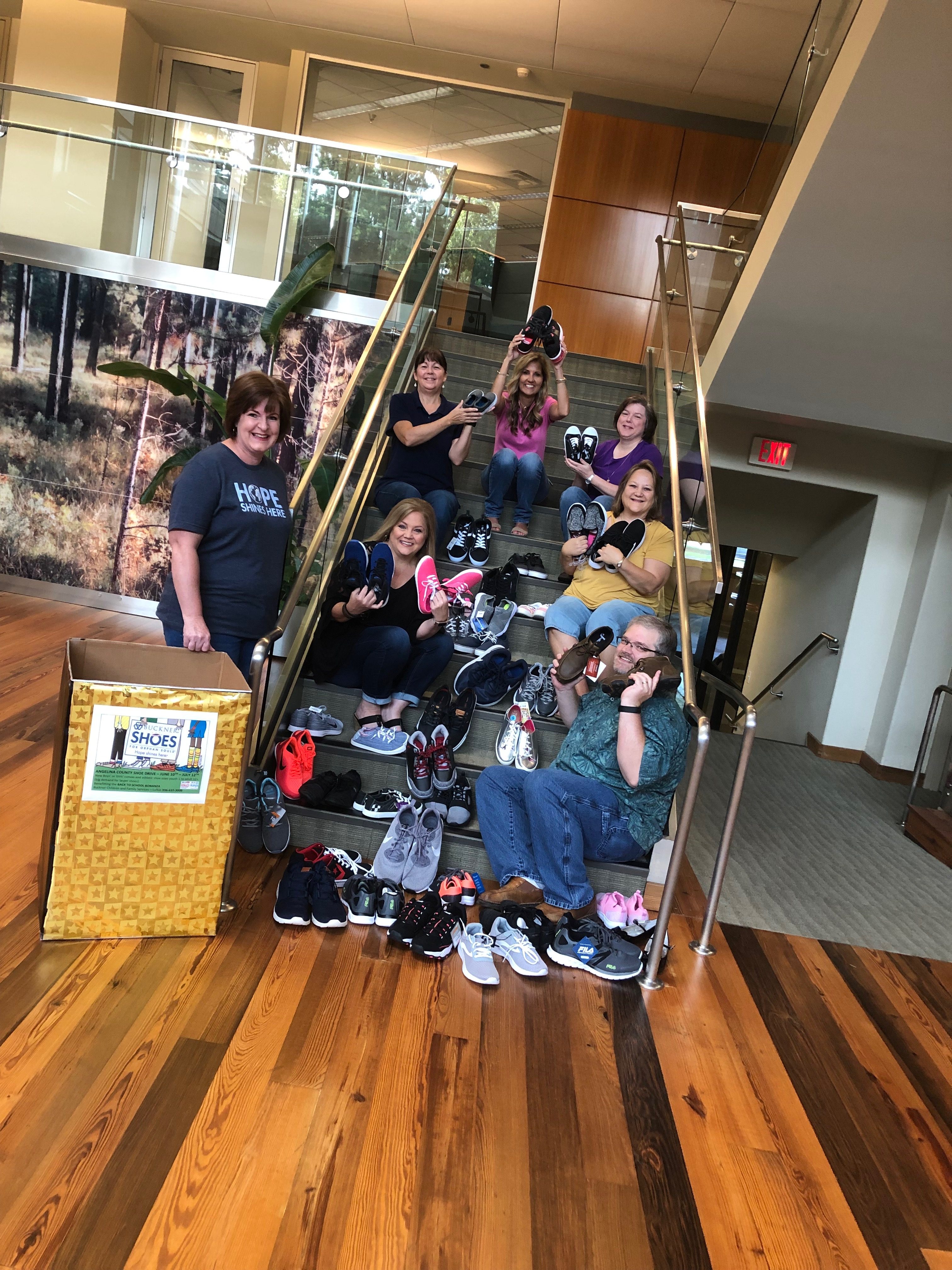
Georgia-Pacific employees in Diboll show off some of the shoes that are being donated to needy Angelina County children. The shoes will be distributed during the Junior League’s annual Back-to-School Bonanza in August. Pictured (bottom row l to r) are Holly Valentine, Buckner Children & Family Services; and Georgia-Pacific employees Allen Foster (center row l to r) Michelle Palmore and Becky Radke (top l to r) Teresa Randolph, Yana Ogletree, and Tara Glaze.

Angelina County students will step out in style as they head back to the classroom this Fall. For the last couple of weeks Georgia-Pacific employees in Diboll have been collecting new shoes for children in need. It was all part of the Buckner Children and Family Services’ annual shoe drive. Close to 50 pairs of shoes—from athletic sneakers and walking shoes to tennis shoes adorned with glitter and bows—were purchased by GP employees and donated to the non-profit organization. The shoes will be distributed to children during the Angelina County Junior League’s annual Back-to-School Bonanza in August.

Loafs Launches The Pacific Shoe to Stylishly Combat Climate Change

0

Look good, feel good, do good. Today, all three are possible thanks to The Pacific, a new and stylish multi occasion shoe by Loafs LLC. This eco-conscious footwear line is made entirely from recycled materials including algae-based foam, chrome-free recycled leather trimmings and tree-based linings.

Taking materials that would be otherwise destined for landfill and combining them with the first plant-based foam made from algae biomass, The Pacific is as sustainable as it is fashion-forward. It’s the perfect all-day shoe with the comfort of a sneaker and the style of a dress shoe.

“People are well aware of how important it is to care for our planet, but don’t always know how,” said Aaron Roubitchek, creator of The Pacific. “The Pacific makes it easy to love the planet we walk on and look great doing it.”

Emphasizing an eco-conscious approach to shoemaking, The Pacific uses less toxic manufacturing processes than conventional footwear brands. Substitutions favoring sustainability include water-based assembly cement, chromium-free recycled leather, GRS-certified 100% recycled polyester, recycled foam, and organic cotton shoelaces without wax. The recycled leather alone is manufactured using 95% recycled water and decreases waste yield by 90% compared to standard leather manufacturing. Beyond the shoe itself, all packaging for The Pacific is made from 100% recycled paper and soybean ink printing.

Doing good for the environment has never been easier or looked better with The Pacific. Modeled after other philanthropic fashion brands, each pair purchased will directly help clean up the Great Pacific Garbage Patch. At the end of each year, the greater of 10% of profits or 1% of sales will go to The Ocean Cleanup Project, one of the most technically innovative and mass scale ocean cleanup efforts in scope.

The Pacific is currently available to pre-order on Kickstarter. It is available in black, tan, slate blue, nimbus grey, and desert orange to match anyone’s personal style. Its lace-up design sports a sophisticated aesthetic that, when coupled with the foam runner’s insole and rubber tread pods, provides all-day comfort for any activity. Starting at $89, pre-order by visiting pr.go2.fund/loafs.

About Loafs

LLC Loafs LLC is an eco-conscious footwear brand that holds itself to an elevated standard of sustainability throughout every step of the process. From manufacturing to post purchase philanthropy, Loafs creates shoes that make customers look and feel good, and helps the earth too. As a company, Loafs aims to inspire their customers to combat climate change through small, everyday actions like choosing the clothes they wear, and being mindful about how they are made. Design, comfort and philanthropy are no longer mutually exclusive, as a percentage of every purchase is donated to The Ocean Cleanup’s efforts to clean the Great Pacific Garbage Patch. For more information, visit www.loafs.com.

An Update from Trent Ashby

0

While some suggest that the general sense of patriotism is dipping across America, I am happy to report that pride for the United States was as prevalent as ever in House District 57 over the July 4th holiday weekend. I had the honor of participating in a parade with countless others dressed in red, white and blue to show their undying love for our beloved country. I capped off the holiday weekend with some much needed family time, and it is my hope that you and yours had some time to reflect on the many blessings we, as proud Americans, enjoy. God bless the USA!

With that, here’s this week’s legislative update. . .

Legislative Update

Over the last year or two, you may have heard or read articles about the latest practice of fraudulent activity — card skimming. This occurs when a microchip is attached to the device patrons use to swipe their debit or credit card, allowing criminals to extract data from the card to access personal accounts, or even steal an individual’s identity. Some reports of captured card skimmers have shown monthly gains of over $60,000 from unsuspecting patrons. Further, Texas accounts for nearly one-third of all financial losses nationwide from the practice of card skimming. With that in mind, the Texas Legislature took action against this practice during the most recent legislative session by passing measures strengthening civil and criminal penalties, instituting jurisdictional boundaries, and cracking down on criminals caught with multiple counterfeit cards and skimming devices.

Another deceitful tactic used by those trying to take advantage of hardworking Texans is the practice of “caller ID spoofing.” We’ve all answered calls from a number with a familiar area code and been frustrated when we realize that the call was just another solicitation. As technology has continued to evolve, telemarketing companies have developed strategies to use fraudulent caller identification numbers to increase connectivity with those they solicit. Given the recent rise in this deceitful practice, the Texas Legislature passed a law that will ensure the number that appears on someone’s caller ID matches the number of the third party, or the entity that has contracted with the third party for the solicitations purpose. In the event that you have blocked a telemarketing number and they’ve still managed to contact you, this law should help stop these phone calls by allowing the Office of the Attorney to prosecute telemarketing companies who continue to misrepresent their identity.

Reminders

With a busy schedule of events in House District 57 throughout the month of July, the mobile office will suspend the regular Wednesday schedule until August 7th. For any questions you may

have, or issues you need help resolving, please reach out to our district office at (936) 634-2762 or our Capitol office at (512) 463-0508 anytime Monday-Friday from 8:00am-5:00pm. We will make every effort to respond to your needs.

Bullying Based on Stigma Has Especially Damaging Effects

0

Bullying is an issue that is constantly in the news – either as a standalone story about a particularly egregious case or as a major contributor to much larger issues, including school shootings.

In a new study, two UD professors are looking at bullying based on stigma – where one is treated unfairly or unjustly due to one’s race, sexual orientation, gender, or other characteristic – and examining the methods used to prevent this type of bullying and address it when it happens.

“I became interested in this because we’re realizing that being bullied due to a stigmatized characteristic or identity is really harmful. I started wondering what people are doing about it, and whether they are doing the right things about it,” said lead author Valerie Earnshaw, a professor of Human Development and Family Sciences.

In a study released recently in the journal Developmental Review, Earnshaw, Assistant Professor Tia Barnes and their colleagues found that although there has been an increase in stigma-based bullying interventions, there are some issues with how these interventions are being implemented and evaluated.

“Stigma-based bullying has always been around, but I think that there have been some recent societal shifts that have led people to pay more attention to it,” Earnshaw said. 

Earnshaw is already in the process of developing new research based on the study. One project focuses specifically on increasing the capacity of school health professionals to address LGBTQ bullying. It aims to develop and pilot an intervention that can help these professionals prevent, identify, and address bullying of LGBTQ students, particularly of multiracial backgrounds and those who identify as transgender. 

Earnshaw said that some strategies like bystander intervention, where students not involved in a bullying incident speak up or intervene in an incident, could be helpful to address all forms of bullying. But specific strategies that address stigma, like reducing stereotypes and prejudice, may be necessary to address stigma-based bullying.

Stopping bullying before it starts

Earnshaw said that although research has not made strong connections between gun violence in schools and stigma-based bullying, some signs are there.

The perpetrator of the school shooting in Parkland, Florida had connections with a white supremacy group, she said. Other perpetrators of gun violence have histories of engaging in gender-based harassment and/or violence.

“Perhaps intervening early on these stigma-related factors could have downstream effects on preventing gun violence,” Earnshaw said.

An intervention to address bullying could be a focused, one-on-one effort with the victim or a perpetrator, or it could be a preventative measure imposed on a whole school.

The study shows an increase in interventions to address stigma-based bullying (such as bullying of young people with stigmatized identities, like LGBTQ youth, overweight youth and youth with disabilities).

Between 2000-2007, six were published in the peer-reviewed literature. From 2008-2015, 16 were published.

“This is good,” Earnshaw said. “People are realizing that stigma-based bullying is harmful, and they’re trying to do things to stop it or help youth experiencing it.”

The reason seems to be issue-oriented: for example, the momentum for equality and civil rights for LGBTQ individuals and support for gay marriage seems to have brought the issue of LGBTQ bullying to the fore.

While this is a positive, it also means that interventions aren’t evenly distributed across stigmas. 

Barnes, who focuses more on race-based bullying, said the team could only find two types of interventions used at schools that addressed race. But she said she wonders if the recent shift in political climate, where students are targeted because they are Muslim or even appear that way to perpetrators, could boost that number.

“We talked a lot about what future research directions should be,” said Barnes, whose PhD is in special education. “It would definitely be that we do need more research on race-based bullying and more interventions at the school level.”

And that is perhaps the most important finding: That more findings need to be made. In other words, Earnshaw said, stigma-based bullying interventions should be rigorously evaluated to see how and why these interventions work.

“Overall, stigma-based bullying is a complex phenomenon that takes an ‘all hands on deck’ approach to address,” Earnshaw said. “Students, teachers, parents, healthcare providers, coaches, religious leaders, and policymakers all have a role to play in ending it and improving the wellbeing of youth who are affected by it.”

-Newswise

A Simple Strategy to Improve Your Mood in 12 Minutes

0

We all have a remedy – a glass of wine or a piece of chocolate – for lifting our spirits when we’re in a bad mood. Rather than focusing on ways to make ourselves feel better, a team of Iowa State University researchers suggests wishing others well.

“Walking around and offering kindness to others in the world reduces anxiety and increases happiness and feelings of social connection,” said Douglas Gentile, professor of psychology. “It’s a simple strategy that doesn’t take a lot of time that you can incorporate into your daily activities.”

Gentile, Dawn Sweet, senior lecturer in psychology; and Lanmiao He, graduate student in psychology, tested the benefits of three different techniques intended to reduce anxiety and increase happiness or well-being. They did this by having college students walk around a building for 12 minutes and practice one of the following strategies:

  • Loving-kindness: Looking at the people they see and thinking to themselves, “I wish for this person to be happy.” Students were encouraged to really mean it as they were thinking it.
  • Interconnectedness: Looking at the people they see and thinking about how they are connected to each other. It was suggested that students think about the hopes and feelings they may share or that they might take a similar class.
  • Downward social comparison: Looking at the people they see and thinking about how they may be better off than each of the people they encountered.

The study, published in the Journal of Happiness Studies, also included a control group in which students were instructed to look at people and focus on what they see on the outside, such as their clothing, the combination of colors, textures as well as makeup and accessories. All students were surveyed before and after the walk to measure anxiety, happiness, stress, empathy and connectedness.

Love and kindness wins

The researchers compared each technique with the control group and found those who practiced loving-kindness or wished others well felt happier, more connected, caring and empathetic, as well as less anxious. The interconnectedness group was more empathetic and connected. Downward social comparison showed no benefit, and was significantly worse than the loving-kindness technique.

Students who compared themselves to others felt less empathetic, caring and connected than students who extended well wishes to others. Previous studies have shown downward social comparison has a buffering effect when we are feeling bad about ourselves. ISU researchers found the opposite.

“At its core, downward social comparison is a competitive strategy,” Sweet said. “That’s not to say it can’t have some benefit, but competitive mindsets have been linked to stress, anxiety and depression.”

The researchers also examined how different types of people reacted to each technique. They expected people who were naturally mindful might benefit more from the loving-kindness strategy, or narcissistic people might have a hard time wishing for others to be happy. They were somewhat surprised by the results.

“This simple practice is valuable regardless of your personality type,” Lanmiao He said. “Extending loving-kindness to others worked equally well to reduce anxiety, increase happiness, empathy and feelings of social connection.”

Social media comparisons

Social media is like a playground for comparisons: he makes more money than I; she has a nicer car. While the study did not look specifically at social media, Gentile says the results demonstrate that comparison is a risky strategy.

“It is almost impossible not to make comparisons on social media,” Gentile said. “Our study didn’t test this, but we often feel envy, jealousy, anger or disappointment in response to what we see on social media, and those emotions disrupt our sense of well-being.”

Comparison works well when we are learning something or making a choice, Gentile said. For example, as children we learn by watching others and comparing their results to ours. However, when it comes to well-being, comparison is not as effective as loving-kindness, which consistently improves happiness.

-Newswise

SFA Forestry Students Get Real World Experience at the Georgia-Pacific Lumber Facility

0

Stephen F. Austin State University Forestry students recently wrapped up a six-week summer course learning how to turn trees into lumber. Last week the group of 58 forestry students toured one of the longest-operating mills in the nation, Georgia-Pacific’s Diboll Lumber Mill.

The junior and senior college students have spent weeks in the field understanding reforestation, harvesting and the process of manufacturing wood products such as lumber, plywood and composite panels. Danny Wright, GP Diboll Lumber Plant Manager, says Georgia-Pacific has worked closely with SFA through the years to provide students with an up-close look at lumber operations. “Many of these students will end up working in the forestry industry and it is important that they see first-hand all aspects of the business. We strive to give students the total experience, from the time a log enters our facility to when it is converted into lumber and loaded on trucks for delivery,” said Wright. “We are proud to partner with SFA to offer these students the real-world experience.”