When Angelina College head soccer coach Freddy Drago arrived last summer, tasked with building a new program from scratch, he had little time to perform the normal recruiting duties associated with the job. He built his first team through tryouts and word of mouth, managing to put together a highly competitive unit that challenged established teams throughout the season in a tough Region XIV conference.
On Thursday, Drago and his assistants Jorden Smith and Sheharyar Khan celebrated the programs first big signing class, with 22 players from throughout the state on-hand to post their signatures on official letters of intent to join the team for the Fall 2017 season.
“Last year, we were fortunate enough to find some guys who were ready to play on short notice,” Drago told the crowd of signees, friends and families. “They helped get us moving forward, and we’re counting on you to step in and help raise us to another level.”
Drago continued his focus on recruiting locally while spreading the Roadrunner reach across Texas. Those signing on Thursday included midfielders Joel Barrientos and Chris Burgess from Poteet High School in Mesquite; Nathan Diaz, defender, from Langham Creek High School in Houston; Abraham Escamilla, defender, from Lewisville High School; Matthew Flaherty, midfielder, from Kingwood Park High School in Houston; Harrison Foulkes, forward, and Dylan Leffert, defender from Atascocita High School in Humble; Caio Lira, forward, from Humble High School; Jack Martinez, forward, from Rowlett High School; Victor Pereira, midfielder, from Lewisville High School; Kevin Perez, midfielder, and Nataniel Villavicencio, forward, of Mount Pleasant High School; brothers Damian Ramirez, defender, and Julian Ramirez, goalkeeper, of Naaman Forest High School in Garland; Luke Sommers, defender, from Central High School in Keller; Jacob Beacham, midfielder, from Tomball High School; midfielders Juan Rios and Josue Salazar and forward Oscar Cordero of Lufkin High School; Jair Ruiz, forward, from Diboll High School; Jesus Zarate, midfielder, from Nacogdoches High School; and Gabriel Tellez, defender, from Taylor High School.
The Roadrunners will open the regular season in August.
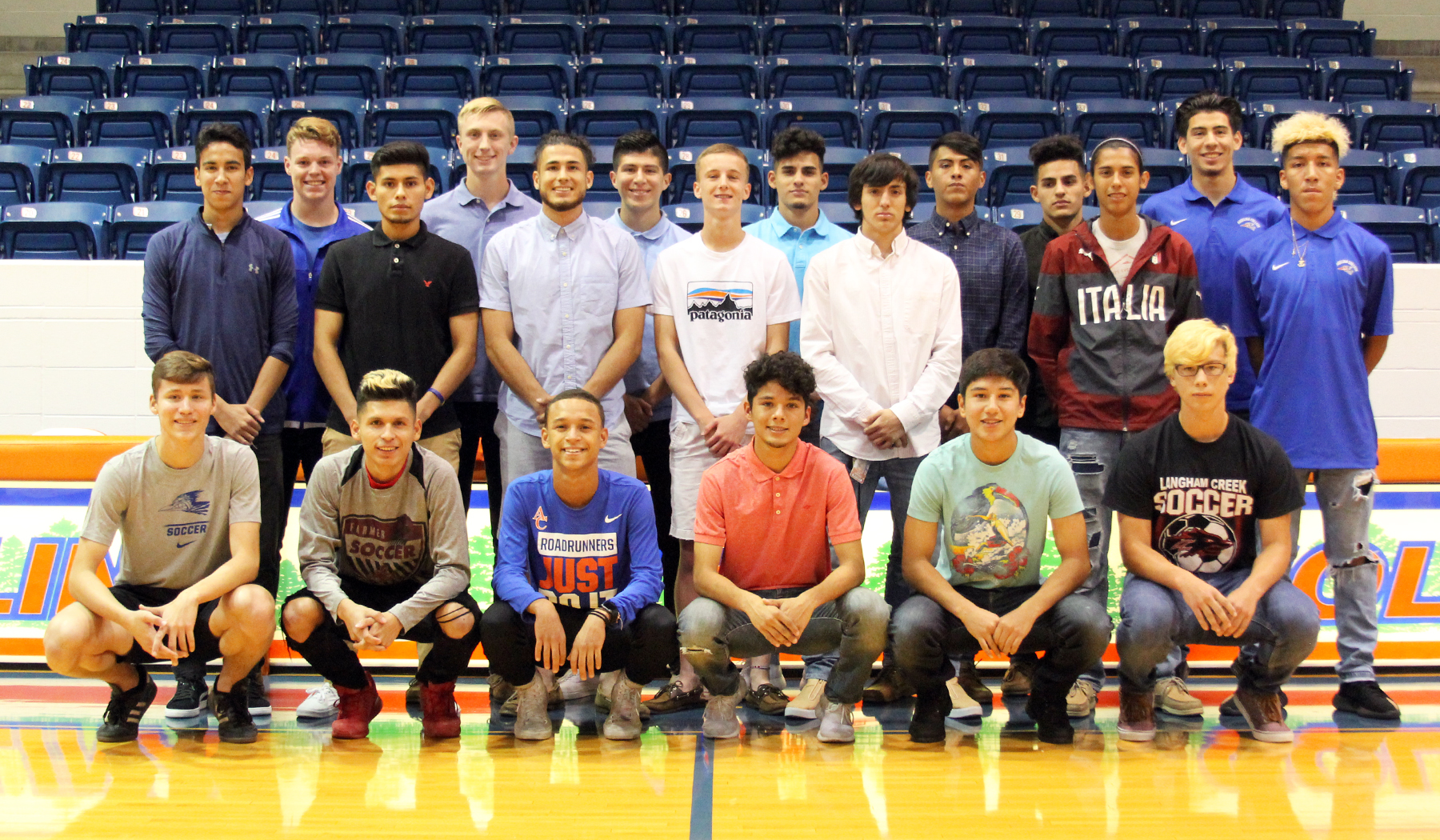
Front row, L-R: Luke Sommers (Central HS, Keller), Abraham Escamilla (Lewisville HS), Jacob Beacham (Tomball HS), Oscar Cordero (Lufkin HS), Jesus Zarate (Nacogdoches HS) and Nathan Diaz (Langham Creek HS); middle row (L-R) Victor Pereira (Lewisville HS), Juan Rios (Lufkin HS), Josue Salazar (Lufkin HS), Chris Burgess (Poteet HS), Jack Martinez (Rowlett HS), Jair Ruiz (Diboll HS) and Kevin Perez (Mount Pleasant HS); and (back row, L-R) Harrison Foulkes (Atascocita HS), Dylan Leffert (Atascocita HS), Joel Barrientos (Poteet HS), Julian Ramirez (Naaman Forest HS), Gabriel Tellez (Taylor HS), Damian Ramirez (Naaman Forest HS) and Nataniel Villavicencio (Mount Pleasant HS). Not pictured: Matthew Flaherty (Kingwood Park HS) and Caio Lira (Humble HS). (AC Press photo/Gary Stallard)
(StatePoint) With the rapid pace of new developments in smartphone technology, it can be hard to keep up with all the changes, especially if you grew up in an era when phones were attached to a cord.
Phones these days aren’t what they used to be — but that’s for the best, as smartphone technology can actually improve your life. Here are three easy ways that seniors can get more from smartphones:
1. “Read” audiobooks.
Whether your hands are tied up gardening or cooking, or you simply want to give your eyes a rest, consider listening to books on your smartphone. You can purchase audiobooks a la carte or opt for a subscription plan, which offers deals, such as unlimited selections for a flat monthly fee.
Features like bookmarks and back buttons make it easy to “flip through” a digital audiobook.
2. Use health apps to manage conditions.
Well-designed health apps can help patients manage their conditions. For example, ArthritisPower, a free app for patients with arthritis, allows users to track symptoms and treatment outcomes, and share the information with their doctors.
Created by CreakyJoints, a go-to resource for arthritis patients and their families, in collaboration with the University of Alabama at Birmingham, the app is also a data-gathering tool for researchers. Via informed consent, user data is helping researchers better understand how different treatments work for different people.
“One out of every five U.S. adults of all ages lives with doctor-diagnosed arthritis and it’s important that patients actively engage in managing their own treatment plan,” says Seth Ginsberg, President and Co-Founder of CreakyJoints and Principal Investigator of ArthritisPower.
To download the free app or learn more, visit arthritispower.org.
3. Video chat with loved ones.
Talk and see grandkids and other far-flung friends and loved ones between visits with video chatting. It’s the perfect way to ensure you don’t miss important milestones.
Many such video communications services are free, even internationally, and can present affordable alternatives to placing long-distance calls on a landline.
Your smartphone is the world at your fingertips. Make great use of it.
(Austin, TX) – Today, the Texas House of Representatives approved the House budget and supplemental budget for the next two years. The House has exercised leadership in crafting a conservative, responsible budget that spends $106.8 billion in available revenue. Despite revenue challenges, and very significant population and inflation growth, the House biennium budget is $1 billion less than the current budget. Despite the very real budget cuts, the House budget still makes significant investments in critical priorities. The proposal includes nearly $1.5 billion in new money for public education, while also reducing recapture (better known as Robin Hood). The budget addresses the foster care crisis in Texas by investing $433 million of additional funds to Child Protective Services. In addition, the House is dedicating $62.6 million in new funds to eliminate waiting lists for community mental health services across the state and maintains our commitment to border security funding. The House budget is fully transparent and protects the state’s investment in transportation while maintaining our long-standing commitment to using dedicated funds for their rightful purpose. “We are confident that the House budget we have crafted addresses critical issues that affect Texans on a daily basis. The House budget is balanced, cuts spending, prioritizes critical funding items, and honors our dedicated funding streams without diversions,” said State Representative James White For more information and contest rules visit www.texashospitalityassociation.com or contact our office at (512) 463-0490 or (409) 283-3700.
Ah, the Easters of my childhood. Hopped up (ha!) on a metric ton of candy, the whole house stinking for the sake of dyeing eggs, frilly dresses in sickening pastel shades that reminds me of Pepto Bismol. Speaking of Pepto Bismol, how about those Peeps? Ugh.
Easter egg hunts ended with your tiny child fingers trying to crack the shell of a dyed, decorated egg, picking and digging and gouging until there wasn’t anything left to eat. It’s hindsight that makes you realize that that boiled egg was probably the healthiest thing within your grasp that day.
Then there were the Easter baskets full of sugar, sugar, and more sugar…and maybe a stuffed animal. That stuffed rabbit wasn’t nearly as interesting as the solid pound of chocolate shaped like a rabbit just waiting to have its ears gnawed off.
I would like to believe that all children experience Easter in a much similar fashion, perhaps with more wide-eyed wonder and less sarcastic nostalgia. If only this were the case.
In the CDC’s Childhood Obesity Facts, it is revealed that one in five school-aged children (ages 6-19) are obese. With schools cutting back on physical education, the prevalence of readily available technology, and our convenience food lifestyle, children are losing the essence of what it means to be a kid. Being a kid means movement, play, and exploration. Do you realize that we spend most of our adults lives trying to regain a sense of youth? Learning to move again after sedentary jobs, taking time to relax and enjoy life, to explore new opportunities we might not have considered before. While we may struggle to find our own place in the Fit Life, let’s make it easy on the kids. They don’t have to learn the importance of health the hard way.
So, how can we turn a kid’s Easter basket into a learning opportunity? Swap something good for something better!
Swap jelly beans for fruit snacks like Annie’s Bunny Fruit Snacks. They’re certified organic, gluten-free, and vegan. Plus, they’re bunny-shaped and individually wrapped. Annie’s also makes
some other pretty rockin’ kids snacks, so swapping out cookies can be made simple! Once again, mostly shaped like bunnies.
Candy-filled trail mix can be swapped for healthy energy bars. Kind Bars are non-messy and sweet-salty yummy.
We can’t leave out chocolate! Dark chocolate is your best bet, of course. So, help endangered species when you buy it! I’ve been an animal lover all of my life, so I knowI would have been tickled pink to have received this as a child.
Finally, now that you’ve stocked your kid up on (relatively) healthy treats, get them active. Consider stuffing their Easter baskets with jump ropes, balls for various sports, protective equipment for skating and biking, and anything else that might get them outdoors and active.
Who remembers Skip Its? Hula hoops? Hop scotch? Sunshine? These things still exist, you know.
With these fun and healthy alternatives,
filling an Easter basket in the Fit Life can be done.
(BRYAN, Texas) — Tiny vesicles isolated from adult mesenchymal stem cells and administered intranasally can limit the damage to the brain of animal models caused by a seizure disorder called status epilepticus, according to research published today in the Proceedings of the National Academy of Sciences (PNAS).
Status epilepticus is the formal name for a single seizure lasting longer than 30 minutes or a series of seizures in which the person doesn’t regain consciousness in between them. If it is not quickly stopped, even one episode can cause brain damage, loss of cognitive function and memory loss.
“Saving the brain from injury and disease is certainly one of the holy grails of medicine,” said Darwin J. Prockop, MD, PhD, the Stearman Chair in Genomic Medicine, professor at the Texas A&M College of Medicine and co-senior author of the article. “Our paper suggests one way that this might be done, and not by a procedure that requires brain surgery or even injection into a vein: All that would be required is a nasal spray that a patient might receive in a doctor’s office.”
The compound in the nasal spray is anti-inflammatory exosomes, or extracellular vesicles, which Prockop and his team isolated from cultures of mesenchymal stem cells, a type of adult stem cell.
Ashok K. Shetty, PhD, a professor at the Department of Molecular and Cellular Medicine at the Texas A&M College of Medicine, associate director of the Institute for Regenerative Medicine, research career scientist at the Olin E. Teague Veterans Medical Center and co-senior author of the paper, and his team tested the efficiency of these exosomes in a status epilepticus model with damage from a period of acute seizures. “What is remarkable is that the animal models were rescued from long-term effects of the seizure-induced brain injury by a nasal spray of exosomes,” Prockop said. It was able to ease inflammation of the neurons, prevent cognitive and memory dysfunction and stop abnormal neurogenesis in the hippocampus, a vital part of the brain responsible for memory.
“We gave the intranasal vesicle spray twice over 24 hours, the first one at two hours after the onset of a status epilepticus episode, and such treatment was effective at reducing multiple adverse effects on the hippocampus,” said Shetty. “In fact, the vesicles were able to move to the hippocampus in six hours, and their neuroprotection was enough to prevent loss of normal cognitive and memory function as well as abnormal neurogenesis, one of the substrates involved in formation of new memories.”
Drugs like benzodiazepines, which are tranquilizers, and hydantoins, a type of anticonvulsant, are used to stop status epilepticus episodes, but they are often unavailable—especially if the person hadn’t previously been diagnosed with epilepsy, which is the case 75 percent of the time—and they are ineffective perhaps as much as 30 percent of the time. “There really hasn’t been anything noninvasive like this to stop the cascade of inflammation and abnormal neuronal wiring or epileptogenesis that occurs after a status epilepticus event,” Shetty said. “These vesicles do seem able to protect the brain after seizures, stop neuroinflammation and prevent the development of chronic epilepsy that often results without this treatment.”
Although the findings are promising, the researchers urge caution before jumping to conclusions about a treatment for humans with seizures.
“Before this therapy can safely be tested in patients, we need to do great deal of further work,” said Prockop, who is also the director of the Texas A&M College of Medicine Institute for Regenerative Medicine. “But the inflammation in the brain caused by acute seizures is similar to the inflammation seen in the late stages of other brain diseases, including Alzheimer’s disease, parkinsonism, multiple sclerosis and traumatic injuries,” Shetty added. “Therefore, the promise of this new therapy is enormous.”
LUFKIN – Motorists are urged to use caution through the construction project on US 59 at SL 224 in Nacogdoches, as additional work is planned this work that will require lane closures.
Crews will be milling and inlaying sections of hot mix throughout the project beginning on Tuesday, weather permitting, in the outside shoulder of the northbound lane. A partial closure of northbound lanes should be expected during work hours.
In addition, on Wednesday, weather permitting, workers will be milling and inlaying portions of the hot mix at the entrance to the westbound SL 224 ramp. This will require the ramp to be closed to traffic. TxDOT is urging motorists who need to access US 59 N/SL 224 West to travel SL 224 East. South Street (BU 59) is not a preferred route.
Electronic message boards will be placed to alert motorists until work is completed.
“TxDOT inspects all work as it is performed and there are a few patches of hot mix that did not meet our requirements,” said Rhonda Oaks, public information officer. “We do not expect these repairs to take too long to complete, and we will do everything we can to finish the work and open the lanes to traffic as quickly as possible.”
All schedules are subject to change in inclement weather. Motorists are urged to stay alert to slowing and merging traffic through the construction areas. For complete information on construction projects, visit drivetexas.org.
For more information, contact Rhonda.Oaks@txdot.gov or (936) 633-4395.
LUFKIN, TEXAS, April 10, 2017 – Angelina College will host an information session for anyone interested in enrolling in its new professional truck driver program. The session is set for April 25 from 5-6:30 p.m. in the Community Services building, room 104.
According to Tim Ditoro, dean of Community Services, the program is a result of a collaboration with Houston Community College in response to area demand for truck drivers. “This is a growing career field in our community. Demand is expected to increase nearly 10 percent over the next 10 years,” Ditoro said.
Students will complete 286 hours of classroom and on-road training during the six-week program. They will use industry-appropriate equipment and have the opportunity to meet with recruiters. The next class is scheduled to begin Monday, May 15.
Program applicants must be 18 years old to be intrastate truck drivers and 21 years old to be interstate truck drivers. A Department of Transportation physical and drug test is required as well as a valid class C driver’s license.
No registration is required. For more information, call the Community Service division at 936-633-5206.
Angelina College’s Roberto Malinowski (6) rounds third and gets a greeting from head coach Jeff Livin after Malinowski’s solo homer against Navarro College. The Roadrunner walked off in a 7-6 win in the nightcap of Saturday’s doubleheader at Roadrunner Field. (AC Press photo/Gary Stallard)
Redden’s 9th-inning Single Lifts AC to Win
Tucker Redden drove a 2-2 pitch into right field to score Tony Lima with the walk-off game winner in Angelina College’s 7-6 win over Navarro College on Saturday night, helping the Roadrunners
Angelina College pitcher Bailey Holstein delivers during Saturday’s game against Navarro College. Holstein struck out eight in six innings, and the Roadrunners earned a 7-6, walk-off win over the Bulldogs in the nightcap at Roadrunner Field. (AC Press photo/Gary Stallard)
avoid a three-game sweep in the series.
Christian Leonard rocked a three-run homer and Roberto Malinowski added a solo shot to back a solid pitching effort from Bailey Holstein, who struck out eight hitters in six full innings of work.
AC led 6-3 heading into the ninth inning, but the Bulldogs pushed across three runs, tying the game on an RBI single from Braden Williams. The Roadrunners answered in the bottom half with singles from Lima and Blake Lazarine sandwiched around Evian Benjamin’s hit-by-pitch. Redden, who was 2-for-4 in the game, ended the game with his second hit.
Earlier, the Bulldogs pounded the Roadrunners 19-8 behind homers from Dawson Shelburn, Tim Bechtold, Noah Menchaca and Robert Salazar. AC’s Garrett Kochakian hit a three-run homer for the Roadrunners.
AC (14-25, 8-10) will travel to Panola College on Wednesday for a single, nine-inning game scheduled to start at 3 p.m.
On the floor of the main Expo Arena at this year’s county fair, a popular attraction are the restored tractors, newly built trailers, bar-b-q pits, livestock feeders and other Ag Mechanics entries.
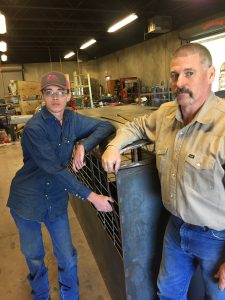
Entering the competition this year from Huntington FFA are Hunter Lightfoot and Marshall Beaty. They are both in 11th grade and in Mr. Robert Williams ag class at Huntington High School.
Sponsored by Hammer Equipment, the Ag Mechanics competition has five categories: agricultural machinery & equipment; livestock and poultry equipment; tractor restoration; trailers; and home & recreational use.
2017 Ag mechanics Marshall Beaty and Mr. Robert Williams
Exhibitors in 4-H or FFA can build and enter projects by themselves or as a group for items they built for others or for their own family. Marshall Beaty built a livestock carrier for his own hog operation.
The carrier is four feet tall, four feet wide and 8 feet long. Beaty designed it so that it can work on a flatbed trailer as well as in a long-bed pickup truck. His teacher, Robert Williams, credits him with doing 99% of the work. “He’s designed, planned and built it without much instruction,” says Williams. Two other students, Michael Pederzani and Robert Noel have assisted Beaty in the construction process.
Beaty says, “I raise hogs and while that’s what I intended it for, it could certainly be used for other small livestock such as sheep and goats.” When I asked if it was for sale, he countered, “I made it for my own operation, but if someone wants to buy it, then we’ll see!”
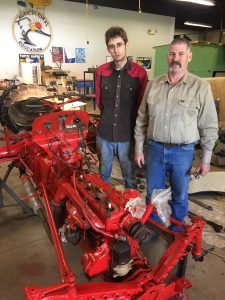
2017 Ag mechanics Hunter Lightfoot and Mr.Robert Williams
Hunter Lightfoot took on a 1942 Ford 9N tractor that had been donated to the Huntington Ag Shop some time ago. He is the lead student on disassembly and paint preparation. He says, “its been a fun challenge and I’d like more time to work more on the engine before the fair, but it still will run just fine.” Also working on the Ford 9N are Dalton Stanley and Nathan Wright.
The red and grey paint they’ve applied is as close to original as anyone knows. According to Williams father, an avid tractor restorer, the Ford plant that housed the paint records burned down in the 1950’s and they lost the files on the true color of the paint.
Rushing against the deadline and kept in check by their budget Williams and Lightfoot agreed that other parts will be replaced later, after the County Fair, as they plan to keep the tractor around the shop.
For the agricultural machinery and equipment, exhibitors can enter hay handling equipment, spraying equipment, mounted and pull- type tractor equipment, hydraulic equipment, shop equipment, and lastly, truck, tractor and agriculture equipment accessories.
If you need equipment for livestock around your farm or ranch, many local FFA chapters build chutes, feeders, chicken coops and more for this division. Those that you see at the Fair are probably already sold, having been ordered months ahead of time.
Judging of entered items focuses on workmanship, design, practicality, degree of difficulty, finish, and the notebook that shows their plans, bill of materials and photos.
Among other things, judges expect all projects to be painted or properly treated and must be clean and in a presentable condition even though they may have been used. Trailers and all other equipment are to be displayed in transport position. Ramps, extension and operation of specific features will be demonstrated only as directed by the official judges and as space permits.
The rigorous standards of the law are enforced at this competition. All trailers and other equipment that will be operated and/ or transported on public roads are to be equipped with the safety equipment specified in Title 7, Vehicles and Traffic Transportation Code of Texas Statues. All towed equipment, regardless of standards, is to be equipped with safety chains. All three- point hitch and P. T. O. operated equipment is to meet current ASAE standards and specifications. 120 VAC and higher electrical plugs and receptacles are to be the equipment grounding type.
Most importantly, an original (exhibitor produced) plan or drawing, a bill of materials, and photographs showing phases of construction are to be provided with all projects. Not only is this critical to the judging but the others viewing the project later will appreciate seeing the progress made by these students.
One of my favorites is tractor restoration. Limited to full size tractors (no lawnmowers allowed), I get a kick going over the old Massey Ferguson, Ford, John Deere and other restored tractors. With tractor renovations, judges look at the aesthetics, authenticity, mechanical systems, safety equipment, and the documentation that shows the progress of the work. Students in this category will also be interviewed by the judges.
Beaty, Lightfoot, and the other exhibitors in the Agriculture Mechanics division will compete on Thursday, April 20 at 9 am on the floor of the Exposition Center.
Since 2003, every “First Tuesday” of the month, doctors and medical students from around the state come to the Capitol to lobby on behalf of their profession and patients. These individuals provide an invaluable service to our state and I look forward to working with them for many years to come.
Here are five things happening at your Capitol this week:
School Choice
The Texas Senate passed Senate Bill 3, which provides public funds to parents who want to put their children in private schools or public charter schools. This bill establishes education savings accounts and tax credit scholarships, which parents can use for tuition at a private school, or stay in public school and get funding for transportation to go to another public school.
I believe education is and always will be the most important issue the Legislature considers. As a state we have a responsibility to ensure our future generations are receiving a quality education. My office received hundreds of calls and emails from Senate District 3, asking me to not support this bill. When I became Senator, I made a promise to not vote for any school choice legislation until we had addressed and created an equitable school finance system. I chose to vote against Senate Bill 3, as I have pledged to represent Senate District 3 to the best of my ability.
Red Light Cameras
Recently, Senate Bill 88 was passed by the Senate, which prohibits local governments or entities from utilizing red light cameras. These cameras, which have been controversial since their implementation over a decade ago, take a picture and issue a citation if a vehicle runs through a red traffic light. This bill has a grandfather clause, which would allow cities who are currently under contract with a company providing the traffic cameras to continue their contract until it expires. It also exempts photo enforcement which is used on toll roads. I have always believed these cameras violate due process because a person is not able to face their accuser.
TxDOT 100th Anniversary
This week, I had the opportunity to help celebrate the 100th anniversary of the Texas Department of Transportation (TxDOT) by recognizing them on the Senate floor. First created as the Texas Highway Department in 1917, they were given the charge of registering vehicles and drawing the first official map to show the 8,865 miles of improved roadways that would help to bring Texas together. TxDOT has grown and transformed, now maintaining 80,000 miles of Texas roadways.
Having served as a former TxDOT Commissioner, I understand the challenges this agency faces in ensuring Texans are able to get where they need to be. You can visit the centennial website at http://www.dot.state.tx.us/txdot100/ to learn more about TxDOT’s history.
Tuition Set-Asides
In 2003, the Legislature required universities to set aside 15% of undergraduate, graduate and professional degree students tuition, to be used to provide assistance to students with a financial need. This set-aside has created a tax on student’s tuition. Even if a student has taken out loans to pay for their education, they will have to take out much more than is needed for their own education to pay for someone else’s tuition. I believe if the Legislature wants to ensure there is aid for students who need it, we should appropriate the funding to cover this need.
This week, Senate Bill 18, of which I am a co-author, was passed by the Texas Senate to repeal tuition-set asides. The bill would also appropriate $30 million for a new financial aid program to be distributed to Universities, which cut their tuition by 5%, to help in providing financial assistance.
Chuck Norris – Honorary Texan
There are probably very few of us who do not know the famous Chuck Norris, who was born in Oklahoma, but has long lived in Texas. He is known for his martial arts movies and superhuman strength, in addition to one of his most popular roles as “Walker, Texas Ranger”. He and his wife have also created a nonprofit organization called Kickstart Kids, with the mission of helping struggling kids. The Texas Senate recognized Mr. Norris on the Senate floor this week, and named him an honorary Texan, to recognize all that he has done for the State and his work to help those who are in need.








 Easter egg hunts ended with your tiny child fingers trying to crack the shell of a dyed, decorated egg, picking and digging and gouging until there wasn’t anything left to eat. It’s hindsight that makes you realize that that boiled egg was probably the healthiest thing within your grasp that day.
 wrapped. Annie’s also makes