Join us for an exciting and heartwarming community event presented by Harbor Hospice called the “Family Fun Night Fall Carnival.” This event promises a night filled with free activities, contests, and events for families to enjoy and make lasting memories.
OCTOBER 18, 4PM-7PM Jasper City Park – Marvin Hancock Drive
The Family Fun Night Fall Carnival offers a wide range of kid-friendly activities that are free of charge, ensuring a fun-filled evening for children and parents alike. From face painting to games and crafts, there’s something for every child to enjoy. No carnival is complete without scrumptious treats! We’re pleased to offer free snow cones, hot dogs, pickles, and popcorn to all attendees!
This year we will be collecting monetary donations for the Harbor Foundation. Your donations will help improve the quality of life to assist persons in hospice care beyond what healthcare would normally provide and, in 2025, awarded local high school seniors with a scholarship to go towards higher education after the loss of a parent.
One of the highlights of the evening is the Community Vendor Booths, where local businesses and organizations will set up shop, offering FREE giveaways and interactive activities. It’s an excellent opportunity to learn more about your community and discover new products and services.
For those with a competitive spirit, the event features exciting contests. The Gumbo Cook-Off will tantalize taste buds as local chefs compete for the title of the best gumbo in town. The Costume Contest for children aged 12 and under adds a touch of Halloween spirit to the carnival, allowing kids to showcase their creative and imaginative costumes.
Harbor Hospice’s “Family Fun Night Fall Carnival” is more than just a community event; it’s a celebration of togetherness, fun, and the vibrant spirit of the local community. Join us for an unforgettable evening of laughter, games, and camaraderie, all while making cherished memories with your loved ones.
The outdoor temperatures might be sweltering but Crockett Area Chamber of Commerce is gearing up for our Annual Christmas in Crockett taking place on Saturday, November 22nd from 10 am to 4 pm. This is the largest and most exciting event of the year!
Arts Crafts Food Entertainment Car show!
We are celebrating a long-standing tradition of 44 years on the Square and are preparing to host over 300 vendors. Join us that day and stay to explore all that East Texas has to offer.
If you are interested in becoming a vendor, complete your application through the link below to reserve your spot!
If you’re not a fan of online forms, feel free to come by the Chamber office and pick up a printed one for you to complete. If you were a vendor last year and would like to request the same booth as last year, please complete your application and submit with payment by August 31st
We welcomed a new addition to the coaching staff this past week, and we’re gearing up to return to action very soon.
We have some of our biggest annual events heading this way, and we’re providing those dates below. There’ll be more info coming as we get it.
Finally, while our first games/scrimmages are still a couple of weeks away, we couldn’t resist adding them to this week’s schedule. Those games are listed below.
Here’s a quick rundown of the past week’s events, along with what’s coming up next:
Crowder Named Roadrunners’ New Assistant Baseball Coach
The Roadrunner baseball team has named Cody Crowder its new assistant baseball coach, joining new head coach Jon Phillips, who is also entering his first year at AC.
Crowder earned a name as both a coach and player at Centenary College of Louisiana, where he spent the past four seasons as Associate Head Coach and Recruiting Coordinator. playing a role in the progam’s Southern Collegiate Athletic Conference (SCAC) titles in 2022 and in 2024, and his resume boasts impressive credentials as a recruiter. In addition, he holds numerous individual records as a player for the Gents.
Coming Soon: Big Events for Angelina College and AC Athletics
The 18th annual Guy Davis Golf Tournament will take place on Saturday, August 16 at the Crown Colony Country Club in Lufkin. The kickoff dinner will take place at 6 p.m. on Friday, August 15 at Crown Colony. The tourney features a five-man scramble format with two separate shotgun starts: One in the morning, and another in the afternoon.
On Sunday, August 17, we’ll host our annual “Meet the Roadrunners” banquet featuring all our incoming student-athletes and their families, along the all the Athletics staff. The event runs from 2:30-5 p.m. inside the AC Conference Center.
In addition, AC’s Sixth annual “Dinner at the Diamond” event will take place on Saturday, Sept. 27 down on the baseball field at Poland Stadium on the AC campus.
The golf tournament and Dinner at the Diamond are very important fund-raisers for Angelina College and its students – not to mention just a lot of fun for everyone involved.
We’ll have registration links and other information for these events to send out in the coming weeks. We just wanted to give you enough time to mark your calendars.
Soccer Schedules Set for 2025 Season
The Lady Roadrunner and Roadrunner soccer teams have released their schedules for the upcoming season (which is rapidly approaching), so fans can start making plans to show up and show out while cheering on both AC teams.
Included in the schedule are five home doubleheaders, one of which is the Tuesday, August 12 scrimmage against Wiley College. The ladies kick off at 5 p.m. while the men follow at 7:30 p.m.
The Roadrunner men’s soccer team has added an ID Camp to its busy summer list.
The ID camp, used to identify prospective future Roadrunners, is for grades 9-12 and will take place from 6-8 p.m. on Friday, August 1 at the Angelina College soccer pitch on the AC campus.
Click the following link for all registration and other information:
The AC baseball team under new coaches Jon Phillips and Cody Crowder in August will host a camp for possible future Roadrunners.
The camp, open to all high schoolers and current college transfers, will take place from 11:30 a.m. until 5 p.m. on Wednesday, August 6 at Poland Stadium on the Angelina College campus.
Schedule Releases for All AC Athletics Teams Coming Soon
All six Angelina College athletics have schedules in place on the website (www.angelinaathletics.com). We’re still finalizing the spring schedules for baseball and softball, but the fall schedules for those teams are up and running. We’ve also added both women’s and men’s basketball schedules for the upcoming 2025-2026 seasons.
Naturally, there may be some changes along the way with teams still looking to add events. The best way to follow any possible changes is to visit the Angelina College Athletics website.
Live Streaming Reminder:
All AC Athletics regular-season home games are live streamed on TSBN Sports (a free streaming service for fans), with most of the conference road games also available for streaming. (This does not include baseball and softball fall games, as those are not considered official games.)
Once TSBN posts its schedules, AC fans simply need to visit the AC Athletics web site, look at the scrolling schedule in the middle of the page and click the blue “Video” link.
TSBN also offers an app great for smart phones, devices and smart TVs. (You’ve GOT to see those matches and games on the big screen.)
Reminder II: Admission to ALL Angelina College Athletics sporting events is free, as is the TSBN live streaming. Any other links offering streaming are scams.
Reminder III: For the most current schedule updates (especially for potential weather issues) visit the official Angelina College Athletics website (angelinaathletics.com). Fans can also receive updates on the AC Athletics Facebook, X/Twitter), and Instagram pages.
Upcoming schedules:
Thursday, August 7:
Lady Roadrunner Soccer at McNeese State University (scrimmage), 7 p.m. in Lake Charles, Louisiana.
Tuesday, August 12:
Lady Roadrunner Soccer vs. Hinds College (scrimmage), 5 p.m. at the AC Soccer Stadium/Larry Phillips Family Sports Complex.
Roadrunner Soccer vs. Hinds College (scrimmage), 7:30 p.m. at the AC Soccer Stadium/Larry Phillips Family Sports Complex.
Friday, August 15:
Roadrunner Soccer vs. LSU-Shreveport (scrimmage), 3 p.m. at the AC Soccer Stadium/Larry Phillips Family Sports Complex.
For any other information, contact Sports Information Director Gary Stallard at gstallard@angelina.edu.
“Yea, though I walk through the valley of the shadow of death, I will fear no evil; For you are with me; Your rod and Your staff, they comfort me” (Psalm 23:4).
“When I am scared, God will help me,” says Joseph, age 7. “And if a burglar is coming into my house, God will protect us.”
This world is full of dangerous places and situations. Sheep, like people, are especially vulnerable to fear. Their greatest comfort is seeing the shepherd, but sometimes it’s difficult to rest in his protection, says Juliet, 11: “This means to me that he is with you always. I know that he is there, but sometimes I fear, and I know I shouldn’t.”
Isn’t that the truth? The shepherd is there with rod and staff in hand ready to defend his sheep against all danger, yet the sheep panic. Often, it’s the unexpected that sends sheep and people into a tizzy.
Former shepherd and author Phillip Keller writes about the time a friend came to visit. As she opened the car door, a tiny Pekingese pup jumped out. More than 200 sheep grazing nearby leaped up in terror and rushed across the pasture.
You won’t find Jordan, 11, running from a Pekingese. “It means that you don’t have to be scared anymore! Just pray to God, and He will be there quicker than the speed of light. (Even though He’s already there!)”
The stark contrast between living by fear and living by faith in the shepherd is portrayed in Proverbs 28:1: “The wicked flee when no one pursues, but the righteous are bold as a lion.” The only way vulnerable sheep can live with a lion’s confidence is to keep close to the shepherd.
Although Psalm 23:4 is often read at funerals, there is no mention of death in the original Hebrew text. It should be translated: “Though I walk in a gloomy ravine, I will fear no evil, for you are with me.”
David drew from his firsthand experience as a shepherd in the Judean desert when he wrote Psalm 23. The contrast between darkness and light is intensified in the desert. Walking after sundown can be deadly. Dark, narrow ravines are ideal hiding places for predators. Shepherds lead their sheep through them to get to better grazing pastures.
Yes, death is the ultimate shadow through which we all must walk; however, the Lord’s comforting presence can sustain us through any dark time or place.
“My rod and staff is God protecting me,” says Jeremy, 11. “I will fear no evil with God around.”
“His rod and staff pull us away from sin,” adds Blair, 9.
The shepherd’s rod and staff work together. Where the staff is used more for gentle functions such as extending a shepherd’s reach to rescue a lamb on the edge of a cliff, the rod is used more for protection against predators.
“Knobkerrie” is the word for rod among certain African herdsmen. Each rod has a rounded head of hard wood. Herdsmen compete to see who can throw his rod the farthest with the greatest accuracy.
“God will pull me on the right path with his strong hands,” says Jackie, 10, who knows the comfort of the shepherd’s rod and staff.
Think About This: Trust the Good Shepherd and live boldly, or trust yourself and live in fear.
Memorize This Truth: Psalm 23:4 quoted in the first line of this lesson.
Ask This Question: Will you let the Good Shepherd guide you through the dark shadows of your fears?
It’s the kind of conversation we’ve all had in Forest Country: You’re chatting with your neighbor at the mailbox, swapping small talk about the heat or the last thunderstorm, when they mention their electric bill.
“Mine was only $112 this month.” You nod… and gulp. Yours was $174. Same street. Same weather. So why are you paying more?
The Texas Electricity Market Is Like a Puzzle—And Most Folks Only See the Box Lid
Unlike some parts of the country, Texas lets us choose our electricity plan. That’s a good thing—if you know what to look for.
But most people don’t have the time to:
Compare dozens of providers
Decode complicated rate structures
Read the fine print on usage fees, base charges, and intro rates
Keep up with shifting market prices
So they stay on the same plan, even after it expires. And over time, they pay more—sometimes a lot more—than their neighbors.
We’ve Seen This All Over the Pineywoods
One family in Huntington was unknowingly rolled onto a variable plan after their fixed rate expired. Another in Nacogdoches was being hit with a minimum usage penalty every month, even though they thought they were saving energy.
Meanwhile, the house next door had a better deal—simply because they took time to shop around… or called someone who could.
So, How Do You Catch Up?
If you’re tired of being the one paying more, the solution is simple: have someone check your bill. And not just anyone—someone local, who knows our area and our usage patterns.
That’s where Amerigy Energy comes in. They’re based right here in Texas and help folks across Lufkin, Nacogdoches, Diboll, and Crockett find the right plan for their home—not just the first one that pops up online.
What to Do Next
You can:
Call 877-631-8875 and talk to Bryan (he’s the residential energy expert) Email a copy of your bill to info@amerigyenergy.com for a free review Or shop on your own at AmerigyEnergy.com/shopnow if you’re the do-it-yourself type
There’s no charge, no pressure—just the facts, laid out in plain English.
Final Thought
Here in the Forest Country, we believe in paying a fair price and helping each other out. So if you find out your neighbor’s paying less, don’t get frustrated—get curious.
Ask questions. Get a second opinion. And stop overpaying.
Because around here, we look out for each other. And a better electric rate might be just one phone call away.
City of Lufkin to Celebrate Grand Opening of New Pickleball Courts at Chambers Park
LUFKIN, TEXAS – July 25, 2025 – The City of Lufkin and the Parks and Recreation Department will host the grand opening of the new pickleball courts at Chambers Park on Wednesday, July 30 at 9:00 a.m. The event will be followed by free open play for all skill levels beginning at 10:00 a.m.
The ceremony will recognize the latest recreational addition to the city’s park system and is part of an ongoing commitment to improve and expand outdoor amenities in Lufkin.
There’s always a seat at the table, and in August, it’s one with statewide impact.
Join us Friday, August 1 at 12 PM for our First Friday Luncheon, presented by Lufkin Coca Cola Bottling Company! We’re honored to welcome Dawn Buckingham, Texas Land Commissioner, who will speak on the role and impact of the Texas General Land Office.
This time of year, when it’s hot and no one is visiting their deer stand or favorite patch of woods, bucks are quietly doing something pretty remarkable — they’re growing antlers. While it doesn’t get the attention of fall rut or hunting season, summer is a critical time for white-tailed deer, especially for wildlife enthusiasts interested in improving the whitetail deer herd’s health or antler size on their property.
Here’s a word to impress your fellow deer enthusiasts: antlerogenesis. It is defined as the process of antler formation and development in deer. It’s not just trivia. Understanding this process helps explain why summer nutrition matters so much.
According to Dr. Marcus Blum, a Texas A&M AgriLife Assistant Professor and Extension Wildlife Specialist, June through August is the peak period for antler growth. In fact, under the right conditions, bucks can grow up to half an inch of antler per day. That’s not a typo. In fact, antler velvet is actually one of the fastest-growing tissues of any mammal.
Antlers in velvet are very much alive. They are full of nerves and blood vessels, delivering the nutrients needed to build bone. That’s where habitat and nutrition come in. Blum explains that bucks depend heavily on high-quality forage during the summer months — particularly plants rich in protein, calcium, and phosphorus.
So, what are they eating to grow those head-turning racks? The list includes native forbs, legumes, and woody browse species. Blum points out that deer forage on over 100 different species in a given region, which makes plant diversity a crucial piece of the puzzle. In other words, you don’t need a monoculture of one magical food plot crop — you need a variety of healthy, native plants.
For landowners or hunting-lease holders looking to give their deer the best shot at strong antler development, Blum recommends a few key habitat practices. First, encourage plant diversity by managing forbs and browse with proper grazing and brush control.
Next, consider planting warm-season food plots, especially legumes like cowpeas, lablab, or soybeans. These are high in protein and offer sustained nutrition through the summer.
Mineral supplements are also important, especially in areas where soils or forage are known to be low in calcium or phosphorus. Antler growth puts huge demands on the buck’s mineral balance.
Another important but sometimes overlooked piece of the equation is water. Drought during summer doesn’t just stress plants, it stresses deer too. Less water means less forage, and lower-quality food. But it’s more than that: deer need water to digest and process what they eat. In short, good water means better nutrient use, and better nutrient use means better body condition and antler growth.
If you are on a hunting lease or own your own land and want to see more from your deer, consider this a gentle nudge to think about summer habitat as a management tool. Whether your goal is producing better antlers, improving herd health, or simply stewarding your land well, now is the time to act.
Blum sums it up well: “By aligning summer habitat management with the nutritional needs of bucks during antlerogenesis, landowners and wildlife managers can positively influence antler size and overall herd health — key goals for both trophy and population-focused management programs.”If you’d like more information on deer habitat, forage plants, or pasture management practices, look up Texas A&M AgriLife Whitetail deer management do an internet search for “AgriLIfe popular whitetail deer resources” or go directly to https://wildlife.tamu.edu/publications/popular-publications/deer/.
AgriLife Extension expert shares how to avoid dehydration or heat-related illnesses
Summer’s all about fun, but it can quickly turn dangerous if you’re not staying cool and hydrated all summer long. High heat and humidity can raise your risk of dehydration, heat exhaustion and heat stroke — serious health threats that are often overlooked.
Why is staying hydrated and heat safety crucial in the summer
Whether on a beach vacation, by the pool or doing yard work, summer weather can negatively affect your health. Lopez said high humidity, along with elevated temperatures, can cause your body to sweat more as it tries to cool down.
When your body loses more fluids than it takes in, dehydration can occur. Consuming enough water and other fluids is vital for regulating body temperature, maintaining energy levels and supporting overall health.
Warning signs of dehydration and heat-related illness
It’s important to recognize your body’s warning signs early.
Lopez said these can all be signs your body needs more water:
Thirst or dry mouth.
Headache, fatigue or dizziness.
Irritability or difficulty concentrating.
Dark-colored urine or infrequent urination.
Lopez said profuse sweating is an important warning sign to replace fluids to stay hydrated. However, a sudden decrease in sweating can also indicate that you may be reaching heat exhaustion or heat stroke-levels of dehydration.
Simple tips to stay hydrated all summer
Lopez shared these practical tips:
Drink water consistently throughout the day, even when you’re not thirsty.
Use a reusable water bottle during camps, sports or outdoor activities. Keeping water easily accessible encourages more frequent drinking.
Infuse water with fruits or vegetables like strawberries, cucumbers or lemons to add flavor without added sugar.
Pack hydrating snacks, such as watermelon, cucumbers and oranges when heading outdoors. These refreshing foods help support fluid intake.
Wear lightweight, breathable clothing to help stay cool and comfortable.
Use a cooling towel, dip it in ice water and wrap it around your neck to help regulate body temperature.
Replenish fluids with sugar-free electrolyte drinks, especially after sweating heavily.
Limit intake of caffeine and alcohol, as they can increase fluid loss and contribute to dehydration.
Take breaks in the shade or go indoors regularly to cool off and prevent overheating.
Children, older adults and people with certain health conditions may be more sensitive to heat and dehydration.
“Having a general understanding of how to stay hydrated during the hottest time of year will help you beat the heat,” Lopez said.
Market conditions remain largely unchanged from two years ago, with strong demand for sawtimber, coming primarily from pine trees in East Texas.
On the flipside, there is an oversupply of smaller-diameter trees, keeping pulpwood prices soft, Taylor said.
East Texas timberland at the heart of production
Roughly one-fifth of the state, concentrated in 43 East Texas counties, provides about 12 million productive acres of timber out of roughly 22 million acres in the region.
Most of the land is privately owned, predominantly by small family landowners. A portion of the land is owned by timber investment management organizations and real estate investment trusts. An even smaller portion is public land.
The pine-dominated forests of East Texas supply dimensional lumber like two-by-fours and two-by-sixes, a backbone of the construction industry. Hardwood markets remain more variable, and the state’s pulp and paper industry faces continued challenges from oversupply, Taylor said.
Still, recent reinvestments and expansions by mills in the region signal confidence in the future of the Texas timber industry, he said.
Housing starts and timber markets remain linked
While the Texas timber sector generally operates as a net-importer state, trade with Mexico and Canada accounts for 88% of Texas’ exports and 42% of its imports in 2024, Taylor said.
The solid wood industry is closely tied to regional housing construction. Sawtimber markets are driven by demand for dimensional lumber and track trends in homebuilding, which have been mixed in recent years.
“Housing starts nationwide have slowed, and that does affect our markets to some degree,” Taylor said. “But Texas is doing better than much of the country. Housing construction here has held up relatively well. In fact, Texas housing starts have seen a recent increase after a two-year slowdown and that’s helped keep our sawtimber markets stable.”
Texas remains a significant contributor to national new home construction, accounting for nearly 17% of the nation’s total new homes. Taylor added that steady homebuilding activity in Texas is one reason mills have reenergized and reinvested in operations, with some even expanding.
Mass timber and new markets show promise
One bright spot is the growing interest in mass timber, a group of engineered wood products that is increasingly used in multistory commercial buildings. Advances in manufacturing have allowed laminated solid wood products to meet strength, stability, and safety requirements for large, open-span, and/multi-story construction. Mass timber is often used in place of concrete or steel.
“Architects and engineers are increasingly recognizing the aesthetic appeal and energy-efficiency of wood and mass timber, making them a practical choice for larger-scale projects,” Taylor said. “It’s a renewable and beautiful resource that also saves on heating and cooling costs. That’s one of the more exciting developments we’re seeing.”
Helping small landowners manage and profit
While industrial and large landowners benefit from economies of scale, most Texas timberland is held in smaller tracts — often under 100 acres — where sustainable forest management can be cost-prohibitive. The Texas A&M Forest Service is addressing this challenge by expanding financial assistance programs to help small landowners pay for management practices like thinning, site preparation and planting.
A new cost-share program, expected to roll out this fall, will reimburse up to 80% of the costs of qualifying management activities.
“These programs make it possible for smaller landowners to actively manage their timber and keep their forests healthy, which is critical for reducing fire risk, minimizing losses to insects and disease, and maintaining productivity,” Taylor said.
Landowners can visit the Funding Connector to identify funding opportunities available for their specific properties.
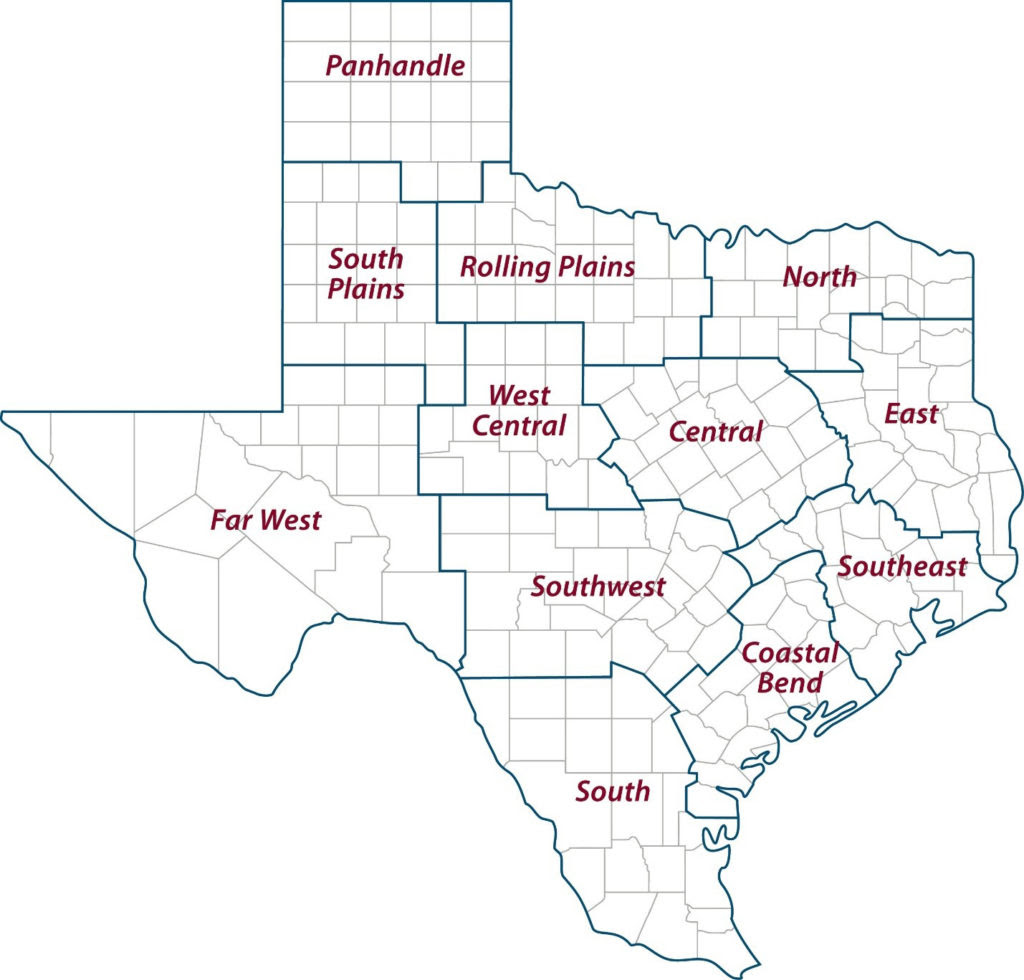
AgriLife Extension district reporters compiled the following summaries:
map of the 12 Texas A&M AgriLife Extension Service districts.
Central
A break in rainfall allowed fields across the district to dry out, enabling producers to resume operations. Corn harvest progressed rapidly, with good yields reported. Hay cutting and baling were widespread, with many producers finishing first cuttings and starting second ones. Armyworms were reported in several counties. Cotton was blooming with good boll loads reported, and sorghum neared maturity. Producers stressed the importance of continued sunshine and dry weather to prevent crop stress and potential aflatoxin. Pastures and livestock remained in very good condition, supported by full stock tanks and strong cattle markets.
Rolling Plains
Extreme heat moved into the district, drying pasture grasses and stressing some crops. Cotton showed strong growth and was performing well in most counties. Timely rainfall could help crops. Despite the heat, livestock remained in good condition, with ample forage available.
Coastal Bend
Drier conditions allowed corn and grain sorghum harvests to continue, though some fields showed reduced yields due to earlier drought. Corn continued to dry down and harvest was in high gear in some areas. Rice harvest began in early planted fields. Cotton appeared healthy with good yield potential. Hay production remained active, though some pastures showed signs of heat stress. Range and pasture conditions were fair to good. Livestock and forage availability remained steady.
East
Drier conditions helped dry saturated soils, enabling producers to catch up on hay production. Pasture and rangeland conditions were good, while subsoil and topsoil moisture remained adequate. Garden and vegetable production slowed. Cattle markets were strong, with higher prices reported in Anderson and Houston counties. Armyworms, grasshoppers and horn flies were present, and wild pig damage persisted in pastures and croplands.
Southeast
Forage harvest and hay production continued across the district, though scattered showers delayed field operations in some counties. Corn, rice, and sorghum made strong progress, while cotton and soybean development remained steady. Range conditions improved in some areas while other areas reported weather-related delays. Armyworm infestations increased in several areas, and rice kernel smut was reported in Waller County. Pasture and rangeland conditions varied from fair to excellent, with livestock conditions mostly good.
South Plains
Steady rainfall continued to support crop and pasture growth in the district. Most crop conditions ranged from fair to excellent. Growth regulators were applied to manage development ahead of forecasted heat. Pastures and livestock remained in good to excellent condition.
Panhandle
Light showers and cooler temperatures supported strong growth in summer crops. Most corn had tasseled or was tasseling, and sorghum performed well. Some insect pressure from cotton leafhoppers and fall armyworms was reported. Unharvested wheat remained in fields due to delays. Rangeland growth slowed, but cattle were in excellent condition. Soil moisture ranged from short to adequate.
North
Hot and humid weather continued in the district with some counties receiving sporadic rainfall. Soil moisture varied from adequate to surplus. Pasture and range conditions ranged from fair to excellent. Harvest of winter wheat, hay and garden crops progressed. Apples and figs benefited from earlier cool temperatures and wet conditions. Livestock remained in good condition, and no major pest or disease issues were reported.
West Central
Widespread flooding early in the week gave way to isolated rainfall and receding waters. Fields remained saturated, with producers still unable to enter some areas. Forage and cotton growth rebounded strongly following rains. Weed pressure increased rapidly. Standing water persisted in low-lying areas, and early planted sorghum neared harvest. Range conditions remained favorable, and livestock losses were minimal. Pastures greened up, and livestock conditions improved. Some producers reported hay losses and damaged fences.
Southwest
Widespread rainfall provided drought relief across the district, reviving pastures and filling stock tanks. Flooding occurred in parts of Kinney County, though soil moisture levels still lagged in some areas. Corn and grain sorghum matured quickly. Hay harvest resumed in drier areas. Pecan orchards showed good nut sets. Armyworms and Bermuda grass stem maggots were reported. Livestock markets held steady, and overall herd conditions were good. Wildlife also showed signs of recovery.
South
The district experienced rising temperatures, little rainfall and drying soils. Pastures and rangeland began to decline despite earlier rains. Heavy rain in northern areas caused localized flooding. Grain and corn harvest progressed, though yields were below average. Cotton and sesame crops advanced steadily, with open bolls reported in cotton fields. Citrus and pecans developed well. Peanut crops were irrigated and podding. Livestock and wildlife benefited from forage availability. Cattle markets remained strong, and wildlife activity was high, with frequent quail and turkey sightings.