Home Blog Page 82

48th Jasper Butterfly Fall Festival

0

October 4, 2025 @ 11:00 pm – October 5, 2025 @ 5:00 am

Celebrate our 48th annual fall fest with a full day family fun and a live butterfly release! Enjoy a variety of local vendors, tasty food, exciting games, and festival fall activities for all ages. Bring your friends, bring your family and don’t miss this cherished jasper tradition. 

Jasper, TX United States

Emerald Ash Borer Reaches Southernmost U.S. Point, 5 New Texas Counties Confirmed

0
Emerald ash borer Texas
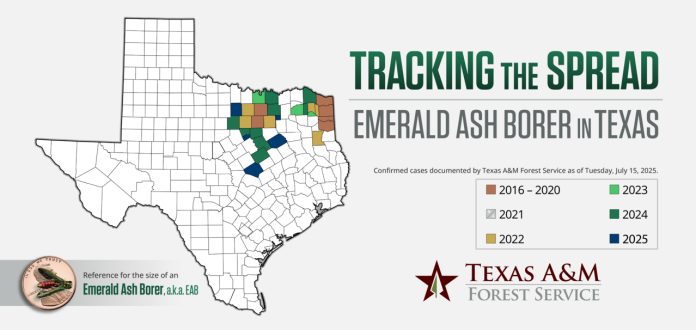
Emerald ash borer has been confirmed in five new Texas counties, including the southernmost point in the U.S. To date, EAB has been confirmed in 31 counties in Texas and continues to spread mostly by human activity.

COLLEGE STATION, Texas – The presence of the invasive emerald ash borer (EAB) has been confirmed in Jack, Navarro, Somervell, Bell and Rockwall counties. Bell County’s confirmation makes it the southernmost confirmed location of EAB in the nation.

First confirmed in Texas in 2016, EAB has spread to 31 counties statewide. In 2024, EAB was confirmed in five new Texas counties.

“EAB is one of the worst invasive insects to impact North American forests,” said Allen Smith, Texas A&M Forest Service Regional Forest Health Coordinator. “EAB does not typically fly far distances naturally. Their expansion across the state and U.S. has been expedited due to human activity, like moving infected firewood and ash tree products across state and county lines.”

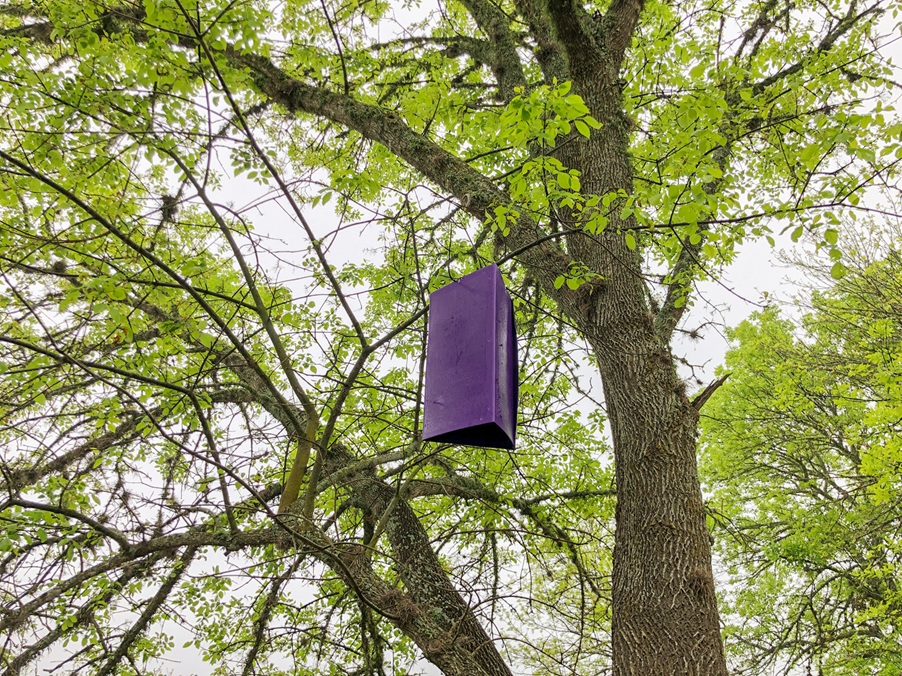
Texas A&M Forest Service deploys traps annually beginning in February to proactively monitor EAB. Currently, the agency has 554 traps placed throughout Texas.

Texas A&M Forest annually deploys traps, lined with a sticky surface and attractive colors and smell, which help identify the movement of EAB. Currently 554 traps are deployed throughout Texas.

“Our timing in trapping EAB is important because its emergence is dependent on weather and temperature conditions,” said Smith.

Once the presence of EAB is confirmed in a county, the Texas Department of Agriculture assumes regulatory responsibility which includes the establishment of quarantines. The state’s mandatory quarantine by the Texas Department of Agriculture restricts movement of any woody ash material exiting the county or quarantined area.

The Texas Department of Agriculture also regulates sawmills, kiln dry facilities, mulch products, wood packing material, ash nursery stock and all hardwood firewood.

“Because EAB is transported unintentionally on wood products, the quarantine helps slow the beetle’s spread by restricting the movement of wood in and out of affected areas,” said Demian Gomez, Texas A&M Forest Service Regional Forest Health Coordinator. “Texans can be proactive in preventing the spread of EAB and other pests and diseases by burning firewood where it is bought.”

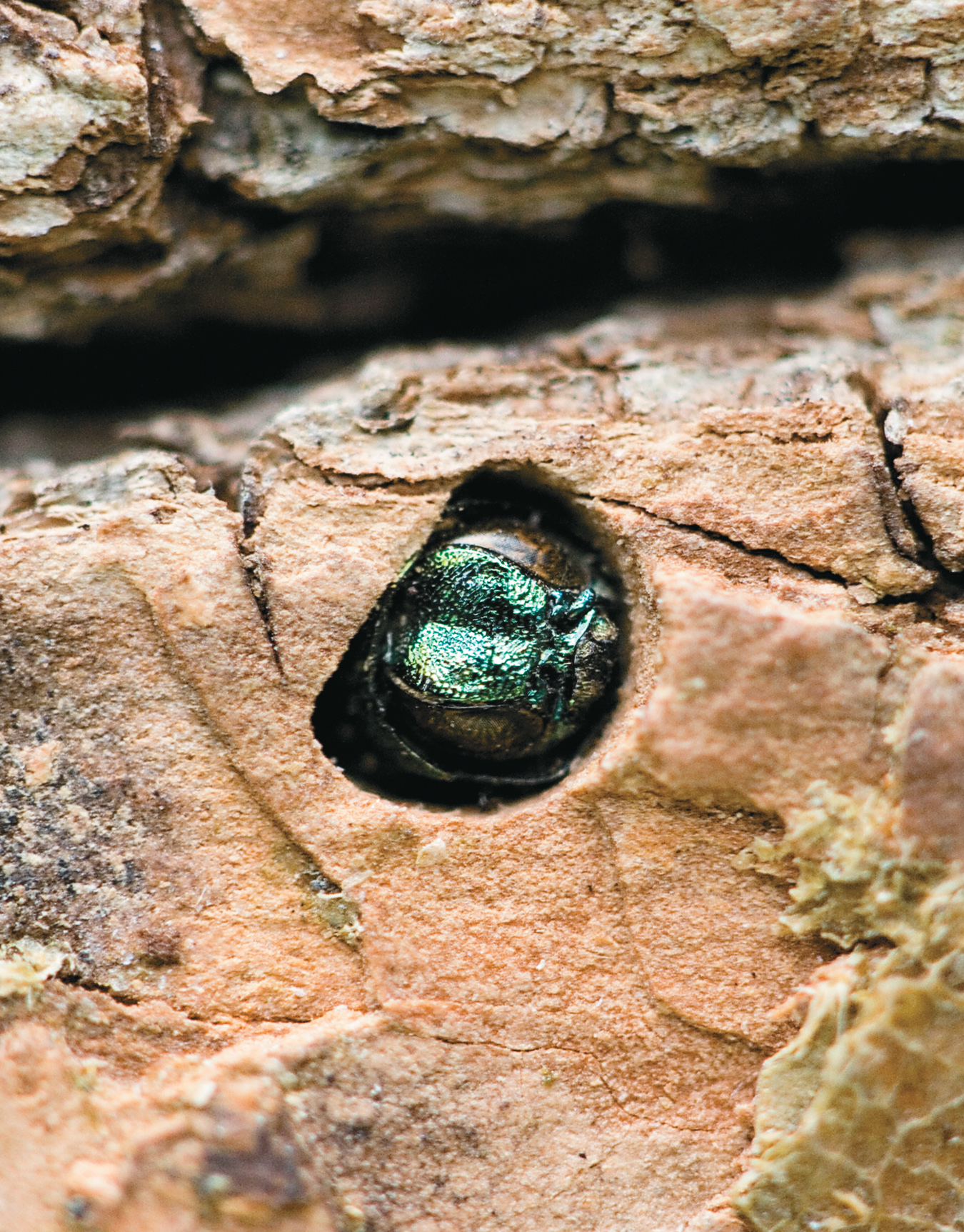
EAB exiting an ash tree. Adult EAB are dark emerald green, one-half inch long and one-eighth inch wide.

All species of ash are susceptible to EAB. Infested ash trees may show few to no symptoms in early stages.

Larval EAB feed in the phloem of branches and trunks, preventing nutrients from being transported from the leaves to the rest of the tree. Tree mortality can occur five to six years after the beetle is introduced.

Symptoms of infestation may include dead branches near the top of a tree, leafy shoots sprouting from the trunk, bark splits exposing s-shaped larval galleries, extensive woodpecker activity and d-shaped exit holes.

When EAB exit a tree after feeding in the phloem of branches and trunks, they leave behind a distinct d-shaped hole.

Adult EAB are dark emerald green, one-half inch long and one-eighth inch wide. They may be seen near ash trees, especially between May and June in Texas, when they are more likely to fly.

Texans can help minimize the spread of EAB by diversifying tree and plant species on their property, following the 10-20-30 rule—planting no more than 10% of any one species, 20% of any one genus or 30% of any one family. 

For more information on EAB in Texas, visit https://tfsweb.tamu.edu/trees/invasive-species/invasive-insects/emerald-ash-borer/.

For information from the Texas Department of Agriculture on EAB quarantine, visit https://texasagriculture.gov/RegulatoryPrograms/PlantQuality/PestandDiseaseAlerts/EmeraldAshBorer.aspx.

To report EAB, please call the EAB Hotline at 1-866-322-4512.

About EAB in Texas
EAB is a destructive, non‐native, wood‐boring pest that targets all ash tree species. Native to Asia, forest health experts have been monitoring its movement across the United States since 2002. It has spread to more than half the states in America — and killed millions of ash trees. The beetle was first detected in Texas in 2016 in Harrison County in northeast Texas. In 2025, EAB has been confirmed in Jack, Navarro, Somervell, Bell and Rockwall counties.

Generation Next: Our Turn to Ranch Online Course Now Registering

0

12-week AgriLife Extension agriculture business and land management course begins Aug. 25

Registration is open for the Generation Next: Our Turn to Ranch 12-week online course offered by the Texas A&M AgriLife Extension Service Aug. 25-Nov. 16. (Courtney Sacco/Texas A&M AgriLife)

Cost is $300, and online registration is required at https://tx.ag/GenNext.

The course includes expert instruction on starting a new agriculture business or enterprise, tax implications and insurance needs, developing grazing or wildlife leases and more.

“Across Texas, we’re seeing individuals who may or may not have experience in agriculture or natural resource management inheriting or purchasing agricultural lands,” said Megan Clayton, Ph.D., AgriLife Extension range specialist and professor in the Texas A&M Department of Rangeland, Wildlife and Fisheries Management, Uvalde.

“The Generation Next curriculum is specifically designed to empower these landowners with the knowledge and resources needed to start a new agricultural operation, improve an existing one or manage the land to meet their specific stewardship goals.”

Getting started with a business plan

The online school enables participants to work toward developing a business plan with support from professionals who specialize in each field and topic, Clayton said. Participants can expect to spend roughly two hours per week on lessons and activities that can be completed at any time throughout the week.

“We realize participants have busy schedules, so we designed the course with flexibility in mind,” Clayton said. “There are no specific meeting times, so lessons and exercises can be completed at your convenience.”

Enrollees will learn from experts regarding land management techniques and resources, alternative ranching operations, ecotourism opportunities, insurance and tax considerations, direct marketing and more. They will also learn how to set goals with measurable objectives for success.

While the course caters to new or inexperienced landowners, individuals with established operations also benefit from the curriculum.  

Upon course completion, participants will have a useful business plan for their operation and receive a Generation Next certificate and T-shirt.

The course provides a financial and ecological foundation

Since its inception in 2019, the online program has reached more than 700 landowners, and improved knowledge is not the only benefit participants can expect.

“On average, participants anticipate the course has an annual economic benefit of about $11,000,” Clayton said.

In addition to business and production-related topics, the course also provides a critical foundation in ecologically and environmentally sound land management.

For more information, contact Clayton at 830-988-6123 or Megan.Clayton@ag.tamu.edu.

Angelina College Athletics Weekly Update

0

Hey, sports fans,

Our youth camps wrapped up another big summer this past week, and now all our athletics programs are heading toward the new academic and athletic year, which is less than a month away from its kickoff. 

We’ve also got some big annual events heading our way, with more info coming soon. 

Here’s a quick rundown of the past week’s events, along with what’s coming up next: 

Coming Soon: Big Events for Angelina College and AC Athletics

The 18th annual Guy Davis Golf Tournament will take place on Saturday, August 16 at the Crown Colony Country Club in Lufkin. The kickoff dinner will take place at 6 p.m. on Friday, August 15 at Crown Colony. 

In addition, AC’s Sixth annual “Dinner at the Diamond” event will take place on Saturday, Sept. 27 down on the baseball field at Poland Stadium on the AC campus.

Both of those occasions are important fundraisers for Angelina College and its students – not to mention just a lot of fun for everyone involved. 

We’ll have registration links and other information for these events to send out in the coming weeks. We just wanted to give you enough time to mark your calendars for those 

Soccer Schedules Set for 2025 Season

The Lady Roadrunner and Roadrunner soccer teams have released their schedules for the upcoming season (which is rapidly approaching), so fans can start making plans to show up and show out while cheering on both AC teams.

Included in the schedule are five home doubleheaders, one of which is the Tuesday, August 12 scrimmage against Wiley College. The ladies kick off at 5 p.m. while the men follow at 7:30 p.m. 

The schedules are now posted online at www.angelinaathletics.com.  

Roadrunner Soccer Sets ID Camp Schedule

The Roadrunner men’s soccer team has added an ID Camp to its busy summer list. 

The ID camp, used to identify prospective future Roadrunners, is for grades 9-12 and will take place from 6-8 p.m. on August 1 at the Angelina College soccer pitch on the AC campus. 

Click the following link for all registration and other information:

https://www.eventbrite.com/cc/mens-soccer-camp-collection-3998183

For other information, contact head coach Martin Melchor at mmelchor@angelina.edu. 

Athletics Schedule Releases Coming in July

All six Angelina College athletics teams are finalizing their 2025-2026 schedules (both soccer teams’ schedules are available now), and those schedules should be ready for release soon. We’ll send out hard copies in a group email, and we’ll also send the link to the Angelina College Athletics website for further viewing. 

Naturally, there may be some changes along the way with teams still looking to add events. The best way to follow any possible changes is to visit the Angelina College Athletics website at www.angelinaathletics.com. 

Live Streaming Reminder: 

All AC Athletics regular-season home games are live streamed on TSBN Sports (a free streaming service for fans), with most of the conference road games also available for streaming. (This does not include baseball and softball fall games, as those are not considered official games.)

Once TSBN posts its schedules, AC fans simply need to visit the AC Athletics web site, look at the scrolling schedule in the middle of the page and click the blue “Video” link. 

TSBN also offers an app great for smart phones, devices and smart TVs. (You’ve GOT to see those matches and games on the big screen.)

Reminder II: Admission to ALL Angelina College Athletics sporting events is free, as is the TSBN live streaming. Any other links offering streaming are scams.  

Reminder III: For the most current schedule updates (especially for potential weather issues) visit the official Angelina College Athletics website (angelinaathletics.com). Fans can also receive updates on the AC Athletics Facebook, X/Twitter), and Instagram pages. 

Upcoming schedules: No further games scheduled until August. 

For any other information, contact Sports Information Director Gary Stallard at gstallard@angelina.edu. 

We’ll see you at the games.

Gary Stallard
Email: gstallard@angelina.edu.
Phone: (936) 465-4614

Timing Herbicide Applications

0
Father showing little son how to use garden sprayer when watering flowers

Our abundance of rainfall this year has been truly remarkable. I know some local orchard owners that haven’t had to turn on their irrigation yet for all of 2025. Cattlemen are bragging about the abundance of grass in their pastures. 

On the other hand, some stockmen wanting to bale hay or spray for weeds have found it difficult to find enough dry days in a row (that aligns with their own personal schedule). Wet ground means they have had some difficulty finding time to get into their fields.  

As a result of these wetter weather patterns, I have received calls from ranchers wondering if it’s too late to spray weeds. Honestly, that answer depends on the type of weed and what stage it’s in. As we’ll discuss below, timing is crucial for different weeds. 

First, knowing whether your target weed is an annual or a perennial will help you make the best management decision. Let’s break it down by weed type and calendar season to see what can still be done.

Annual weeds are those that germinate, grow, set seed, and die all in one year. These are best controlled when they’re young and actively growing. We’re talking about things like bitterweed, goat weed (Wooly croton), and buttercup. They can be either cool- or warm-season annuals, and right now in July, most warm-season annuals are nearing full size or even flowering.

That means spraying summer annuals now would require a higher rate of herbicide as the early season rate and it won’t be nearly as effective as it would have been back in late April or May. In fact, with mature annual plants, you might see them turn brown, but they’ve likely already produced seed and will be back next year.

If you’ve got a handful of small seedlings popping up in bare patches, spot-treating at a higher rate may still be worthwhile. But in most cases, it’s better to hold off and plan for an earlier application next spring. 

Perennials are a different animal altogether. These weeds—like broomweed, ironweed, dogfennel, and dewberry—come back every year from the same root system. Because of this, the goal is to get the herbicide all the way into the root zone where it can do the most damage.

The two best windows for perennial weed control are (1) right as they begin to bloom and (2) in late summer to early fall as they start storing up food for winter. In East Texas, we are approaching that second window.

When perennials are transitioning toward dormancy, they naturally move nutrients—and herbicides—down into the roots. That’s the perfect time to spray. If you’ve got trouble spots with established perennials, you’re in a great position to knock them back in the coming weeks.

There’s a temptation to “spray and pray” when pastures look rough in midsummer, but it’s important to make sure the plant is still actively growing. Plants that are stressed from heat or drought don’t absorb herbicide well. And with dryer weather coupled with increasingly higher temps, you run the risk of herbicide volatility or reduced uptake.

Likewise, be cautious not to overuse herbicides this time of year. Always follow the label—and I mean always. Often, more than one product can be effective, but rates matter and so does timing.

Keep in mind that if you use a soil residual herbicide like picloram, you may need to be careful with what follows in that pasture or hayfield. There are plant-back restrictions to watch for if you plan to rotate winter clovers or other sensitive crops.

Here’s my simple takeaway for you: Summer annuals? You’ve likely missed the best time of the year unless you see new seedlings. Used increased rates according to the label but plan to treat earlier next spring.

Perennials? You could be entering the best time. Start identifying and treating those patches while the plants are still green and moving nutrients.

When we get into the pattern of dry weather, hold off until you see signs of new growth. A wilted/ drought stressed weed won’t take up herbicide.

If you want a one-time, silver-bullet solution, I hate to disappoint you. But with a little planning, a sprayer calendar, and close observation of your pastures, you can stay ahead of weed problems.

For more details and specific herbicide suggestions, be sure to check out some of the Texas A&M AgriLife websites. One of my favorites is https://foragefax.tamu.edu/.  They’ve got pasture herbicide guides that are tailored for our region and can help you make the best call for your operation.

If you want to learn more about the weather, forecasting and how to plan your outside work, the Angelina County Extension Office is having its Noon Gardening Seminar this Tuesday, July 15, from 12 to 1 pm. Entitled “The sky above and the soil below: Weather’s Impact on Gardening”, the featured speaker is Matthew Addison, a retired USAF Meteorologist and now an Angelina County Master Gardener. Matthew has worked with weather patterns across the globe in service of this country and has a passion for chasing storms! 

Electricity Plans Are Like Shoes

0

One Size Doesn’t Fit All in Texas (and It Shouldn’t on Your Power Bill Either)

Here in East Texas, we know a good pair of boots is worth every penny—but only if they fit.
Too tight? You’ll be limping by lunchtime.
Too loose? Good luck staying on your feet.

Now think about your electricity plan.
Is it really the right fit for your home or business—or just the one that someone sold you?


Why Most Plans Don’t Actually Fit

The truth is, electricity plans aren’t designed with you in mind.
They’re made to sound good in a commercial or flyer, but they don’t account for:

  • How much electricity your family actually uses
  • Whether you live in a 1,200 sq. ft. cabin or a 4,000 sq. ft. farmhouse
  • If you’re working from home or away all day
  • Whether you own an RV hookup, workshop, pool pump, or deep freezer
  • Or if you run a small business, like a salon or feed store, out back

You wouldn’t wear your neighbor’s boots—so why use their electricity plan?

Here’s What’s Happening Across the Pineywoods

We’ve seen it across Lufkin, Nacogdoches, Diboll, Crockett, and beyond.
Folks who thought they were on a “cheap” plan get hit with surprise fees like:

Minimum usage charges (even when you’re trying to save power)
Base fees that show up even if you turn off the lights and leave town
“Renewable energy riders” they never knowingly signed up for

It adds up. Fast.

What You Can Do About It

You don’t have to be an energy expert to get the right plan—you just need someone local who knows the market and has your back.

That’s where Amerigy Energy comes in. They’re Texas-based and work with over 100 electricity providers to help folks right here in our community find a plan that actually fits.

Their team offers free reviews of your electricity bill and usage—residential or business—and helps you pick a plan based on what you really need, not what some provider wants to sell.

 Call to Talk to a Local Expert

Whether you’re trying to cut costs at home or keep overhead low at your business, it starts with a conversation. And around here, we still believe in picking up the phone.

Call 877-631-8875
Ask for Bryan if you’re looking at your home bill.
Ask for Lee if you’re calling about your business.

Final Thought

In Forest Country, we don’t settle for “good enough.”
We work hard, spend wisely, and take pride in knowing where our money’s going.

So if you’re not sure whether your power plan fits—you’ve got folks nearby who can help you find one that does.

Kids Talk About God by Carey Kinsolving and Friends

0

Can I Know I’m in the Place Where God Wants Me? (Psalm 23:2)
 
“He makes me to lie down in green pastures; He leads me beside the still waters” (Psalm 23:2).

If we follow the Lord beside still waters, “We won’t fall into rushing waters,” says T.J., age 6.

Did you know that sheep have died of thirst standing beside rushing waters? They won’t drink unless the water is calm.

“I think it means to take some time off and talk to God,” says Marcus, 8. “God loves us, and we drink from him because he is the still water.”

Many of us can’t remember the last time we quieted our souls and spirits to drink from God’s still waters. The rushing waters of modern life leave us dry, restless and unsatisfied.

“‘He leads me beside still waters’ could mean he brings peace if you put your trust in him,” says Haleigh, 9.

Jesus said, “If anyone thirsts, let him come to Me and drink. He who believes in Me, as the Scripture has said, out of his heart will flow rivers of living water” (John 7:37b-38). “To drink” in a spiritual sense means “to believe” or “to receive.”

Finding water, still or rushing, in the arid Judean hills and valleys was no small task. Water came from dew, springs or streams, and deep wells. Only a skillful shepherd could lead his flock to calm, unpolluted waters in a country where it usually doesn’t rain for nine months of the year.

“By following God, we will find our green pastures,” says Colton, 9. “Only God knows what our still waters are. We must obey God to find these places.”

Idyllic images of Scotland and New Zealand come to mind when most people read “He makes me to lie down in green pastures.” It’s easy to forget that the Judean hills of which the Psalmist wrote were rocky and dry.

“Green pastures did not happen by chance,” writes author Phillip Keller, whose book on Psalm 23 has sold more than 1 million copies. “Green pastures were the product of tremendous labor, time and skill in land use.”

Yet, green pastures are essential, Keller writes, when “lambs are maturing and the ewes need green, succulent feed for a heavy milk flow, there is no substitute for good pasturage.”

“Lambs like to lie down in green pastures, not bad, brown pastures,” says Mary, 10. “So that means he takes care of us and wants the best for us.”

Hungry sheep are constantly on their feet looking for more food. Their gnawing hunger won’t let them rest. Nothing is so satisfying to a shepherd as to see his flock at rest after their fill of plentiful, green grass and shrubs from a spring pasture. With good pasture and care, lambs can gain 100 pounds within 100 days after birth.

God promised Israel’s patriarchs a land flowing with “milk and honey.” To nomadic shepherds, this imagery represented the peak production time of spring and summer. Sheep grazed in luxuriant pastures while bees made honey from wild flowers and goats produced rich milk for their offspring and owners.

Television advertisers are always promising us more, but the reality is that “more” is often less fulfilling. Try turning off the TV and meditating upon God’s Word to discover God’s provision of milk and honey.

Think about this: God wants you to rest in his provision.

Memorize this truth: “He makes me to lie down in green pastures; He leads me beside the still waters” (Psalm 23:2).

Ask this question: Are you resting in God’s provision?

____________________________________________________________________________________

Kids Talk About God is designed for families to study the Bible together. Research shows that parents who study the Bible with their children give their character, faith and spiritual life a powerful boost. To receive Kids Talk About God three times a week in a free, email subscription, visit www.KidsTalkAboutGod.org/email. 

Speed Networking (Angelina County)

0

July 25, 2025 @ 8:00 am – 10:00 am

Join us Friday, July 25, at 8 AM for an exciting round of Speed Networking at our next Power Networking Breakfast, presented by Angelina College SBDC. This Speed Networking event is brought to you by Commercial Bank of Texas.

Attendance is free! While registration is not required, it is strongly encouraged to help us plan accordingly. Register today >>> bit.ly/PNB-0725

Don’t forget to bring your business cards and perfect those elevator pitches. See you there!

1615 S. Chestnut
Lufkin, TX 75901 United States
+ Google Map

City of Nacogdoches Main Street Program

0

DESIGNATED AS A 2025 ACCREDITED PROGRAM BY MAIN STREET AMERICA

[Nacogdoches, Tx 6/17/25] – City of Nacogdoches Main Street Program has been designated as an Accredited Main Street America program for meeting rigorous performance standards. Each year, Main Street America and its partners announce the list of designated programs to recognize their exceptional commitment to preservation-based economic development and community revitalization through the Main Street Approach™.

Main Street America recognizes two tiers of national designation — Affiliate and Accredited. These designations are a powerful advocacy tool, signaling to local stakeholders, as well as city, state, and national funders, that a Main Street program has an established position within a nationwide movement with a 45-year proven track record of generating impressive economic returns, building local capacity, creating welcoming and inviting communities, and creating lasting impact.  

“Main Street America is proud to recognize this year’s 821 Accredited Main Street America programs for their commitment to building strong and vibrant communities,” said Erin Barnes, President and CEO of Main Street America. “Their tireless efforts show what’s possible when engaged leaders work together to shape places that reflect the people they serve. The continued impact of our network shows that the Main Street movement remains a powerful force for positive transformation.” 

Nacogdoches Main Street’s performance was evaluated through assessments conducted by the organization’s personnel and board of directors, and The Texas Main Street Program, which works in partnership with Main Street America to identify local programs that meet rigorous national community evaluation standards. 

These standards provide the Main Street America network with a strong foundational framework to review progress, recognize strengths, understand trends, and identify strategies that move Main Street programs forward. To quality for Accredited status—Main Street America’s top designation tier—communities must demonstrate a proved track record of achieving outcomes in alignment with the Main Street Approach and exceptional performance in six areas: broad-based community commitment to revitalization; inclusive leadership and organizational capacity; diversified funding and sustainable program operations; strategy-driven programming; preservation-based economic development; and demonstrated impact and results. 

In 2024, Main Street America programs generated $7.65 billion in local reinvestment, helped open 6,324 new businesses, facilitated the creation of 33,835 new jobs, rehabilitated 10,126 historic buildings, and logged 1.9 million volunteer hours. On average, for every dollar that a Main Street program spent to support their operations, $21.73 was reinvested into their downtown and commercial corridor communities.  

“We’re honored to once again be recognized as an Accredited Main Street America program,” said Tori Proctor, Main Street Manager for the City of Nacogdoches. “This designation reflects the collective effort of our City leadership, the Main Street board, volunteers, downtown businesses, and community partners who are committed to preserving our historic character while driving thoughtful, long-term growth. From revitalization projects to supporting local entrepreneurs and community events, our work is focused on building a vibrant and resilient downtown for everyone.”

Nacogdoches Main Street celebrated a successful 2024 marked by major accomplishments and community impact. The annual Wine Swirl fundraiser raised $30,000, funding refreshed holiday décor—including a new downtown Christmas tree and a 12-foot lighted angel that became an instant community favorite. Downtown also saw significant reinvestment with the purchase of the Old Regions Bank Building at 300 E. Main by Elliott Electric Supply; renovations are currently underway to transform the space into the company’s new corporate headquarters. In addition, major renovations began at the Old Hazel Building at 401 E. Main, continuing the momentum of historic preservation and revitalization in the district.

In October, Nacogdoches received statewide recognition at the Texas Downtown Conference with a President’s Award for Best Renovation, honoring the transformation of the Old Wettermark Bank Building—now home to Roma’s Italian Kitchen—located at 124 E. Main. Main Street Manager Tori Proctor was also appointed to the Texas Downtown Board, marking another proud milestone for the community.

________________________________________________________________________________

About Nacogdoches Main Street

Nacogdoches Main Street’s mission is to preserve and promote historic downtown Nacogdoches through economic, historic, and cultural revitalization. We envision a year-round destination where visitors and locals experience the heart of our community, rich with history, commerce, entertainment, cultural, and educational opportunities.

About Main Street America

Main Street America leads a movement committed to strengthening communities through preservation-based economic development in older and historic downtowns and neighborhood commercial districts. For more than 40 years, Main Street America has provided a practical, adaptable, and impactful framework for community-driven, comprehensive revitalization through the Main Street Approach™. Our network of more than 1,600 neighborhoods and communities, rural and urban, share both a commitment to place and to building stronger communities through preservation-based economic development. Since 1980, the Main Street Movement has resulted in $115.42 billion reinvested locally, 181,647 net new businesses, 815,895 net new jobs, 345,801 buildings rehabilitated, and 37.3 million volunteer hours. Main Street America is a nonprofit subsidiary of the National Trust for Historic Preservation. For more information, visit mainstreet.org.

Don’t Click it. It’s Not A Ticket!

0

TxDMV warns Texans about ongoing text scam.

(AUSTIN, Texas – July 8, 2025) – Texans should think twice before clicking on links in threatening text messages that falsely claim to be from the Texas Department of Motor Vehicles (TxDMV) or similarly named agencies.

Drivers across Texas and the nation have reported receiving alarming messages alleging unpaid traffic tickets, toll violations, or other infractions. These texts often threaten immediate prosecution, suspension of vehicle registration, or loss of driving privileges. They typically include a link urging recipients to pay fines immediately to avoid further penalties. These scams are designed to steal personal and financial information.

The Texas Department of Motor Vehicles is not a law enforcement agency and does not issue or collect fines for toll or traffic violations. It also does not communicate about alleged violations through unsolicited text messages.

If you receive a suspicious message:

  • Do not click any links.
  • Do not reply or share personal information.
  • Report the message to the FBI’s Internet Crime Complaint Center at www.ic3.gov or the Federal Trade Commission at www.reportfraud.ftc.gov.