It’s time to start signing up for the Rae Estes BBQ Cook-off sanctioned by Outlaw BBQ association held during the 35th Annual Sassafras festival on October 25, 2025. Contact Bethany Butler or give us a call for more info: 936-275-3610.
Constrained cattle supplies and strong beef demand continue to fuel record prices at all levels of the U.S. beef market – from sale barns to grocery aisles, said Texas A&M AgriLife Extension Service experts.
Jason Cleere, Ph.D., AgriLife Extension statewide beef cattle specialist in the Texas A&M Department of Animal Science, Bryan-College Station, said cow/calf producers are realizing strong calf sale prices as a result of strong consumer demand for beef and low cattle supplies.
The national cattle herd continues to hover at historically low numbers following bouts of drought across major beef-producing states, including back-to-back years of extreme drought across Texas.
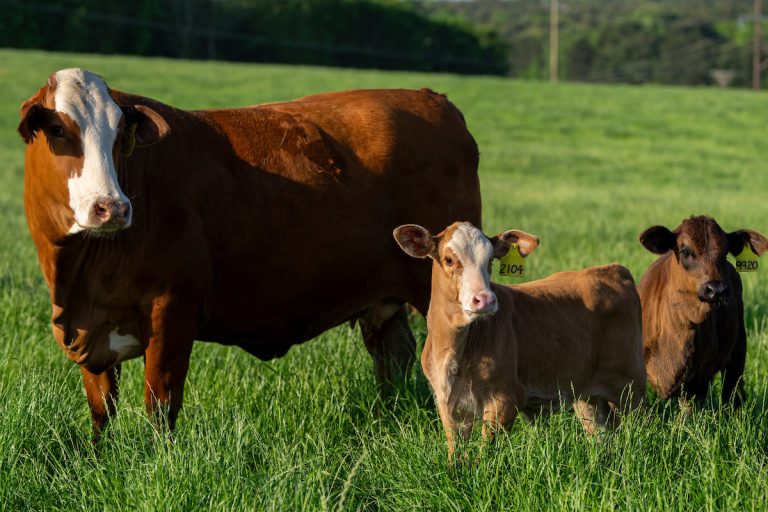
According to Texas A&M AgriLife Extension Service experts, cow/calf producers are realizing strong calf sale prices as a result of strong consumer demand for beef and low cattle supplies. (Michael Miller/Texas A&M AgriLife)
The national beef herd hit a 73-year low in January 2024 at 28.2 million head. Beef herd numbers have increased slightly to 28.7 million head, according to the U.S. Department of AgricultureJuly cattle inventory report, but cow-calf prices continue to reach new heights.
Cleere said feeding cattle to heavier weights has helped make up for lower cattle numbers, but beef production is down year-over-year overall. Cleere said the herd size coupled with strong consumer demand at the retail level has continued to fuel historically high prices for cow-calf producers.
“Retail prices are high, but there is still strong consumer demand,” Cleere said. “On the other end of production, you have ranchers capitalizing on record calf prices and asking, ‘How long are these high calf prices going to last?’”
Cow/calf biology weigh on U.S. beef market
David Anderson, Ph.D., AgriLife Extension economist in the Texas A&M Department of Agricultural Economics, Bryan-College Station, said low herd numbers and fewer market-ready calves are fueling record high prices at all levels of the beef market.
“We’ve got record high calf prices and record high fed cattle prices, and that is fueling record high beef prices on the wholesale and retail side,” he said. “Beef supplies have been particularly low since April while the demand from meatpackers and ultimately consumers has been strong.”
Nationally, Anderson said 300-400-pound calves were averaging $4.67 per pound while 500-600-pound calves were bringing $4.17 per pound on average. Localized sale prices have been even higher.
A weekly price-trend report by Jason Banta, Ph.D., AgriLife Extension beef cattle specialist, Overton, shows the average high price reported by six Central and East Texas auctions was $5.25 per pound for 300-400-pound calves and $4.70 per pound for 500-600-pound calves.
Anderson said the present market is also a good snapshot of how beef production cycle dynamics can influence supply and ultimately prices throughout the year.
Springtime is calving time for most cattle operations, he said. Those spring-born calves will go to auction in the fall. That influx of supply tends to create a price low point for the year whereas fall- and winter-born calves are hitting the market through spring and summer.
“It’s the biology of when calves are born and how fast they grow,” he said. “A decent number to go by from birth to finishing weight is 18-20 months, and that cycle can ripple through the sale barns all the way to the grocery store.”
Margins improve for Texas ranchers
The USDA Economic Research Service estimated the value of U.S. beef cattle and calf production at more than $83 billion in 2024. Record calf prices have been “tremendous” for Texas cattle producers who endured years of drought and high input costs, Anderson said.
Cleere said margins for cow/calf producers have improved as grazing around the state improved and input costs fell some. Ranchers are holding back replacement heifers, but better margins continue to incentivize selling those future calf-producing cows at rates that do not signal broader growth of the Texas or U.S. herd.
Anderson said individual producers may be utilizing excellent grazing conditions to keep or buy heifers to capitalize in the future, but most are seeing profitability now and taking it.
Both Anderson and Cleere expect calf prices to continue trending upward in 2026. Their upward price trajectory could steepen if more producers begin holding back more heifers for future calf production.
“Holding back heifers would really reduce the supply of calves for sale, and that usually drives prices even higher,” Anderson said. “You can’t discount the effect of rain and the good grazing conditions, which can lead to higher prices too, especially at local levels. But even with all that good grass, the incentive to sell is strong with these record high prices.”
Ranchers should plan for best and worst
With no signs of a herd rebuild, Cleere recommends cow/calf producers find efficiencies where they can optimize profitability while prices are high. Reproductive efficiency, nutrition and herd health practices, forage management and operational improvements that reduce long-term costs can all factor into increased productivity.
Preparing for best- and worst-case scenarios can give producers the ability to adjust their strategies, he said.
“It’s easy to make a profit right now,” he said. “But that is going to change, and we know eventually times will get leaner.”
AgriLife Extension district reporters compiled the following summaries:
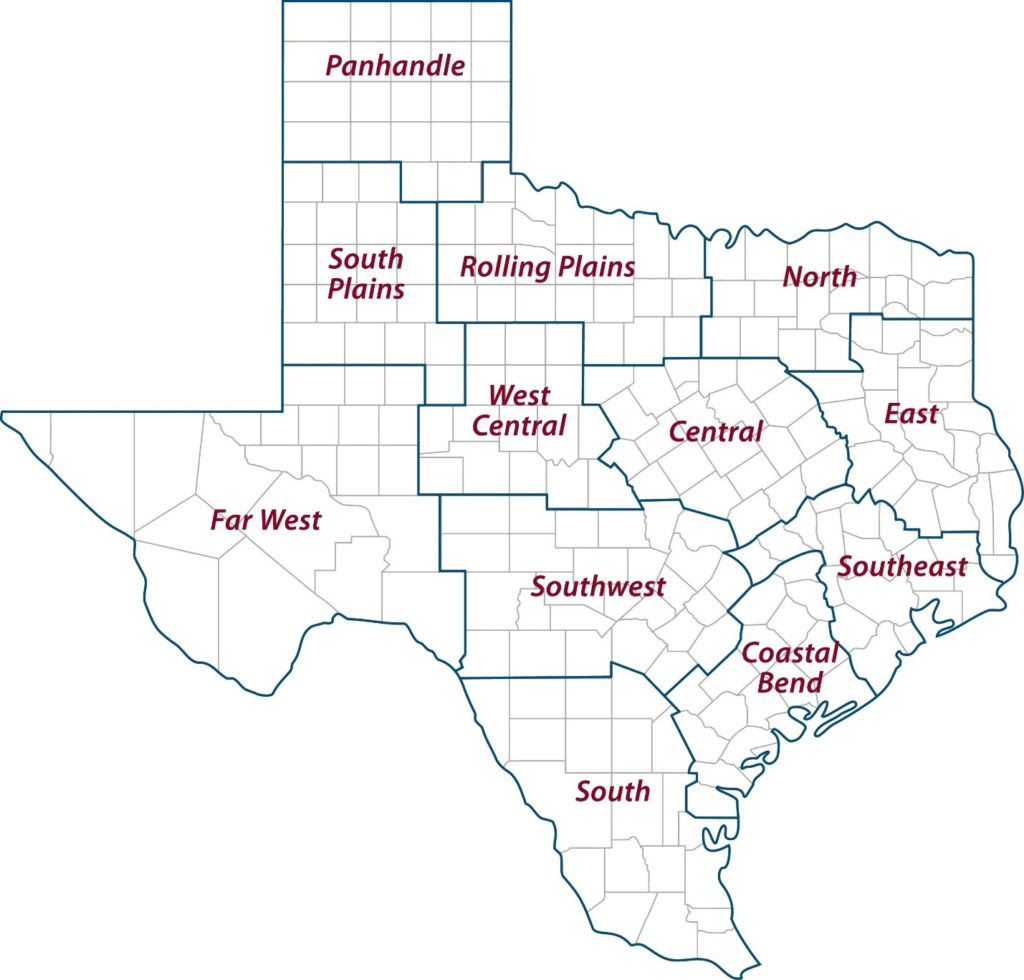
A map of the 12 Texas A&M AgriLife Extension Service districts.
Panhandle
The district received scattered showers, with overall soil moisture ranging from short to adequate. Timely moisture, coupled with a drop in heat, promoted good conditions to finish summer crops. Overall crop conditions were reported as fair to good. Pasture and range conditions ranged from good to excellent. Producers were watching for signs of insect pressure and continued to treat for weed issues.
South Plains
Despite very dry conditions over the past two weeks, subsoil and topsoil moisture levels remained on the higher side. This moisture was expected to decline as higher temperatures move in next week. Irrigation was running at full capacity, and more rain was needed to maintain and finish crops. Earlier summer rain resulted in heavy weed pressure, and producers continued to control with sprays. Early planted dryland cotton was blooming, and growth regulators were being applied. Cucumber planting was expected to finish soon, with other crops like sorghum, peanuts, black-eyed peas and corn progressing well. Hay was being cut, and livestock were in good condition. Aphids and lygus bugs were being seen, and treatments were being applied.
Rolling Plains
Heat gave way to cooler temperatures and some scattered rainfall, but not enough to ease overall dry conditions. Crops like sorghum performed surprisingly well despite earlier flooding. Corn yields were fair, although production acreage was declining due to development. Cotton ranged from good to excellent. Hay production has been strong, and livestock were in good condition.
North
The region experienced hot temperatures and limited rainfall, leading to short to adequate soil moisture conditions. Corn, peanuts, sorghum and soybeans were progressing and range from fair to good condition. Harvest was nearing for many crops. Healthy pastures and rangelands supported overall good livestock conditions. A few sorghum aphids were observed in Johnsongrass along roadsides and field edges. Grasshoppers and nuisance flies were noted, but no disease or major insect issues exist.
East
Subsoil and topsoil conditions were adequate. Hay production continued despite slower growth and lower soil moisture. Pasture and rangeland conditions were good overall. Livestock were in fair to good condition, and cattle markets remained strong. Producers have reported some armyworms and Bermuda grass stem maggots.
Far West
Overall good growing conditions reported for this time of the year, however, seasonal temperatures warmed, reaching 100 or just below most days. Western portions of the region reported a variety of impacts due to an abundance of rain, while the eastern portion was in desperate need of measurable precipitation. Most irrigated cotton was blooming, fields that were not will see reduced yields this season. Quite a few fields have yet to produce a square, and these fields will not make anything. Pima and Upland cotton was coming along nicely, but had some pest pressure. Corn was finished and drying down. Some sorghum neared maturity while other fields were just headed out and beginning to bloom. Melon harvest continued and demand was good. Alfalfa looks good but rains were expected, which could ultimately negatively impact price and quality if alfalfa was rained on. Sudan grass was also affected by rain while in windrows. Pecans were loaded up at this time, overall seems to be an “on” year. Range conditions continued to require additional supplementation.
West Central
Conditions were hot and mostly dry, with some daytime highs above 100 degrees. Soil conditions remained good overall. A lack of precipitation allowed some areas to sufficiently dry out, and flood damage assessments ramped up. Row crops were beginning to show signs of stress from heat and lack of moisture. Sorghum harvest started for fields planted early, and later-planted sorghum is maturing. Corn was being cut for silage, and cotton and sorghum looked good overall. The pecan crop was reported as very little to acceptable. Hay baling continued with higher-than-normal yields. Pasture and range conditions looked good overall. Livestock remained in good condition. Armyworms were present and required treatment in some instances.
Southeast
The region reported hot and dry weather overall, with some areas seeing temperatures above 100 degrees. Soil moisture ranged from adequate to surplus. Rice and corn were progressing well, with most rice heading. Cotton ranged from fair to good. Corn and sorghum harvest is expected soon, and hay baling continued with only a few delays. Pasture and rangeland conditions were fair to excellent, and livestock conditions were good overall. Some pest issues, such as armyworms and stem maggots, emerged in limited areas and prompted insecticide applications.
Southwest
While scattered showers brought some areas over 2 inches of rain, hot and mostly dry conditions caused an overall reduction in soil moisture. Hay, corn and milo harvest continued with below-average yields reported for corn and milo. Pecans were advancing in nut development, with some pecan scab reported. The hot, dry conditions were stressing pastures and turfgrass, causing an increase in fungal infections and insect pest pressure. Rangelands were drying out. Livestock and wildlife remained in good condition.
Coastal Bend
Hot, dry weather continued, and soil moisture was low. Corn and sorghum harvest were nearly complete. Cotton looks good overall, and harvest should begin soon. Rice harvest continued with fair to good yields. Hay harvest was ongoing, with decent yields despite the heat. Some producers were just completing first cuttings due to earlier weather delays. Range and pasture conditions were declining. Livestock remained in good condition, but ongoing dry conditions may soon require changes to herd management. Some mealybugs in hayfields and pastures were reported.
South
Extreme heat and wind greatly reduced environmental moisture, but creeks and rivers maintained water levels. Despite some producers reporting up to 0.5 inch of rain, topsoil and subsoil conditions remained very dry. Vegetable crops have slowed but were still producing. Soil was being prepped for strawberries. Corn and grain sorghum harvest continued. Cotton defoliation has started in earlier-planted fields, and harvest was expected soon. Late-planted grains needed a few more weeks until harvest. The pecan crop looks good for now. Peanut crops were growing under irrigation. Hay producers continued to irrigate and roll up bales when possible. Increasing temperatures were expected to dry out pastures and caused declining conditions. Livestock were in good condition, and producers were providing minimal supplements. Feed prices remain high, and producers were expected to thin out herds as triple-digit temperatures approach. Wildlife were in good condition.
Tyler County Back to School Bash: Stuff a Backpack Giveaway
Get ready for the new school year with the Tyler County Back to School Bash! Join us for a FREE Stuff a Backpack Giveaway on:
Location: Woodville Health and Rehabilitation Center 102 N. Beech St., Woodville, TX 75979
Over 200 backpacks filled with school supplies will be handed out to school-age children—while supplies last!
This event is made possible by the generous support of our community partners:
Encompass Health Rehabilitation Hospital Woodville Health and Rehabilitation Center Dogwood Trails Manor East Texas Home Health Heart to Heart Hospice Pivot Rehabilitation The Orchard Assisted Living Tyler County Hospital
Come celebrate the start of the school year with us and make sure your child is ready to succeed!
A Texas Watershed Steward workshop on the Middle Neches River watershed will be held on August 21 in Lufkin.
The free event will be held at the Angelina County AgriLife Extension Office, 2201 S Medford Dr, from 1:00 p.m.-5:00 p.m. and is open to anyone interested in improving the region’s water quality.
“This workshop is designed to help watershed residents learn about their water resources and how they may become involved in local watershed protection and management activities,” said Michael Kuitu, AgriLife Extension program specialist and coordinator for the Texas Watershed Steward program, Bryan-College Station.
Once registered, additional meeting information will be provided, Kuitu said.
Helping improve water quality in the Middle Neches River watershed
The workshop will include a discussion on watershed systems, along with types and sources of water pollution. There will also be a group discussion on community-driven watershed protection and management and an overview of water quality as it relates to watershed management at the local level.
The public is encouraged to attend and learn not only about water quality management, but also how they may become involved in improving and maintaining the water quality of the Middle Neches River watershed through best management practices. Though the workshop will provide an emphasis on local water resources, the information remains applicable to all waters throughout the region, Kuitu said.
Light refreshments will be provided. Attendees will receive a copy of the Texas Watershed Steward Handbook and are eligible to earn a certificate of completion.
Continuing education opportunities
The Texas Watershed Steward program offers continuing education units, CEUs, for multiple professional disciplines. However, the quantity of continuing education offered may vary for select disciplines.
CEUs will include four hours in the following professional disciplines: soil and water management for certified crop advisers, professional engineers, certified teachers, professional geoscientists, and certified floodplain managers. American Institute of Certified Planners are eligible for four certification maintenance and one law hours. Four CEUs are also offered for each of the following Texas Commission on Environmental Quality occupational licensees: wastewater system operators, public water system operators, on-site sewage facility installers and landscape irrigators.
In addition, three general CEUs are offered for Texas Department of Agriculture private pesticide applicator license holders, and two credits are offered for nutrient management specialists. For questions regarding professional continuing education afforded to attendees, contact Kuitu.
For more information on the Texas Watershed Steward program, contact Kuitu at 979-321-5935, michael.kuitu@ag.tamu.edu or Cary Sims at 936-634-6414, cw-sims@tamu.edu.
For more information on the Middle Neches River watershed, contact Matt Stellbauer at 979-324-8211, matt.stellbauer@ag.tamu.edu.
AUSTIN – Governor Greg Abbott today released the following statement outlining the legal consequences that House Democrat members face for breaking quorum, including the potential loss of their seats and felony violations. This letter is also being sent directly to the individual members who have fled Texas. The Governor’s full statement is as follows:
Real Texans do not run from a fight. But that’s exactly what most of the Texas House Democrats just did. Rather than doing their job and voting on urgent legislation affecting the lives of all Texans, they have fled Texas to deprive the House of the quorum necessary to meet and conduct business.
These absences are not merely unintended and unavoidable interruptions in public service, like a sudden illness or a family emergency. Instead, these absences were premeditated for an illegitimate purpose—what one representative called “breaking quorum.” Another previously signaled that Democrats “would have to go by an extreme measure” of a quorum break “to stop these bills from happening.” In other words, Democrats hatched a deliberate plan not to show up for work, for the specific purpose of abdicating the duties of their office and thwarting the chamber’s business.
That amounts to an abandonment or forfeiture of an elected state office. When the Governor calls a Special Session, our Constitution provides that the “Legislature shall meet.” TEX. CONST. art. III, § 5 (emphasis added). It’s not optional. It’s a duty. The absconded Democrat House members were elected to meet and vote on legislation—not to prevent votes that may not go their way. Every session, legislators on both sides of the aisle find themselves on the losing side of a legislative vote. And every session, most of those legislators find a way to disagree agreeably and behave like adults, rather than going AWOL.
This truancy ends now. The derelict Democrat House members must return to Texas and be in attendance when the House reconvenes at 3:00 PM on Monday, August 4, 2025. For any member who fails to do so, I will invoke Texas Attorney General Opinion No. KP-0382 to remove the missing Democrats from membership in the Texas House. In that Opinion, the Attorney General considered “whether Texas law allows for a determination that a legislator has vacated office” if they intentionally break quorum. The Attorney General concluded that “whether a specific legislator abandoned his or her office such that a vacancy occurred will be a fact question for a court.” He further concluded that “through a quo warranto action, a district court may determine that a legislator has forfeited his or her office due to abandonment and can remove the legislator from office, thereby creating a vacancy.” That empowers me to swiftly fill vacancies under Article III, Section 13 of the Texas Constitution.
In addition to abandoning their offices, these legislators may also have committed felonies. Many absentee Democrats are soliciting funds to evade the fines they will incur under House rules. Any Democrat who “solicits, accepts, or agrees to accept” such funds to assist in the violation of legislative duties or for purposes of skipping a vote may have violated bribery laws. See TEX. PENAL CODE § 36.02. The same could be true for any other person who “offers, confers, or agrees to confer” such funds to fleeing Democrat House members. I will use my full extradition authority to demand the return to Texas of any potential out-of-state felons.
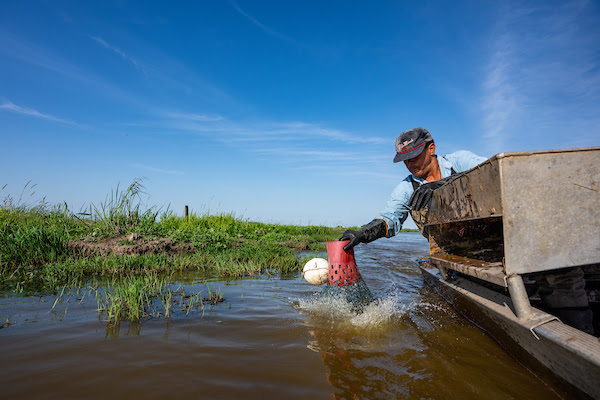
Texas aquaculture remains strong, with significant growth occurring over the last five years, said a Texas A&M AgriLife Extension Service expert.
Todd Sink, Ph.D., AgriLife Extension aquaculture specialist and director of the AgriLife Extension Aquatic Diagnostics Laboratory, Bryan-College Station, said his assessment of Texas aquaculture contrasts with the findings of the 2023 U.S. Department of AgricultureCensus of Aquaculture. The report showed a decline in the number of aquaculture farms and sales in Texas. But producer numbers have increased.
Sink attributed the inaccurate data to low numbers of Texas producers filling out voluntary U.S. Census of Aquaculture surveys.
More than 20 of those producers are new oyster farms along the coast. That increase in production was made possible by legislation passed in 2019.
“Prior to 2019, oyster mariculture was not allowed in Texas,” Sink said. “Now, the number of oyster farms is growing so fast, the state’s two oyster hatcheries are struggling to keep up with the demand for seed stock.”
More to the industry than catfish
Although many only think of catfish when considering Texas aquaculture, Sink said the industry is much more varied, supporting bait, ornamental and food fish species like pinfish, fathead minnow, koi, tilapia, shrimp, red drum and hybrid striped bass.
Red drum and hybrid striped bass alone generate around $20 million of the state’s annual farm-gate sales, he said.
“There are only around 12 red drum and hybrid striped bass producers in the state, and they’re producing as much as the catfish industry in terms of value and quantity,” Sink said. “Those fish are considered a higher-value product.”
The current farm-gate price for red drum is between $5.50 per pound and $5.70 per pound, compared to the average price of catfish, which has ranged between 80 cents per pound to $1.20 per pound over the last two decades.
Sink said red drum and hybrid striped bass are uniquely Texan aquaculture products, and the state leads the nation in production of both.
“If I go to a restaurant or supermarket anywhere in the U.S. and order red drum, there’s an extremely high chance that I’m going to be eating a farm-raised Texas product,” he said.
Market status and current trends
As Texas producers establish stronger holds in aquaculture markets, Sink said recent tariffs on imported seafood products have helped.
“Many producers are now getting orders from companies that previously dealt exclusively with China, Vietnam or Mauritius,” he said. “Competition from foreign seafood imports has been an ongoing issue in the industry.”
Sink said overall, the number of farms and sales for sportfish and food fish has remained relatively stable, with a few notable exceptions, including tilapia, which has expanded significantly in both the number of farms and sales.
“We’re also seeing food fish producers who previously specialized in a single species, such as catfish, hybrid striped bass or red drum, diversifying the species they grow to better protect themselves from any production failures such as disease, freeze events or market collapses,” he said.
Another industry trend Sink noted is producers joining together to form larger cooperative farms.
“It may only be two producers, or it may include eight, but they are partnering,” he said. “That offers buying power, better market access and supply, and species diversification.”
AgriLife Extension district reporters compiled the following summaries:
map of the 12 Texas A&M AgriLife Extension Service districts.
Panhandle
Widespread thunderstorms across the district brought additional precipitation during the week. Rains added to moisture soil profiles throughout the district, but overall, soil moisture levels were still short to adequate. Daytime high temperatures were in the upper 80s and low 90s, which helped moderate evapotranspiration rates. Most warm-season crops were transitioning from vegetative to reproductive growth and demanding more water. Overall, crops were in fair to good condition. Spraying and tillage of fallow and harvested wheat ground continued. Pasture and rangeland conditions were fair to good. Cattle gains were excellent.
South Plains
The area received rainfall from 0.5-2 inches over the week, benefiting all crops but also promoting weed growth. Temperatures were fair to hot. Timely rainfall helped move crops along through the season. Corn was pollinating, and grain sorghum was getting ready to flower. There were reports of leafhoppers and mites. Cotton was growing, and growth regulators were necessary in some areas. The potato harvest was about 50% complete with great quality being reported. Rain made the pastureland and cattle thrive, and most were in good to excellent condition.
Rolling Plains
Conditions were hot and dry with some locations receiving a bit of rain. Daily high temperatures were in the 90s. Atmospheric humidity was still facilitating sporadic, pop-up showers. Most counties reported crop and soil moisture levels persisting, but those conditions were deteriorating quickly. The late summer months are expected to be harsh for crops and livestock.
North
Conditions were hot, humid and dry for the most part. Topsoil and subsoil moisture levels ranged from short to surplus across the district. Summer grass growth was slowing, but hay harvest was still in full swing. Pastures, ponds, livestock and gardens were all in good shape. Beef cattle supplementation increased. Crops, including corn and soybeans, were in good condition overall. Grain sorghum was in good shape and rapidly approaching harvest. Winter wheat harvest was complete, with producers reporting an overall successful season.
East
Soil moisture levels declined with continued high temperatures and little to no rainfall. Subsoil and topsoil moisture conditions were adequate. Pasture and rangeland conditions were good overall. Hay production remained in full swing. Pond and creek levels began to drop. Cattle markets were strong and active in some counties. Livestock were in fair to good condition. Feral hog control was underway to mitigate damage.
West Central
With hot and dry conditions, flood recovery was in full swing as fields and pastures began to dry out enough to get back into; however, many were still too muddy to begin repairing damages. Some field preparation for fall small grain planting has started, with some being side-dressed with fertilizer after the rains. Hay cutting and baling was underway in many areas, and some corn was harvested for silage. A few row crops were showing signs of heat and moisture stress, but the rain helped the cotton crop. Sorghum was maturing with good yield potential, with harvest expected to begin next week. Corn was mature and ready for harvest. Pastures were in fair to good condition. Range and pasture conditions were declining slightly but were mostly fair to good. Most cattle continued to gain weight.
Central
The district experienced hot temperatures with minimal rainfall, causing soil moisture levels to decline and drought stress to emerge in some areas. Burn bans were in place for some counties. Pastures showed mixed conditions with some areas maintaining good grazing while others began showing stress. Stock tanks and reservoirs remained full. Corn reached maturity, and harvest operations began. Hay production remained active with armyworms present in some hayfields. Some grasshopper activity was also reported. Cattle maintained good body condition with minimal supplemental feeding required. The cattle market remained strong, and sheep and goat markets held steady. Producers continued to rebuild livestock herds after previous drought years.
Southeast
Soil moisture levels were adequate to surplus. Dry spells in Chambers, Liberty and Brazos counties allowed producers to resume cutting and baling hay, while wet conditions in San Jacinto County made fieldwork difficult. Rice was in good condition, and some harvesting began in Chambers County, and Jefferson County reported issues with rice delphacid. Cotton was maturing, and corn and sorghum harvests were expected to begin soon. Sorghum was in good to excellent condition. Armyworms and grasshoppers became more prevalent. Livestock in Madison and Walker counties reported favorable forage conditions and moderate temperatures. Overall, crop and livestock conditions showed signs of improvement, with producers closely monitoring the weather. Pasture and rangeland conditions ranged from fair to excellent. Livestock conditions ranged from very poor to excellent.
Southwest
Seasonal summer temperatures accompanied a few spotty downpours. Rain totals ranged between 0.5-1.25 inches. Most of the rainfall was insufficient to have a meaningful impact on developing crops. Overall, forages, range and pastures were in good shape. Grain sorghum harvest began. Corn was still drying out for harvest. Grass growth slowed down considerably. Hay harvest continued with reports of second cuttings on Sudan and Hegari hay expected soon. Deer fawns were doing well. Livestock body conditions improved steadily with producers having to supplement very little. Livestock markets were steady to high. A slight chance of rain was expected this weekend.
Coastal Bend
Most of the county received rain over the weekend, with totals between 0.5-1 inch. Soil moisture conditions continued to decline in most areas. Rice and corn harvests were in full swing. Grain sorghum harvest was complete with the exception of late-planted acres that followed failed cotton. Cotton harvest started in early planted fields and should progress well, although some fields were still maturing. Range and pasture conditions remained mostly fair to good due to earlier rains. Livestock remained in good condition thanks to earlier high-quality forage production. Pasture conditions began to decline due to dry conditions and heat, and hay harvest continued. Bermuda grass stem maggot and fall armyworms were active in hay fields.
South
Tropical moisture brought hit-and-miss showers, and there was a chance of rain in the forecast. Weed problems were reported. Warmer temperatures and little rain allowed row crop farmers to proceed with corn and grain sorghum harvests. Crops looked good overall. Grain sorghum, corn and sunflower harvests neared completion in some areas and attention was turning to peanuts, cotton and sesame. Peanut fields continued to progress under irrigation and develop pods. Sesame harvest was awaiting the appropriate harvest window. Cotton bolls were setting and beginning to open in most fields. Cotton defoliation was expected to begin soon. Some citrus orchards were irrigated, and fruit was developing. Range and pasture conditions were still good, but soil moisture continued to decline due to extremely high temperatures. Falcon Reservoir levels remained critically low, affecting water quality for municipalities, irrigation and livestock. Beef cattle supplementation was increasing, and beef cattle prices remained very high. Wildlife such as deer, quail and turkey remained in good shape, but water and cover will be critical going into August.
It’s that time of year again—when store aisles fill with sharpened pencils, new sneakers, and the hopeful anticipation of a fresh school year. As families across Deep East Texas gear up for the classroom, don’t miss out on one of the most practical money-saving opportunities of the season. The 26th Annual Texas Sales Tax Holiday is set for August 8–10, 2025, and it’s expected to save Texas shoppers over $140 million at the checkout counter.
Since its creation in 1999, this tax-free weekend has saved Texans nearly $2.2 billion on back-to-school essentials. During the holiday, shoppers can purchase clothing, footwear, school supplies, and backpacks priced under $100 without paying sales tax. It’s a modest break that can make a meaningful difference, especially as families prepare for the year ahead.
With that, here’s an update from your State Capitol…
Capitol Update
Over the past several weeks, the Texas House and Senate Select Committees on Disaster Preparedness and Flooding have convened to examine the recent catastrophic floods that impacted Central Texas. These hearings go beyond reviewing the past—they focus on learning vital lessons to ensure our communities, especially those in rural areas, are better equipped for future disasters.
Officials from both state and local levels have shared firsthand accounts of the flooding’s aftermath, the preparations made ahead of time, and the ongoing efforts to recover. One urgent takeaway is clear: many rural and underserved communities still lack sufficient emergency warning systems. Without dependable sirens or alerts, families face increased danger when floods occur, losing precious moments to act.
Texas Division of Emergency Management Chief Nim Kidd highlighted the critical importance of readiness during his testimony, stating, “The strength of our emergency response lies in the preparation and support we provide before disaster strikes.” This powerful reminder calls on us to prioritize investments in training, resources, and infrastructure—especially for those first responders in rural areas who are often the first line of defense.
East Texans know the harsh reality of flooding all too well. But what truly defines our region is not just the challenges we face, but the resilience and unity we show in response. When disaster hits, neighbors reach out, communities rally, and together we rebuild stronger than before.
As the Legislature continues these essential discussions during the First Called Special Session, I remain committed to advancing policies that equip rural and underserved communities with the tools and support they need.
The mobile office is on the road again in August, and our District Director looks forward to seeing you on the following dates, in the following locations: August 6 at the San Augustine County Courthouse from 9:30-11:30am; August 13 at the Polk County Commissioner’s Court Room in Livingston from 9:30-11:30am, or at the Tyler County Courthouse in Woodville from 1:30-3:30 pm; August 20 at the Houston County Courthouse Annex in Crockett from 9:30-11:30am, or at the Trinity County Courthouse in Groveton from 1:30-3:30pm.
As always, please do not hesitate to contact my office if we can help you in any way. My district office may be reached at (936) 634-2762 and my Capitol office may be reached at (512) 463-0508. Additionally, I welcome you to follow along on my Official Facebook Page, where I will post regular updates on what’s happening in your State Capitol and share information that could be useful to you and your family: https://www.facebook.com/RepTrentAshby/.
And How a Simple Electricity Review Could Save You Thousands
We talk a lot about stretching a dollar here in the Forest Country. Whether you’re running a small business in Crockett, keeping a church cool in Alto, or powering a feed mill in Diboll—you already know that every expense matters.
But what if I told you that many local businesses are overpaying for electricity by thousands of dollars each year, without even realizing it?
It’s not because they’re doing anything wrong. It’s because no one ever told them they could do it better.
The Mistake? Letting Your Energy Contract Auto-Renew (or Expire Quietly)
In deregulated parts of Texas, commercial electricity contracts don’t renew themselves fairly. In fact, many businesses are rolled into “month-to-month” plans with inflated rates, and they never know it—until the bill gets out of hand.
Others sign a contract once and assume it’s a good deal forever. But the market changes constantly. What was a good rate last year could now be 10–20% too high.
Real Example from the Forest Country
We worked with a business in Wells that was paying nearly 16¢ per kWh—well above market. With one quick review, we helped them secure a rate closer to 9¢—saving over $400 a month.
That’s $4,800 a year back into their operation. No new equipment. No headaches. Just a smarter plan.
What You Can Do Today
Here’s the good news: You don’t have to be an energy expert to save like one. You just need someone who knows how to read your usage, understands the providers, and speaks the language of contracts.
That’s where Amerigy Energy comes in. They’re based here in Texas, and they’ve helped small-town businesses across the Pineywoods cut their electricity costs—without switching providers, installing anything new, or spending a dime.
Want Someone to Take a Look?
You can call 877-631-8875 and ask for Lee—he works with businesses, nonprofits, schools, and churches. Or if it’s easier, email a copy of your last electric bill to info@amerigyenergy.com for a free analysis. You can also explore options at your own pace at AmerigyEnergy.com/shopnow.
Final Thought
In towns like Diboll, Crockett, Alto, and Wells, running a business already takes grit, grace, and long hours. Don’t let a quiet mistake on your electricity bill be the reason you come up short.
A quick review could save you thousands—money that belongs back in your business, your church, or your family’s hands.
“You prepare a table before me in the presence of my enemies; You anoint my head with oil; My cup runs over” (Psalm 23:5).
As I sit down to write, there’s a table before me with many interpretations of this well-known Bible verse. One of my favorite attempts to unravel this Scripture comes from Elizabeth, age 8: “Be kind to your enemies, and I’ll make you a king.”
King David treated his enemies with kindness and became a king. But I think he had something else in mind when he wrote this psalm.
“God prepares a life with enemies in it for us,” says Jessica, 9. Well, this also has possibilities. David was an unknown shepherd boy until he heard Goliath taunt the armies of Israel. Certainly, the Lord can use enemies to test us and to teach us how to trust him. As David said when facing Goliath, “The battle is the Lord’s.”
“The enemy is around you, and God can help you,” says Scott, 10.
Some experts believe the scene shifts to the banquet table of the king; however, I’m going to stick with the shepherd and his sheep. The summer grazing ranges in the high mountains are known as tables. In Spanish, the word for such a place is “mesa,” which means “table.”
The picture here is fit for a postcard: sheep grazing in a luxurious pasture on a high mountain plain. Before the sheep arrive, the shepherd has removed poisonous weeds, killed venomous snakes and driven away lurking predators.
Now, we come to the oil as in “You anoint my head with oil.” Bethany, 7, has the right idea when she says, “When he puts oil on our heads, he blesses us.” Adrianna, 8, is also on track: “God anoints our head with the Holy Spirit.” Both are true in the lives of God’s people.
But in the context of sheep peacefully grazing on a high mountain plain, there’s a fly in the ointment. Except here it’s more than a figure of speech.
The nose fly can harass sheep literally to death. They deposit their eggs in the damp mucous membranes of the sheep’s nose. The eggs hatch to form worms, which make their way into the sheep’s head. For relief from the severe inflammation, sheep will beat their heads against rocks and trees.
At the first sign of these pesky flies, the alert shepherd will apply a special ointment to the heads of his sheep so they can continue to graze peacefully.
Life is full of small things beyond our control that can “bug us.” By allowing the Good Shepherd to anoint us, these irritations are counteracted by the presence of God’s Spirit.
“‘My cup runs over’ means that God gives you so many blessings that they are uncountable,” says Sean, 10. Or it could mean “God is more than you ask for!” says Derek, 9.
One picture the overflowing cup suggests is the shepherd providing water for his skittish sheep. They’re thirsty but instinctively fearful of rushing river water because their heavy wool makes them vulnerable to being swept away by the current.
Running water has to be channeled into a vessel so that it’s still. “He leads me beside still waters.”
“Jesus’ love is filling my cup,” says Ester, 8.
Think About This: God has prepared a place for you where he will pour blessings into your life.
Memorize This Truth: Please see Psalm 23:5 above.
Ask This Question: Are you willing to follow the Good Shepherd to the place where he can bless you?
Kids Talk About God is designed for families to study the Bible together. Research shows that parents who study the Bible with their children give their character, faith and spiritual life a powerful boost. To receive Kids Talk About God three times a week in a free, email subscription, visit www.KidsTalkAboutGod.org/email.
OK, it’s a scrimmage, but we’re still pumped about it since it signifies the beginning of a brand-new series of sports seasons for Angelina College Athletics teams. Our Lady Roadrunner soccer team will play its first scrimmage on the road this Thursday, and on Tuesday (Aug. 12), they’ll kick off a home scrimmage doubleheader with the men’s team.
We’re attaching a couple of schedules (thanks to Melissa Durham for the cool graphics) to help you keep up with all the upcoming “futbol” action.
We’ve also got the 18th Annual Guy Davis Golf Tournament on the way, along with our annual Meet the Roadrunners Banquet and Dinner at the Diamond.’
FYI, our faculty and staff report back full-time on Monday, Aug. 11, and the first class day for the new semester is Monday, Aug. 18.
See? We’re back and ready to Run ‘Em.
Here’s a quick rundown of the past week’s events, along with what’s coming up next:
Lady Roadrunners to Open Season with Thursday Scrimmage
Lady Roadrunner head soccer coach Sergio Gardea heads into his second season with a solid list of returning players from his 2024 South Zone winners, and his squad will square off against McNeese State University Thursday evening in Lake Charles, Louisiana. Kickoff is set for 7 p.m.
Since this is a scrimmage, the match will not be live-streamed.
Coming Soon: Big Events for Angelina College and AC Athletics
The 18th annual Guy Davis Golf Tournament will take place on Saturday, August 16 at the Crown Colony Country Club in Lufkin. The kickoff dinner will take place at 6 p.m. on Friday, August 15 at Crown Colony. The tourney features a five-man scramble format with two separate shotgun starts: One in the morning, and another in the afternoon.
On Sunday, August 17, we’ll host our annual “Meet the Roadrunners” banquet featuring all our incoming student-athletes and their families, along the all the Athletics staff. The event runs from 2:30-5 p.m. inside the AC Conference Center.
In addition, AC’s Sixth annual “Dinner at the Diamond” event will take place on Saturday, Sept. 27 down on the baseball field at Poland Stadium on the AC campus.
The golf tournament and Dinner at the Diamond are very important fund-raisers for Angelina College and its students – not to mention just a lot of fun for everyone involved.
We’ll have registration links and other information for these events to send out in the coming weeks. We just wanted to give you enough time to mark your calendars.
Soccer Schedules Set for 2025 Season
The Lady Roadrunner and Roadrunner soccer teams have released their schedules for the upcoming season (which is rapidly approaching), so fans can start making plans to show up and show out while cheering on both AC teams.
Included in the schedule are five home doubleheaders, one of which is the Tuesday, August 12 scrimmage against Wiley College. The ladies kick off at 5 p.m. while the men follow at 7:30 p.m. Both AC soccer teams will kick off the regular season at home on Friday, August 29 against Northeast Texas Community College. Again, the ladies will start at 5 p.m., and the guys will follow immediately afterward. Those matches will be live streamed on TSBN, the home doubleheader on Saturday, August 30 against Paris Junior College.
Baseball ID Camp Scheduled for August 6
The AC baseball team under new coaches Jon Phillips and Cody Crowder in August will host a camp for possible future Roadrunners.
The camp, open to all high schoolers and current college transfers, will take place from 11:30 a.m. until 5 p.m. on Wednesday, August 6 at Poland Stadium on the Angelina College campus.
Lady Roadrunner and Roadrunner fans can now find their favorite teams’ schedules on the Angelina College Athletics website (www.angelinaathletics.com). For now, only the fall schedules for baseball and softball are in place (with the potential to add more events later), but all other teams, including both women’s and men’s basketball, are ready for viewing and planning.
We’ll update any changes as we receive them.
We can’t wait to see you at the games.
Live Streaming Reminder:
All AC Athletics regular-season home games are live streamed on TSBN Sports (a free streaming service for fans), with most of the conference road games also available for streaming. (This does not include baseball and softball fall games, as those are not considered official games.)
Once TSBN posts its schedules, AC fans simply need to visit the AC Athletics web site, look at the scrolling schedule in the middle of the page and click the blue “Video” link.
TSBN also offers an app great for smart phones, devices and smart TVs. (You’ve GOT to see those matches and games on the big screen.)
Reminder II: Admission to ALL Angelina College Athletics sporting events is free, as is the TSBN live streaming. Any other links offering streaming are scams.
Reminder III: For the most current schedule updates (especially for potential weather issues) visit the official Angelina College Athletics website (angelinaathletics.com). Fans can also receive updates on the AC Athletics Facebook, X/Twitter, and Instagram pages.
Upcoming schedules:
Thursday, August 7:
Lady Roadrunner Soccer at McNeese State University (scrimmage), 7 p.m. in Lake Charles, Louisiana.
Tuesday, August 12:
Lady Roadrunner Soccer vs. Hinds College (scrimmage), 5 p.m. at the AC Soccer Stadium/Larry Phillips Family Sports Complex.
Roadrunner Soccer vs. Hinds College (scrimmage), 7:30 p.m. at the AC Soccer Stadium/Larry Phillips Family Sports Complex.
Friday, August 15:
Roadrunner Soccer vs. LSU-Shreveport (scrimmage), 3 p.m. at the AC Soccer Stadium/Larry Phillips Family Sports Complex.
For any other information, contact Sports Information Director Gary Stallard at gstallard@angelina.edu.