


Home Blog Page 682

Longtime CHI St. Luke’s Health Memorial Chaplain Dies at 92

0
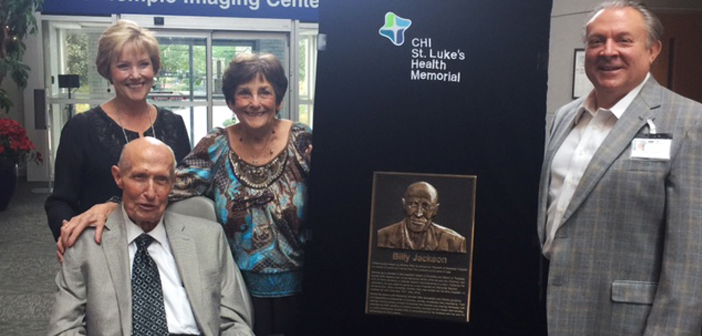
Brother Billy (seated), his daughter Brenda Walker (far left), and wife Anita Jackson (center) pose with the newly unveiled bronze plaque and CHI St. Luke’s Health Memorial Market CEO Gary Looper (right). (Photo: CHI St. Luke's Memorial Health)

Longtime chaplain and spiritual counselor at CHI St. Luke’s Health Memorial died at the age of 92.

Serving as a member of the hospital’s Board of Directors and Board of Trustees, Brother Billy Jackson became part of the Memorial family while he was the Chairman and CEO of Perry Brothers, a national retailer headquartered in Lufkin. Following his retirement, he was asked to serve as a Lay Chaplain for Memorial Medical Center-Lufkin. Soon thereafter, Brother Billy was named the full time chaplain—a position he held from May 1997 to May 2015.

“We extend our deepest sympathies to Brother Billy’s wife Anita and his entire family,” said Shawn Barnett, CHI St. Luke’s Health Memorial Market COO & Lufkin President. “We are grateful for his longtime, compassionate service to the patients, providers and guests of CHI St. Luke’s Health Memorial. He will be greatly missed.”

Last month, more than 100 employees gathered to honor Brother Billy as we unveiled a bronze plaque in his honor that now hangs next to the chapel.

During his tenure with Memorial, Brother Billy counseled and offered guidance and leadership to thousands of patients, guests, employees and physicians. He led morning prayer groups around the hospital, prayed intimately with patients and their families, offered spiritual guidance, held worship services in the hospital chapel and could be seen handing out daily devotionals to all he met.

Brother Billy is remembered by his Memorial family for his timeless service and his faithfulness to God’s cause.

About CHI St. Luke’s Health Memorial

Memorial provides more than a quarter of a million patient services each year and has a longstanding history of providing quality, innovative health care in East Texas.

With hospitals in Lufkin, Livingston, San Augustine and Memorial Specialty – the area’s only long-term acute care hospital – CHI St. Luke’s Health Memorial provides millions of dollars in charity care and community support each year.  Our mission is to nurture the healing ministry of the Church, supported by education and research.  Fidelity to the Gospel urges us to emphasize human dignity and social justice as we create healthier communities.

Memorial offers a wide array of services, including the area’s first dedicated heart and stroke care facility and radiation oncology at the Temple Cancer Center. It is also known for the area’s only comprehensive diabetes, heart and stroke education center. Other specialty areas include imaging, orthopedic care, women’s services, inpatient and outpatient rehabilitation, homecare, wound care and hyperbaric oxygen therapy, kidney & diabetes treatment, sleep disorders treatment and express lab.

About Catholic Health Initiatives

Catholic Health Initiatives, a nonprofit, faith-based health system formed in 1996 through the consolidation of four Catholic health systems, expresses its mission each day by creating and nurturing healthy communities in the hundreds of sites across the nation where it provides care. One of the nation’s largest health systems, Englewood, Colo.-based CHI operates in 19 states and comprises 105 hospitals, including four academic health centers and major teaching hospitals and 30 critical-access facilities; community health-services organizations; accredited nursing colleges; home-health agencies; and other facilities that span the inpatient and outpatient continuum of care.

In fiscal year 2014, CHI provided $910 million in charity care and community benefit – a nearly 20% increase over the previous year – for programs and services for the poor, free clinics, education and research. Charity care and community benefit totaled more than $1.7 billion with the inclusion of the unpaid costs of Medicare. The health system, which generated revenues of almost $13.9 billion in fiscal year 2014, has total assets of $21.8 billion. Learn more at www.catholichealthinitiatives.com.


Empowering Gratitude in an Imperfect World

0

At most family gatherings during the holiday season, there is a formal or informal time for reflecting on what we are grateful for. Almost invariably a prominent object of that gratefulness is family, in its many varied forms. What a lovely tradition.

This season I AM grateful for my family – well, in my case, that should be families. I have several.

At age two, I was abandoned by my original biological family and spent time in an orphanage and foster care until I was adopted at age four. But let me just go on record here and say, I’m grateful for my original family. Without them, I wouldn’t exist – and I’m quite fond of existing.

My adoptive family took me in and nurtured me into adulthood. I’m grateful for the stability and example of responsibility, respect and hard-work they showed and taught. I’m also grateful for the introduction to a loving God they provided.

I’ve now been married for thirty-one years and have formed my own family. I’m grateful for the patient love of my wife and for how she balances me in so many ways. She has believed in me and motivated me in ways I did not experience before marriage. And though we do not have children, I’m grateful for the opportunity to have a role in the lives of nieces and nephews (both biological and not) who provide a way to pass something of value into the next generation.

Recently I went on a search to discover my biological roots and have connected with biological members of my family I hadn’t known about in my prior half-century of life. These folks have offered a new dimension of family that most adopted folks don’t get to experience – but some of you know exactly what I’m talking about. I’m grateful for these “new” family members for the history and identity they bring to my life and the way they explain the on-going wonder of the nature vs. nurture debate.

But it strikes me that around most of our holiday tables this year, there will be a feeling that if we are not completely grateful for a part of our family, we can’t express any gratitude at all. The shadow part of them overcomes whatever light there may be. I’ll resist this dualistic approach to gratitude because, in my case, it would severely limit my ability to give thanks for my many blessings.

I’m able to be grateful to my biological family for giving me the gift of life, while at the same time not being grateful for the abandonment. I’m able to be grateful to my adoptive family for their inclusion of me and their many positive examples, without pretending to appreciate their overly harsh discipline or lack of emotional support. I can be grateful to my wife for decades of love and support while at the same time acknowledging that marriage is a challenge and gets messy sometimes.

As you ponder what you are grateful for this year, allow yourself to hold both extremes of every relationship at the same time. Each of us has a shadow side and each has that side of us that absorbs and reflects light. The fullness of gratitude is being able to celebrate the light, without the fantasy that the light won’t reveal a shadow.

Go forth and plot goodness.

Craig A. Steffen is President of Paraclete Consulting, Inc. of Spring Valley, Ohio. He was adopted at the age of four and shares his journey to find his biological identity in the new book, A Family Apart. For more information, visit:www.craigasteffen.com


Who’s The Boss? More Women Decide They Are

0

The number of American women who own their own businesses is on the rise.

It’s estimated that more than 9.1 million women now lead their own enterprises. What’s more, from 1997 to 2014, when the number of businesses in the United States grew by 47 percent, those owned by women grew by 68 percent, according to a report published by American Express OPEN.

One woman who is part of that trend – and is helping other women become their own bosses, too – says those statistics may not be that surprising.

“I think many women are willing to branch out on their own because they decide that the benefits outweigh the risks,” says Dr. Diana Hoppe, founder of Amazing Over 40 Inc. (www.amazingover40.com), a health coaching certification program for women.

“We live in a time when people often re-invent themselves because job opportunities are limited or they are looking for new challenges.”

Hoppe says that when you do that, it’s important to study the market to see where the opportunities are going to be and find a good fit for yourself.

“The women I work with who are going into health coaching, for instance, understand that having a health coach is a major trend in fitness,” she says. “So look at the trends. Where will the opportunities be?”

Dr. Diana Hoppe says there are plenty of advantages to starting a business. Among them:

• Be Your Own Boss. When you own your own business, you can discover what it’s like to be fully independent, dictating your own path without anyone looking over your shoulder. You’re the boss and the decisions are yours.

• Set Your Own Schedule. Maybe you want to work a full 40-hour week, or maybe you are seeking a part-time schedule. When you are setting up your own business, you have more flexibility about when, where and how you work.

• Find Work That Fulfills You. Those who start a business can create a career for themselves that provides fulfillment. Hoppe says she has seen that in action with women who decided to become health coaches. They can personally change the lives of the clients they work with, helping them take charge of their health and discover their best selves. “I think it’s always important – whether you are launching a business or building a career working for someone else – that you find something you consider rewarding,” she says.

But it’s also critical to have a strong business plan so that you understand the market, have specific goals and know how to achieve those goals.

“If you don’t focus on building a strong foundation for your business at the beginning, it is likely to fail or not grow as fast as it can,” Hoppe says.

Among the factors to consider is that some businesses require more overhead than others. For example, if you are working from home, you don’t need to worry about leasing commercial space. Regardless, it’s crucial to make sure you have the necessary capital for whatever business you launch.

That’s been challenging at times for women, according to the National Women’s Business Council. Research shows that businesses owned by women start with about half the amount of capital as men, the council reports.

But don’t think you need millions of dollars, Hoppe says. Many successful businesses have been started with a relatively small amount of money.

“One of the most frequent questions I get asked involves what the start-up costs are for becoming a health coach,” she says. “This is a good example of one of the less costly businesses to start. Mainly, you just need business cards, a cell phone, a computer and transportation. Of course, not every business is quite that simple.”

Once a business is in full swing, one goal is to continue to grow the business while keeping current clients or customers happy, Hoppe says.

“One thing you can do for your customers is develop a relationship with them by engaging them on social media or by keeping them interested with email content,” she says. “Customer service is a critical part of any business because once someone begins to use your product or service, you want them to keep coming back.”

About Dr. Diana Hoppe

Dr. Diana Hoppe, an obstetrician and gynecologist, is the founder of Amazing Over 40 Inc. (www.amazingover40.com), a health coaching certification program for women. She also is an author and speaker who has been featured on a number of TV shows, including “Dr. Oz.”

If you would like to run the above article, please feel free to do so. I can also provide images to accompany it. If you’re interested in interviewing Dr. Diana Hoppe or having her write an exclusive article for you, let me know and I’ll gladly work out the details. Lastly, please let me know if you’d like to receive a copy of her book, “Healthy Sex Drive, Healthy You,” for possible review.


Protecting Plants From A Late Frost

0

Have you had your first frost?

I haven’t had a frost at my house, yet. I know that because my Celebrity tomatoes that I planted last spring are still alive and have a few green tomatoes growing on them.

Historically, our first frost in Angelina County is the middle of November. And that date was three weeks ago!

There are two types of frosts that can occur. One is when a cold front sweeps into an area. Called an advective frost, winds are typically gusty, clouds may occur and the cold air layer may reach more than a mile high. One seldom sees the first frost of the season under these conditions.

Our typical first frost is a radiation frost. This occurs under a clear sky and calm winds much like we’ve had this past week. Clear skies and calm winds allow radiant heat from the Earth to rise to the upper layers of the atmosphere and colder air to collect below.

This is also known as an inversion. The atmospheric conditions are inverse or opposite of normal daytime conditions when air temperature decreases with height. In an inversion, cold air collects near the ground while warmer air lies above this trapped cold layer.

On cloudy nights, the cloud cover acts like a blanket on the Earth, trapping radiant heat from the ground. Study the forecast and you’ll note the cloudless nights are typically the colder nights.

The topography of the land and your landscape also affects where frost will occur. On any given property, there may be temperatures on different sides of the house, under protective trees, on south or north facing slopes, or in low-lying spots.

Cool air settles at the bottom of slopes because it is heavier than warm air. Frost pockets will then form in valleys where cool air is trapped. Higher altitudes also have colder temperatures.

This is the concept that can confound me at times. Our house is at the top of a small hill. I know I’ll escape the cooler air that settles to my neighbors around me. Yet, I realize my “hilltop” home isn’t high enough for me to have the cooler air at higher altitudes.

Nevertheless, you are apt to see frost damage at the bottom of slopes and on the (high) hilltops, while the hillsides are frost-free.

But rather than just talking about the weather, there are several things that gardeners can do to minimize the effects of the first radiation frost. Keep a careful eye on the weather forecast too. We know cool, clear nights with low humidity, often following a cold front, are signs of an impending frost.

But what can you do to protect your plants?

Irrigate before the frost. A moist soil can hold four times more heat than a dry soil. It will also conduct heat to the soil surface faster than a dry soil, aiding in frost prevention.

In a study performed years ago, the air temperature above a wet soil was 5 degrees F higher than that above a dry soil and the difference was maintained until 6 a.m. the next morning.

Covering plants can give you 2 to 5 degrees F protection. The covers can be laid right over the crop, or can be supported on stakes. The difference being that protection is less wherever the cover touches the plant. Any material can be used to cover the plants, however woven fabrics are better insulators then plastics or paper.

The best time to apply covers is in the late afternoon after the wind has died down. Remove covers the next morning before the sun hits them.

I will let my tomato plants suffer from the eventual frost. I’ve enjoyed a good run of them. At best, I’ll pick what is left before the frost and see if they are far enough along to ripen in the kitchen.

Next week we’ll talk about those plants who can survive frost and cooler weather.

Dr. Michael Simon Addresses State of Schools At First Friday Luncheon

0
Dr. Michael Simon, President of Angelina College, provides the State of the Schools address during the Angelina County Chamber of Commerce First Friday Luncheon on Dec. 4 at Crown Colony Country Club. (Photo: Misty Boggs | MSGPR)

Dr. Michael Simon, President of Angelina College, presented the State of the Schools address during the First Friday Luncheon held Dec. 4 at Crown Colony Country Club in Lufkin.

“In my opinion, the schools are thriving,” he said. “Elementary, Secondary, and Post Secondary are thriving in large part through the commitment of the community support, engaged parents, citizens, and of course, the work of instructors, administrators, and staff who are deeply committed to student success.”

“We are excited to partner with Angelina county Early College And High School Consortium to offer eight Workforce degrees to our ECAHS students,” Dr. Simon said. “The six superintendents of Angelina county are to be commended for the creation of ECAHS which increases access, creates effeciences and targets at-risk and under-represented students.”

Dr. Simon noted in his address that a number of trends are affecting Angelina College, which included campus safety, accountability and outcomes, and technology.

“Comparing Angelina College to other campuses our size,” Dr. Simon said, “it is clear AC continues to be a remarkably safe learning environment for our students, faculty, staff, and employees.” However, with the rise of threats and violence on other campuses, Dr. Simon announced the creation of a campus police department that would work under a community policing philosophy to build positive relationships on the campus. The officers, armed and licensed peace officers, will have jurisdiction in the 12 counties within the college’s service area.

“in this area, an ounce of prevention is worth more than a pound of cure,” said Dr. Simon. “Community policing involves  developing relationships with the people you serve and working closely with the community. They will respond to crime and emergencies on campus, but they will also develop positive relationships on campus with our students and faculty, and be engaged with the life of the college.”

Outcomes and accountability is another hot-button topic for education, and for AC, that means a focus on remedial courses. “Today, approximately 45% of undergraduates are attending a two-yr college,” he said. “However, nationally and at AC, 50% of those students require remediation in math, reading, and/or writing before they can successfully complete college level work.” It’s not a bright future either, with states and students paying over $2 billion dollars for remedial courses and 17% of students who enroll in a remedial reading class and 27% who enroll in remedial math class will ever earn a degree. To combat this prognosis, AC developed a quality enhancement program called MASS – Mathematic Achievement and Student Support – to which brought together learning cohorts, computer mediated math instruction, and targeted student services. With the initial course, 19% of the students in the pilot passed their first remedial class 27% more MASS students enrolled in the spring semester. “As the college brings MASS up to scale,” he said, “we will try to monitor these results and try to sure we are keeping that pace or improving those student outcomes. Eventually, if we find a model that works for mathematics, we wil apply it to reading and writing as well.”

Dr. Simon also noted a shift in how higher education is perceived. “In the past, a student would show up on campus and discover themselves,” he said. “Increasingly, higher education is seen as a private good. It’s about investing in your self so that you can have a better life. It places greater emphasis on career preparation and training in college. At AC, the mission of a community college is being responsive to regional needs. As evidence to responsiveness in the region, Ac offers degrees and certifications in 70% of the target occupations identified by the Deep East Texas Workforce Development.”

Lastly, Dr. Simon spoke on the change in technology. “Today’s world technology is changing everything we do. More and more of the world’s books, manuscripts, research journals, and other publications are readily available online,” he said. “Education leaders have to be able to help campus libraries evolve from a storehouse of information to being a conduit to reliable information.” To meet the growing demands of students to access these features and to have greater access to enrollment and bill paying online, Angelina College has provided additional funding to buy new computers for classrooms, labs and instructors while also upgrading network servers on the campus. Plans were also announced for updating and renovating science labs and equipment used by the college’s workforce programs.


The Texas Tenors Coming Back To Temple Theater Dec. 21

0

LUFKIN, TX. THE TEXAS TENORS are coming back – by popular demand – to the Temple Theater Monday, December 21, 7:30 pm, with a special holiday presentation ‘Deep in the Heart of Christmas.’ With virtually every live performance a sell-out, and with their Emmy Award winning PBS special, it’s easy to see why The Texas Tenors are quickly becoming America’s favorite tenors. Since their whirlwind debut five years ago on America’s Got Talent, The Tenors have accumulated a long list of awards, accolades and excited fans. Deep in the Heart of Christmas strikes a holiday chord with songs such as “What Child Is This”, “White Christmas” and “Mary Did You Know?” along with the warm, funny and interactive antics from THE TEXAS TENORS that everyone has come to love. Tickets, priced from $45-$55 (Premium/Box $60), went on sale August 4th and within days were sold-out, however the box office has a ‘waiting list’ for people still wanting tickets. Call the Temple Theater box office at 936-633-5454 to get on that list. Angelina Arts Alliance proudly welcomes THE TEXAS TENORS back to Lufkin along with show sponsor, City of Lufkin. 2015-2016 15th Anniversary Season sponsors are Georgia- Pacific and CHI St. Luke’s Health Memorial.

For more information on the 2015-2016 Performing Arts Series visit the Temple Theater Box Office on the Angelina College Lufkin campus, Monday through Friday 11 am – 5 pm or call (936) 633-5454. Go online at www.angelinaarts.org, the Arts Alliance website for details and video clips from the entire season. Follow Angelina Arts Alliance on Facebook for late-breaking news, photos, videos and ticket giveaways.

Texas House Plans Hearing On Sanctuary Cities

0

Too often during the hustle and bustle of the Christmas season, it’s easy to get overwhelmed and focus our attention on material gifts. This year, I hope you will be mindful of the one gift that everyone desires, and yet, only you can offer. Your time. Make it a priority this Christmas season to invest some of your time in a child, a neighbor, a coworker, or even a complete stranger. Take time to offer help to someone in need. Go visit a shut-in or a nursing home. True joy comes from giving and loving one another. Here is a quick look at what’s happening in your state capitol…

Texas House Hearing on Sanctuary Cities
This month, the Texas House of Representatives State Affairs Committee will hold a public hearing to investigate sanctuary cities in Texas. Sanctuary cities are those that do not enforce federal immigration laws. There has been much discussion, both in Austin and across the country, regarding this issue and what role the states play in making sure our immigration laws are not being selectively ignored by certain municipalities. Our country is a nation of laws, and it is critical that every governmental entity upholds the laws of the land. I believe that through this hearing both the Legislature and the public will gain a better understanding of the reality of the current situation, as well as be able to discuss ideas for meaningful solutions to address this problem.

House Interim Charges: House Committee on Agriculture and Livestock
After every session, the Speaker of the House releases the interim charges, which give direction to each House committee to study various issues leading into the next legislative session. These studies will be critically important for the Texas House as we prepare for the coming session. In light of how important these studies are, I will be starting a new series walking through the various interim charges that the House Committees will be studying. We will start our series looking at the House Interim Charges for the Agriculture and Livestock Committee. First, the committee will evaluate policy challenges to the state’s agriculture and livestock industry, including the long-term impacts of price declines in oil and natural gas; the availability of water necessary to conduct agricultural operations, and how to prepare for potential future natural disasters, such as drought or disease.

Another critical task for the committee will be to determine the sources of water used in agricultural production, and to examine the current water delivery methods and water conservation goals for agricultural use. The committee will evaluate whether there are more efficient and effective water-usage management practices that could be employed in the industry. Another interesting study for the committee will be to evaluate ways Texas can continue to promote our domestic agricultural products, both nationally and internationally, and to strengthen our state’s international ties for the purpose of exporting these products. In addition to these studies, the Agriculture and Livestock Committee is tasked with overseeing and monitoring all of the state agencies and programs under the committee’s jurisdiction, and to oversee the implementation of relevant legislation passed by the 84th Legislature.

Reminders
The mobile office will be taking the month of December off during the Christmas season. If you are in need, please know that my office is always just a phone call away, and we always appreciate your input and are ready for the opportunity to help you navigate state government. Please do not hesitate to contact us at (936) 634-2762 or (512) 463-0508 if we can ever be of assistance, and remember that our door is always open.

Finding Holiday Bliss Beneath The Weight Of Caregiving

0

When a major illness or injury leaves someone in need of long-term, nearly round-the-clock care, it’s often up to a family member to step in and provide it.

But research shows that the role of caregiving can lead to its own health issues, creating a significant amount of stress and strain for the caregiver.

“That stress can come in many forms,” says Marylee MacDonald (www.maryleemacdonald.org), a caregiver advocate and writer whose debut novel, “Montpelier Tomorrow,” was inspired in part by her experience helping care for her son-in-law.

“There is emotional stress, physical stress and even financial stress. Sometimes there’s also additional stress from the guilt that caregivers feel when they find themselves resenting the people they are caring for.”

MacDonald says caregivers overwhelmed by the stress must make a concerted effort to find things that will bring happiness into their lives. That may be even more important during the holidays when the season calls for merriment, but each day still brings its share of difficulties.

“Finding your bliss ranks high on the to-do list,” she says. “It’s not easy, but you always should be on the lookout for things that surprise you and bring you joy.”

A recent study by the AARP Public Policy Institute and the National Alliance for Caregiving revealed that 22 percent of caregivers felt their health had gotten worse because of caregiving.
“I don’t think that’s all that surprising,” MacDonald says. “If anything, it’s a wonder that the percentage isn’t higher.”

Other findings in the study included:

Nearly one in five caregivers (19 percent) reported a high level of physical strain resulting from caregiving, while 38 percent considered their caregiving situation to be emotionally stressful. Those percentages go up significantly for caregivers who provide 21 or more hours of care each week.

When people feel that had no choice in taking on their caregiving role, the stress becomes even greater. More than half – 53 percent – report high levels of emotional stress.

Caring for a close relative causes more emotional stress than caring for another relative or a non-relative, with 45 percent of those caring for a spouse and 44 percent of those caring for a parent reporting emotional stress. That compares to 35 percent of those caring for another relative and 18 percent of those caring for a non-relative.

Finances sometimes take a hit, with 18 percent of caregivers saying they experienced financial strain. Financial strain was more commonly reported by higher-hour caregivers.

“What often happens these days is that most of the burden falls to one person, with maybe other family members stepping in occasionally to provide respite care,” MacDonald says. “Some of that is because of the way society is today. We don’t have three generations living within a few blocks of each other any more.”
MacDonald’s involvement in caregiving began when her son-in-law became afflicted with ALS and she put some of her own goals on hold to help her daughter.

“My son-in-law’s illness threatened my daughter’s happiness and I wanted to protect her,” MacDonald says. “I think that’s only natural. But it also made me aware of the strains that caregivers are under, and that in many cases there aren’t always good long-term institutional care options available. That puts the onus on family members.”

Depending on the situation, caregivers become responsible for any number of duties. They help the care recipient get in and out of bed and chairs. They deal with incontinence or diapers, help the recipient to and from the toilet, and assist with bathing or showering.

They also provide transportation, take care of grocery or other shopping, and do housework.
“People have their own lives to live, and not everyone wants to work without pay 24/7, for months or years on end,” MacDonald says. “That’s another reason why one person often has to take on the bulk of the responsibility alone.”

About Marylee MacDonald

Marylee MacDonald (www.maryleemacdonald.org) is a caregiver advocate and a writer whose debut novel, “Montpelier Tomorrow,” focuses on a family caring for a loved one with ALS. The novel recently won Gold Medal for Drama from Readers’ Favorites. MacDonald’s fiction has won the Barry Hannah Prize, the ALR Fiction Award, the Ron Rash Award, the Matt Clark Prize and two Illinois Arts Council Fellowships. Her works have appeared in the American Literary Review, Blue Moon Literary & Art Review, Briar Cliff Review, Broad River Review and others. She lives in Tempe, Ariz.

If you would like to run the above release, please feel free to do so. I am able to provide images if you would like some to accompany it. If you’re interested in interviewing Marylee MacDonald or having her write an exclusive article for you, let me know and I’ll gladly work out details. Lastly, please let me know if you’d like to receive a copy of her book, “Montpelier Tomorrow,” for possible review.

CHI St. Luke’s Health Memorial Donates Health Kits to CISC

0
Members of the CHI St. Luke’s Health Memorial Lufkin leadership team assembled more than 100 health kits for CISC on December 2. (Photo courtesy of CHI St. Luke's Health Memorial Lufkin)

LUFKIN, TEXAS – For its 2015 Leadership Christmas Project, CHI St. Luke’s Health Memorial Lufkin donated more than 100 health kits to Christian Information & Services Center (CISC) to promote healthier communities and support those in need during the holiday season.

Each department in the hospital was assigned to bring items needed for the kits. In all, Memorial employees donated 670 band-aids, 255 combs, 274 washcloths, 127 tubes of toothpaste, 25 bars of soap, 127 toothbrushes, and 98 canisters of deodorant. The kits were assembled on December 2 by members of Memorial’s leadership team, who also added candy and prayer cards.

“Our Leadership Luncheon agenda planning team always does something special for our luncheon scheduled in December,” said Peggy Mortensen, Market Vice President of Clinical Operations & Lufkin Chief Operating Officer. “Our luncheon topic was mission and ethics oriented, and by being a part of CHI, we wanted to do a simple project to give to others in need.”

Picking and Preserving The Perfect Christmas Tree

0

Whether it’s the eight-foot color-coordinated Christmas tree or the Charlie Brown-esqe one-ornament masterpiece, choosing the right Christmas tree can be perplexing. Getting it to last all season can be tough, especially if the growing season hasn’t been all that helpful. Fortunately, two experts weigh on how to get the perfect tree and keep it green throughout the holidays.

Elizabeth Lamb, who holds a Ph.D. in plant breeding, works with Cornell Cooperative Extension’s New York State Integrated Pest Management Program. “The fresher the tree the better, which is a good reason to buy local,” she said. “The branches should be springy and smell good. A few loose needles aren’t a problem but you shouldn’t get handfuls when you brush the branches.”

Once you find that tree, Brian Eshenaur, plant pathologist with the New York State Integrated Pest Management program, recommends water is the key to keeping that tree fresh.“The best way to preserve the tree’s freshness is to keep the water flowing from the cut bottom of the cut trunk to the needles,” he said. “When you bring it home recut the trunk if you can, especially if you think the tree has spent some time on the tree lot and the cut stump looks dry and dirty. That way you’re sure to have open ‘pipework’ to keep the water flowing which will keep the needles fresh.”

Here are a few great tips to keep handy when you and your family select your tree:

    • Don’t be afraid to handle and bend the branches and shoots. Green needles should not come off in your hands. Also, the shoots should be flexible. Avoid a tree if the needles are shed or if the shoots crack or snap with handling.
    • Look for a tree with a good solid green (or blue green for some species) color. Needle yellowing or a slight brown speckled color could indicate there was a pest problem and could lead to early needle drop.
    • Have fun looking over all the types of trees. New York growers are producing a wider variety of trees compared with past years. One can find New York grown firs such as Fraser, Balsam, Douglas and the bluish tinted Concolor fir. Spruces and old-fashioned pines can also be found. Each variety tree offers its own shape, color, fragrance, and branch stiffness for holding needles.
    • Christmas trees should smell good. If there isn’t much fragrance when you flex the needles, it may mean that the tree was cut too long ago.
    • If possible, make a fresh cut on the bottom so the tree’s vascular tissue (pipe work) is not plugged and so the tree can easily take up water. Then, if you’re not bringing it into the house right away, get the tree in a bucket of water outside.
    • Once you move your tree gets inside the house, don’t locate it next to a radiator, furnace vent or other heat source. And always remember to keep water in the tree stand topped off, so it never goes below the bottom of the trunk.

You can find a Christmas tree farm in your area by visiting www.TexasChristmasTrees.com and choosing North East Texas Region for Lufkin, Nacogdoches, and Jacksonville areas or South East Texas Region for Beaumont and Lumberton areas.