Home Blog Page 76

Capitol Update: Lower Taxes, Safer Streets

Memorial Day serves as a meaningful moment for us to honor and remember those who selflessly laid down their lives so that our freedom endures. While Memorial Day is one of solemn reflection, it’s also a day to celebrate and cherish the values and freedom our fallen heroes fought to protect. 

As we embrace the long weekend, let’s remember that we’re afforded the opportunity to enjoy our favorite summer activities because of the brave men and women who paid the ultimate price. God bless their sacrifice; God bless their memory; and may God continue to bless the United States of America.

With that, here’s an update from your State Capitol…

Capitol Update

This week, the House took action to increase the amount of homestead exemptions that will lower property taxes for millions of homeowners across Texas. Senate Bill 4 provides additional property tax relief to homeowners in Texas by increasing the homestead property tax exemption from $100,000 to $140,000. 

S.B. 4 also provides protections for public school districts against a loss in funds as a result of increased exemptions by entitling school districts to state aid for general funding and debt obligations. 

Additionally, the House passed Senate Bill 23 this week to provide additional property tax relief to elderly and disabled homeowners, along with an increase to the general homestead exemption proposed by S.B. 4. This legislation raises the property tax exemption for seniors who are 65 or older and disabled Texans from $110,000 to $200,000.

Both of these property tax bills will be contingent on voter approval in this coming November’s constitutional amendment election. I am proud to serve as a co-author of both S.B. 4 and S.B. 23 to deliver much-needed relief to Texans struggling under the burden of property taxes while also ensuring our schools remain funded.. 

The House also took up vital measures this week to ensure we keep dangerous criminals off the street and in jail where they belong. Senate Bill 9 reforms Texas’s bail system to ensure that activist judges or “charitable organizations” cannot enable the release of violent offenders back onto our streets. 

Additionally, the House passed Senate Bill 40 to prohibit the use of public funds to pay a nonprofit organization that accepts and uses donations to pay a defendant’s bail. I am proud to have supported both of these measures to keep violent criminals off of our streets.  

The mobile office is on the road again in June and our district director looks forward to seeing you on the following dates, in the following locations: June 4 at the San Augustine County Courthouse from 9:30-11:30 am, June 11 at the Polk County Commissioner’s Court Room in Livingston from 9:30-11:30 am, or at the Tyler County Courthouse in Woodville from 1:30-3:30 pm; June 18 at the Houston County Courthouse Annex in Crockett from 9:30-11:30 am, or at the Trinity County Courthouse in Groveton from 1:30-3:30 pm.

As always, please do not hesitate to contact my office if we can help you in any way. My district office may be reached at (936) 634-2762. Additionally, I welcome you to follow along on my Official Facebook Page, where I will post regular updates on what’s happening in your State Capitol and share information that could be useful to you and your family: https://www.facebook.com/RepTrentAshby/.


Remembering the Cost: Honoring Memorial Day Through the Lens of Leadership

Today on Memorial Day, our thoughts turn solemn—not to the sales, the summer kickoffs, or the backyard BBQs, but to the men and women who laid down their lives for our freedom. Memorial Day is not a holiday we celebrate—it’s a sacred day we observe. It’s a moment for remembrance, for reverence, and for deep reflection on the ultimate price of liberty.

These are not just names on gravestones or stars on a flag. These were sons and daughters, husbands and wives, leaders and servants. They stood in the gap between tyranny and freedom, between chaos and order. And in doing so, they modeled something all of us—especially those in leadership—should never forget: the power of sacrificial service.

True leadership isn’t about position or prestige—it’s about purpose. The kind of leadership that moves nations and transforms lives always starts with someone willing to carry the weight for someone else. Our fallen heroes didn’t lead from boardrooms—they led from the battlefield, through courage, conviction, and selfless action.

Today, as we honor their memory, we’re also faced with a question: What are we doing with the freedom they fought to secure?

Are we leading with integrity in our homes, our businesses, our communities? Are we standing firm when it’s easier to stay silent? Are we using our platforms—however big or small—to lift others, protect truth, and serve the greater good?

Leadership requires vision, but it also demands sacrifice. And while most of us will never be asked to make the ultimate one, we are called daily to live with that same mindset—to lead not for applause but for impact.

So this Memorial Day, I challenge you: Pause. Reflect. Then lead with honor. Make decisions that would make the fallen proud. Live with such conviction that your leadership, like their sacrifice, leaves a lasting legacy.

Because freedom was never free. And leadership, at its best, always remembers that.

Ready for Summer Heat?

As I looked at the weekend weather, the forecast was for highs in the mid- to low-90’s. The summer heat for our part of the world is already here. Is your landscape ready for the heat?

Let us start with our watering systems. It is best to water in the early morning when dew is still on the ground. Setting the irrigation timer during the cooler morning reduces evaporation that will be intensified later in the day. When you add water, water your landscape deep and slow. It is best to allow the water to soak down deep into the ground and provide a ‘reserve’ bank of moisture for the roots to reach. Deep watering also encourages deeper roots which make for healthier lawns, ornamentals, and trees. 

Homeowners can provide the most efficient irrigation in flower beds and around the foundation with a drip or “soaker” irrigation system. When you use a drip system, you allow water to percolate deep into the soil (which prevents runoff) and almost eliminates evaporation that is common with sprinklers and misting systems. 

If you haven’t added mulch, now is high time to do so. Mulch has several benefits and key among those benefits is reducing soil temperature and water evaporation. Barks, wood chips from a local tree-trimmer, and pine straw are all wonderful, viable options. You could use rock or plastics mulches, but the organic materials will break down over time and help enrich the soil even as they suppress weeds and reduce water evaporation.

As you add more plant specimens to the landscape, study which plants are heat resistant. There is a wide variety of native and well-adapted species that tolerate our weather fluctuations quite well and can thrive will little extra water once they are established. 

Provide extra attention to container-grown plants. The wonderful clay terracotta pots we often use will certainly wick water away from the soil inside if it is not glazed or lined with a water-proof membrane. You can not only move these pots to an area that receives more shade in the summer, but group them together to create their own shady oasis. 

Last is the largest part of most everyone’s landscape- the lawn. Set your mower blades higher during the warmer times of the year. The extra leaf matter will provide a small measure of shade to the soil and the leaf matter below it. In addition, leaving more leaf material above the soil will encourage a larger root system below the soil. This larger root system will, in turn, allow your turfgrass to reach more moisture deeper in the ground that you provided when you watered more deeply.

Warm weather is upon us and is a very normal part of our climate. Setting up your irrigation, mulch, plant selection, and lawn maintenance to handle the heat is completely in your hands.  

First Responders Gather in East Texas for Annual Wildland Fire Training Academy

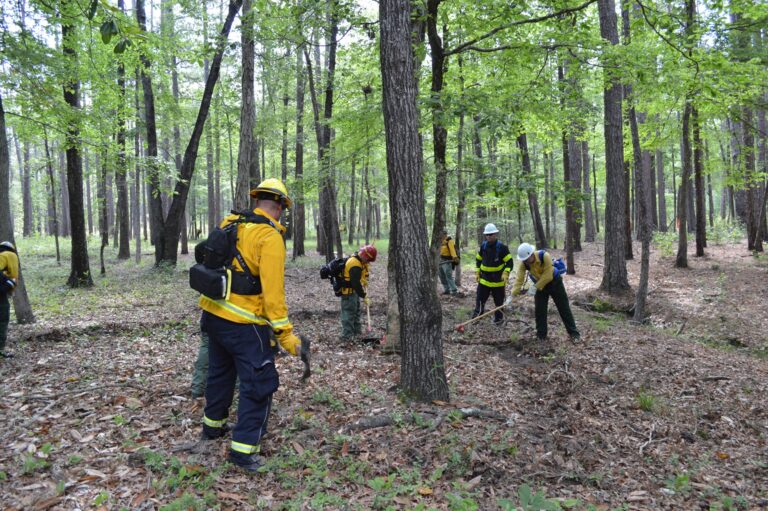
LUFKIN, Texas – More than 200 emergency responders attended the 26th annual East Texas Wildfire and Incident Management Academy at Angelina College in Lufkin May 13-21, 2025, to grow their knowledge, skills and interagency coordination for combating wildfires and managing common complex, large-scale Texas disasters.

The East Texas Interagency Wildfire and Incident Management Academy is held annually in East Texas as a joint effort by Texas emergency response agencies to provide training to all levels of firefighters and incident managers.

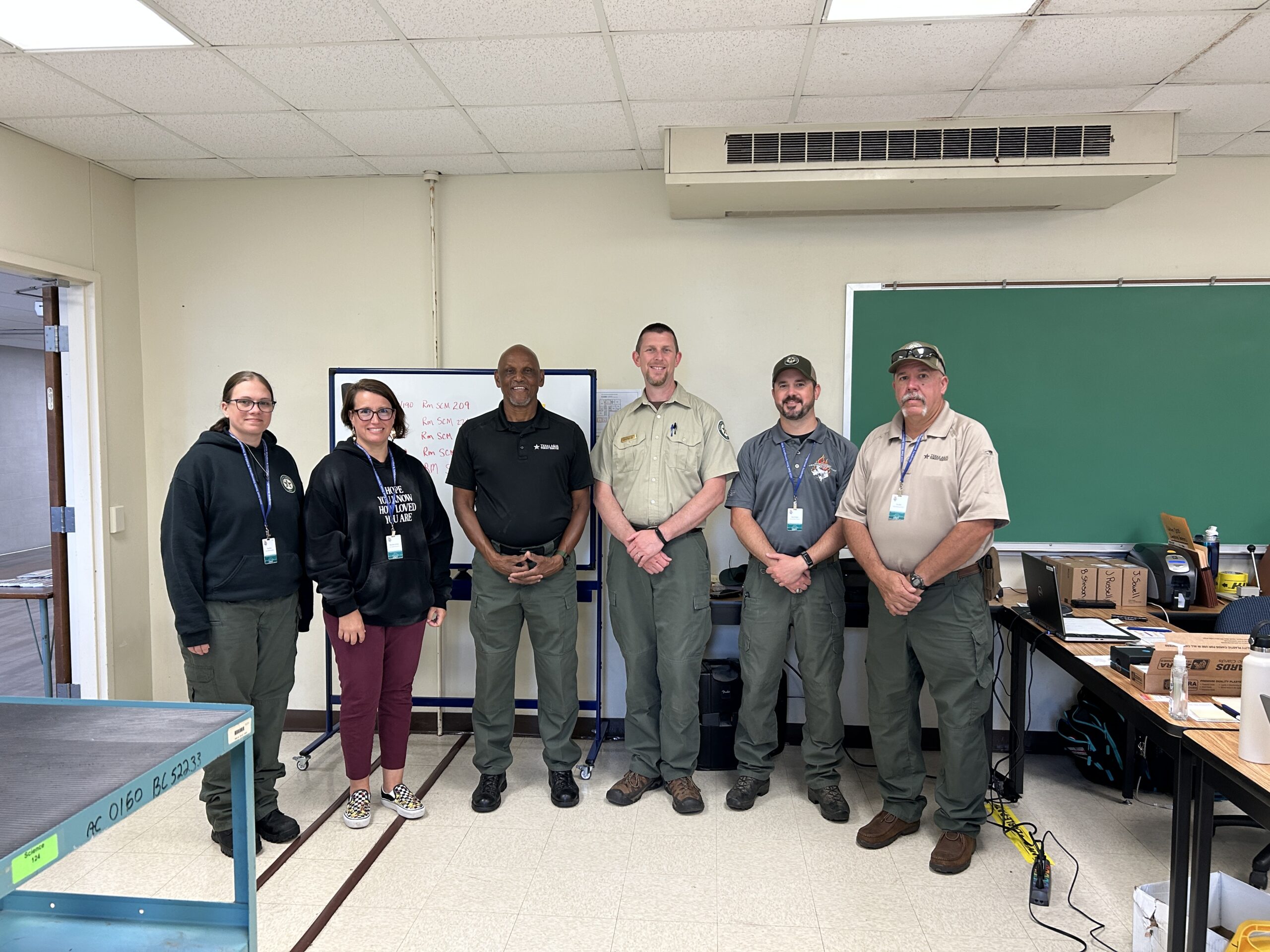
East Texas Interagency Wildfire and Incident Management Academy Command and General Staff poses with Texas A&M Forest Service Director Al Davis at the Incident Command Post.

Academy students represented emergency response backgrounds including paid and volunteer fire departments, state and federal agencies in Texas and other first responders from four additional states.

“Training is critical for Texas A&M Forest Service and all Texas emergency response agencies to ensure we are equipped to respond to a wide range of disasters and are coordinated in our response efforts,” said Meredith McNeil, Texas A&M Forest Service Training Program Leader. “Additionally, continued education and training are essential for first responders to meet certification requirements, expand their expertise and remain current in emergency response techniques.”

Fifteen course options were available throughout the academy, including instruction on fire behavior, equipment operations, air operations and various incident leadership situations.

Instruction for the academy’s classes was provided by Texas A&M Forest Service, U.S. Forest Service, National Park Service, U.S. Fish and Wildlife Service, Texas Parks and Wildlife Department and other state and local cooperators.

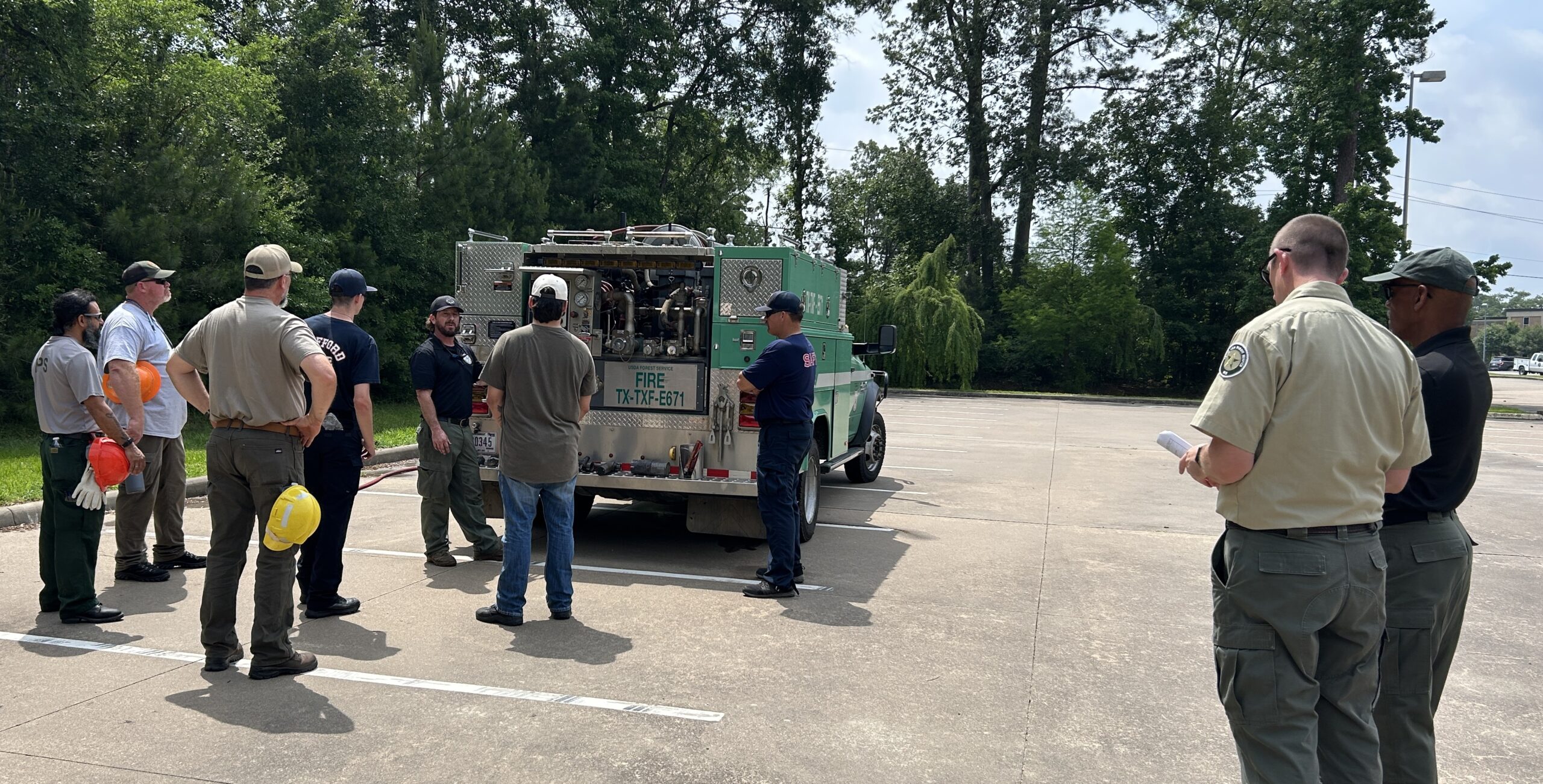
On right hand side of the image: Texas A&M Forest Service Director Al Davis wearing black polo shirt and green pants, along with Texas A&M Forest Service Department Head Jon Motsinger, wearing agency tan collared uniform shirt with agency patch on left sleeve and green pants, are observing the 130/190 class as they are learning about the Type 6 engine. On left-hand side of the image: Six students from the 130/190 class facing the instructor who is facing the camera as he describes the US Forest Service mint green Type 6 Wildland Fire engine.

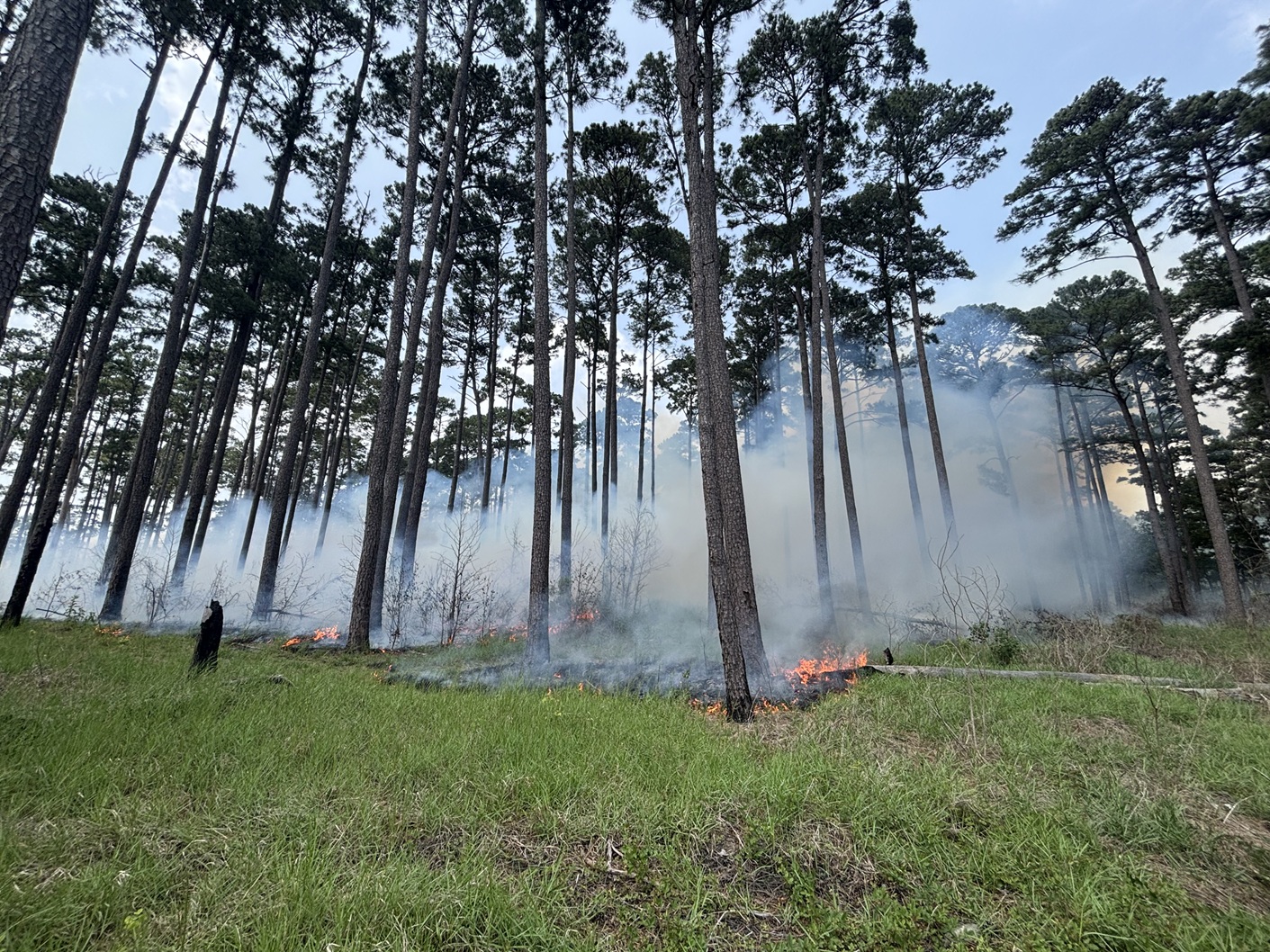
To conclude the academy, participants of the Firing Operations Course conducted a 40-acre prescribed fire at Needmore Point on Lake Sam Rayburn. This course and associated prescribed fire introduced the roles and responsibilities of a firing boss and other personnel who engage in firing operations. Prescribed fire is the planned application of low-intensity fire to the landscape by fire and fuel specialists to maintain healthy, resilient landscapes.

A stand of pine trees with smoke filtering up from the low intensity flames on the ground can be seen in the image. The angle of the photo is looking up from the ground which is green grass at a distorted angle to view the tops of the pine trees at the top of the image.

Through the Rural Volunteer Fire Department Assistance Program (HB2604) and Texas Intrastate Fire Mutual Aid System (TIFMAS), Texas A&M Forest Service provides reimbursement to qualifying fire departments to attend the academy.

“I’m passionate about protecting natural resources, supporting my community during emergencies and being part of a strong, team-oriented environment,” said Kaylie Wheeler, Davy Crockett National Forest. “This academy is a valuable opportunity for me to learn from experienced professionals, improve my physical and mental readiness and prepare me for a long career in wildland fire service.”

Texas A&M Forest Service also hosts additional internal and external nationally accredited wildfire and incident management training throughout the state including the Capital Area Interagency Wildfire and Incident Management Academy, all hazard incident management training and wildland fire training.

Learn more about Texas A&M Forest Service Interagency Wildfire and Incident Management Academies and other training opportunities: https://ticc.tamu.edu/Training/default.aspx

My Five Cents: A Weekly Column by Sen. Robert Nichols

Session is coming to a close and, as it does, critical deadlines have to be met for legislation to pass. Those deadlines fall throughout the next week and if bills do not pass those benchmarks, they won’t become law this session. It’s a sprint to the finish, but we’re almost there!

Here are five things happening around your state: 

  1. Lottery overhaul passes Senate

This week the Senate unanimously passed a bill to reform the Texas Lottery by moving governance to the Texas Department of Licensing and Regulation (TDLR) and abolishing its current governing body, the Lottery Commission. The bill also requires the Sunset Advisory Committee to conduct a review of lottery games by August 2027 and prohibits the purchase or order of a lottery ticket by telephone, internet application, or other courier-type service. Initial concerns stemmed from the Lottery Commission’s decision to alter rules to allow the sale of tickets by courier services, which essentially allowed for the sale of tickets online. The Wall Street Journal and other news outlets uncovered a scheme by an international gambling ring to take advantage of the Texas Lottery and, in coordination with a nearly-defunct courier service, purchase almost every ticket combination to effectively rig the lottery for their benefit. Reforms and additional oversight of the lottery at TDLR are necessary to ensure the integrity of the Texas Lottery.  

  1. Governor seeks waiver to prohibit unhealthy food purchases with SNAP 

Last week, Governor Abbott sent a letter to Secretary of Agriculture Brooke Rollins requesting a waiver from the United States Department of Agriculture (USDA) Food and Nutrition Service to ban unhealthy food from being purchased using Supplemental Nutrition Assistance Program (SNAP) benefits. SNAP serves more than 3 million Texans every year and provides more than $7 billion to reduce food insecurity, especially for low-income Texans. SNAP was created to increase access to nutritious foods, but SNAP benefits are often used to buy foods with little nutritious value. States now have the opportunity to regulate the foods that SNAP benefits are used to purchase. The Governor’s letter is the first step to ensure that tax dollars are used to make healthy food more accessible to all Texans. 

  1. Bail reform passes House, goes to Governor 

This week, the Texas House passed a package of bail reform bills that take significant steps to protect Texans from offenders accused of violent crimes. These bills passed out of the Senate in the early weeks of session. Bail reform was one of the emergency items that the Governor declared in his State of the State Address. One of the central pieces of legislation, SJR 5 by Senator Joan Huffman, is a constitutional amendment which would require judges to deny bail for offenders accused of certain violent crimes like murder, rape, and kidnapping. Upon passage by the legislature, this measure will be placed on the November ballot. This legislation has been an emergency item for three sessions and the passage of these bills will ensure the safety of our communities. 

  1. Legislature develops proposal for school finance

The House and Senate have been collaborating for months to develop a comprehensive plan for school finance. The most recent proposal is an $8.5 billion dollar infusion of funds in critical areas. This includes roughly $4 billion specifically for teacher pay raises. Additionally, $500 million will be dedicated to other school employees’ salaries and $100 million will be dedicated for windstorm property insurance for coastal districts. The most recent changes to the plan will help districts address costs other than teacher salaries, like building repairs, the purchasing of school buses and district vehicles, and district support staff salaries. 

  1. Broadband Development Office announces BEAD funding opportunity

The Broadband Equity, Access, and Deployment Program, authorized by the Infrastructure Investment and Jobs Act, provides funding to help increase high-speed internet access. The Texas Broadband Development Office (BDO) has released a Notice of Funding Availability (NOFA) for the state’s allocation of the BEAD Program and the Texas Match Assistance Program (TMAP). The NOFA provides nearly $4 billion in combined federal and state funding to expand broadband infrastructure. Local governments, internet service providers, non-profits, utility companies, institutions of higher education and other entities may apply for these funds. Interested parties will have until May 29 at 2 p.m. to submit any questions or request information regarding the funding. Responses to these inquiries are estimated to be made available by June 12th, 2025. 

My Five Cents… A Weekly Column by Sen. Robert Nichols

Today is the first of many deadlines the legislature will reach over the next two and a half weeks. It’s the last day for the House to pass House Bills on second reading. After today, the House will only pass Senate Bills until the Legislature adjourns Sine Die on June 2. Historically, only about one in five bills filed actually become law.  

Here are five things happening around your state: 

  1. Bill creating Dementia Prevention and Research Institute goes to the Governor

In the first weeks of this legislative session, I voted for Senate Bill 5 by Senator Huffman, which establishes the Dementia Prevention and Research Institute of Texas (DPRIT). DPRIT will bring together researchers to create and expedite innovation in dementia, Alzheimer’s, and Parkinson’s treatment and invest $3 billion over the next ten years. The money will be used to award grants for research in these areas. The Institute will work collaboratively with institutions of higher education in this state to further it’s goals. The House has also passed SB 5 and now the bill will go to the Governor’s desk to be signed into law. I am grateful that our state has made such a significant investment in this program. DPRIT will bring together researchers to develop critical resources for enhanced dementia, Alzheimer’s, and Parkinson’s care.  

  1. State prohibition on foreign land ownership bill passes both chambers

Many Texans have expressed concerns regarding the purchase of Texas land and natural resources by entities from foreign nations, many of which have been designated as a threat to the country or state. Senate Bill 17 by Senator Kolkhorst, which passed the House this week, aims to end ownership of Texas land by hostile foreign actors. The U.S. Director of National Intelligence maintains an updated list of nations who qualify as a threat to the U.S. That list currently includes China, Iran, North Korea and Russia. Senate Bill 17 would prohibit governmental entities, corporations, and individuals from countries on that list from purchasing property in Texas. In June, the New York Times reported that the federal government was taking similar steps as foreign actors have increasingly bought land in close proximity to military bases or other locations important to national security. The House and Senate passed slightly different version of SB 17, so those differences will have to be reconciled before the bill goes to the Governor to become law.  

  1. Port Neches-Groves High School’s Unified track team wins state

Port Neches-Groves High School is leading the way in inclusion with their Unified Sports Program. The program is a joint venture between University Interscholastic league (UIL) and Special Olympics Texas. The program brings together athletes with and without intellectual disabilities to train and compete together. On April 25, the Port Neches-Groves Unified Track and Field Team won their first-ever state title. So far, Port Neches-Groves is the only team in the area with a unified team. Students testified to their growth both athletically and personally. I would like to commend Port Neches-Groves on the success of their program! 

  1. Senate considers bill to relocate the “Travis Letter” to the Alamo

Representative Cody Harris, from Palestine, filed HB 1397 which establishes custody and display for several of Texas’ foundational documents. This includes the Texas Declaration of Independence, the Texas Constitution, and the “Victory or Death” letter by William B. Travis. Under current law, the custody and care of these documents are not expressly granted to one entity. This bill designates “care, custody, and secure display” of these artifacts to the Texas State Library and Archives Commission (TSLAC). The bill also directs TSLAC to work with the Texas Historical Commission and State Preservation Board to coordinate an appropriate location for display at the Capitol Complex and when feasible, the Alamo complex. The bill has passed the House, and this week passed committee in the Senate. 

  1. Financial Crimes Bill signed by the Governor

This session I have authored a package of bills related to the Financial Crimes Intelligence Center or FCIC. The FCIC is a statewide task force based out of Smith County. The FCIC combats growing issues including card skimming, fuel theft, check fraud and other organized financial crimes. One of the bills I authored expands the statutory scope of the agency to include all forms of payment fraud. This week the Governor signed SB 1499 into law after successful passage in both chambers. The FCIC has investigated and brought to justice criminals who have defrauded Texans from across the state. I was honored to work with this agency and appreciate their commitment to prevention, investigation, and deterrence of organized financial crimes. 

How One Business Transformed Operations by Unifying Their Tech

By Alec Castleberry

A logistics company operating multiple facilities across East Texas was used to juggling vendors—one for cabling, another for cameras, and a third for IT support. Over time, the patchwork setup caused delays, miscommunications, and more than a few 2 a.m. emergency calls. When a missed systems alert nearly triggered a warehouse shutdown, the company’s leadership decided something had to change.

That’s when they called Castleberry Services.

A Tangled Web of Technology

Castleberry’s team quickly discovered that none of the systems talked to each other. Cameras weren’t integrated with access controls. Wi-Fi struggled to reach high-traffic work zones. And the server room? Let’s just say it had seen better days.

In short, they weren’t facing an IT failure—they were facing an IT fragmentation.

The Integration Game-Changer

Castleberry’s solution wasn’t to replace everything. It was to connect everything.

They started with the infrastructure: structured cabling to unify the network. Then came synchronized access control and security monitoring, followed by a cloud-based management platform that brought everything—files, users, alerts—into one streamlined dashboard.

Suddenly, the company could:

  • Monitor and control building access in real time
  • Spot system alerts before they became problems
  • Support new hires at multiple locations without a hitch

From Chaos to Confidence

Within two months, downtime dropped by nearly half. Employee support tickets decreased. And for the first time in years, the IT team had breathing room.

Operations ran smoother, faster, and safer—because everything was finally working together.

For any business still juggling disconnected vendors and outdated tech, the message is clear: Integration isn’t a luxury—it’s a necessity.

How One Business Transformed Operations by Unifying Their Tech

By Alec Castleberry

A logistics company operating multiple facilities across East Texas was used to juggling vendors—one for cabling, another for cameras, and a third for IT support. Over time, the patchwork setup caused delays, miscommunications, and more than a few 2 a.m. emergency calls. When a missed systems alert nearly triggered a warehouse shutdown, the company’s leadership decided something had to change.

That’s when they called Castleberry Services.

A Tangled Web of Technology

Castleberry’s team quickly discovered that none of the systems talked to each other. Cameras weren’t integrated with access controls. Wi-Fi struggled to reach high-traffic work zones. And the server room? Let’s just say it had seen better days.

In short, they weren’t facing an IT failure—they were facing an IT fragmentation.

The Integration Game-Changer

Castleberry’s solution wasn’t to replace everything. It was to connect everything.

They started with the infrastructure: structured cabling to unify the network. Then came synchronized access control and security monitoring, followed by a cloud-based management platform that brought everything—files, users, alerts—into one streamlined dashboard.

Suddenly, the company could:

  • Monitor and control building access in real time
  • Spot system alerts before they became problems
  • Support new hires at multiple locations without a hitch

From Chaos to Confidence

Within two months, downtime dropped by nearly half. Employee support tickets decreased. And for the first time in years, the IT team had breathing room.

Operations ran smoother, faster, and safer—because everything was finally working together.

For any business still juggling disconnected vendors and outdated tech, the message is clear: Integration isn’t a luxury—it’s a necessity.

Angelina College Law Enforcement Academy Class 118

Twelve New LEOs Earn New Badges

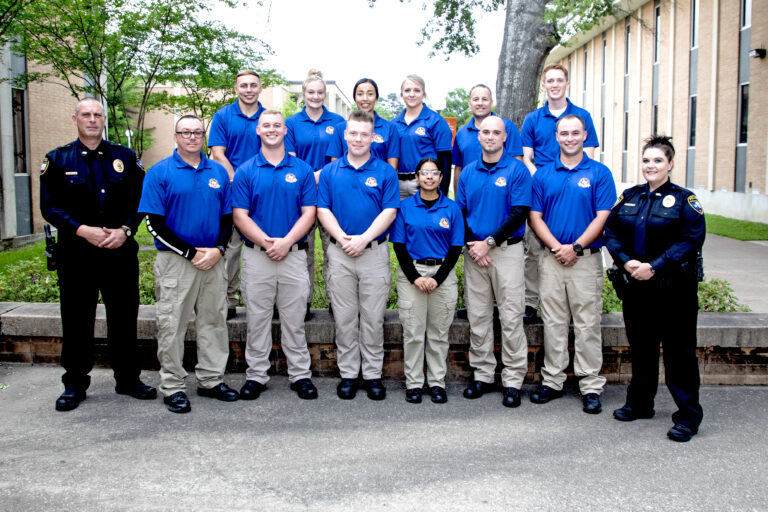
The Angelina College Law Enforcement Academy on Monday held a ceremony honoring its Class 118 graduates as they head into their respective law enforcement careers. 

Friends, family and fellow law enforcement officers showed up to pay their respects inside AC’s Hudgins Hall.

Cadets earning class honors included Amber Lee (Top Gun, Valedictorian), Grant Wilson (Top Driver) and Jonas Guy (Physical Fitness Award). 

Interim Police Chief and Academy TCOLE (Texas Commission on Law Enforcement_ instructor Ashley Jowell lauded the graduating cadets for their perseverance throughout the grueling training.

“Today marks the culmination of months of hard work, dedication, sacrifice and growth,” Jowell said. “You entered this program as individuals with shared goals, but you leave it as a united class bonded by experience and readiness to serve with integrity. 

“This academy is not just a place of learning. It’s a crucible where character is tested, leadership is forged and the foundation for public service is laid. Class 118 has met every challenge head-on.”

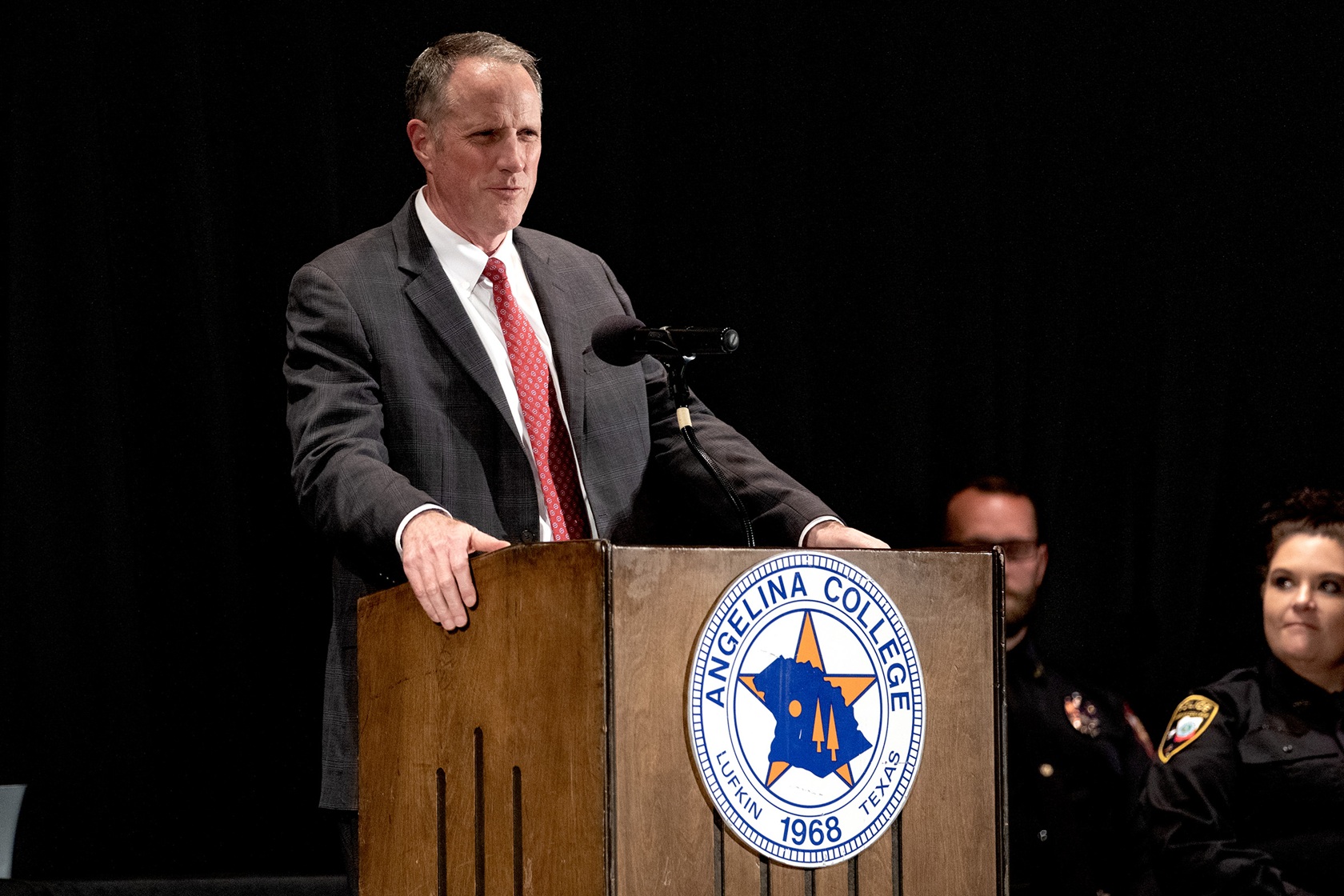
Keynote speaker Judge Jefferson Davis, 145th District Court Judge, Nacogdoches County, offered remarks ranging from movie quotes to his personal observations of law enforcement officers. 

Keynote speaker Judge Jefferson Davis, 145th District Court Judge (Nacogdoches) address the crowd during Monday’s ceremony. The Angelina College Law Enforcement Academy graduated 12 new law enforcement officers in a ceremony held inside AC’s Hudgins Hall. (Gary Stallard photo for the AC News Service)

“Law enforcement officers have shaped me,” Davis said. “I feel I’ve had a front-row seat all my days to watch the good works involved with law enforcement.”

Davis shared some of his witnessed experiences, including the humorous and the tragic as warning of sorts to the cadets about facing the unexpected. Each of his stories related how despite all the training involved, there are those situations not covered in any curriculum – stories that included an au naturel intoxicated driver and “guard donkeys” at a wrecking yard.

“You’re going to be faced with some incredibly unusual situations,” Davis said. “Those situations will call for you to improvise, to think outside the box. I encourage you to do so, and always fall back on your training.

“You will have the unique opportunity to touch countless lives. It may be as simple as encouraging words or guiding someone in the right direction. It’s a gift, and I encourage you to take advantage of every one of those opportunities.”

Valedictorian Lee praised her classmates for their shared bond throughout the rigors of the academy. 

“As we’re here reflecting on this journey, it’s hard not to reflect on what brought us here to this moment: the late nights, the early mornings, the extremely hot and cold days, the challenges, the tears, the laughter, the pain,” Lee said. 

“On January 13th we started as individuals with one common goal. Today, I’m grateful to say we became a family. These men and women pushed each other, gave each other motivation and fought for one another.”

Academy Training Manager Lt. Logan Finch wrapped up the ceremony with reminders of the cadets’ futures. 

“I just want to say that while today marks the end of your training, it’s still just the beginning of your lifetime of service,” Finch said. “You’ve chosen a profession that’s not just a job. It’s the answer to a call. You’ve been burdened with the gift of service, and all of you are answering that call. 

“Remember that when you leave the academy, the badge you’re wearing isn’t just made of metal. It’s made of trust: Trust from the community you’re going to protect, trust from your colleagues with whom you’ll work and trust from the loved ones who believe in your character.”

Graduating cadets of Class 18 (along with listed home towns) were as follows:   

James C. Collins (Nacogdoches), Christopher A. Cox (Onalaska), Darrell D. Derbin (Nacogdoches), Derek G. Foster (New Caney), Jonas P. Guy (Lufkin), Luke J. Jones (Groveton), Amber M. Lee (Nacogdoches), Samantha I. Love (Livingston), Yarely Ortiz (Nacogdoches), Odalia I. Penado (Cleveland), Jared C. Seagroves (Nacogdoches) and Grant K. Wilson (Lufkin).

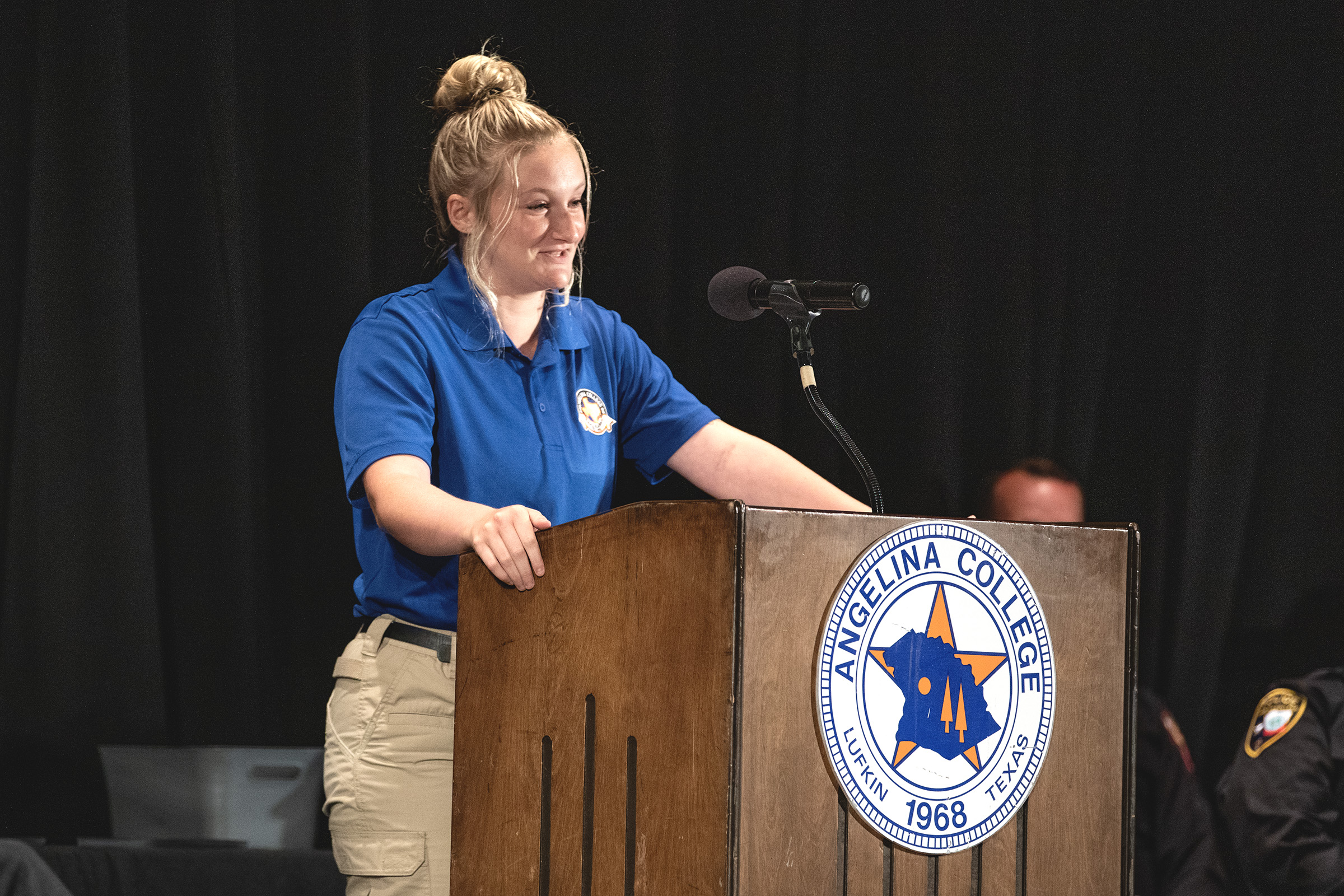
Amber Lee, Valedictorian and Top Gun Award recipient for the Angelina College Law Enforcement Class 118, address her fellow cadets and supporters during Monday’s ceremony. The academy graduated 12 new law enforcement officers in a ceremony held inside AC’s Hudgins Hall. (Gary Stallard photo for the AC News Service)

The academy staff includes Ashley Jowell, Chief of Police; Lt. Logan Finch, Training Manager; and Kim Capps, Administrative Assistant.

Class 118 instructors included Lt. Logan Finch (Angelina College Police Department), Chief Ashley Jowell (ACPD), Doug Conn (Jasper County Sheriff’s Office); Daniel Boots (ACPD); Randy Holland (ACPD); Bill Gates (Angelina College Fire Academy); Trent Lozano (Texas Municipal Police Association); Cpl. Brad Davis (Lufkin PD); Adam Coats (Central ISD PD); Sgt. Nathan Jessup (Nacogdoches PD); Sgt. Corey Bean (Texas Department of Public Safety); Amy Wren (Nacogdoches County District Attorney’s Office); Danielle Lewis (Burke Center); Capt. Alton Lenderman (Angelina County Sheriff’s Office); Pam Hollis (CPR Instructor, Angelina College); Kim Riddle (Harold’s House); Josh Hadnot (Jasper ISD PD); and Danny Weise (Physical Training Instructor). 

Gary Stallard’s email address is gstallard@angelina.edu.

Oak Wilt Cost-Share Program Available to Help Minimize The Spread of Oak Wilt in Texas

COLLEGE STATION, Texas – Texas A&M Forest Service is offering cost shares for Texas landowners to suppress the spread of oak wilt through the Texas Oak Wilt Suppression Program.

Eligible oak wilt suppression practices through this program include trenching or removal of infected red oak trees. All treatments must be installed according to Texas Oak Wilt Suppression Program guidelines and approved by Texas A&M Forest Service personnel. An application for cost-share funding must be approved before any cost-shareable treatment can begin.

Funding for trenching is limited to 50% of approved costs up to $2,000 per cooperator year. Multiple cooperator project costs are limited to 50% of approved costs up to $6,000 per project year.

Funding for tree pushing within trenched areas is limited to 50% of approved costs up to $2,000 per cooperator per year.

Funding for removal of certain diseased red oaks is limited to 50% of approved costs with a maximum of $2,000 per cooperator year.

Oak wilt is one of the most destructive tree diseases in the United States and is killing oak trees in Central and West Texas at epidemic proportions. Oak wilt has been confirmed in 76 Texas counties. While destructive to the ecosystem, the effects of oak wilt can also reduce property value by 15 to 20 percent.

Oak wilt is one of the deadliest tree diseases in the United States, killing millions of trees across 76 Texas counties. The signs of oak wilt can be seen on a majority of leaves when a tree is fully infected.

“Oak wilt fungus, Bretziella fagacearum, is responsible for the disease and spreads rapidly through the interconnected roots of live oaks” said Demian Gomez, Texas A&M Forest Service Regional Forest Health Coordinator. “All oak trees are susceptible to oak wilt, and red oaks are the most susceptible and can die within as little as one month of being infected.”

Oak wilt is spread primarily in two ways—above ground by sap-feeding beetles or below ground through interconnected root systems between trees.

Above ground, infected trees that died the year before may produce spore mats under the bark, creating a fruity smell which attracts sap-feeding beetles. As the beetles carry fungus spores on them, they easily infect other oak trees through any fresh wound on the tree.

Below ground, oak wilt can travel an average 75 feet per year through the interconnected root systems of oak trees, primarily in live oaks, and is responsible for the majority of spread and deaths in Central Texas.

Trenching is a common method to prevent the spread of oak wilt underground by creating trenches at least four feet deep using trenching machines, rock saws or ripper bars. Trenches should be placed a minimum of 100 feet beyond symptomatic trees.

Landowners unaffected by oak wilt should continue to take precautions to minimize the susceptibility of their oak trees to the disease.

“One of the easiest ways for oak wilt to spread is by fresh wounds in oak trees, so it is especially important to avoid pruning or creating new wounds on oak trees from February to June,” said Gomez.

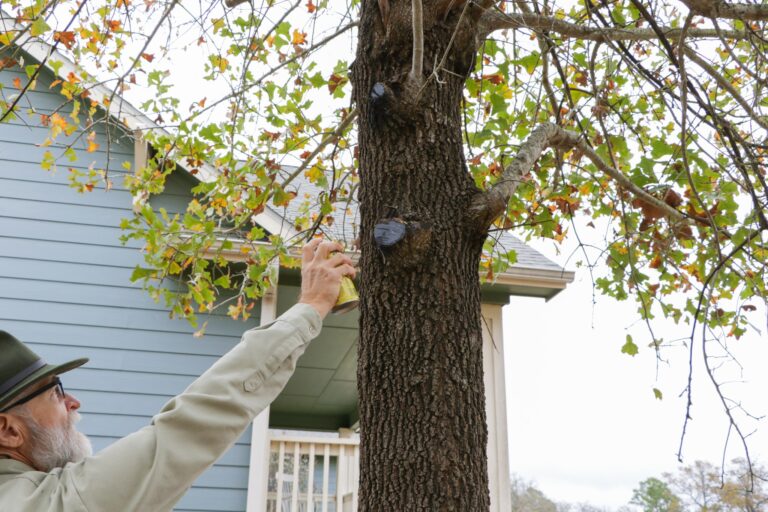
Oak wilt is often recognized in live oaks by yellow and brown veins showing in leaves of infected trees, known as veinal necrosis. The signs of oak wilt can be seen on a majority of leaves when a tree is fully infected. Landowners should contact a certified arborist if they are unsure if their tree is infected.

Oak wilt is often recognized in live oaks by yellow and brown veins showing in leaves of infected trees, known as veinal necrosis.

Landowners with oak wilt-infected trees can explore cost-share resources here: https://texasoakwilt.org/getting-help/oak-wilt-cost-share

Beat the East Texas Heat: A Pet-Safety Guide for Texas Forest Country Living

When the piney woods start to steam, your four-legged family members feel it first. Here’s how to spot trouble early, act fast in an emergency, and keep dogs (and cats) cool, comfortable, and healthy all summer long.

Why Heat Hits Pets Hard in the Piney Woods

Unlike people, pets shed excess body heat mainly by panting and through the pads of their feet. High humidity slows that process, so even an 85 °F afternoon can push a healthy dog or cat into danger in minutes. Flat-faced breeds (Bulldogs, Pugs, Boxers, Persians), seniors, the very young, and pets carrying a few extra pounds are at the greatest risk.

Red-Flag Signs of Heat Stress

Watch for:

  • Heavy, rapid panting or open-mouth breathing
  • Rope-like drool or thick saliva
  • Bright-red (or very pale) gums and tongue
  • Wobbling, collapse, seizures, or vomiting

If a rectal thermometer reads 105 °F + or you see any of the symptoms above, treat it as an emergency.

First-Aid Road Map (Goal: 103 °F in 10 – 15 minutes)

  1. Move to shade or A/C.
  2. Start active cooling: Pour or spray cool (not ice-cold) water along the belly, armpits, and paw pads, then place a fan nearby for evaporative cooling.
  3. Re-check temperature every few minutes. Stop once you hit 103 °F to prevent a plunge into hypothermia.
  4. Head to the vet—immediately. Dangerous heart, kidney, or neurological issues can surface hours later even when a pet seems normal.

Gear tip: A compact digital pet thermometer and a collapsible water bowl belong in every East Texas go-bag.

Prevention Plays That Work in Texas

Daily HabitWhy It Helps
Walk at dawn or after sunsetPavement temps can top 130 °F by midday.
Set up misting stations or kiddie poolsEvaporative cooling knocks temps down fast without startling pets.
Offer multiple ceramic water bowlsCeramic stays cooler than metal or plastic, encouraging more drinking.
Freeze broth or tuna water into ice treatsAdds electrolytes and keeps hydration fun.
Update parasite & heartworm medsMosquitoes, fleas, and ticks explode in warm, wet weather.

Cars: A Two-Minute Danger Zone

Even with windows cracked, cabin temps soar past 100 °F in 10 minutes and can reach 120 °F in half an hour on an 85 °F day. Leave pets at home when you run errands. If you spot an animal locked inside a vehicle, notify the store manager, then call animal control or local police if the owner doesn’t return quickly.

Year-Round ID & Wellness Checklist

  • Collar + microchip: East Texas storm season can open gates and fences.
  • Emergency contacts: Add your vet and nearest 24-hour clinic to your phone.
  • Travel prep: Keep vaccination records and a spare leash in the car.
  • Groom smart, don’t shave: A well-brushed coat insulates against heat and sunburn.

Final Bark

Texas summers are no joke, but with a thermometer, fresh water, and a dash of vigilance, you’ll give your pets a season full of safe backyard barbecues and lakeside adventures. When in doubt, cool first and call the vet—because nothing beats having your best friend healthy and wagging at your side when the sun finally sets behind the pines.